Last reviewed: September 2026 · By the HVAC Brief Editorial Team · Our sourcing and editorial standards
Residential cooling comes in five forms, and the deciding factor is almost always whether the house has usable ductwork. Central split systems dominate where ducts exist; ductless mini splits dominate where they do not.
109.51 million of 123.53 million US homes use air conditioning equipment, about 89%, per EIA survey data.
The five types
| Type | Needs ductwork | Heats as well | Efficiency metric |
|---|---|---|---|
| Central split system air conditioner | Yes | No, paired with a furnace | SEER2 |
| Heat pump, ducted | Yes | Yes | SEER2 and HSPF2 |
| Ductless mini split | No | Usually yes | SEER2 and HSPF2 |
| Packaged unit | Yes | Depends on configuration | SEER2 |
| Room or window unit | No | Some models | CEER |
Note that room units are rated on a different scale, CEER, and cannot be compared with central equipment by rating. Their minimums rose sharply for units manufactured from May 26, 2026. See our breakdown of the new levels.
How to narrow it down
- Does the house have sound ductwork? If yes, central split or ducted heat pump is usually the efficient answer. If no, the cost of adding ducts is normally the largest single line in a retrofit.
- Do you need heat as well? A heat pump covers both in one machine. An air conditioner needs a separate heat source.
- Is the problem the whole house or one space? One stubborn room is a distribution problem, and upsizing the central system for it oversizes everything else.
- Is there space for an outdoor unit? Packaged units put everything outside, which matters where indoor plant space does not exist.
- Is this permanent? Rentals and short occupancies change the calculation toward room units.
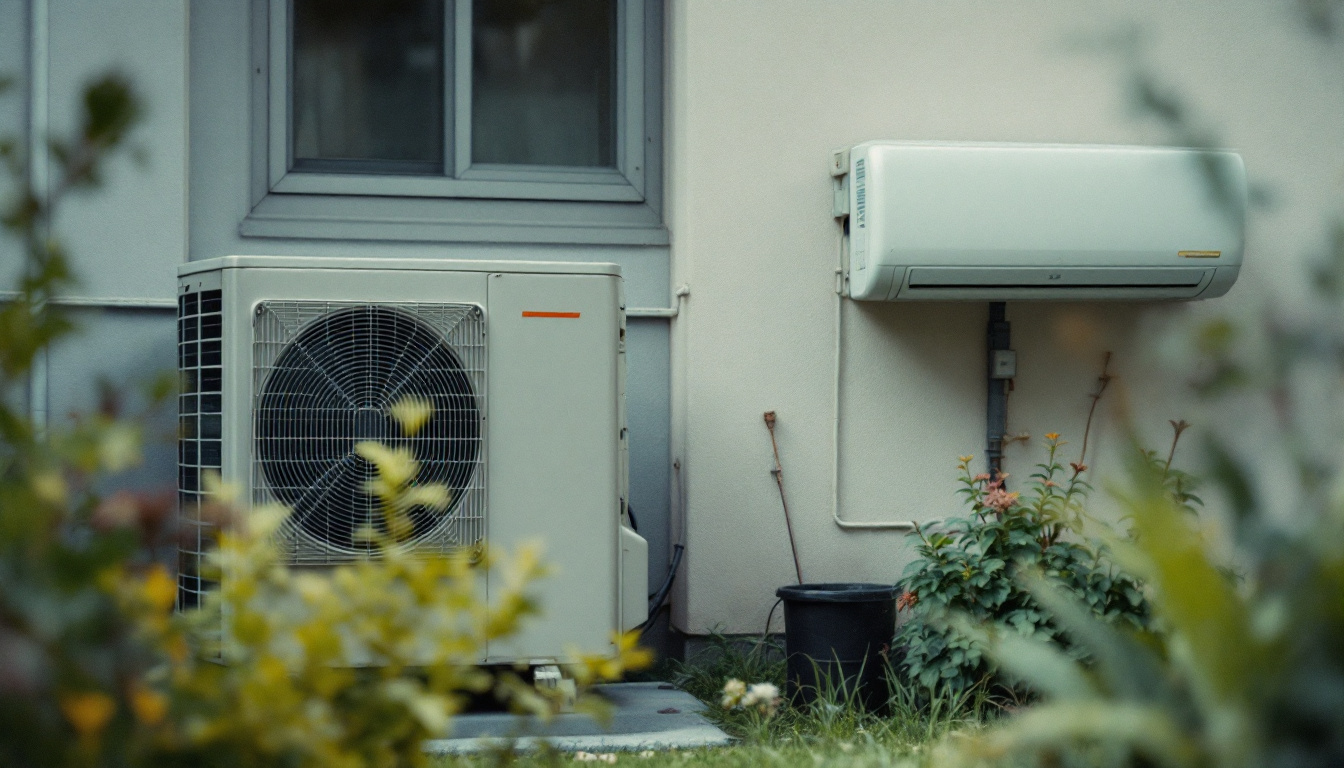
A split system has an outdoor unit and a separate indoor unit connected by refrigerant lines. A packaged unit puts everything in one outdoor cabinet and connects to the house with ducts. Ductless is a split system where the indoor units sit in the rooms rather than feeding ductwork.
Frequently asked questions
What are the types of air conditioning systems?
Five in residential use: central split system air conditioners, ducted heat pumps, ductless mini splits, packaged units, and room or window units. The first four are rated on SEER2, while room units use a separate CEER scale that is not comparable. Whether the house has usable ductwork usually decides between them.
What is the difference between a split and a packaged system?
A split system separates the outdoor unit containing the compressor and condenser from an indoor unit containing the evaporator and blower, connected by refrigerant lines. A packaged unit puts all components in one outdoor cabinet and connects to the house through ducts. Packaged units suit houses without indoor plant space.
Which type of air conditioning is most efficient?
Central equipment and mini splits share the SEER2 scale, so rated efficiency compares directly between them. The structural difference is duct losses, which ducted systems incur and ductless systems do not. Room units use the separate CEER scale and cannot be compared by rating with either.
Can I add central air to a house without ducts?
Yes, but installing a duct system is normally the largest single cost in that retrofit, which is why ductless mini splits are common in houses heated by boilers or baseboards. The choice usually turns on whether ductwork can be routed sensibly rather than on the cooling equipment itself.
Methodology and limitations
Installed base figures are EIA RECS 2020 table HC7.1. Efficiency metrics are those defined in 10 CFR 430.32.
- We publish no installed costs, as no federal series measures them.
- SEER2 and CEER are different measures on different equipment classes and are not comparable.
- Which type suits a specific house requires a load calculation for that house.
Sources
- US Energy Information Administration, Residential Energy Consumption Survey 2020, table HC7.1.
- US Department of Energy, 10 CFR 430.32, efficiency standards.
The HVAC Brief is an independent trade publication. We do not sell equipment, take manufacturer advertising, or accept payment for placement in our research. Corrections welcome.
Leave a Reply