Last reviewed: August 2026 · By the HVAC Brief Editorial Team · Our sourcing and editorial standards
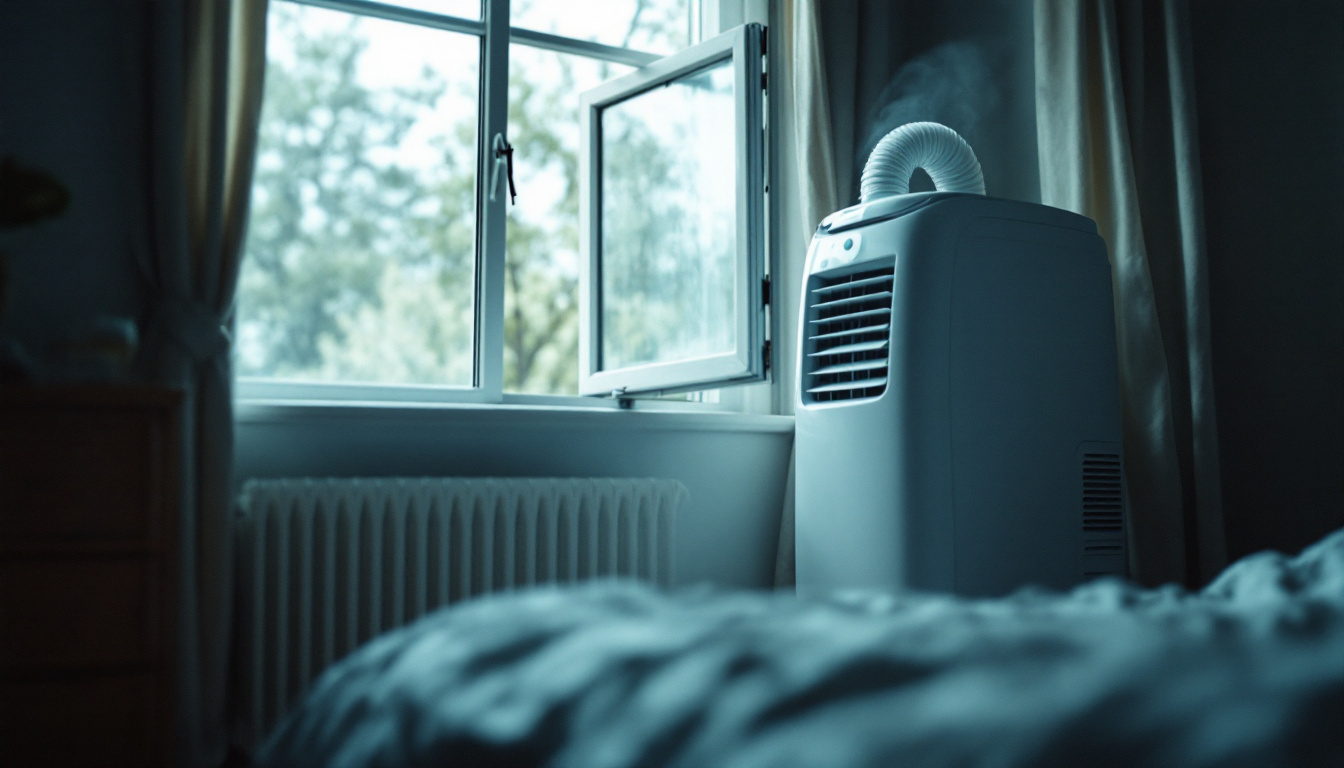
A single-hose portable air conditioner exhausts indoor air outside, which pulls unconditioned outdoor air into the room through every gap to replace it. That is a physical consequence of the design, not a defect.
It is why a portable unit rated the same as a window unit performs worse in the same room. The rating measures the machine; the hose configuration determines how much of that output reaches you.
Portable units solve a real problem: rooms where a window unit cannot be fitted, rented properties, and windows that do not take a standard sash mount. Understanding the trade-off lets you choose well rather than expecting window-unit performance.
Why single hose costs you capacity
An air conditioner rejects heat outdoors. The condenser needs air to carry that heat away, and a single-hose portable takes that air from the room it is cooling, then pushes it out of the window.
- The unit blows conditioned room air across the condenser and out of the hose.
- That air leaves the house, so the room is now at slightly negative pressure.
- Air is pulled in from outdoors and adjoining spaces through gaps to equalise.
- The incoming air is hot and humid, which is exactly what the unit is trying to remove.
A dual-hose design draws condenser air from outside through a second hose instead of from the room, which removes most of that penalty. It is the single most useful specification to check.
| Consideration | Window unit | Single-hose portable | Dual-hose portable |
|---|---|---|---|
| Condenser air source | Outdoors | The cooled room | Outdoors |
| Creates negative room pressure | No | Yes | Largely no |
| Needs a suitable window | Yes, sash mount | Vent kit only | Vent kit only |
| Federal efficiency metric | CEER | Portable AC standards | Portable AC standards |
Rooms with casement windows, rentals that prohibit window installation, spaces where a unit must be moved between rooms, and situations where nothing can be permanently mounted. In those cases the comparison is against no cooling at all, and the hose penalty is irrelevant.
Room air conditioners just got a big standards increase
Federal minimums for window and through-the-wall units rose sharply for products manufactured from May 26, 2026, by between 19% and 50% depending on class. That changes what is available new, and older stock built to the previous standard remains legal to sell. See our breakdown of the new CEER minimums.
Frequently asked questions
Are portable air conditioners less effective than window units?
Single-hose portables are, for a structural reason: they exhaust conditioned room air outside, which pulls hot outdoor air in through gaps to replace it. A dual-hose design takes condenser air from outside instead and avoids most of that penalty. Window units do not have the problem at all.
What is the difference between single-hose and dual-hose?
A single hose exhausts air from the cooled room to outdoors, depressurising the room and drawing in unconditioned replacement air. A dual-hose unit draws condenser air from outdoors through a second hose, so it does not use room air for heat rejection. Dual hose is the more effective configuration.
When is a portable air conditioner the right choice?
Where a window unit cannot be fitted: casement windows, rentals prohibiting window installation, rooms needing occasional rather than continuous cooling, or spaces where nothing may be permanently mounted. In those cases the comparison is against no cooling, not against a window unit.
Do portable air conditioners have efficiency standards?
Yes, portable air conditioners are a separate regulated product class from room air conditioners under federal appliance standards, with their own metric. Window and through-the-wall units are rated on CEER, and those minimums rose substantially for units manufactured from May 26, 2026.
Methodology and limitations
Room air conditioner standards are quoted from 10 CFR 430.32(b). The single-hose explanation describes the physical mechanism of a negative pressure air balance, not a measured capacity penalty, because the size of that penalty depends on the specific room and building envelope.
- We publish no percentage capacity loss for single-hose designs. It varies with room tightness and conditions.
- We name no products and publish no efficiency figures for specific portable models.
- Portable and room air conditioners are separate regulated classes with different metrics and are not directly comparable by rating.
Sources
- US Department of Energy, 10 CFR 430.32(b), room air conditioner standards.
The HVAC Brief is an independent trade publication. We do not sell equipment, take manufacturer advertising, or accept payment for placement in our research. Corrections welcome.
Leave a Reply