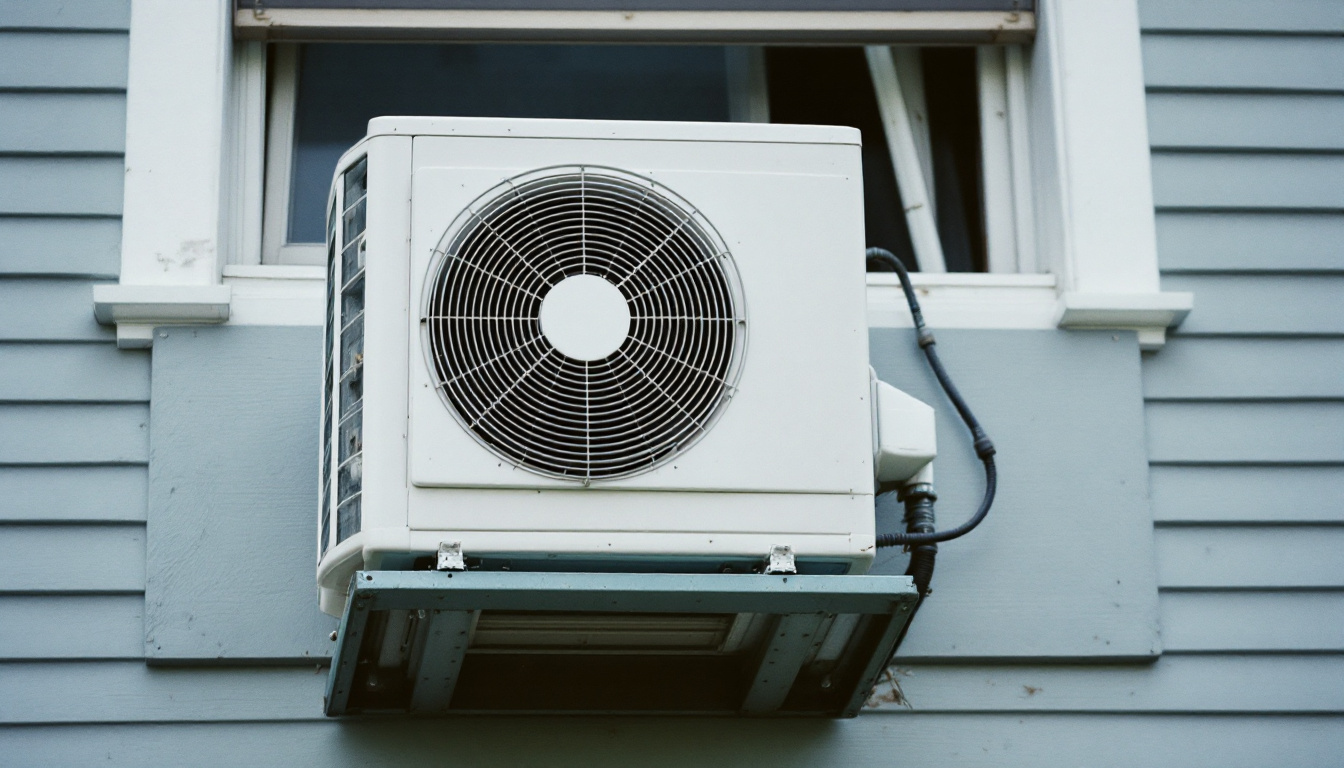
How do you do a window AC installation safely? Match the unit to the window type, carry the weight on brackets rather than the sash, pitch it slightly outward, seal every gap, and plug it into a wall outlet on a circuit that can take the load. Never an extension cord.
Key Takeaways
- Louvered units of 8,000 to 13,900 Btu/h made from May 26, 2026 must reach 16.0 CEER, up from 10.9 (10 CFR 430.32(b)).
- DOE puts the electrical line at 7.5 amps. Above it, a unit wants a dedicated 115 volt circuit (DOE Energy Saver, archived).
- CPSC counts about 2,000 US residential fires a year involving electric cords or plugs, killing 60 people (CPSC NSN-09-2).
- An IRC R310 escape opening needs 5.7 square feet net clear, sill under 44 inches (DOE Building America).
- New York City tells owners to fasten the unit with metal angles, never to level it on blocking (NYC DOB).
What does a window AC installation have to get right?
Five things: window type, support, pitch, sealing and power. Only one is about cooling, and it is settled before you buy. DOE’s sizing rule of thumb is 20 Btu per square foot, and it warns that an oversized unit cools too fast to dehumidify, leaving a room cold and clammy; our sizing guide walks the ENERGY STAR chart.
Will the unit fit your window type?
A unit built for a double hung sash will not work in a casement or a slider, because the design assumes a sash that drops onto the cabinet and holds it fore and aft. Federal law draws the same line: 10 CFR 430.32(b)(2) lists Casement-Only and Casement-Slider as separate classes, at 13.9 and 15.3 CEER.
| Window type | Standard double hung unit? | What fits, and its federal class |
|---|---|---|
| Double hung sash | Yes, the design case | Louvered or non-louvered room unit |
| Horizontal slider | No, it sits on its side | Tall slider unit. Casement-Slider, 15.3 CEER |
| Casement, crank out | No, no sash traps it | Tall narrow unit. Casement-Only, 13.9 CEER |
| Awning or fixed pane | No | Wall sleeve unit or ductless head |
If your window is the last row, the job becomes cutting an opening: see our wall sleeve unit guide and the comparison of cooling types.
What actually supports the weight in a window AC installation?
Brackets do. The lowered sash holds the cabinet fore and aft, but a sash is a closure, not a structural member, and the sill under it is often the oldest wood in the house. New York City’s buildings department tells owners to support the unit from underneath, or firmly fasten it from inside with angles, using metal brackets strong enough for the unit’s size and weight, and never to level one on loose objects such as wood blocking, bricks or cans.
- Check the sill and lower sash for rot and loose glazing first.
- Fit the bracket from the unit’s manual, into frame or wall structure, not trim.
- Have a second person hold the cabinet as you set it in. These units are front heavy.
- Lower the sash on and fasten it so it cannot be lifted from outside.
- Screw the accordion panels to the sash as well as the cabinet.
Local rules vary: some cities require brackets above a given floor.
How much should a window air conditioner tilt?
Follow the unit’s own manual, and never pitch it back into the room. Federal guidance asks for level: DOE’s Energy Saver page says to ensure the unit is level for efficient drainage and operation, and ENERGY STAR says a room unit should be level so the drainage system works effectively.
Manufacturers are more specific, because the base pan and slinger ring are designed around one attitude. LG’s installation help says to set the rear tilted downward by 10 mm to 15 mm, roughly 0.39 to 0.59 inches: a pitch, not a visible slope.
Both point the same way: level side to side, flat or slightly low at the back. Tilt it into the room and condensate runs across the sill into the wall cavity, one of the ways a unit ends up leaking indoors.
Why does sealing decide whether the efficiency rating means anything?
Because the rating measures the machine, not the hole it sits in. Combined energy efficiency ratio is measured on a test stand under appendix F to subpart B of 10 CFR part 430, in British thermal units per watt hour. Nothing in that test accounts for outdoor air pouring past a loose panel.
Three leaks need closing: the accordion panels between cabinet and jamb, the sash gap where the raised lower sash passes the upper sash, and the panel to frame joint. The sash gap needs a filler strip. ENERGY STAR notes that certified units now ship with better materials and clearer instructions to improve sealing and insulation around the unit so air leaks are minimized.
That matters more this year because the federal floor moved so far, as our breakdown of the 2026 room air conditioner standards shows. Loose panels throw that gain away, and decide whether your running cost estimate means anything.
What circuit does a window air conditioner need, and why not an extension cord?
DOE draws the line at 7.5 amps. Smaller units can share a 15 or 20 amp, 120 volt circuit carrying no major appliances; units above 7.5 amps require a dedicated 115 volt circuit, and the largest need 240 volts.
The National Electrical Code sets the arithmetic. The International Association of Electrical Inspectors restates NEC 440.62 this way: a cord and plug connected room air conditioner’s marked rating shall not exceed 80 percent of the branch circuit rating where no other loads are supplied, and 50 percent if lighting or appliances share it. On a 15 amp circuit that is 7.5 amps.
The plug is part of the safety system
The IAEI summary of NEC 440.65 notes that cord and plug connected room air conditioners must carry a factory installed leakage current detector interrupter, arc fault circuit interrupter or heat detecting circuit interrupter, in the plug or within 300 mm (12 inches) of it. Run the unit through an extension cord and several feet of unprotected wire sit outside what that device watches.
CPSC is direct about cords. Extension cords can overheat and cause fires when used improperly, it says, usually from overloading or appliances that draw more watts than the cord can handle. Its safety alert counts about 2,000 US residential fires a year involving electric cords or plugs, killing 60 people. That is also why portable electric heaters are a wall outlet only appliance.
Does the unit block a bedroom’s emergency escape opening?
It can, and it is the part of a window AC installation most homeowners never check. Codes based on the International Residential Code require an emergency escape and rescue opening in sleeping rooms. DOE’s Building America Solution Center restates the R310 dimensions as 20 inches wide by 24 inches high, 5.7 square feet net clear, sill no higher than 44 inches.
A unit bolted into the lower sash of a bedroom’s only escape window eats that opening. Whether that is a violation depends on the code edition your jurisdiction adopted, its amendments, and whether the room has a second qualifying window. Verify with your building department, not a national summary.
Use a window that is not the room’s escape opening wherever possible. If it must go in the only opening, keep the fasteners reachable from inside and tell everyone who sleeps there. Leases vary, and some cities require window guards where young children live.
How do you secure the unit and take it out at the end of the season?
Secure it from inside, then check it twice a season. A window unit is an entry point unless the sash is locked to the cabinet or the frame, because an accordion panel pushes aside easily from outside. Sash locks, a bolt through the sash into the cabinet flange and a bar that blocks the sash lifting are standard hardware. NYC also asks owners to check the unit’s position and the window frame periodically.
Removal at season’s end is not housekeeping. A unit left in all winter is an uninsulated hole in the wall. Pull it, clean or replace the filter before storage rather than after, and store it upright. Filter neglect is the usual reason a room unit loses airflow, the path that ends in a frozen coil; our guide to filters and MERV ratings covers what to check.
If the window is a slider you cannot seal, a portable unit is the fallback, with the penalty we measured in our comparison of portable and window air conditioners.
How we researched this
Research completed September 2026. Figures come from the eCFR text of 10 CFR 430.32 and 430.23, DOE Energy Saver (archived copy, since the live page no longer resolves), ENERGY STAR, two CPSC publications, the DOE Building America Solution Center and the New York City Department of Buildings. LG guidance is labelled as manufacturer instruction, and NEC text is cited through the International Association of Electrical Inspectors because NFPA 70 is not openly published. Contractor blogs were excluded, and Reddit was skipped entirely: this is an electrical safety topic. No installed price is given because no federal series measures it. The International Code Council blocks automated retrieval, so IRC R310 is cited through DOE’s restatement.
Frequently asked questions
Can you put a window AC unit in a casement window?
No. A cabinet built for a double hung sash has nothing to sit in when a casement opens. Buy a unit made for the opening: 10 CFR 430.32(b)(2) treats these as separate classes, Casement-Only at 13.9 CEER and Casement-Slider at 15.3 CEER.
Should a window air conditioner be tilted?
Slightly toward the outside, only as far as the manual says. DOE’s Energy Saver page asks for the unit to be level for efficient drainage, while LG’s installation help calls for the rear tilted downward by 10 mm to 15 mm. Never pitch it back into the room.
Can you run a window air conditioner on an extension cord?
No. CPSC says extension cords can overheat and cause fires when overloaded or used with appliances that draw more watts than the cord can handle, and counts about 2,000 US residential fires a year involving cords or plugs. The unit’s protective plug stops covering the added wire.
Does a window air conditioner need its own circuit?
Above 7.5 amps, yes. DOE says units under 7.5 amps can plug into any 15 or 20 amp, 120 volt circuit not shared with major appliances, units above that need a dedicated 115 volt circuit, and the largest need 240 volts.
Is it legal to put a window unit in a bedroom window?
It depends on the jurisdiction. Codes based on the IRC require an emergency escape and rescue opening in sleeping rooms, at least 5.7 square feet net clear with the sill no higher than 44 inches. If that is the room’s only escape window, ask the building department.
Do you have to take a window air conditioner out for the winter?
Not always, but a unit left in place is an uninsulated opening in the wall all heating season. If it stays, fit an insulated cover and check the brackets. If it comes out, clean the filter and store the cabinet upright.
Sources
- eCFR. “10 CFR 430.32.” https://www.ecfr.gov/current/title-10/section-430.32. Accessed September 2026.
- eCFR. “10 CFR 430.23.” https://www.ecfr.gov/current/title-10/section-430.23. Accessed September 2026.
- DOE. “Room Air Conditioners,” Energy Saver, archived. https://web.archive.org/web/2025id_/https://www.energy.gov/energysaver/room-air-conditioners. Accessed September 2026.
- ENERGY STAR. “Room Air Conditioners.” https://www.energystar.gov/products/room_air_conditioners. Accessed September 2026.
- CPSC. “Household Extension Cords Can Cause Fires,” publication 5032. https://www.cpsc.gov/s3fs-public/5032.pdf. Accessed September 2026.
- CPSC. “Power Up With Safety,” NSN-09-2. https://www.cpsc.gov/s3fs-public/ExtensionCordsPowerStrips.pdf. Accessed September 2026.
- DOE Building America Solution Center. “Roof Escape Openings for Flood-Prone Areas,” on IRC R310. https://basc.pnnl.gov/resource-guides/roof-escape-openings-flood-prone-areas. Accessed September 2026.
- NYC Department of Buildings. “Installing Air Conditioning Units.” https://www.nyc.gov/site/buildings/property-or-business-owner/installing-air-conditioning-units.page. Accessed September 2026.
- IAEI. “Air-Conditioning Equipment Installations,” on NEC 440.62 and 440.65. https://iaeimagazine.org/2017/julyaugust-2017/air-conditioning-equipment-installations/. Accessed September 2026.
Leave a Reply