Last reviewed: August 2026 · By the HVAC Brief Editorial Team · Our sourcing and editorial standards
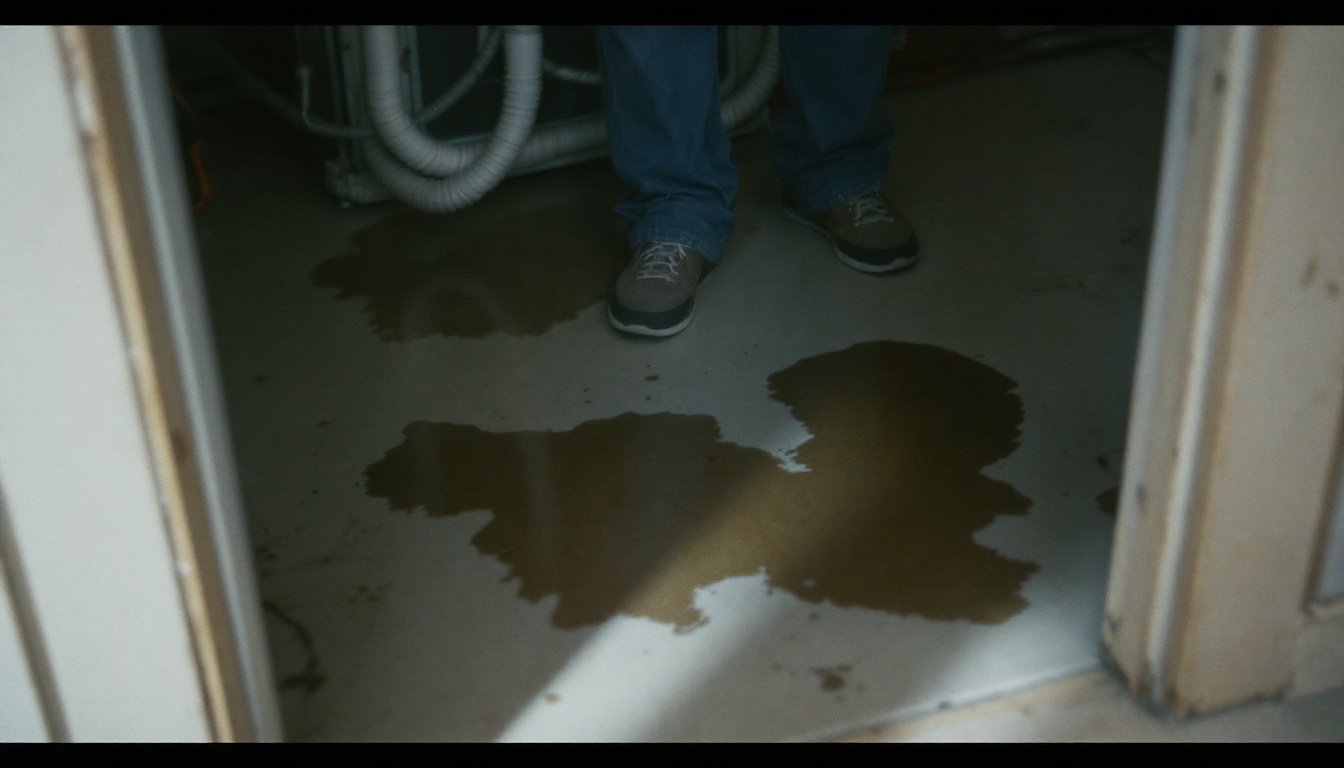
An air conditioner leaking water inside almost always means the condensate is not draining, not that refrigerant is leaking. Refrigerant is a gas at those pressures and does not pool on a floor.
An air conditioner blowing warm air points at a different set of causes: loss of refrigerant charge, a compressor or capacitor fault, a frozen coil, or the system simply not being in cooling mode.
These two symptoms account for a large share of homeowner searches and they have distinct mechanisms. Knowing which family a symptom belongs to tells you whether it is an owner-fixable maintenance issue or a service call.
Water leaking from the indoor unit
Cooling removes humidity, and that water collects in a drain pan and leaves through a condensate line. Water appearing where it should not means that path is blocked or overwhelmed.
- Blocked condensate drain. The most common cause. Biological growth blocks the line and the pan overflows.
- Full or cracked drain pan. Age and corrosion.
- Frozen evaporator coil that has thawed. Ice melting at once overwhelms the pan. This is a symptom of a deeper fault, usually low airflow or low charge.
- Dirty filter restricting airflow. Low airflow drops coil temperature toward freezing, which leads back to the previous cause.
- Improper installation slope. A pan or line that does not drain by gravity.
Only the filter is reliably an owner fix. A blocked drain is sometimes clearable, but a coil freezing repeatedly is a diagnostic problem rather than a cleaning problem.
Refrigerant leaves a system as gas, not liquid pooling indoors. A system low on charge shows up as poor cooling and a freezing coil, not as a puddle. If a technician attributes indoor water directly to refrigerant loss, ask them to walk you through the mechanism.
Blowing warm air
| Cause | Typical signature | Owner fixable |
|---|---|---|
| System not in cooling mode | Thermostat set to fan or heat | Yes |
| Dirty filter, restricted airflow | Weak flow at registers, possible coil ice | Yes |
| Frozen evaporator coil | Ice visible, airflow drops, water on thaw | No, find the cause |
| Low refrigerant charge | Gradual loss of capacity, coil freezing | No, it is a leak |
| Failed capacitor | Outdoor fan or compressor not starting | No |
| Outdoor coil blocked | Vegetation or debris against the unit | Partly |
A system that needs refrigerant has a leak. Sealed circuits do not consume refrigerant in normal operation, so repeatedly topping up treats the symptom while venting a controlled substance. Ask for the leak to be found.
Frequently asked questions
Why is my air conditioner leaking water inside?
Almost always a condensate drainage problem rather than a refrigerant leak. Cooling removes humidity into a drain pan that empties through a condensate line; a blocked line, full or cracked pan, or a frozen coil thawing all put water where it should not be. Refrigerant leaves a system as gas and does not pool indoors.
Why is my AC blowing warm air?
Common causes are the system not being in cooling mode, a dirty filter restricting airflow, a frozen evaporator coil, low refrigerant charge from a leak, a failed capacitor preventing the compressor or fan starting, or a blocked outdoor coil. Only the thermostat setting and the filter are reliably owner fixable.
Does my AC need a refrigerant top up?
A sealed refrigerant circuit should not lose charge in normal operation, so a system needing refrigerant has a leak. Repeatedly adding refrigerant treats the symptom while venting a controlled substance and leaves the underlying fault in place. Ask for the leak to be located.
Why does my evaporator coil freeze?
Usually low airflow or low refrigerant charge. Restricted airflow from a dirty filter or duct problem drops coil temperature below freezing; low charge does the same by dropping evaporator pressure. Freezing is a symptom of another fault rather than a fault in itself.
Methodology and limitations
This page describes physical mechanisms rather than publishing failure frequencies, because no federal source measures residential HVAC fault rates. Refrigerant handling context is from 40 CFR part 82 and part 84.
- No frequency or probability is claimed for any cause listed.
- Nothing here is a diagnosis. Symptoms overlap and correct diagnosis requires measurement.
- Refrigerant work requires EPA Section 608 certification and is not owner serviceable.
Sources
- US Environmental Protection Agency, 40 CFR part 82 subpart F, refrigerant handling and technician certification; 40 CFR part 84, hydrofluorocarbon management.
The HVAC Brief is an independent trade publication. We do not sell equipment, take manufacturer advertising, or accept payment for placement in our research. Corrections welcome.
Leave a Reply