
AC drain line clogged? If the indoor unit quit and water is standing in the pan, almost certainly. Algae and sludge block the pipe, a float switch opens the 24-volt control circuit, and most owners can clear it: power off, vacuum the outdoor end, then flush through the cleanout.
Key Takeaways
- Model code (IRC M1411.3, as adopted in the 2021 Seattle Residential Code) sets a 3/4-inch minimum drain sloped at least 1/8 inch per foot.
- Where overflow would cause damage, code requires a backup: a 1.5 inch deep auxiliary pan, an overflow drain, or a UL 508 water-level switch.
- A 1,600 square foot Florida Solar Energy Center lab home produced 12.6 gallons of condensate on one hot, humid day (DOE Building America, 2018).
- Trane wants the trap within 4 feet of the air handler, plus a cleanout tee.
- RectorSeal says to inspect and test its Safe-T-Switch at least every 180 days.
- EPA says to dry water-damaged materials within 24 to 48 hours and does not recommend routine chlorine bleach.
Why does an AC drain line clog, and how do you know it has?
Because it carries warm, dirty water all summer. DOE’s Building America Solution Center notes that stagnant pan water becomes a breeding ground for algae and bacteria. That slime collects in the trap, the lowest point.
The signs run in order: water in the primary pan, a drip from the secondary drain outlet, then no cooling while the thermostat still calls. Water plus warm air? Our guide to an AC leaking water or blowing warm air separates the causes. Dead unit, dry pan? Start with the owner checks for an AC that will not turn on.
Volume is why a clog floods fast: the Florida Solar Energy Center measured 105 pounds, or 12.6 gallons, of condensate from its 1,600 square foot lab home on one very hot, humid day. DOE’s FEMP map of 111 locales rates the Gulf Coast, southern Florida and Hawaii highest for condensate, and the arid West lowest.
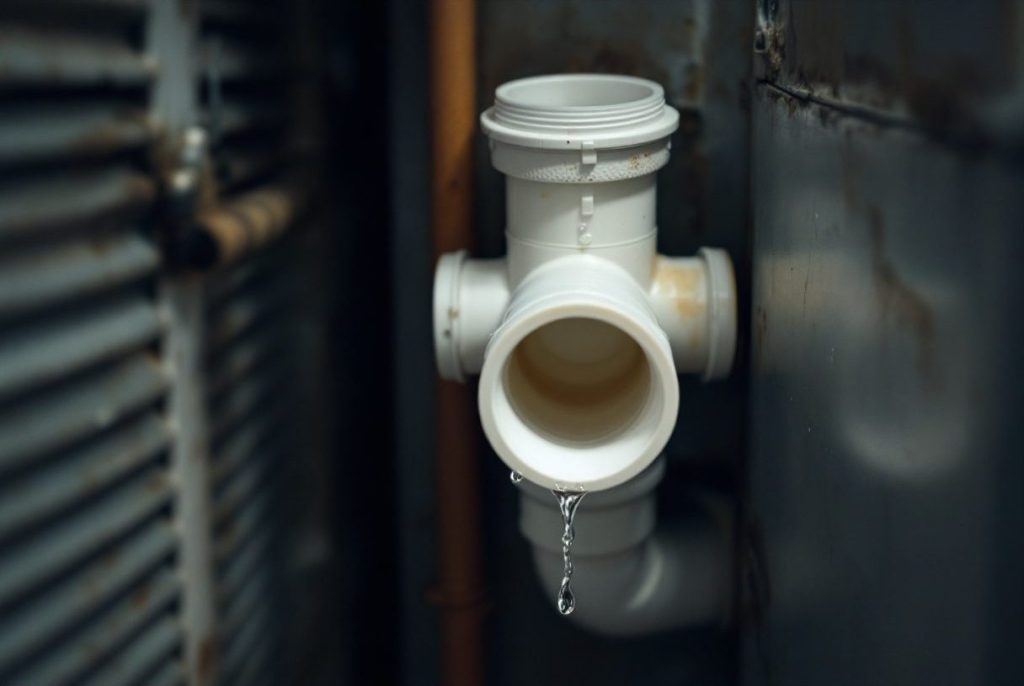
How do you fix a clogged AC drain line yourself?
Cut the power, find the cleanout and the outdoor end, pull the clog out with a wet/dry vac, then flush with water. DOE’s Energy Saver page says to clear drain channels with a stiff wire (archived copy).
- Power off. Thermostat off, then the air handler or furnace breaker. Trane and RectorSeal instructions both open with that warning.
- Empty the pan. Sponge or vacuum standing water from the primary and secondary pans.
- Find both ends. Indoors, the cleanout is a capped vertical tee near the unit. Outdoors, look for a PVC stub near the foundation. A line ending in a small motorized box is a condensate pump, a different repair.
- Vacuum the outdoor end. Remove the paper filter, seal the hose to the pipe with a rag or tape, and run short bursts.
- Flush from the cleanout. Pour water slowly into the tee. If it backs up, the clog remains.
- Close it up and test. Cap the tee, restore power, and confirm a drip outside once cooling runs.
The cap matters: Trane notes that the blower creates negative pressure at the drain connections; the trap’s water seal lets water leave against that suction. Dust past the filter feeds the slime, so a correctly rated filter is part of the fix.
Why is the shop vac not clearing the drain line?
Usually because it is pulling air through an opening instead of pulling the clog. Cover any uncapped cleanout or vent tee between the vac and the blockage.
- The clog is upstream. Sludge often sits in the trap or pan outlet, behind the cleanout. RectorSeal’s cleanout tool aims suction either direction for this reason. Work toward the unit, or clear the outlet with a stiff wire.
- The hose is not sealed. Wrap tighter or use a rubber adapter.
- The line sags. Code requires at least 1/8 inch per foot; Trane asks for 1/4 inch per foot. A belly refills with sludge; that is a re-hang job.
- It is not a clog. Ice on the coil means meltwater; see why an AC freezes up .
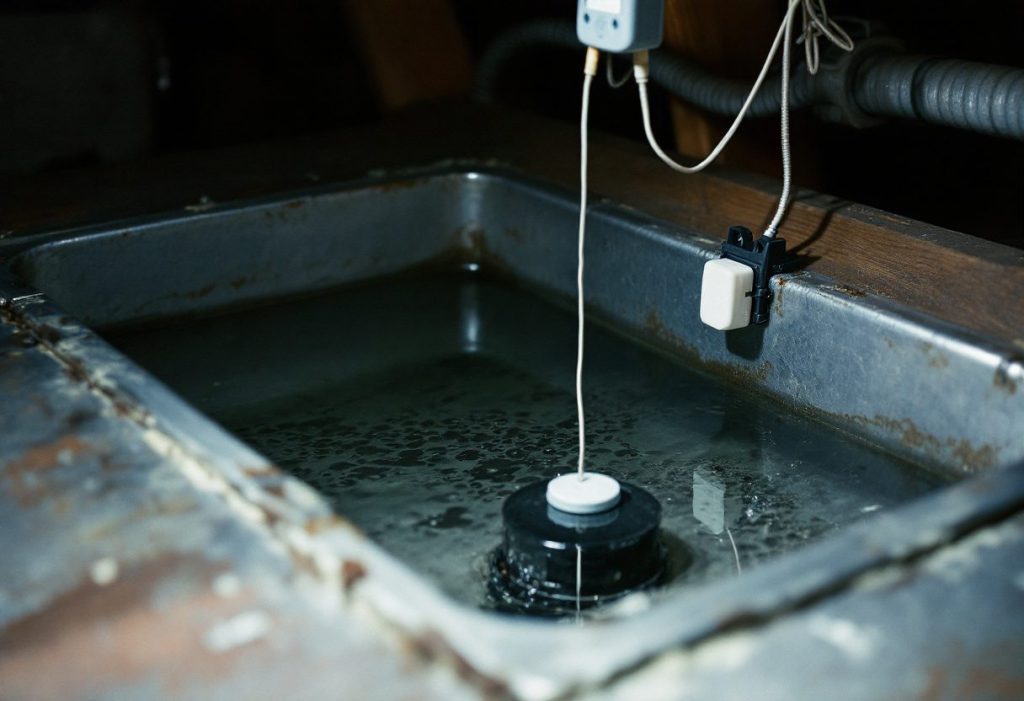
Why did the float switch shut the AC off?
Because it did its job. A condensate float switch sits in the 24-volt thermostat circuit; rising water lifts the float, opens the circuit and stops cooling before the pan overflows. Once the water drains, the system can restart.
Wiring decides what you notice. RectorSeal’s SS1 instructions: a switch in the red wire shuts down the entire unit; in the yellow (compressor) circuit the fan keeps running. Colors are in our thermostat wiring reference. The SS1 is rated 24 volts, 1.25 amp maximum, tested to UL 508.
Location matters too. Code allows the switch in the primary line, overflow line or equipment pan. RectorSeal warns its inline switch “will not detect clogs occurring upstream from the installation point.” On down-flow coils without a secondary pan, code requires the device inside the primary pan.
A float bobbing at the trip point can cycle the system; RectorSeal recommends a time delay, and our guide to AC short cycling covers other causes. Never jumper a tripped switch.
What does code require for the condensate drain line and overflow pan?
A 3/4-inch minimum drain sloped at least 1/8 inch per foot, a way to clear blockages without cutting the pipe, and a backup wherever overflow would damage the building. Below is IRC M1411.3 as printed in the 2021 Seattle Residential Code; local editions and amendments vary.
| Item | Model code (IRC M1411.3) | Manufacturer or DOE guidance |
|---|---|---|
| Slope | At least 1/8 inch per foot (1 percent) | Trane TGB air handlers: at least 1/4 inch per foot |
| Pipe size | Not less than 3/4-inch nominal to the point of disposal | Carrier FV4C: primary and secondary 3/4 inch drain connections |
| Trap | No trap rule in M1411.3 | DOE Building America: 2 inches of drop plus 2 inches of seal; Trane: within 4 feet of the outlet |
| Cleanout | M1411.3.3: clear blockages without cutting the line | DOE: cleanout with removable cap; Trane: cleanout tee or cross |
| Auxiliary pan | 1.5 inches deep, 3 inches larger than the unit, corrosion resistant | Carrier: pan under the entire unit if it sits in or above living space |
| Overflow switch | UL 508 device that shuts the equipment off | RectorSeal SS1: tested to UL 508 |
| Condensate pump | M1411.4: in attics and crawl spaces, pump failure must stop the equipment | Install per the pump maker |
The secondary drain must discharge to a “conspicuous point of disposal to alert occupants”; DOE notes some attic installers end it over a window so the drip gets noticed. Carrier’s FV4C fan coil instructions say water from that drain means “the unit requires servicing, or water damage will occur.” Pan and drain setup during an air handler installation is covered separately.
Should you pour vinegar or bleach down the condensate line?
Use water first, and chemicals only as your manual allows. None of the Carrier, Trane or RectorSeal documents we read tells owners to pour bleach or vinegar; Carrier says to inspect the coil, pan and condensate drain each cooling season.
The bleach habit, corrected. EPA says the use of a biocide “(chlorine bleach, for example) is not recommended as a routine practice during mold cleanup.” Trane warns that condensate plus chlorides from sources including cleaning compounds “creates a corrosive condition” in the cabinet. Physical clearing removes clogs.
We found no federal or manufacturer test showing vinegar prevents clogs, so treat it as optional. RectorSeal recommends its own Nu-Line cleaner, a maker’s claim, not independent evidence. Coil disinfectant rules are in our AC coil cleaning guide.
When is a clogged drain line in the attic a job for a technician?
Call one when the attic secondary pan is full, water has reached a ceiling, or the line clogs again in one season. A full secondary pan means the primary drain failed and the backup is carrying the load beside live wiring.
Ceiling stains are a moisture problem first: EPA says dry wet materials within 24 to 48 hours, treat mold under about 10 square feet as an owner job, and keep humidity below 60 percent. Whether a policy pays is covered in our piece on homeowners insurance and HVAC damage.
Repeat clogs point to installation faults: a sagging run, shallow running traps (Carrier says they “DO NOT allow proper condensate drainage”), or no cleanout, which would not meet M1411.3.3. Our list of what a real tune-up includes includes the drain test.
How we researched this
Research date: October 2026. Cited: IRC M1411.3 as printed in the 2021 Seattle Residential Code, the DOE Building America Solution Center, Carrier’s FV4C and Trane’s TGB air handler installation instructions, RectorSeal’s Safe-T-Switch SS1 data sheet, an FSEC report for DOE Building America, DOE FEMP’s water tool guide, EPA’s mold guide and an archived DOE Energy Saver page. Excluded: contractor and content-farm advice on bleach schedules and drain cleaning prices, because no federal or manufacturer source supports them. Reddit was searched for questions only; no Reddit content is used.
Frequently asked questions
Will a clogged drain line stop my AC from cooling?
Often, yes. DOE’s Energy Saver guidance says a clogged drain can cause the equipment to turn off until the drain has been cleared, or cause water damage where it overflows. The shutoff comes from a float switch; without one, the water goes into the building instead.
Where is the condensate float switch located?
Model code (IRC M1411.3.1) allows it in the primary drain line, the overflow drain line or the equipment pan, above the primary drain connection, or in an auxiliary pan under the unit. On down-flow coils without a secondary pan, code requires it inside the primary pan.
Can I pour vinegar down my AC drain line?
Usually, if your equipment manual does not forbid it, but it is not a substitute for clearing the line. The Carrier, Trane and RectorSeal documents we read do not tell owners to use vinegar or bleach, and EPA does not recommend chlorine bleach as a routine mold cleanup practice.
How often should an AC drain line be cleaned?
Carrier’s FV4C instructions say to inspect the coil, drain pan and condensate drain each cooling season and clean as necessary. RectorSeal says its Safe-T-Switch should be opened, cleaned and tested at least every 180 days and after every drain line cleaning. Humid climates produce the most condensate.
Why is water dripping from a pipe above my window?
That is usually the secondary drain, and it means the primary drain is blocked. Code requires it to discharge to a conspicuous point to alert occupants, and Carrier’s FV4C manual says water from it means the unit requires servicing, or water damage will occur.
Does a condensate pump change the fix?
Yes. You cannot vacuum the outdoor end of a pump discharge line the same way, and the pump itself may be the failure. Model code (IRC M1411.4) requires a pump in an attic or crawl space to be wired so the equipment stops when the pump fails.
Sources
- City of Seattle. “2021 Seattle Residential Code, Chapter 14 (IRC M1411).” https://seattle.gov/documents/Departments/SDCI/Codes/SeattleResidentialCode/2021SRCChapter14.pdf. Accessed October 2026.
- DOE Building America Solution Center. “HVAC Has Corrosion-Resistant Condensate Drain Pan.” https://basc.pnnl.gov/resource-guides/hvac-has-corrosion-resistant-condensate-drain-pan. Accessed October 2026.
- Carrier. “FV4C Fan Coil Installation Instructions, IM-FV4C-01.” https://refripartes.com/uploads/FV4C%20Installation%20Manual.pdf. Accessed October 2026.
- Trane. “Installer’s Guide 18-GD06D1-5, Air Handlers.” https://elibrary.tranetechnologies.com/public/trane-history/Literature/Installation/18-GD06D1-5_01012009. Accessed October 2026.
- RectorSeal. “Safe-T-Switch SS1 Product Data Sheet.” https://pdf.lowes.com/productdocuments/272cd199-7801-4897-950b-732afaecb5d4/70441877.pdf. Accessed October 2026.
- Florida Solar Energy Center for DOE Building America. “Evaluating Moisture Control of Variable-Capacity Heat Pumps (DOE/EE-1702).” https://www1.eere.energy.gov/buildings/publications/pdfs/building_america/1421385.pdf. Accessed October 2026.
- DOE FEMP. “Alternative Water Supply Tool Help Guide.” https://www.energy.gov/sites/default/files/2026-09/alternative_water_supply_help_guide_mar2026.pdf. Accessed October 2026.
- EPA. “A Brief Guide to Mold, Moisture and Your Home.” https://www.epa.gov/mold/brief-guide-mold-moisture-and-your-home. Accessed October 2026.
- DOE Energy Saver. “Air Conditioner Maintenance” (archived copy). https://web.archive.org/web/2025id_/https://www.energy.gov/energysaver/air-conditioner-maintenance. Accessed October 2026.
Leave a Reply