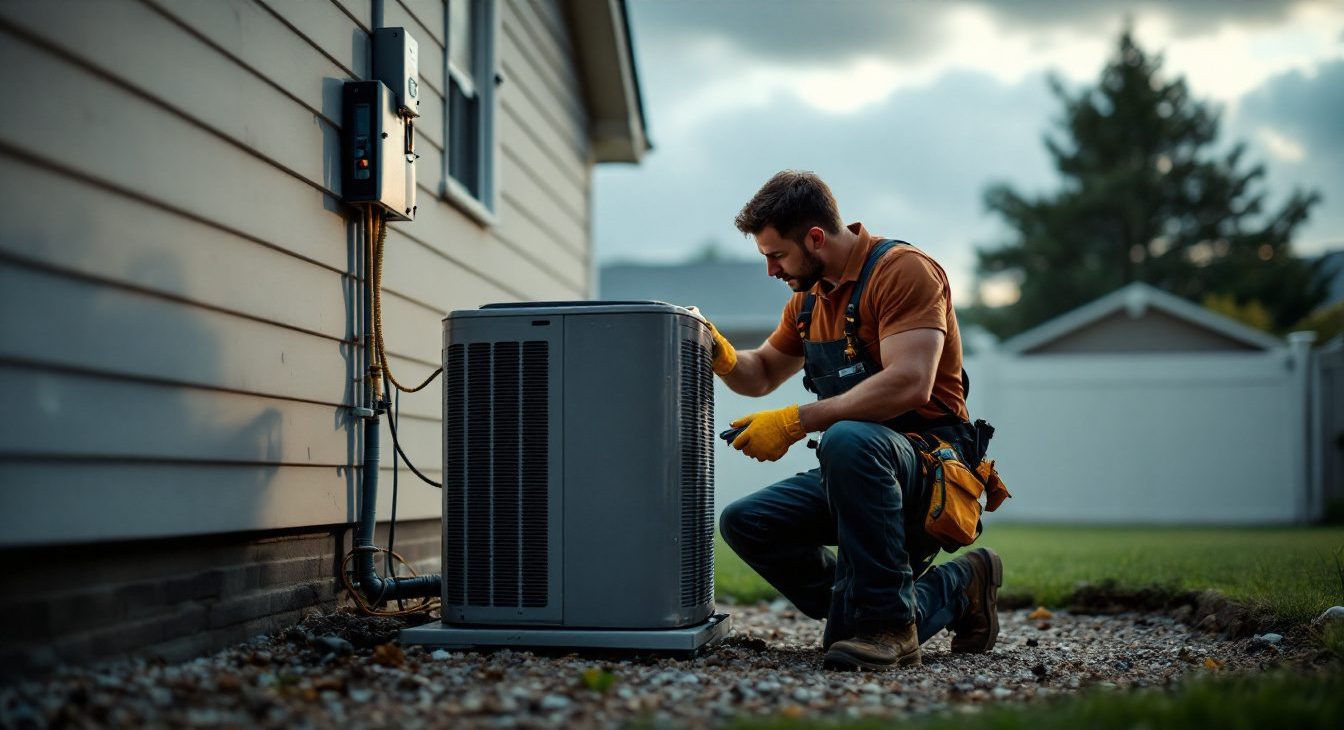
What is an AC surge protector, and is it worth it? An AC surge protector is a hardwired surge protective device, usually mounted at the outdoor disconnect, that clamps microsecond voltage spikes before they reach the condenser. It pays off as a second layer behind the panel device the 2020 NEC requires.
Key Takeaways
- A surge lasts only a few millionths of a second, yet can push a 120 volt line to thousands of volts (NIST SP 960-6, 2001).
- A GE survey of US homes, reprinted by NIST, recorded surge peaks up to 5,600 volts (NISTIR 6714-3).
- UL 1449 sorts surge protective devices into Types 1 to 4 by where they connect; an SPD at the AC disconnect is Type 1 or Type 2 (Hubbell UL 1449 summary).
- NEC 2020 section 230.67 requires a Type 1 or Type 2 device at every dwelling service, including replaced service equipment (EC&M Code Q&A).
- A surge protector does nothing for brownouts; relay models such as Micro-Air EasySurge add an 80 to 230 volt low-voltage cutout (maker claim).
- US insurers paid $1.04 billion on 55,537 lightning-related homeowners claims in 2024 (Triple-I).
What is an AC surge protector, and what does it stop?
An AC surge protector is a permanently wired surge protective device (SPD) on the condenser’s 240 volt supply. As NIST puts it, these devices neither suppress nor arrest a surge but “simply divert it to ground.”
A plug-in strip cannot protect a central system, because the outdoor unit is hardwired through the outdoor disconnect box. The right device carries a UL 1449 listing and a status light, and sits ahead of the control board, the run capacitor and the compressor. NIST notes that appliances containing semiconductors “may be more vulnerable.”
Where do power surges come from, and how big do they get?
Surges have two origins, lightning and switching, according to NIST’s homeowner guide by François Martzloff. Switching surges start when loads turn on or off, inside the house or on the utility’s lines.
The best field record is old but primary. In the 1960s, Hahn and Martzloff of General Electric monitored 16 homes and two poles for 7,000 hours; NIST reprinted the work in its 2002 surge anthology. Surge rates ran from zero to 0.5 per hour, with peaks up to 5,600 volts. Furnaces and refrigerators were among the devices found to generate surges, with internal peaks as high as 2,500 volts.
Lightning is rarer per house but bigger: counters in 91 homes logged 0.205 to 0.5 surges above 1,200 volts per home per year. Separately, 2.4 percent of 250 homes had repeating internal surges above 1,200 volts. NIST puts a typical strike at about 20,000 amperes, and the National Weather Service says lightning strikes the United States about 25 million times a year. NIST cautions that measured levels are lower today because SPDs are common.
Which UL 1449 type is an AC surge protector?
An AC surge protector mounted at the disconnect is normally a Type 1 or Type 2 device under UL 1449, the standard that renamed “transient voltage surge suppressors” as SPDs in its 3rd edition (effective 2009). The type depends on where it connects, not on how strong it is, as this Hubbell restatement of UL 1449 lays out.
| UL 1449 type | Where it connects | Nominal discharge options | Home HVAC example |
|---|---|---|---|
| Type 1 | Line side of the service disconnect, meter socket included; no external overcurrent device needed | 10 or 20 kA | Meter or main panel SPD; Intermatic AG3000 is listed Type 1 or 2 |
| Type 2 | Load side of the service disconnect, including branch panels | 3, 5, 10 or 20 kA | Panel SPD, or an SPD fed from the AC disconnect |
| Type 3 | Point of use, at least 30 feet of wire from the panel: plug-in, cord or receptacle | 3 kA | Window or portable AC strip; not for a condenser |
| Type 4 | Component inside listed equipment, not field installed | Per end use | Protection a maker builds into a board |
Compare two label numbers, not joules. The Voltage Protection Rating (VPR) is the limiting voltage under a 6 kV, 3 kA test, in steps starting at 330 volts. The nominal discharge current (In) is the surge a device survives 15 times. The Intermatic AG3000 spec sheet lists a 700 volt VPR line to neutral, 1,200 volts line to line, 20 kA In and 50 kA maximum surge current. NIST adds that 330 volts is “not a requirement.”
Does code already require a whole house surge protector?
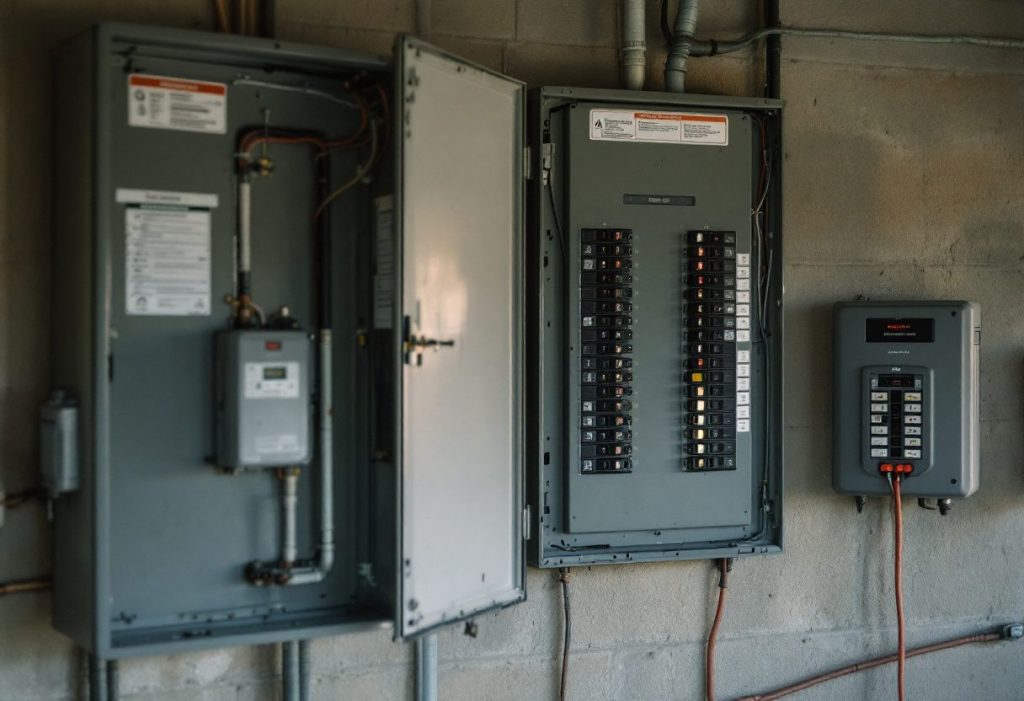
Yes, in places that have adopted the 2020 or later National Electrical Code. Section 230.67 says all services supplying dwelling units must have a Type 1 or Type 2 SPD, built into the service disconnect or immediately adjacent to it, as the EC&M Code Q&A by Mike Holt restates. An exception allows the device in the next panelboard downstream instead.
The rule also applies “where service equipment is replaced,” so a panel upgrade usually brings a whole house surge protector with it. Adoption varies by state and city, so ask your permit office which edition applies. Section 230.67 covers the service, not the air conditioner, so a second SPD at the condenser is an owner’s choice under that section.
Placement matters. NIST says a panel protector should sit less than about one foot (30 cm) from the panel, “otherwise the voltage-limiting effect will be degraded.” Intermatic’s instructions ask for short, straight leads with rounded bends, never coiled.
What does an AC surge protector not protect against?
An AC surge protector only handles fast overvoltage. It does not fix sags, brownouts or outages, and it cannot stop a direct strike. NIST treats sags and outages as separate problems with separate remedies, and says sags are “unlikely to damage most appliances.”
Myth check: the SPD is not a lightning shield. The Intermatic AG3000 instructions say it outright: “This product does not protect against lightning strikes.” Direct strikes are a lightning rod job, and NIST notes rods do not stop wiring surges.
Low voltage is the gap a standard SPD leaves open. Relay models add a monitor: Micro-Air says its EasySurge Guardian disconnects the condenser, offers a low-voltage cutout adjustable from 80 to 230 volts, and waits a restore delay of 5 to 600 seconds before reconnecting. These are maker claims, not test results.
An SPD also will not cure a breaker that keeps tripping or a worn contactor; those are faults for a technician.
Is an AC surge protector worth it?
An AC surge protector is worth it when a panel SPD is already in place, or going in with it. On its own it can end up absorbing surges meant for a bigger device. Martzloff’s coordination work for NIST (NISTIR 6714-8) found the service entrance device must divert “the bulk of the surge current,” or the downstream protector takes “the bulk of the energy.”
No federal source measures surge repair costs, so weigh three things instead. Lightning exposure varies: Florida led the nation with 4,780 lightning claims in 2024, and the average lightning claim was $18,641, per Triple-I. A State Farm spokesperson there said ground surges cause “nearly half of all claims.”
Equipment matters: a variable-speed condenser carries more electronics than a single-stage unit, and a dead board or failed compressor is a large bill.
Coverage is third: whether a policy pays for a grid surge turns on its wording, covered in our homeowners insurance and HVAC breakdown. Intermatic’s $7,500 connected equipment warranty on the AG3000 starts with a homeowners insurance claim.
How is an AC surge protector installed, and who should do it?
AC surge protector installation happens at or beside the condenser’s disconnect, and Intermatic requires “a qualified licensed technician or electrician” with power off first. Micro-Air pitches its unit as suited to DIY installation, but the same job carries Intermatic’s printed warning, “Risk of Fire or Electric Shock,” on a 240 volt circuit. Treat it as licensed work.
A typical installation, per the AG3000 instructions, runs like this:
- Disconnect power at the breaker or disconnect switch before any work starts.
- Mount the SPD on or beside the disconnect, with a weatherproof fitting if outdoors.
- Land the black leads on the line terminals and the white lead on neutral, or on equipment ground where no neutral exists.
- Keep leads short and straight, with rounded bends, ideally a 4 inch radius; trim, never coil.
- Confirm the overcurrent protection ahead of it is 60 A or less, then restore power and check that the green light is on.
After that, the owner’s job is the status light. Intermatic says a dark light means “protection has diminished” and the unit should be replaced. Like a hard start kit, it is a small add-on worth raising during a visit for an AC that will not turn on after a storm.
How we researched this
Researched October 8, 2026. We consulted 15 sources and cite 11: NIST surge publications by François Martzloff, the National Weather Service, UL 1449 and NEC 230.67 restatements, two SPD makers’ documents and Triple-I claims data. Excluded: repair-cost and price ranges on ranking pages (unsourced) and Reddit (electrical safety topic).
Frequently asked questions
Do I need an AC surge protector if I have a whole house surge protector?
Not always, but the pair beats either alone. NIST’s coordination research found the panel device should divert the bulk of the surge current, with point-of-use protection handling what remains, including switching surges created inside the house. The AC unit is that close layer at the condenser.
Is a whole house surge protector required by code?
For dwelling services under the 2020 NEC or later, yes. Section 230.67 requires a Type 1 or Type 2 SPD built into or immediately adjacent to the service disconnect, and it also applies when service equipment is replaced. Local adoption varies, so check with your building department.
Can I plug a window air conditioner into a surge protector?
Yes, if the plug-in device is rated for the unit’s current. UL 1449 calls these Type 3 point-of-use devices, meant for at least 30 feet of wire from the panel. A central condenser is hardwired, so it needs a Type 1 or Type 2 device at the disconnect instead.
Does an AC surge protector stop lightning?
Not a direct strike. Intermatic’s AG3000 instructions state the product “does not protect against lightning strikes.” It handles surges that travel in on the wiring from nearby strikes and switching. A direct hit calls for a lightning rod system, a separate job.
How long does an AC surge protector last?
No federal source publishes a lifespan, so go by the status light instead. Intermatic says that if the green light is off, protection has diminished and the device should be replaced immediately. Relay models also log voltage events.
How much does an AC surge protector cost?
No federal or national-lab source publishes installed prices, so we give none. The one maker list price we verified was $325 for the Micro-Air EasySurge Guardian in October 2026, before labor. Ask for a written quote naming the device and its UL 1449 type.
Sources
- NIST. “Surges Happen! How to Protect the Appliances in Your Home,” SP 960-6, Martzloff, 2001. https://nvlpubs.nist.gov/nistpubs/Legacy/SP/nistspecialpublication960-6.pdf. Accessed October 2026.
- NIST. “Surge Protection Anthology, Part 3: Recorded Surge Occurrences,” NISTIR 6714-3, 2002. https://nvlpubs.nist.gov/nistpubs/Legacy/IR/nistir6714-3.pdf. Accessed October 2026.
- NIST. “Anthology Part 8: Coordination of Cascaded SPDs,” NISTIR 6714-8, 2002. https://nvlpubs.nist.gov/nistpubs/Legacy/IR/nistir6714-8.pdf. Accessed October 2026.
- National Weather Service. “Lightning Safety.” https://www.weather.gov/safety/lightning. Accessed October 2026.
- Hubbell. “UL1449 3rd Edition.” https://hubbellcdn.com/ohwassets/HCI/WiringDevice/media/Wiring_UL14493rdEdition.pdf. Accessed October 2026.
- EC&M. “Code Q&A: Protection of Dwelling Unit Services,” Mike Holt, 2020. https://www.ecmweb.com/national-electrical-code/qa/article/21146819/code-qa-protection-of-dwelling-unit-services. Accessed October 2026.
- Leviton. “2020 NEC Updates: 230.67 Surge Protection.” https://leviton.com/content/dam/leviton/residential/product_documents/product_specification/NEC%20230.67%20Surge%20Protection%20Flyer%20Q-1285A_Greg%20Rhoades.pdf. Accessed October 2026.
- Intermatic. “AG3000 Specification Sheet.” https://assets.unilogcorp.com/267/ITEM/DOC/Intermatic_AG3000_Specification_Sheet.pdf. Accessed October 2026.
- Intermatic. “AG3000 Installation Instructions.” https://assets.unilogcorp.com/267/ITEM/DOC/Intermatic_AG3000_Instruction_Installation_Manual.pdf. Accessed October 2026.
- Micro-Air. “EasySurge Guardian HVAC Surge Protector.” https://www.microair.net/products/easysurge-guardian-hvac-surge-protector. Accessed October 2026.
- Triple-I. “Lightning caused $1.04B in homeowners claim payouts in 2024.” https://www.iii.org/press-release/triple-i-lightning-caused-104b-in-us-homeowners-claim-payouts-in-2024-frequency-drops-215-year-over-year-061925. Accessed October 2026.
Leave a Reply