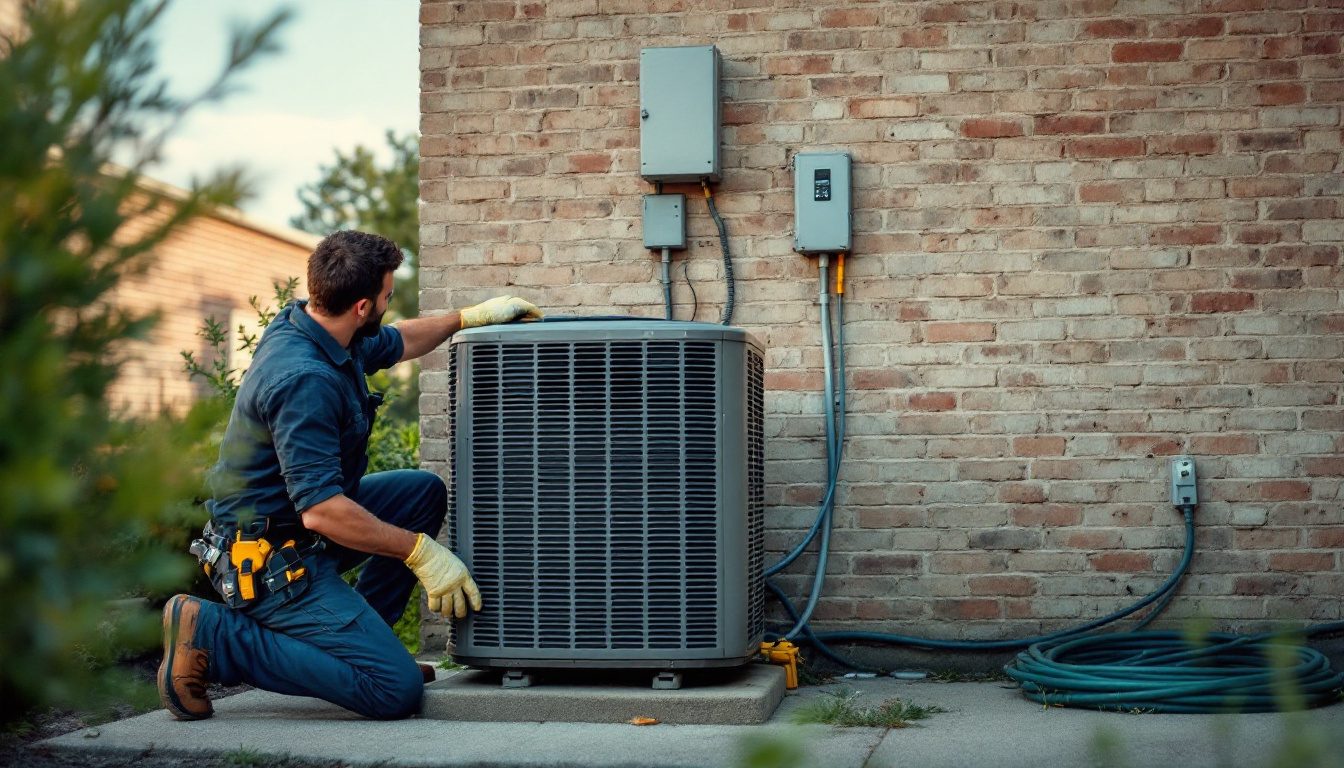
What is an AC disconnect box? It is the weatherproof switch beside your outdoor unit that cuts its 208/230 volt supply for service. The National Electrical Code requires one within sight of the unit, and whether it holds fuses depends on what the condenser nameplate allows.
Key Takeaways
- NEC 440.14 requires a disconnect within sight of the unit and readily accessible, per EC&M’s 2022 Article 440 review; “within sight” means visible and no more than 50 feet away (EC&M Code Q&A).
- Local rules can be stricter: Town of Manalapan, Florida allows six (6) feet at most.
- The nameplate decides fused vs non-fused. Goodman’s GSXN4 sheet says “Must use time-delay fuses or HACR-type circuit breakers of the same size as noted.”
- A 3-ton Goodman GSXN4 lists 21.0 amps minimum circuit ampacity and 35 amps maximum overcurrent protection (SS-GSXN4, 5/22).
- The disconnect’s own rating must be at least 115% of the compressor’s rated-load current under NEC 440.12, per EC&M.
- Pulling the handle does not make the box dead: line side field wires “are live even with the pull-out removed,” a disconnect kit instruction warns.
What is an AC disconnect box?
An AC disconnect box is a small outdoor enclosure, usually on the wall beside the outdoor condenser, that opens the power conductors between your electrical panel and the outdoor unit. With it off, the outdoor unit stays dead whatever the thermostat calls for.
The panel breaker protects the wire; the disconnect lets a technician kill power at the unit while working on the contactor that switches the outdoor unit or compressor. A typical residential box is a two-pole switch rated for 120/240 volts in a NEMA 3R enclosure, which Schneider Electric describes as built for outdoor use against “rain, sleet, and damage from external ice formation.”
Is an AC disconnect required, and how far away can it be?
Yes. NEC 440.14 requires a disconnecting means “within sight and readily accessible from the equipment it supplies,” as EC&M restated it in December 2022. Article 100 defines “within sight” as visible and not more than 50 feet away, per an EC&M Code Q&A by Mike Holt.
The same section bars mounting the box on panels designed to permit access to the equipment, or where it would obscure the nameplates.
Your jurisdiction can go further. The Town of Manalapan, Florida change-out form says the condensing unit disconnect “shall in no case” sit further than six (6) feet from the service side. Washington’s Department of Labor & Industries, on its manufactured home checklist, accepts an HACR breaker in an outside panel “if in sight” of the outdoor unit. Inspectors check these points under an HVAC replacement permit.
Code point
NEC editions and local amendments vary by jurisdiction; the Washington checklist cites the 2005 NEC. Ask your building department what applies before you buy or move a disconnect.
Fused vs non-fused AC disconnect: which does your unit need?
Read the nameplate, because inspectors check the protective device against it. A plate that names fuses only calls for fuses, which usually means a fused disconnect at the unit. A plate that names “fuse or HACR breaker” lets a correctly sized HACR breaker in the panel do the protecting, so the outdoor box can be non-fused.
Goodman’s spec sheet for its GSXN4 condensers is explicit: “Must use time-delay fuses or HACR-type circuit breakers of the same size as noted.” Manalapan accepts non-fusible boxes with protection “supplied at the main breaker panel,” fused boxes, or breaker types, and requires every breaker protecting mechanical equipment to be “H.A.C.R. type per the unit identification plate.”
The HACR label matters less on newer breakers: Schneider Electric states that section 7.8 of the 11th edition of UL 489 “granted HACR listing to all UL 489 listed circuit breakers.” The nameplate still governs.
How do you size an AC disconnect from the nameplate?
Two numbers on the condenser’s rating plate do the work. Minimum circuit ampacity (MCA) sizes the wire; maximum overcurrent protection (MOCP) caps the fuse or breaker. The disconnect itself must carry at least 115% of the compressor’s rated-load current under NEC 440.12.
Goodman’s SS-GSXN4 specification sheet (dated 5/22) notes that “extensive wire runs will require larger wire sizes” and tells installers to check the unit’s S&R plate.
| Goodman model (208/230V, 1 phase) | Nominal capacity | Min. circuit ampacity | Max. overcurrent protection |
|---|---|---|---|
| GSXN402410 | 2 tons (24,000 BTU/h) | 11.2 A | 15 A |
| GSXN403610 | 3 tons (36,000 BTU/h) | 21.0 A | 35 A |
| GSXN406010 | 5 tons (60,000 BTU/h) | 33.3 A | 50 A |
Read the 3-ton row this way: wire good for at least 21.0 amps, and time-delay fuses or an HACR breaker of the 35 amp size the sheet notes. The Village of Biscayne Park, Florida asks for both numbers, old unit and new, on its replacement permit sheet and a new circuit belongs in any central air installation scope. For the draw behind the figures, see how many amps an air conditioner pulls.
Pull-out, fused pull-out or switch: which AC disconnect types exist?
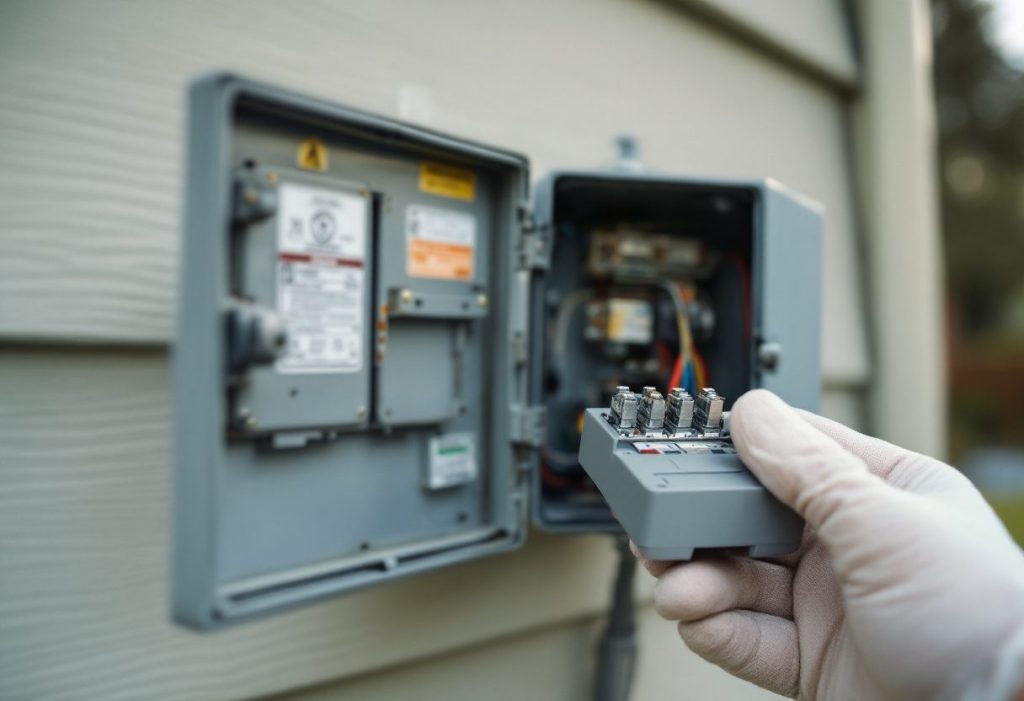
Residential AC disconnects come in four forms: a non-fused pull-out, a fused pull-out, a lever-operated molded case switch, and an enclosed breaker. Only the fused and breaker types also protect against overcurrent at the box.
| Type | Example and maker rating | Protection at the box | How it opens |
|---|---|---|---|
| Non-fused pull-out | Eaton DPU222R: 60A, 120/240V, 10 kAIC, NEMA 3R, 10 hp at 240V | None; panel breaker protects | Pull the pull-out head |
| Fused pull-out | Eaton DPF221R: 30A, 120/240V, 10 kAIC, NEMA 3R, 3 hp at 240V | Fuses in the box | Pull the pull-out head |
| Molded case switch | Square D QO200TR: 60A, 2 pole, 240VAC, 22kA, NEMA 3R | None; panel breaker protects | Flip the lever |
| Enclosed circuit breaker | Accepted by Manalapan “per the unit identification plate” | Breaker sized to the plate | Switch the breaker off |
Ratings come from Eaton’s DPU222R sheet, Eaton’s DPF221R sheet and Schneider’s QO200TR listing. Note the horsepower column: a 30A fused pull-out is rated for 3 hp at 240V, the 60A non-fused unit for 10 hp. A disconnect with a surge protector is a separate decision; see our explainer on the AC surge protector.
Is the AC disconnect still live when it is switched off?
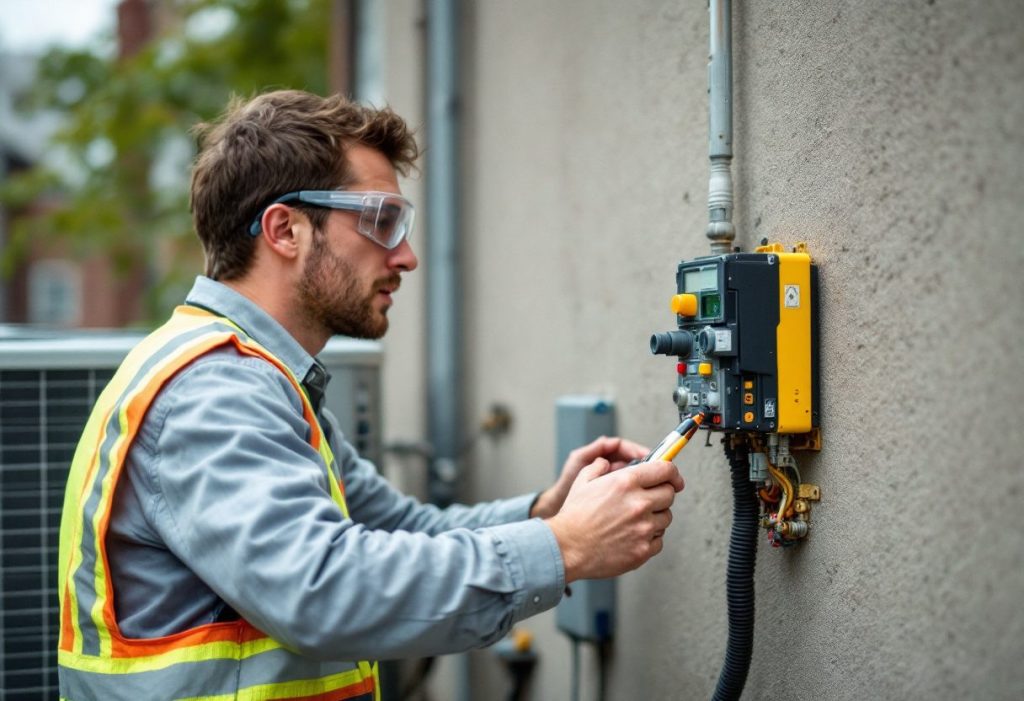
Only half of it. Opening the disconnect kills the load side, the wires running to the condenser, but the line side terminals stay energized from the panel. One disconnect kit instruction warns: “Field wires on the line side of the disconnect are live even with the pull-out removed.”
Goodman’s wiring diagrams also warn that “Multiple power sources may be present,” and OSHA 1910.333 requires capacitors to be discharged and a lock and tag on each disconnecting means used for the work. The same rule has a qualified person test the parts with a meter to verify they are deenergized. OSHA 1910.147 lists a disconnect switch as an energy isolating device.
What a homeowner can safely do:
- Switch the thermostat off, then open the disconnect by pulling the head or flipping the lever, without opening the inner cover.
- Leave the cover closed if you see scorching, melted plastic, rust through the box, or water inside; call an electrician.
- Check the panel breaker, and read our note on why a breaker that keeps tripping should not be reset again and again.
- Push a pulled head fully home so its contacts engage, then restore the thermostat call.
A silent outdoor unit with a running indoor blower can be as simple as a pulled head; our AC not turning on checklist covers the other owner checks.
Can you replace an AC disconnect fuse yourself?
Treat it as technician or electrician work unless your disconnect maker’s instructions say otherwise. The fuses sit beside line terminals that stay live with the head pulled, and replacements must match the plate: Goodman specifies time-delay fuses “of the same size as noted.”
A blown fuse is also a symptom. Something downstream drew more current than the fuse allows, and a technician should check the run capacitor, the contactor and the compressor windings before restoring power. A compressor that struggles to start may be a candidate for a hard start kit, but only after that diagnosis.
How we researched this
Research date: October 8, 2026. We opened 21 documents and cite 15. NFPA’s free NEC viewer cannot be read by our tools, so NEC 440.14, 440.12 and the Article 100 “within sight” definition come from named EC&M restatements (2004 and 2022) cross-checked against three municipal or state inspection documents: Manalapan and Biscayne Park, Florida, and Washington L&I. Equipment figures come from the Goodman SS-GSXN4 sheet and Eaton and Schneider product documents, named as maker data for their own products.
Excluded: Reddit and homeowner forums, because this is an electrical safety topic; electrician forum threads, used only to map the search results; and content farm pages quoting “30 to 60 amps” with no source. No prices appear here because no federal series publishes installed disconnect costs.
Frequently asked questions
How far can an AC disconnect be from the unit?
Under NEC 440.14 it must be within sight, which Article 100 defines as visible and not more than 50 feet away, per EC&M. Local amendments can tighten that: Manalapan, Florida allows no more than six (6) feet from the service side.
Does an AC disconnect have to be fused?
Only when the nameplate requires fuse protection that nothing upstream provides. Goodman’s GSXN4 sheet allows “time-delay fuses or HACR-type circuit breakers,” so an HACR breaker in the panel sized to the plate lets the outdoor box be non-fused. Manalapan accepts both arrangements.
What size AC disconnect do I need?
Its rating must be at least 115% of the compressor’s rated-load current under NEC 440.12, per EC&M, and its fuses or breaker must match the plate’s maximum overcurrent protection. Check both against the plate: a 3-ton Goodman GSXN4 lists 21.0 amps MCA and 35 amps maximum protection.
Can the disconnect be mounted on the AC unit?
Yes, within limits. EC&M’s 2022 summary of NEC 440.14 says it cannot sit on panels designed to permit access to the equipment, or where it would obscure the equipment nameplates. A wall mount beside the condenser, kept clear of its service panels, avoids both problems.
Does a panel breaker count as the AC disconnect?
It can if it is within sight of the unit. Washington L&I’s checklist accepts “a HACR breaker in a panel installed on the outside of the home” if it is in sight of the outdoor unit. A panel that cannot be seen from the unit does not qualify.
Is the AC disconnect box safe to touch when it is off?
The handle and closed cover are designed to be operated, but the inside is not safe. A disconnect kit instruction warns that line side field wires “are live even with the pull-out removed,” and OSHA 1910.333 requires testing to verify parts are deenergized before work.
Sources
- EC&M. “NEC: Air Conditioning and Refrigerating Equipment, Part 2.” https://www.ecmweb.com/maintenance-repair-operations/motors/article/21255893/nec-air-conditioning-and-refrigerating-equipment-part-2. Accessed October 2026.
- EC&M. “Code Q&A.” https://www.ecmweb.com/nec/code-qa-54. Accessed October 2026.
- Town of Manalapan. “Air Conditioning Replacement Data.” https://manalapan.org/wp-content/uploads/2025/08/Airconditioning-Changeout-1.pdf. Accessed October 2026.
- Village of Biscayne Park. “Air-Conditioning Replacement Sheet.” https://biscayneparkfl.gov/vertical/sites/%7BC4179EE4-3062-4442-8583-B704F0600806%7D/uploads/AC_CHANGE_OUT(1).pdf. Accessed October 2026.
- Washington L&I. “Air Conditioner/Heat Pump Pre-Inspection Checklist, F622-014-000.” https://lni.wa.gov/forms-publications/F622-014-000.pdf. Accessed October 2026.
- Goodman. “SS-GSXN4 Product Specifications.” https://cdn.shopify.com/s/files/1/0766/1171/5363/files/GSXN402410.pdf. Accessed October 2026.
- Eaton. “DPU222R Specifications.” https://res.cloudinary.com/wernerelectric/image/upload/f_pdf,q_auto:good/Eaton/EATON_DPU222R_Specification_Sheet.pdf. Accessed October 2026.
- Eaton. “DPF221R Specifications.” https://res.cloudinary.com/wernerelectric/image/upload/f_pdf,q_auto:good/Eaton/EATON_DPF221R_Specification_Sheet.pdf. Accessed October 2026.
- Schneider Electric. “QO200TR.” https://www.se.com/us/en/product/QO200TR/. Accessed October 2026.
- Schneider Electric. “HACR circuit breakers, FA230479.” https://www.se.com/ca/en/faqs/FA230479. Accessed October 2026.
- Schneider Electric. “NEMA 3 vs NEMA 3R, FA130639.” https://www.se.com/au/en/faqs/FA130639. Accessed October 2026.
- Electrical Disconnect Kit instructions, EBP/EBX/EBV/EBW fan coils, 482 01 2225 01. https://c.searspartsdirect.com/doc/L0502510. Accessed October 2026.
- OSHA. “1910.333 Selection and use of work practices.” https://www.osha.gov/laws-regs/regulations/standardnumber/1910/1910.333. Accessed October 2026.
- OSHA. “1910.147 The control of hazardous energy.” https://www.osha.gov/laws-regs/regulations/standardnumber/1910/1910.147. Accessed October 2026.
- BLS. “Census of Fatal Occupational Injuries, Table 2.” https://www.bls.gov/news.release/cfoi.t02.htm. Accessed October 2026.
Leave a Reply