Last reviewed: September 2026 · By the HVAC Brief Editorial Team · Our sourcing and editorial standards
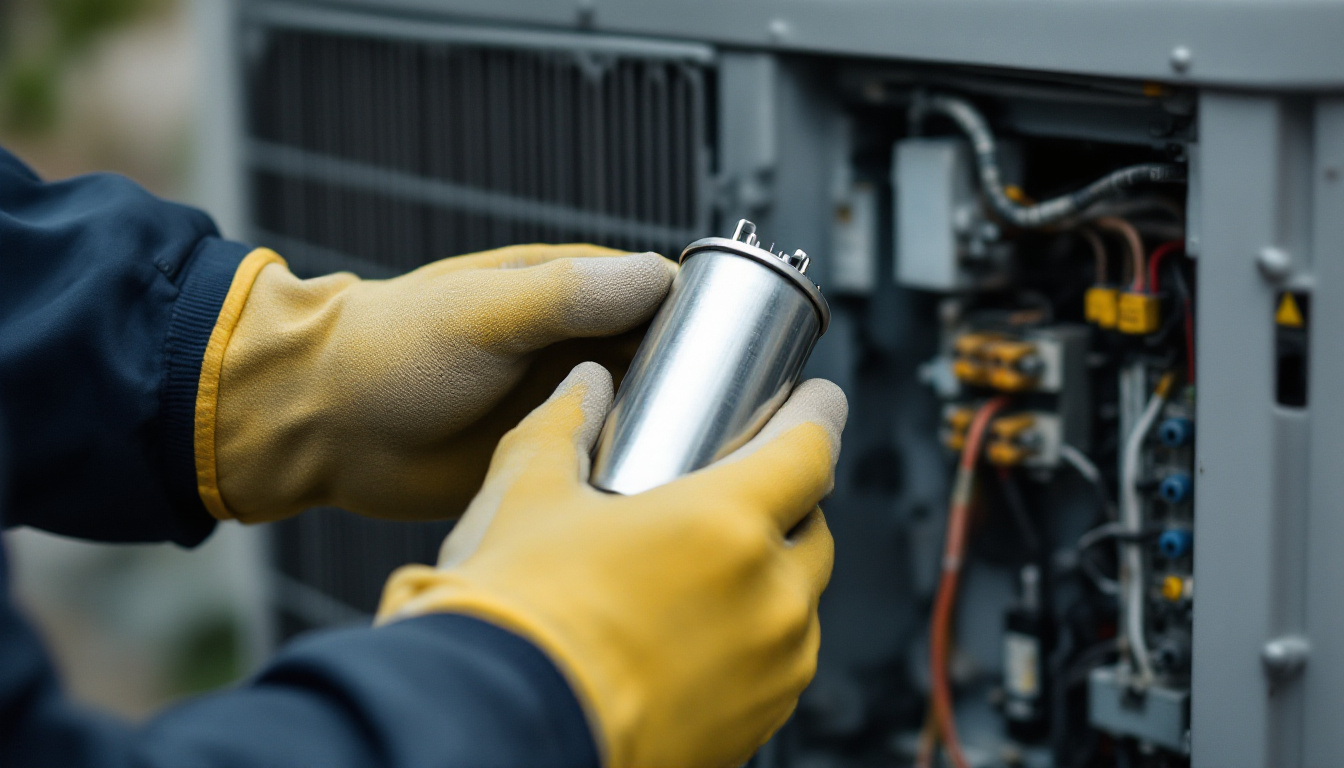
An HVAC capacitor is a small electrical component that helps start, and keep running, the motors in an air conditioner or heat pump: the compressor, the outdoor fan and often the indoor blower. The classic sign of failure is an outdoor unit that hums but does not start.
It is one of the least expensive parts in the system. It is still a job for a technician, because a capacitor can hold a dangerous charge after the power is switched off.
What a capacitor does
A capacitor stores electrical charge and releases it in step with the motor. That shifts the timing of current in a second motor winding, which gives a single-phase motor the push it needs to start and the balance it needs to run efficiently.
Without it, a compressor or fan motor receives power but cannot turn, or turns weakly. That is why a failed capacitor so often looks like a failed motor from the outside, and why the two are told apart by measurement rather than by looking. See what an AC condenser does for the rest of the outdoor unit.
Start, run and dual run capacitors
Residential systems use two kinds of job, sometimes combined in one part: a run capacitor that stays in the circuit, and a start capacitor that helps only at start-up.
| Type | Job | Typically found on |
|---|---|---|
| Run capacitor | Stays in the circuit while the motor runs, for efficient operation | Outdoor fan motors, blower motors, compressors |
| Dual run capacitor | One case serving two motors, with terminals usually marked HERM, FAN and C | Outdoor condensing units, serving compressor and fan |
| Start capacitor | Adds a burst of starting torque, then is switched out | Some compressors, and hard start kits |
| Hard start kit | An added start capacitor with a relay | Compressors that struggle to start |
Signs a capacitor has failed
Most capacitor symptoms are about motors not starting properly. Each one has other possible causes, which is why a technician tests before replacing anything.
- The outdoor unit hums but the fan does not turn. The most common pattern. A failed contactor or a seized motor can look the same. More in what HVAC noises mean.
- The compressor tries to start and trips the breaker. A weak start or run capacitor is one cause; a failing compressor is another.
- The fan starts slowly or not at all while the compressor runs.
- The system runs but blows warm air. If the compressor is not starting, the indoor blower can still move uncooled air. See AC running but not cooling.
- A visibly swollen or leaking case. A domed top is a clear sign, but many failed capacitors look perfectly normal.
If the outdoor unit is humming without starting, switch the system off at the thermostat. A motor that keeps receiving power without turning can overheat.
A capacitor can retain a charge after the disconnect is off, and the outdoor unit runs on a 240-volt circuit. Fitting one with the wrong rating can damage the motor it is meant to protect, and confirming the fault takes a meter. Replacing a capacitor does not open the refrigerant circuit, so EPA Section 608 certification does not govern that task itself, but state and local electrical rules may.
Reading the label
Every capacitor is printed with its capacitance in microfarads, shown as µF or MFD, and a voltage rating, commonly 370 or 440 volts AC on residential equipment.
A replacement should match the capacitance the equipment calls for and meet or exceed the voltage rating. On a dual run capacitor both capacitance values matter, one for the compressor and one for the fan. The equipment wiring diagram, not the old part alone, is the reference, because the old part may itself be the wrong one.
Why a small part matters
A capacitor is cheap; the motors it serves are not, and they are getting more expensive. The BLS producer price index for motor and generator manufacturing reached 318.1 in 2026-08, up 3.9% on a year earlier and 47.5% above its 2019 average.
That is a factory-gate index for motors in general, not a price for HVAC replacement motors. It still makes the practical point: dealing with a failing capacitor promptly costs less than letting a motor strain against it.
What a capacitor replacement costs
No federal series measures HVAC repair prices, so any figure you see for a capacitor replacement is a vendor survey or a contractor estimate. We do not publish one.
The part is inexpensive and the visit is short, which puts it at the low end of HVAC repairs. Ask for part and labour separately, and ask why it failed: a capacitor that fails twice in two seasons points to a different problem. Our page on what HVAC repair costs are actually measured explains the gap in the data.
Frequently asked questions
What does a capacitor do on an AC unit?
It stores and releases electrical charge to help the compressor, outdoor fan and sometimes the indoor blower motor start and run efficiently. Without a working capacitor, those single-phase motors receive power but cannot turn, or turn weakly.
How do I know if my AC capacitor is bad?
The usual sign is an outdoor unit that hums but does not start, or a fan that will not spin while the compressor runs. A swollen or leaking case confirms it, but many failed capacitors look normal. A failed contactor or motor can cause the same symptoms, so a technician tests it with a meter.
Can I replace an AC capacitor myself?
It is not recommended. A capacitor can hold a dangerous charge after the power is off, the outdoor unit runs on 240 volts, and the wrong rating can damage a motor. EPA refrigerant certification does not govern the task, but state and local electrical rules may.
What is a dual run capacitor?
A single capacitor case that serves two motors, usually the compressor and the outdoor fan, with terminals commonly marked HERM for the compressor, FAN for the fan motor and C for common. It carries two capacitance ratings, and a replacement must match both.
Methodology and limitations
This page describes how motor capacitors work in residential air conditioners and heat pumps in general terms. Equipment-specific ratings come from the manufacturer’s wiring diagram and data plate.
- No federal source measures capacitor failure rates or replacement prices, and we publish neither.
- The motor price index is BLS series PCU335312335312, not seasonally adjusted, and covers motors broadly rather than HVAC replacement parts.
- Nothing here is electrical safety advice for a specific installation.
Sources
- US Bureau of Labor Statistics, Producer Price Index series PCU335312335312, motor and generator manufacturing.
- US Environmental Protection Agency, Section 608 of the Clean Air Act, refrigerant management requirements.
The HVAC Brief is an independent trade publication. We do not sell equipment, take manufacturer advertising, or accept payment for placement in our research. Corrections welcome.
Leave a Reply