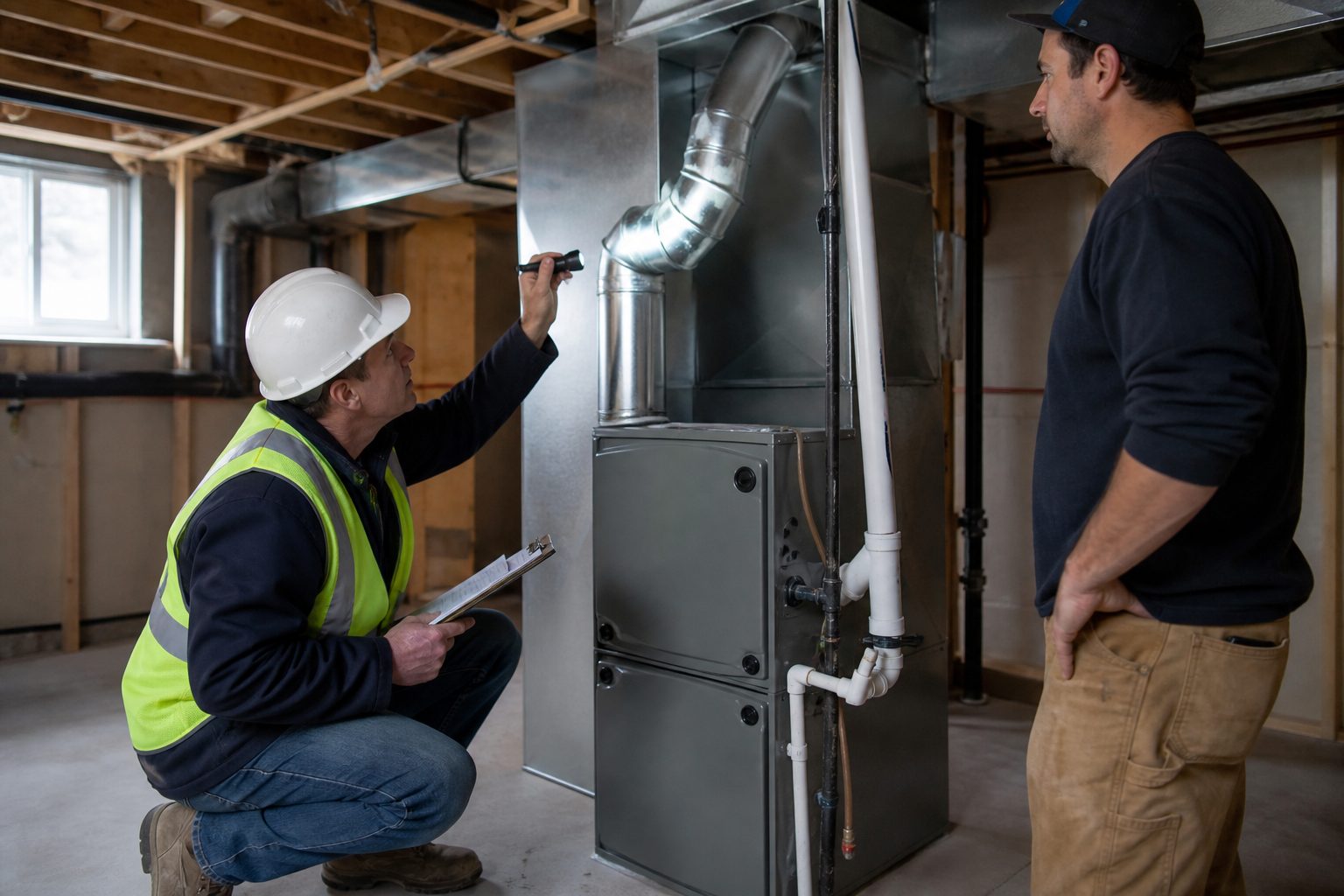
Do you need an HVAC permit to replace a furnace or air conditioner? In most US jurisdictions, yes. Mechanical codes treat equipment replacement as permitted work, and the permit is what buys you an inspection of the venting, the combustion air and the electrical connection.
Key Takeaways
- Montgomery County, Maryland requires a mechanical permit to “install, enlarge, alter, repair, remove, convert or replace” an HVAC system, and inspects gas furnace work twice (Montgomery County DPS).
- Chicago is the counter example: in residential buildings up to 4 stories, in-kind replacement of a furnace, boiler or air conditioning appliance needs no building permit (Chicago Department of Buildings).
- The IECC has held residential total duct leakage at 4 CFM25 per 100 square feet of conditioned floor area from the 2012 edition through the 2021 edition (DOE Building America Solution Center).
- Apple Valley, Minnesota publishes its furnace inspection list: vent pitch, B-vent material, combustion air opening height and clearance to combustibles (City of Apple Valley).
- More than 200 people a year die of unintentional non-fire carbon monoxide poisoning linked to consumer products, which is why venting gets inspected (CPSC).
- EPA Section 608 certification is federal and separate from any local permit, and a technician who opens a refrigerant circuit must hold one of its four types (EPA).
Does replacing equipment require an HVAC permit?
In most places, yes. Model mechanical and residential codes treat an equipment swap as regulated work, not maintenance, because it touches venting, fuel gas, refrigerant and line voltage at once. Adoption is local, so the binding answer comes from your own authority having jurisdiction.
Montgomery County, Maryland states the rule in the model code’s own words: a mechanical permit is required to “erect, install, enlarge, alter, repair, remove, convert or replace a mechanical heating, ventilating and air-conditioning system.” The county draws its exemption line inside the cabinet, exempting “replacement of components within a unit such as compressors and/or burners.” A whole furnace is not a component.
Apple Valley, Minnesota is blunter. Its building inspections page requires a mechanical permit for furnace replacement and says “mechanical permits are required for installing or replacing an air conditioning unit.” Neither jurisdiction excuses the job because the new unit sits where the old one sat, which is the same logic behind the questions a furnace changeout has to settle first.
What does an HVAC permit actually buy you?
An inspection. The fee is admission; the product is a municipal employee with no stake in the invoice looking at the parts of the job about to be hidden behind sheet metal and drywall.
Apple Valley, Minnesota publishes its furnace checklist, the clearest public picture of what that inspector does. It covers clearance to the appliance, 6 inches to combustibles for single-wall vent and 1 inch for Class B vent, a vent connector rise of one quarter inch per foot, a listed cap on the vent termination, and combustion air openings at least 12 inches above grade with quarter-inch mesh screening. Gas piping is pressure tested at 25 psi for 30 minutes with the inspector watching.
Condensate and the electrical disconnect ride along on the same visit, as does whether the equipment matches its listing: Apple Valley requires the installation manual on site at inspection. We cover what should happen on installation day and the air handler drain pan rules separately.
The inspection exists because of combustion, not paperwork. CPSC reports that more than 200 people a year die of unintentional non-fire carbon monoxide poisoning associated with consumer products, and advises a yearly professional inspection of every fuel-burning heating system including “furnaces, boilers, fireplaces, wood stoves, water heaters, chimneys, flues and vents.” A vent connector with the wrong pitch is invisible from the thermostat. See also where carbon monoxide alarms go.
Why does the energy code decide whether ducts get tested?
Because duct leakage is a code metric with a number attached, and somebody has to witness the test. The DOE Building America Solution Center, restating the residential IECC, says duct testing arrived in the 2009 IECC and that the limit has been “very consistent requiring total duct leakage of 4 CFM25 per 100 square feet of conditioned floor area from the 2012 IECC to the 2021 IECC.”
Two details matter on a replacement. The test pressurizes or depressurizes the ducts to 25 pascals, or 0.10 inch water column, and reads the airflow needed to hold it. Systems entirely inside the building thermal envelope were exempt until the 2021 IECC, which added a final-test limit of 8 CFM25 per 100 square feet. Whether any of it attaches to your changeout depends on the code edition your jurisdiction adopted.
That is why a duct test result beats a visual opinion, and why airflow faults get misdiagnosed as equipment faults.
Who pulls the HVAC permit, and why ask for the number?
The installing contractor normally pulls it, and that is the point. Montgomery County notes that electronic applications for one-for-one replacements “can be issued immediately,” so a same-day changeout is no reason to skip it. Ask for the permit number before the crew leaves, then confirm it with the building department.
A permit number is a verifiable fact about your house. A promise that the company “handles all that” is not. It is a different check from the licence and quote questions in vetting an HVAC contractor, and different from the three activities people call an HVAC inspection.
What happens if the work is done without a permit?
Nothing, until it does. The exposure is deferred, not avoided, and lands at a sale, a claim or a later inspection. Rancho Palos Verdes, California triples permit fees where work requiring a permit was started or finished before the permit was obtained, and says inspectors “may require demolition of finishes and wall coverings” to verify the work.
Resale is where it usually surfaces. Prince William County, Virginia puts the transfer plainly: “If you purchase property where building code violations exists, you become legally responsible for correcting whatever the building code deficiency is as the new owner.” The liability follows the house, not the contractor. We found no federal or national-lab dataset quantifying insurance outcomes on unpermitted HVAC work, so treat any figure on that point as unsourced.
Which replacements are exempt, and where?
Some jurisdictions do carve out like-for-like work, and Chicago is the clearest example. In residential buildings up to 4 stories above grade, no building permit is required for “repairing or replacing (in-kind) a furnace,” a boiler or “an air conditioning appliance.” In-kind means “new materials, objects, or elements of the same type, size, and shape.”
The catch is in the same document. Chicago adds that work performed without a permit “must still comply with all applicable requirements of the Chicago Construction Codes.” An exemption from the permit is not an exemption from the code, and it removes the inspection that would have proved compliance.
| Jurisdiction | Permit for equipment replacement | Stated exemption | Inspection note |
|---|---|---|---|
| Montgomery County, MD | Required to install, replace or convert an HVAC system | Components within a unit, such as compressors or burners | Gas furnace work inspected by DPS and WSSC; all-electric heat pump by DPS only |
| Chicago, IL | Not required for in-kind residential replacement up to 4 stories | In-kind furnace, boiler or AC appliance replacement | Construction codes still apply with no permit inspection attached |
| Apple Valley, MN | Required for furnace and for AC install or replacement | Separate electrical permit waived for a qualifying HVAC employee reconnecting the existing circuit | Published inspection list covers venting, combustion air, clearances and gas piping |
Does an HVAC permit cover the refrigerant rules?
No. EPA Section 608 certification is a federal requirement under 40 CFR Part 82, Subpart F, and it applies whether or not your city issues a permit. EPA states that “technicians who maintain, service, repair, or dispose of equipment that could release refrigerants into the atmosphere must be certified,” and that attaching or detaching hoses and gauges to measure pressure counts as technician work.
There are four types. Type I covers small appliances, Type II high-pressure and very high-pressure appliances other than small appliances and motor vehicle systems, Type III low-pressure appliances, and Universal all of them. A residential split system changeout is Type II or Universal, and our breakdown of which 608 type a technician needs goes further.
The category matters more now that A2L refrigerants have replaced R-410A in new equipment and the rules on installing R-410A in 2026 have narrowed.
How we researched this
We used primary sources only: three municipal or county building departments publishing their mechanical permit rules, the DOE Building America Solution Center for the IECC duct leakage limits, EPA for Section 608 and CPSC for the carbon monoxide figure. codes.iccsafe.org blocks automated retrieval, so every code position is cited through a jurisdiction or a federal restatement. Contractor blogs, permit lead-generation sites and cost aggregators were excluded. No Reddit material was used, because this topic involves combustion and gas. No fee figures are given. Research date: September 2026.
Frequently asked questions
Do I need an HVAC permit for a like-for-like furnace swap?
Usually yes. Montgomery County, Maryland requires a permit to replace an HVAC system and exempts only components inside the unit, such as compressors or burners. Chicago waives the permit for in-kind residential replacement up to 4 stories.
Who is supposed to pull the permit, me or the contractor?
The installing contractor normally does. Montgomery County issues electronic one-for-one replacement applications immediately, so speed is no excuse to skip it. Ask for the permit number and verify it with the building department.
What does the inspector look at on a furnace changeout?
Apple Valley, Minnesota lists vent connector rise of one quarter inch per foot, a listed vent cap, 1 inch clearance to combustibles for Class B vent, combustion air openings at least 12 inches above grade, and a witnessed 25 psi gas piping test.
Will my ducts be leak tested when I replace equipment?
It depends on the energy code edition your jurisdiction adopted. The residential IECC held total duct leakage at 4 CFM25 per 100 square feet of conditioned floor area from 2012 through 2021, per the DOE Building America Solution Center.
What happens if HVAC work was done without a permit?
It surfaces later. Rancho Palos Verdes, California triples permit fees for work started before permitting and lets inspectors require demolition of finishes. Prince William County, Virginia says a buyer becomes legally responsible for inherited code violations.
Does EPA Section 608 certification depend on my local permit rules?
No. Section 608 is federal, under 40 CFR Part 82, Subpart F. EPA requires certification of technicians who maintain, service, repair or dispose of equipment that could release refrigerant, including anyone attaching gauges to measure pressure.
Can I get a permit after the work is finished?
Often yes, at a penalty. Rancho Palos Verdes allows a retroactive permit where the work meets local codes without demolishing the building, but charges tripled fees and may require finishes to be opened so concealed work can be inspected.
Sources
- Montgomery County Department of Permitting Services. “Residential Mechanical permit process.” https://www.montgomerycountymd.gov/department-permitting-services/all-permits/electrical-mechanical-permits/residential-mechanical-permit-process. Accessed September 2026.
- City of Chicago Department of Buildings. “Mechanical (HVAC) Work: what types of work do not require a building permit.” https://www.chicago.gov/city/en/sites/guide-to-building-permits/home/help/faq/DOB/bldg-permit-not-required/worktype/mechanical.html. Accessed September 2026.
- City of Apple Valley, Minnesota. “Heating & AC.” https://www.applevalleymn.gov/709/Heating-AC. Accessed September 2026.
- DOE Building America Solution Center (PNNL). “Duct Leakage Tests.” https://basc.pnnl.gov/resource-guides/duct-leakage-tests. Accessed September 2026.
- US EPA. “Section 608 Technician Certification Requirements.” https://www.epa.gov/section608/section-608-technician-certification-requirements. Accessed September 2026.
- US CPSC. “Home Heating Equipment, Carbon Monoxide Information Center.” https://www.cpsc.gov/Safety-Education/Safety-Education-Centers/Carbon-Monoxide-Information-Center/Home-Heating-Equipment. Accessed September 2026.
- City of Rancho Palos Verdes. “Legalize Unpermitted Work, FAQ.” https://rpvca.gov/FAQ.aspx?QID=322. Accessed September 2026.
- Prince William County, Virginia. “Correcting and Resolving Unpermitted Work.” https://www.pwcva.gov/department/building-development-division/unpermitted-work. Accessed September 2026.
Leave a Reply