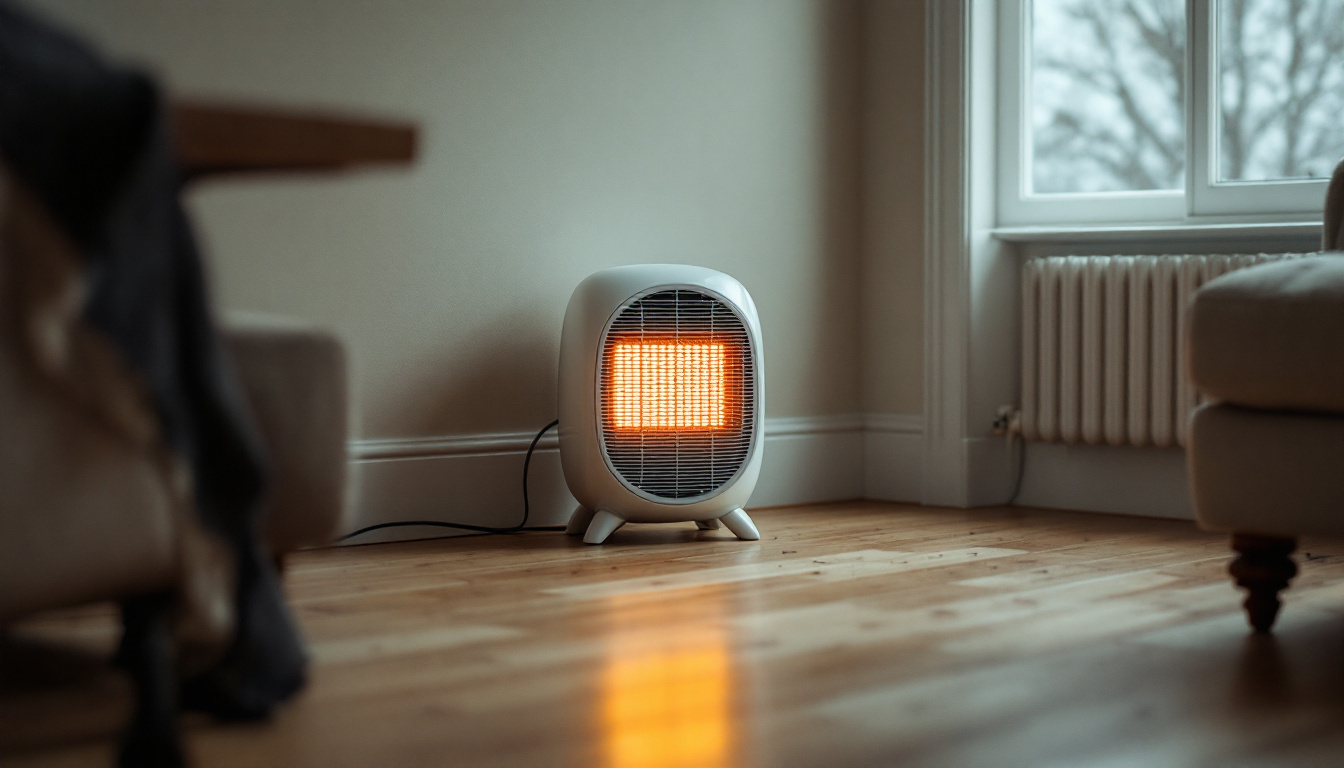
What does a space heater cost to run, and how risky is one? About 27.5 cents an hour for a 1,500 watt unit at the June 2026 US average electricity price. Federal agencies tie portable heaters to roughly 1,600 fires and 70 deaths a year.
Key Takeaways
- CPSC estimates portable heaters are involved in 1,600 fires, 70 deaths and 150 injuries a year, 2020 to 2022 (CPSC, January 2026).
- Portable heaters caused 3% of residential building heating fires but 41% of the fatal ones, 2017 to 2019 (US Fire Administration).
- US average residential electricity was 18.34 cents per kilowatthour in June 2026, against 17.47 a year earlier (EIA Electric Power Monthly, Table 5.6.A).
- Every 1,500 watt electric heater makes the same 5,118 Btu per hour, because EIA fixes 1 kilowatthour at 3,412 Btu (EIA units and calculators).
- DOE says a heat pump “can reduce your electricity use for heating by up to 75% compared to electric resistance heating” (DOE Energy Saver, archived copy), leaving a plug-in heater the costliest heat in most homes.
How many Btu does a 1,500 watt space heater actually produce?
About 5,118 Btu per hour. Electric resistance heating turns nearly all the electricity it draws into heat in the room, so the label wattage fixes the output. The same arithmetic applies to an electric fireplace, which is a resistance heater in a decorative case.
EIA sets 1 kilowatthour equal to 3,412 Btu, so 1,500 watts is 5,118 Btu per hour, our calculation rather than a federal statistic. How many homes rely on them is in our secondary heating data: 28 million households run about 46 million portable electric heaters.
Against a whole house that is small: a modest furnace delivers 40,000 to 80,000 Btu per hour. The same physics governs fixed resistance strips along a wall. At 120 volts, 1,500 watts draws 12.5 amps by our calculation, close to an ordinary branch circuit.
Does an infrared space heater put out more heat than a ceramic one?
No. Infrared, ceramic, oil-filled and quartz space heaters rated at 1,500 watts all produce the same 5,118 Btu per hour. The difference is where the heat goes, not how much.
Radiant heaters “emit infrared radiation that directly heats objects and people within their line of sight”, which DOE calls the more efficient choice for a brief stay in a room (DOE Energy Saver, archived copy). Oil-filled units store heat in a transfer fluid, which DOE says lets the unit cycle less.
What does a space heater cost to run per hour and per month?
At the June 2026 US average of 18.34 cents per kilowatthour, a 1,500 watt space heater costs 27.5 cents an hour, about $66 a month at eight hours a day and about $198 a month running continuously, by our calculation.
| State or area | Residential price, June 2026 (cents per kWh) | Cost per hour | Cost per month, 8 hours a day |
|---|---|---|---|
| Nevada (lowest state) | 13.11 | 19.7 cents | $47.20 |
| Texas | 15.94 | 23.9 cents | $57.38 |
| US average | 18.34 | 27.5 cents | $66.02 |
| New York | 29.49 | 44.2 cents | $106.16 |
| California | 34.74 | 52.1 cents | $125.06 |
| Hawaii (highest state) | 52.72 | 79.1 cents | $189.79 |
Prices: EIA Electric Power Monthly Table 5.6.A, June 2026. Costs are HVAC Brief calculations at 1.5 kilowatthours per hour and 240 hours a month.
The spread matters more than the average: the same heater costs four times as much in Hawaii as in Nevada, which is why we publish the full state by state price table. The seasonal fuel forecast for 2026 and 2027 is a better guide to a December bill.
When is one space heater cheaper than heating the whole house?
Only when it displaces several times its own output from a cheaper system. Electric resistance heat costs about $53.75 per million Btu delivered at June 2026 prices, by our calculation, and almost every central system beats it, as our comparison of what a million Btu costs by fuel shows.
| Heat source | Cost per million Btu delivered | Times the cheapest option shown |
|---|---|---|
| 1,500 W electric space heater | $53.75 | 4.0 |
| Gas furnace at 80% AFUE | $16.84 | 1.25 |
| Gas furnace at 95% AFUE | $14.18 | 1.06 |
| Heat pump, DOE best case | $13.44 | 1.00 |
All four are HVAC Brief calculations from EIA prices (electricity 18.34 cents per kWh, June 2026; natural gas $13.96 per Mcf, January 2026) and the factors of 3,412 Btu per kilowatthour and 1,036 Btu per cubic foot. The heat pump row uses DOE’s “up to 75%” case.
The rule is arithmetic. Against a 95% AFUE gas furnace, every Btu the heater adds must displace roughly 3.8 Btu of furnace output to break even, which is why a heat pump can exceed 100% efficiency and a resistance heater cannot.
DOE says turning the thermostat back 7 to 10 degrees Fahrenheit for 8 hours a day saves as much as 10% a year on heating and cooling (DOE Energy Saver, archived copy). A heater that buys that setback can pay; one beside an untouched thermostat is pure addition, the limit of what a thermostat does for you.
A house already on electric resistance heat has no cheaper Btu to displace, and a room cold from missing insulation or a duct fault is the case for fixing the envelope before sizing equipment.
What do the federal fire numbers say about space heaters?
They say portable heaters are rare as a fire cause and lethal as one. The US Fire Administration estimates they caused 3% of residential building heating fires from 2017 to 2019 but 41% of fatal heating fires.
USFA put portable heater fires at an estimated 1,100 a year across 2017 to 2019, with 65 deaths, 150 injuries and $51 million in property loss. CPSC, on a different data system, estimates 1,600 fires and 70 deaths a year across 2020 to 2022, so the two are not additive. USFA found the leading factor was a heat source too close to combustibles, and that these fires peaked in January, at 25%. NFPA, counting fixed and portable space heaters together, attributes 88% of all home heating fire deaths to them; our home heating fire statistics reconcile the two sources.
A heater beside bedding overnight is the scenario behind that fatality share, so switch it off before sleeping, a check for our pre-winter safety run through.
Can an electric space heater produce carbon monoxide?
No. An electric space heater burns nothing and emits no carbon monoxide. Every CO risk belongs to fuel-burning portable heaters running on propane, kerosene or natural gas, a separate category in federal data.
CPSC estimated 34 non-fire CO deaths from fuel-burning portable heaters in 2022, out of 274 tied to consumer products, 76 of them from heating systems. About 70% of the 43 deaths tied to LP gas systems involved unvented portable propane heaters.
Unvented combustion small space heaters “are not recommended for use inside your home because of the risk of carbon monoxide poisoning”, and most states have banned unvented kerosene heaters for home use (DOE Energy Saver, archived copy). Install a carbon monoxide detector, DOE says.
The three rules that carry the fatality data
In its January 2026 winter release, CPSC tells consumers to keep portable heaters at least three feet from drapes, furniture, bedding and other combustibles; to plug them directly into a wall outlet, never into an extension cord or power strip; and to turn heaters off when sleeping. DOE adds that any unavoidable cord should be 14 gauge wire or larger, with a tip-over safety switch on the unit.
What should you do instead of running a space heater all winter?
Treat a plug-in heater as a bridge, not a heating plan: an hour in a home office, a guest room used twice a month, a cold snap while a repair is booked.
About 37% of US households run a secondary heat source, almost half of those portable electric heaters, the most common choice in every climate region in EIA’s 2015 survey, part of the wider fuel and equipment mix of US homes.
Where one room is always cold, the durable fixes are structural: sealing, insulating, correcting ducts, or a ductless head. And auxiliary and emergency heat are resistance strips at the same $53.75 per million Btu.
How we researched this
Research date: September 18, 2026. Cited: EIA Electric Power Monthly Table 5.6.A (June 2026), EIA residential natural gas prices (January 2026), EIA units and calculators, EIA reporting on secondary heat, the CPSC news release of January 23, 2026, CPSC Non-Fire Carbon Monoxide Deaths (2022), two US Fire Administration reports and three archived DOE Energy Saver pages.
We skipped Reddit: our standard bars it for combustion, carbon monoxide, electrical and fire topics, and this article is all four.
Excluded: vendor and retailer running-cost calculators, contractor blog estimates, any cost figure without a published price and conversion factor, and NFPA estimates, widely quoted but paywalled. CPSC and USFA figures come from different collection systems, so we report them separately. Several DOE Energy Saver pages now 404, so we cite labelled archived copies.
Frequently asked questions
How much electricity does a space heater use per hour?
A 1,500 watt space heater uses 1.5 kilowatthours for every hour it runs. At EIA’s June 2026 US average residential price of 18.34 cents per kilowatthour, that is 27.5 cents an hour by our calculation, and a 750 watt setting halves it.
Is it cheaper to run a space heater or central heat?
Usually central heat, per unit of warmth. Electric resistance heat costs about $53.75 per million Btu delivered at June 2026 electricity prices, against about $14.18 for a 95% AFUE gas furnace at January 2026 gas prices, both HVAC Brief calculations from EIA data.
How many fires do space heaters cause each year?
CPSC estimates portable heaters are involved in an average of 1,600 fires a year, with 70 deaths and 150 injuries, from 2020 to 2022. The US Fire Administration separately estimated 1,100 portable heater fires a year across 2017 to 2019. Different data systems, so do not add them.
Do electric space heaters give off carbon monoxide?
No. Electric heaters burn no fuel and produce no carbon monoxide. The risk belongs to fuel-burning portable heaters. CPSC estimated 34 non-fire CO deaths from portable heaters in 2022, and about 70% of the 43 deaths tied to LP gas heating systems involved unvented portable propane heaters.
Can you plug a space heater into an extension cord?
CPSC says to plug electric space heaters directly into a wall outlet and never into an extension cord or power strip. A 1,500 watt heater draws 12.5 amps at 120 volts by our calculation, near the limit of a branch circuit. Any unavoidable cord should be 14 gauge wire or larger, DOE says.
Are unvented propane or kerosene space heaters legal indoors?
It depends where you live. DOE states that unvented combustion space heaters are not recommended inside a home because of carbon monoxide risk, that most states have banned unvented kerosene heaters for home use, and that California and some cities have banned unvented natural gas heaters indoors.
Sources
- U.S. Energy Information Administration. “Electric Power Monthly, Table 5.6.A.” https://www.eia.gov/electricity/monthly/epm_table_grapher.php?t=epmt_5_6_a. Accessed September 2026.
- U.S. Energy Information Administration. “Units and calculators explained.” https://www.eia.gov/energyexplained/units-and-calculators/. Accessed September 2026.
- U.S. Energy Information Administration. “U.S. Price of Natural Gas Delivered to Residential Consumers.” https://www.eia.gov/dnav/ng/hist/n3010us3m.htm. Accessed September 2026.
- U.S. Energy Information Administration. “U.S. households’ heating equipment choices are diverse and vary by climate region.” https://www.eia.gov/todayinenergy/detail.php?id=30672. Accessed September 2026.
- U.S. Consumer Product Safety Commission. “Keep Warm and Safe This Winter.” https://www.cpsc.gov/Newsroom/News-Releases/2026/Keep-Warm-and-Safe-This-Winter-Tips-for-Using-Generators-Furnaces-and-Space-Heaters. Accessed September 2026.
- U.S. Consumer Product Safety Commission. “Non-Fire Carbon Monoxide Deaths Associated with Consumer Products, 2022.” https://www.cpsc.gov/s3fs-public/Non-Fire-Carbon-Monoxide-Deaths-Associated-with-the-Use-of-Consumer-Products-2022-Annual-Estimates.pdf. Accessed September 2026.
- U.S. Fire Administration. “Portable Heater Fires in Residential Buildings (2017-2019).” https://www.usfa.fema.gov/statistics/reports/fire-causes/portable-heater-fires-residential-buildings-v21i11.html. Accessed September 2026.
- U.S. Fire Administration. “Residential building heating fire trends (2014-2023).” https://www.usfa.fema.gov/statistics/residential-fires/heating.html. Accessed September 2026.
- U.S. Department of Energy, Energy Saver. “Small Space Heaters.” Archived copy. https://web.archive.org/web/2025id_/https://www.energy.gov/energysaver/portable-heaters. Accessed September 2026.
- U.S. Department of Energy, Energy Saver. “Thermostats.” Archived copy. https://web.archive.org/web/2025id_/https://www.energy.gov/energysaver/thermostats. Accessed September 2026.
- U.S. Department of Energy, Energy Saver. “Heat Pump Systems.” Archived copy. https://web.archive.org/web/2025id_/https://www.energy.gov/energysaver/heat-pump-systems. Accessed September 2026.
Leave a Reply