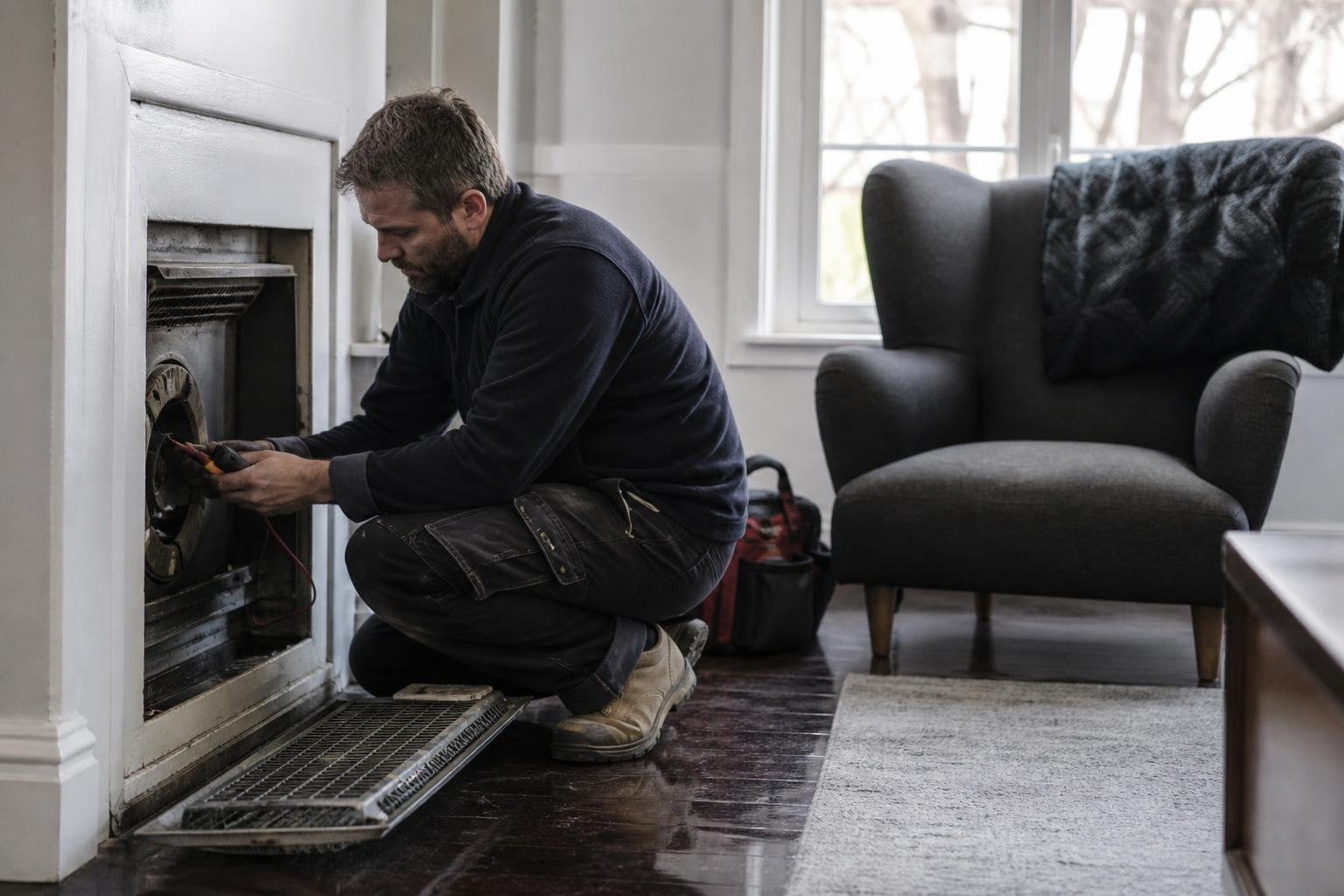
What is a wall heater? A wall heater is one of two different appliances: an electric fan-forced heater recessed into the wall, or a vented gas wall furnace. They fail differently. Electric units can overheat and start fires; gas units can leak carbon monoxide when venting or combustion goes wrong.
Key Takeaways
- Gas wall furnaces made since April 16, 2013 need 65% to 76% AFUE under 10 CFR 430.32(i).
- A 1,500 watt electric wall heater costs about $0.27 an hour at EIA’s July 2026 US residential price of 18.31 cents per kWh (our arithmetic).
- More than 1.9 million Cadet and Encore in-wall heaters were recalled in 2000, per CPSC.
- Wall and floor furnaces averaged 2 non-fire CO deaths a year in 2020 to 2022, per CPSC estimates.
- Built-in gas room heaters were the main heat in 2.77 million US homes in 2020, per EIA RECS.
- Keep anything that can burn at least 3 feet from heat sources, says USFA.
What are the two kinds of wall heater?
The two kinds are the electric wall heater, a resistance element and usually a small fan in a box set into the wall, and the gas wall furnace, a burner and heat exchanger that vents exhaust outdoors. Federal rules treat them as separate products, and they fail in different ways.
| Feature | Electric in-wall heater | Gas wall furnace |
|---|---|---|
| Heat source | Resistance element, usually fan-forced | Natural gas or propane burner |
| Venting | None | Through the wall, or a vertical vent |
| Federal efficiency standard | None | 65% to 76% AFUE, by type and size |
| Main hazard | Overheating and fire | Carbon monoxide |
| Common faults | Element, fan motor, limit switch, thermostat | Pilot, thermocouple, vent, burner |
Plug-in units are in our guide to portable space heater costs and safety, and strip units under windows in our electric baseboard heater explainer.
How does an electric wall heater work, and what does it cost to run?
An electric wall heater passes current through a resistance element and a small fan blows room air across it. Running cost is wattage times your electricity rate: at the July 2026 US average, a 1,500 watt unit costs about $0.27 per hour.
DOE’s Energy Saver guide (archived copy) describes “an electric element with a reflector behind it” and “usually a fan to move air through the heater,” and calls resistance heating “100% energy efficient” at the point of use. Units run on 120 volt or 240 volt circuits.
The table is our arithmetic: wattage times EIA’s preliminary July 2026 US residential price of 18.31 cents per kWh.
| Nameplate rating | Energy per hour | Cost per hour |
|---|---|---|
| 1,000 watts | 1.0 kWh | $0.18 |
| 1,500 watts | 1.5 kWh | $0.27 |
| 2,000 watts | 2.0 kWh | $0.37 |
| 3,000 watts | 3.0 kWh | $0.55 |
| 4,000 watts | 4.0 kWh | $0.73 |
A 1,500 watt heater running 8 hours a day for 30 days uses 360 kWh, about $65.92. The thermostat cycles the element, so real run time is usually shorter.
How does a gas wall furnace work?
A gas wall furnace burns natural gas or propane in a wall-mounted heat exchanger and moves warm air by gravity or a fan. Exhaust leaves through the wall or up a vertical vent.
A direct vent, or sealed combustion, model takes combustion air from outdoors. DOE’s Energy Saver page on small space heaters (archived copy) says sealed combustion heaters “are much safer to operate” and “less likely to backdraft,” while cheaper units “use the room air for combustion.” Many older gravity units also keep a standing pilot. A thermocouple in the pilot flame holds the gas valve open; CPSC lab staff explained in 2005 that when it stops being heated, “the thermocouple then cools, causing the gas valve to close.”
What efficiency does federal law require of a gas wall heater?
A gas wall heater made on or after April 16, 2013 must reach 65% to 76% AFUE, depending on whether it is a fan type or gravity type and on its input rating, under 10 CFR 430.32(i). Electric heaters have no such standard.
| DOE product class | Made 1990 to April 15, 2013 | Made from April 16, 2013 |
|---|---|---|
| Gas wall fan type, up to 42,000 Btu/h | 73% | 75% |
| Gas wall fan type, over 42,000 Btu/h | 74% | 76% |
| Gas wall gravity type, up to 27,000 Btu/h | 59% to 63% | 65% |
| Gas wall gravity type, over 27,000 to 46,000 Btu/h | 64% | 66% |
| Gas wall gravity type, over 46,000 Btu/h | 65% | 67% |
A large gravity unit can comply at 67%, against 76% for a large fan type. For the fuel side of the cost comparison, see our state natural gas price tracker.
How safe is a wall heater?
Each type has a documented failure record: electric in-wall units have faced large fire-hazard recalls, and gas wall furnaces carry a carbon monoxide risk.
In February 2000, CPSC and Cadet recalled more than 1.9 million Cadet and Encore in-wall heaters after more than 320 reports; “flames, sparks or molten particles can spew through the front grill cover.” By November 2002, a CPSC reminder said the incidents had allegedly caused four deaths and damage claims exceeding $4.3 million. In September 2024, about 12,900 Cadet Apex72 wall heaters rated 1,200 to 1,600 watts were recalled because the fan could fail and let the unit “overheat and ignite internally.”
For gas units, CPSC’s 2022 estimates attribute 76 of 274 non-fire CO deaths that year to heating systems, and an average of 2 a year in 2020 to 2022 to wall and floor furnaces. A 2015 CPSC staff letter to the ANSI Z21.86 committee named the usual causes: disconnected vents, partially blocked vents, over-fired appliances and inadequate combustion air. Sealed units can fail too: Rinnai recalled about 52,000 direct vent wall furnaces in 2008 over a gasket that could fail and leak CO. See our guide to where to mount a CO alarm.
Clearance rule
Keep furniture, curtains and bedding off the grille. USFA’s rule is to keep anything that can burn at least 3 feet from all heat sources; your installation manual’s clearances govern that model. CPSC advises a yearly professional inspection of all fuel-burning heating systems and vents.
Why does a wall heater run constantly or smell of burning?
A wall heater that never shuts off usually has a thermostat or control fault; a persistent burning smell can mean overheating. Continuous running was the defect in one federal recall.
In April 2002, Cadet recalled about 19,000 RM and ZM in-wall heaters with “the potential for continuous heater operation, regardless of thermostat settings or room temperature,” and told owners to switch them off at the breaker. DOE notes that built-in line voltage thermostats “often don’t sense the room temperature accurately”; our explainer on how thermostats sense and switch covers why. Lasting smell, smoke or sparks means shut it off. On a gas unit, if a CO alarm sounds, leave first and call 911 or the gas utility from outside.
What fails on each type of wall heater?
On an electric wall heater, the usual failures are the element, fan motor, limit switch and thermostat. On a gas wall furnace, they are the pilot and thermocouple on standing-pilot models, the vent and the burner.
- Check supply first: breaker, gas valve, pilot. A breaker that trips again points to a fault, as our guide to a breaker that keeps tripping explains.
- Electric, fan runs but no heat: suspect the element or limit switch.
- Electric, heat but no fan: stop using it.
- Gas, pilot will not stay lit: suspect the thermocouple or pilot assembly.
- Gas, soot around the grille or vent: shut it off. CPSC’s CO report describes vents “blocked by soot caused by inefficient combustion.” Our gas fireplace venting explainer covers the same logic.
When should you replace a wall heater with something else?
Replace a wall heater when it is recalled, when a gas unit shows venting or CO problems, or when the room also needs cooling; a ductless heat pump head then heats and cools from one wall unit.
Recalled Cadet and Encore models carry the letters FW, FX, LX, TK, ZA, Z, RA, RK, RLX, RX, RW or ZC. Gas units remain common: EIA does not count wall furnaces separately, but built-in gas room heaters were the main heat in 2.77 million US homes in 2020, per RECS Table HC6.1.
A mini split needs a line set and an outdoor unit; see how a ductless head works and our federal mini split cost data.
For cooling only, see our through-the-wall AC guide; for ducted electric heat, our electric furnace explainer.
How we researched this
Research date: October 5, 2026. We opened 19 documents and cite the 15 below: eCFR (September 1, 2026 edition), EIA tables, CPSC recalls and CO reports, archived DOE Energy Saver pages and USFA guidance. We excluded installed prices (no federal series), manufacturer claims, contractor blogs and an NFPA page that returned no readable text. This is a fire and carbon monoxide safety topic, so we skipped Reddit entirely. Running costs are our arithmetic.
Frequently asked questions
How much does it cost to run an electric wall heater?
Multiply wattage by your electricity rate. At EIA’s July 2026 US residential average of 18.31 cents per kWh, a 1,500 watt wall heater costs about $0.27 per hour of full output and a 4,000 watt unit about $0.73, by our arithmetic.
Is my Cadet wall heater part of a recall?
CPSC’s February 2000 recall covered more than 1.9 million Cadet and Encore in-wall heaters, models FW, FX, LX, TK, ZA, Z, RA, RK, RLX, RX, RW and ZC. A separate 2024 recall covered about 12,900 Cadet Apex72 high wall units. CPSC told owners of the 2000 units to have them replaced.
What efficiency must a gas wall furnace meet?
It depends on type and size. Under 10 CFR 430.32(i), a gas wall fan type furnace made on or after April 16, 2013 must reach 75% AFUE up to 42,000 Btu/h and 76% above that. Gravity types need 65% to 67%. Electric wall heaters have no federal efficiency standard.
Do I need a carbon monoxide alarm with a wall heater?
With a gas wall furnace, yes. An electric unit burns no fuel, but a gas unit can leak CO if a vent fails. CPSC estimates wall and floor furnaces averaged 2 CO deaths a year in 2020 to 2022, and advises CO alarms “on every level of the home and outside sleeping areas.”
How far should furniture be from a wall heater?
Follow the clearances in your heater’s installation manual first. As a general rule, the US Fire Administration says to keep anything that can burn at least 3 feet from all heat sources. Keep curtains, bedding and furniture well clear of the grille.
Why does my wall heater keep running when the room is warm?
A stuck thermostat or control fault is the usual cause. In April 2002, Cadet recalled about 19,000 RM and ZM in-wall heaters that could run continuously regardless of thermostat settings and overheat nearby combustibles. Turn the heater off at the breaker and have it checked.
Sources
- eCFR. “10 CFR 430.32(i), Direct heating equipment.” https://www.ecfr.gov/current/title-10/chapter-II/subchapter-D/part-430/subpart-C/section-430.32. Accessed October 2026.
- EIA. “Electric Power Monthly, Table 5.6.A.” https://www.eia.gov/electricity/monthly/epm_table_grapher.php?t=epmt_5_6_a. Accessed October 2026.
- EIA. “RECS 2020, Table HC6.1.” https://www.eia.gov/consumption/residential/data/2020/hc/pdf/HC%206.1.pdf. Accessed October 2026.
- CPSC. “CPSC, Cadet Recall In-Wall Heaters; Settle Lawsuit.” https://www.cpsc.gov/Recalls/2000/cpsc-cadet-recall-in-wall-heaters-settle-lawsuit. Accessed October 2026.
- CPSC. “CPSC Reminds Consumers to Check for Recalled Cadet In-Wall Heaters.” https://www.cpsc.gov/Newsroom/News-Releases/2003/CPSC-Reminds-Consumers-to-Check-for-Recalled-Cadet-In-Wall-Heaters. Accessed October 2026.
- CPSC. “Cadet Manufacturing Co. Recall of In-Wall Electric Heaters.” https://www.cpsc.gov/Recalls/2002/cadet-manufacturing-co-recall-of-in-wall-electric-heaters. Accessed October 2026.
- CPSC. “Glen Dimplex Americas Recalls Cadet Apex72 Electric Heaters.” https://www.cpsc.gov/Recalls/2024/Glen-Dimplex-Americas-Recalls-Cadet-Apex72-Electric-Heaters-Due-to-Fire-Hazard. Accessed October 2026.
- CPSC. “Rinnai Recalls Wall Furnaces Due to Carbon Monoxide Hazard.” https://www.cpsc.gov/Recalls/2008/rinnai-recalls-wall-furnaces-due-to-carbon-monoxide-hazard. Accessed October 2026.
- CPSC. “Non-Fire Carbon Monoxide Deaths, 2022 Annual Estimates.” https://www.cpsc.gov/s3fs-public/Non-Fire-Carbon-Monoxide-Deaths-Associated-with-the-Use-of-Consumer-Products-2022-Annual-Estimates.pdf. Accessed October 2026.
- CPSC staff. “ANSI Z21.86 CO shutoff proposal letter,” 2015. https://www.cpsc.gov/s3fs-public/pdfs/blk_pdf_UpdatedCOShutoffProposal2014ANSIZ2186coverletter6bcleared.pdf. Accessed October 2026.
- CPSC. “Technical Feasibility of a CO Shutdown System for Tank-Top Heaters.” https://www.cpsc.gov/s3fs-public/tanktop.pdf. Accessed October 2026.
- CPSC. “There’s a Chill in the Air.” https://www.cpsc.gov/Newsroom/News-Releases/2025/Theres-a-Chill-in-the-Air-Stay-Warm-Safely-Be-Cautious-When-Using-Generators-Furnaces-and-Space-Heaters. Accessed October 2026.
- DOE Energy Saver. “Electric Resistance Heating” (archived copy). https://web.archive.org/web/2025id_/https://www.energy.gov/energysaver/electric-resistance-heating. Accessed October 2026.
- DOE Energy Saver. “Small Space Heaters” (archived copy). https://web.archive.org/web/2025id_/https://www.energy.gov/energysaver/small-space-heaters. Accessed October 2026.
- USFA. “Heating fire safety.” https://www.usfa.fema.gov/prevention/home-fires/prevent-fires/heating/. Accessed October 2026.
Leave a Reply