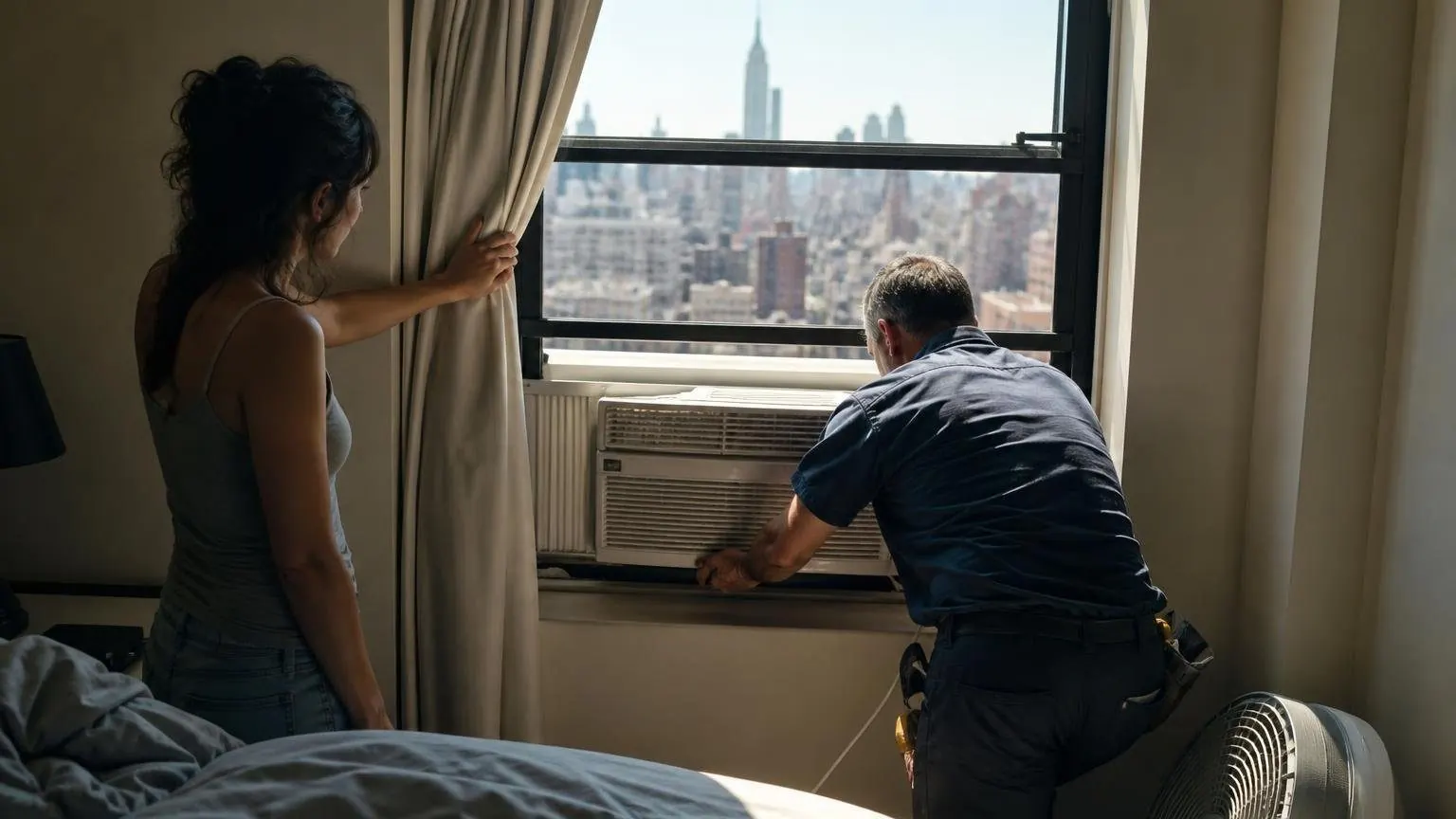
What are landlord air conditioning laws? Landlord air conditioning laws are mostly local. Maryland now requires 80°F cooling in many apartment buildings, cities such as Phoenix and Dallas set indoor maximums, and most states only require landlords to repair AC they supply.
Key Takeaways
- Maryland: from June 1, 2026, covered units in buildings with 10 or more units need AC that holds 80°F or less from June 1 to September 30 (Real Property § 8-122).
- New York City: Local Law 23 of 2026 requires cooling to 78°F in bedrooms tenants opt in, enforced from June 1, 2030 (Admin. Code § 27-2030).
- Phoenix: installed air conditioning must cool rentals to 82°F, evaporative coolers to 86°F (City Code 39-5).
- Dallas: every rental needs refrigerated air holding each room 15°F below outdoors, never above 85°F (Dallas Code Compliance).
- Oregon: units in buildings permitted on or after April 1, 2024 need cooling in at least one room (ORS 90.320).
- Texas: the Property Code’s repair duty does not name air conditioning; it covers conditions that materially affect health or safety (Property Code § 92.052).
Do landlords have to provide air conditioning?
Usually not, unless a state or local code says so. Among the statutes we read, only Maryland and Oregon require landlords to provide cooling in some rentals, and both rules are narrow. Phoenix, Tempe, Dallas and Montgomery County, Maryland set their own standards, and New York City’s begins in 2030.
Everywhere else, the usual duty is to keep equipment you supply in working order. Arizona’s statute covers cooling only “where such units are installed and offered.” Renters face this split more than owners, as our analysis of renter and owner equipment in federal data shows, and AC ownership varies widely by state, per our state-by-state AC and heat pump figures.
This is not legal advice. Codes change, and a city can be stricter than its state. Check your local code or housing agency before acting.
Landlord air conditioning laws by state and city: the verified table
Every row was read in October 2026 from code text, an enacted bill or the enforcing agency’s own page. Where a source states no value, the cell says so.
| Jurisdiction | Who is covered | Requirement | Maximum indoor temp | Season or start | Citation |
|---|---|---|---|---|---|
| Maryland (statewide) | Apartment buildings with 10 or more units: new units, units with AC on or after Jan. 1, 2025, and some renovations | Provide AC | 80°F, 3 feet above the floor | June 1 to Sept. 30; in force June 1, 2026 (renovations Oct. 1, 2026) | Real Prop. § 8-122 (Ch. 664, 2026) |
| Montgomery County, MD | Rental housing except detached single-family homes and National Register sites | Maintain or provide AC capable of the limit | 80°F, 3 feet above the floor | June 1 to Sept. 30; since June 1, 2020 | County Code § 26-7(f), Bill 24-19 |
| New York City | Tenant units in multiple dwellings and rented 1- or 2-family homes | Cooling in each bedroom the tenant opts in | 78°F, 3 feet up and 3 feet from exterior walls | June 15 to Sept. 15; enforced from June 1, 2030 | Admin. Code § 27-2030 (Local Law 23 of 2026) |
| Phoenix | Rentals where cooling is installed | Cool all habitable rooms and bathrooms | 82°F air conditioning; 86°F evaporative | None stated | City Code 39-5 B.1.b |
| Tempe | Every rental unit | Cooling under the tenant’s control | 82°F air conditioning; 88°F evaporative | None stated | City Code § 21-34(c) |
| Dallas | All rental properties | Refrigerated air, 15°F below outdoors | 85°F; above 110°F outside, one room at 85°F | None stated | City Code Chapter 27 |
| Oregon (statewide) | Buildings permitted on or after April 1, 2024 | Cooling in at least one room, not a bathroom | Not stated | Not stated | ORS 90.320(1)(n) |
| Arizona (statewide) | Units where cooling is installed and offered | Supply reasonable cooling when weather requires | Not stated | Seasonal weather | ARS 33-1324(A)(6), 33-1364 |
| Texas (statewide) | All residential leases | Repair conditions that materially affect health or safety; no AC mandate | Not stated | Not stated | Property Code §§ 92.052, 92.056 |
The Phoenix row comes from the city’s cooling ordinance flyer, which reprints the code text; Tempe’s from an archived copy of the city’s code page. Montgomery County’s text is the enacted Bill 24-19.
What temperature must a landlord’s air conditioning reach?
Between 78°F and 85°F for refrigerated air in the codes we read. New York City is strictest at 78°F, Maryland and Montgomery County use 80°F, Phoenix and Tempe 82°F, and Dallas 85°F. Evaporative coolers get more room: 86°F in Phoenix and 88°F in Tempe.
Most codes measure 3 feet above the floor, and Phoenix and Tempe add the center of the room. A reading taken by a sunny window will not match an inspector’s, a point our guide to where thermostats belong also makes. Desert renters with a swamp cooler should read our explainer on where evaporative coolers work and fail.
What changes with the 2026 landlord air conditioning laws?
Two big jurisdictions changed their rules this year. Maryland’s law took effect June 1, 2026, and New York City’s was enacted in January 2026 with a 2030 start. Both cap indoor temperature rather than naming equipment.
Maryland’s law, approved May 26, 2026, covers apartment buildings with 10 or more units. It applies to new units and to units that had landlord-supplied AC, or a lease promising it, on or after January 1, 2025; renovations replacing electrical or heating systems join on October 1, 2026. Buildings on the National Register of Historic Places are exempt. The law says it supersedes inconsistent local rules, so Montgomery County renters should ask the county which standard now applies.
New York City’s law was passed December 18, 2025 and returned unsigned by the mayor on January 20, 2026. Tenants can opt in from March 1, 2028, the duty starts June 1, 2030, and NYCHA may comply through a cooling plan instead.
Two claims to retire
Some coverage says New York City’s 78°F rule applies only when it is 82°F or hotter outside. The enacted text of § 27-2030 contains no outdoor trigger. Several landlord blogs also say Arizona requires AC statewide; ARS 33-1324 covers cooling only where units are installed and offered.
Arizona’s SB 1608, introduced in the 2026 session, proposed capping every rental room at 82°F. It remained a proposal: the current ARS 33-1324 text, read October 28, 2026, does not include that language.
What if the landlord’s air conditioning breaks?
Give written notice first; remedies depend on state law. In Arizona, a tenant facing a health and safety breach can give notice ending the lease in 5 days if it is not fixed; Texas presumes 7 days is a reasonable repair time.
In Arizona, if a landlord deliberately or negligently fails to supply cooling where units are installed and offered, the fit-premises statute and ARS 33-1364 let a tenant, after notice, buy the service and deduct the cost, recover reduced rental value, or move to substitute housing. In Texas, the tenant must be current on rent, and the condition must materially affect an ordinary tenant’s health or safety.
Before calling anyone, run the owner checks for an AC that will not start; a tripped breaker or thermostat setting is not a code violation. Then work through these steps.
- Notify the landlord in writing, with dates and indoor temperatures.
- Measure as your code does: 3 feet above the floor, center of the room.
- Call the city: Phoenix’s Landlord and Tenant Program takes complaints at 602-262-7210.
- Ask legal aid before withholding rent or repairing and deducting.
Heat is a health issue, not only comfort; our review of heat-related deaths and air conditioning covers the mortality data. Our guide to which HVAC failures are emergencies helps sort urgent calls.
Can a landlord ban a window or portable air conditioner?
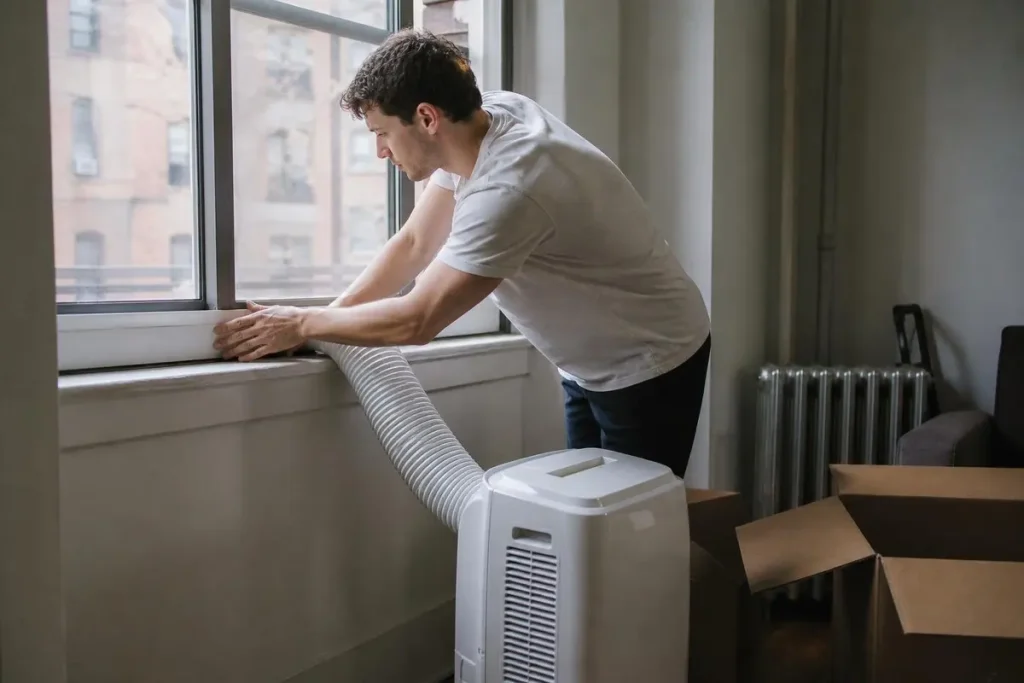
In Oregon, only for listed reasons. ORS 90.355 bars landlords from prohibiting a tenant’s portable cooling device unless it would break codes or safety guidelines, damage the unit, exceed electrical capacity, or block a required egress window.
Oregon landlords may require installation by their own staff and removal from October 1 through April 30, and restrictions must be in writing. Elsewhere, the lease usually governs.
A safe window install needs support and drainage, as our window AC installation guide explains. Single-hose portables trade capacity for convenience, per our portable versus window comparison.
Winter rules sit in separate code sections; our landlord heat requirements table covers them.
How we researched this
Research date: October 28, 2026. We opened 18 sources and cite 12: enacted law or code text for Maryland, Montgomery County, New York City, Oregon, Arizona and Texas, and agency pages for Phoenix, Tempe and Dallas. Tempe and Oregon text came from archived copies because the live sites refused automated reads. We dropped Houston and Austin because we could not open either city’s code text, and we read landlord blogs for SERP context only. Reddit was skipped for this legal topic.
Frequently asked questions
What states require landlords to provide air conditioning?
Of the state laws we read, Maryland and Oregon. Maryland requires AC holding 80°F in covered units of buildings with 10 or more units from June 1, 2026. Oregon requires cooling in one room for buildings permitted on or after April 1, 2024. Other states, including Arizona and Texas, mainly regulate repairs.
How long can a landlord leave you without air conditioning in Arizona?
Arizona sets no repair deadline for AC itself. Under ARS 33-1361, a tenant facing a breach that materially affects health and safety can give written notice that the lease ends in 5 days unless it is fixed. ARS 33-1364 adds remedies when cooling that was installed and offered is not supplied.
Can you withhold rent if the AC isn’t working?
Withholding is risky and depends on state law. Texas Property Code § 92.056 lists ending the lease, repair and deduct, and court remedies, but only if the tenant was current on rent when giving notice. Arizona allows deducting the cost of substitute service after notice. Ask legal aid before you hold back rent.
What can I do if my landlord in Texas won’t fix my AC?
Send notice to where you pay rent, then a second written notice, or send the first by certified mail. Under § 92.056, Texas presumes 7 days is a reasonable repair time. Repair and deduct for cooling also needs written notice from a local official under § 92.0561. In Dallas, rooms must stay at or below 85°F.
Does New York City require landlords to provide air conditioning?
Not yet. Local Law 23 of 2026 requires cooling to 78°F in bedrooms tenants opt in, from June 1, 2030, during the June 15 to September 15 season. Tenants can begin opting in on March 1, 2028. The Council passed it on December 18, 2025, and it became law without the mayor’s signature.
Is air conditioning required in Phoenix rentals?
Where cooling is installed, yes. Phoenix City Code 39-5 requires it to cool habitable rooms and bathrooms to 82°F with air conditioning or 86°F with an evaporative cooler, measured 3 feet above the floor in the center of the room. Tempe goes further and requires cooling in every rental.
Sources
- Maryland General Assembly. “Chapter 664 (Senate Bill 12), 2026 Laws of Maryland.” https://mgaleg.maryland.gov/2026RS/Chapters_noln/CH_664_sb0012e.pdf. Accessed October 2026.
- Montgomery County Council. “Bill 24-19, Obligations of Landlord, Air Conditioning.” https://mgaleg.maryland.gov/pubs/LegisLegal/County-Legislation/2021-Montgomery-County-24-19.pdf. Accessed October 2026.
- City of New York. “Local Law 23 of 2026.” https://www.nyc.gov/assets/buildings/local_laws/ll23of2026.pdf. Accessed October 2026.
- City of Phoenix. “Cooling Ordinance, Phoenix City Code Chapter 39-5.” https://www.phoenix.gov/heatsite/Documents/6-3-22%20Cooling%20Ordinance%20Flyer%20English%20and%20Spanish_-combined.pdf. Accessed October 2026.
- City of Tempe. “Thermal Environment, Sec. 21-34” (archived copy). https://web.archive.org/web/20251219222140/https://www.tempe.gov/government/community-development/code-compliance-open-m-i-n-d/landlords-and-renters/violations/owner-tenant-building-requirements/thermal-environment. Accessed October 2026.
- City of Dallas Code Compliance. “Frequently Asked Questions.” https://dallascityhall.com/departments/codecompliance/PublishingImages/Pages/Help-Page-SFRP/Frequently%20Asked%20Questions%20-%20Copy.pdf. Accessed October 2026.
- Oregon Legislature. “ORS Chapter 90” (archived copy). https://web.archive.org/web/20261004190738/https://www.oregonlegislature.gov/bills_laws/ors/ors090.html. Accessed October 2026.
- Arizona Legislature. “ARS 33-1324.” https://www.azleg.gov/ars/33/01324.htm. Accessed October 2026.
- Arizona Legislature. “ARS 33-1361.” https://www.azleg.gov/ars/33/01361.htm. Accessed October 2026.
- Arizona Legislature. “ARS 33-1364.” https://www.azleg.gov/ars/33/01364.htm. Accessed October 2026.
- Arizona Legislature. “SB 1608, 2026, introduced version.” https://www.azleg.gov/legtext/57leg/2R/bills/SB1608P.htm. Accessed October 2026.
- Texas Legislature. “Property Code Chapter 92.” https://tcss.legis.texas.gov/resources/PR/htm/PR.92.htm. Accessed October 2026.
Leave a Reply