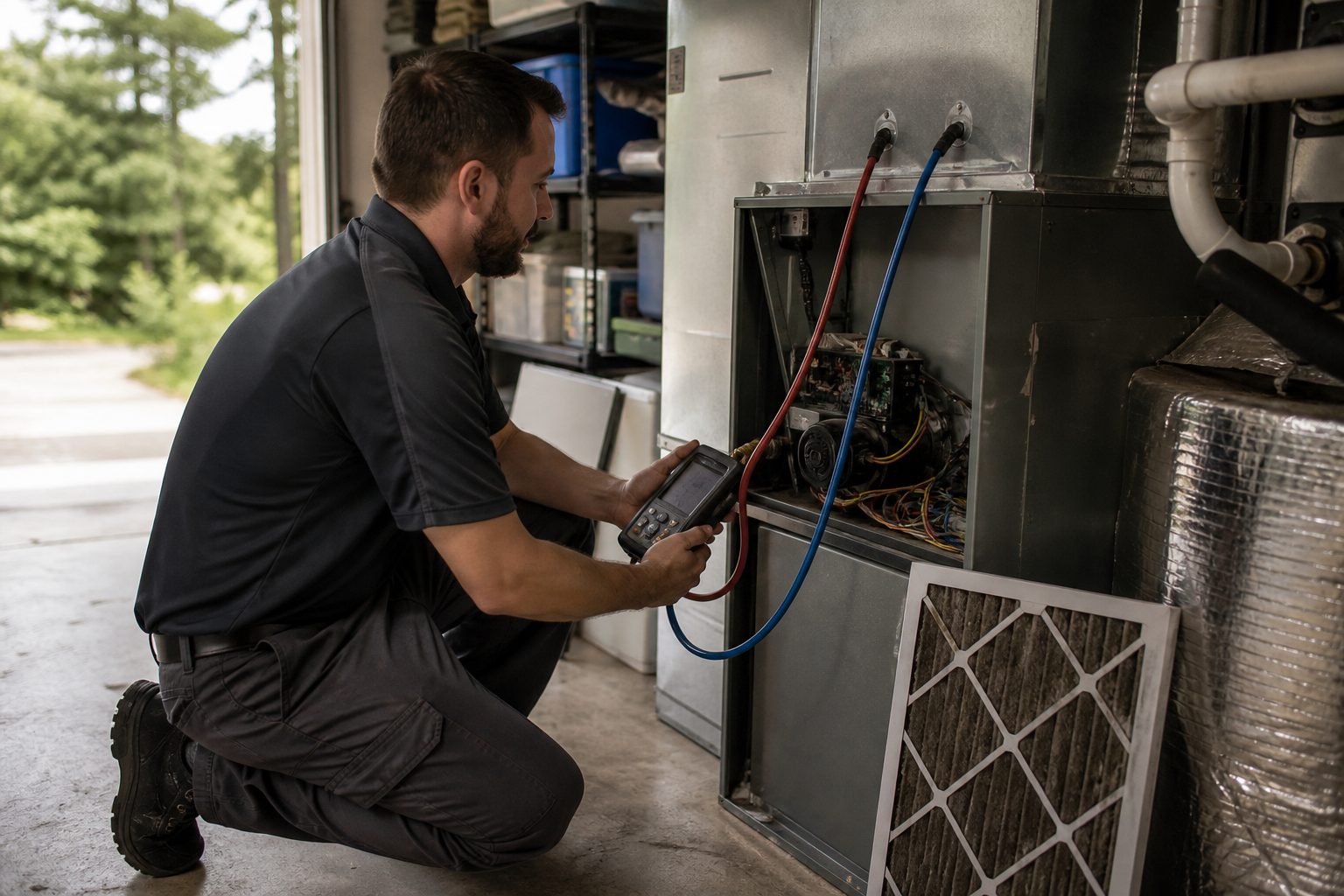
How much cfm per ton does an air conditioner need? Roughly 400 cfm per ton of cooling. That is the airflow the federal test procedure assumes when no other value is certified, and humid climates are often set nearer 350 to remove more moisture.
Key Takeaways
- One ton of cooling is 12,000 Btu/h, a rate ASHRAE Terminology ties to melting 2,000 lb of ice in a day.
- Section 3.1.4.1.1 of 10 CFR part 430, appendix M tells the lab to use “400 scfm per 12,000 Btu/h” when no airflow rate is certified.
- ENERGY STAR publishes no cfm per ton figure. Its 2025 commissioning checklist requires measured fan airflow within “± 15% of design HVAC fan airflow.”
- A 2019 DOE Building Technologies Office presentation measured a sensible heat ratio of 0.62 at 245 cfm per ton, against “typical SHR of 80%.”
- The 350 to 450 cfm per ton band is trade convention from manufacturer blower data, not a federal rule.
What is a ton of cooling, and where does 12,000 Btu/h come from?
A ton of cooling is a rate of heat removal equal to 12,000 Btu/h. ASHRAE Terminology defines a ton of refrigeration as a “time rate of cooling equal to 12,000 Btu/h (approximately 3517 W),” roughly the heat absorbed melting a short ton of ice over 24 hours. The unit survives from the ice trade, and nothing in it describes air, weight or watts.
Every residential airflow rule is written per ton. A three ton condenser is nominally 36,000 Btu/h, but whether it delivers that depends on how much indoor air crosses the evaporator coil. Sizing equipment and sizing air are separate jobs; choosing capacity from a load calculation covers the first.
Where does the 400 cfm per ton rule come from?
From the federal rating lab, not from a building code. Section 3.1.4.1.1 of appendix M to subpart B of 10 CFR part 430 tells the test lab to use the manufacturer’s certified cooling full-load air volume rate, and adds: “If there is no certified Cooling full-load air volume rate, use a value equal to the certified cooling capacity of the unit times 400 scfm per 12,000 Btu/h.”
The rule is a fallback, which is why a technician’s first move is the blower table in the installation manual. It still carries weight: a rated SEER2 belongs to the unit tested at that airflow, so a system far off it is not the machine on the label. That links duct work to the efficiency floors federal standards enforce.
Tons, Btu/h and cfm per ton: the conversion table
Multiply tons by 12,000 for Btu/h, then by the airflow target for cfm. At 400 cfm per ton a three ton system wants 1,200 cfm.
| Nominal tons | Btu/h | 350 cfm per ton | 400 cfm per ton | 450 cfm per ton |
|---|---|---|---|---|
| 2.0 | 24,000 | 700 cfm | 800 cfm | 900 cfm |
| 2.5 | 30,000 | 875 cfm | 1,000 cfm | 1,125 cfm |
| 3.0 | 36,000 | 1,050 cfm | 1,200 cfm | 1,350 cfm |
| 4.0 | 48,000 | 1,400 cfm | 1,600 cfm | 1,800 cfm |
| 5.0 | 60,000 | 1,750 cfm | 2,000 cfm | 2,250 cfm |
Airflow columns are arithmetic, not a published federal table.
What 400 cfm per ton is not
It is not a code requirement and not an ENERGY STAR threshold. Federal documents set a lab default, or require installed airflow to match design airflow within a tolerance. Anyone quoting 400 cfm per ton as “the code” is quoting a convention.
Is 350 cfm per ton better in a humid climate?
Often, yes. Slowing the air drops the coil surface temperature and shifts its work from cooling toward wringing out water. A 2019 DOE Building Technologies Office peer review by Home Innovation Research Labs measured it in test homes in Houston and Savannah.
Running a dehumidification mode “at 70% of system airflow (245 CFM/ton),” the team calculated a sensible heat ratio of “62% (0.62) representing a significant increase in latent capacity compared to typical SHR of 80% in normal AC mode.” At 0.62, 38 percent of the coil’s work went into moisture. The same slide records the limit: “A 60% airflow was evaluated and deemed too marginal for consistent reliable operation.”
That document names 350 cfm per ton and “typical 400 CFM/ton” as industry reference points. It does not create a federal 350 requirement, and we found no rule that does. The 350 to 450 band lives in manufacturer blower tables and ACCA design literature, so we report it as convention. If a house stays clammy at setpoint, systems that cool without drying covers the oversizing angle.
What goes wrong when airflow per ton is off?
Too little air freezes the coil. Less heat arrives to boil the refrigerant, the coil surface falls below 32 degrees F, condensate turns to ice, and the ice blocks more air until nothing cools. The causes stack up quietly: a loaded filter, an undersized return, a crushed flex run, a dirty blower wheel.
Low charge ices a coil too, and superheat and subcooling readings separate the two. That diagnosis lives in the two causes of a frozen coil.
Too much air is the quieter failure. The coil runs warmer, spends less time below the dew point of the passing air, and removes less moisture per hour, so the house hits setpoint and still feels sticky. Velocity noise and higher watt draw come with it, which is where motor type matters.
How does a technician measure cfm per ton?
Nobody measures cfm per ton directly. A technician measures total airflow at the air handler and divides by nominal tons. On the National HVAC Commissioning Checklist, Rev. 14, items 3.2 through 3.7 mark test holes, read return and supply static pressure, add them, then look up “Measured HVAC fan airflow, using Item 3.5 and fan speed setting.”
The companion design report defines the target as “the design airflow for the blower in CFM, as determined using the manufacturer’s expanded performance data.” On the reading itself, see what static pressure tells you.
| Method | What it tells you | Main limitation |
|---|---|---|
| Static pressure plus blower table | Total system cfm at the measured pressure and fan tap | Needs clean test holes and the right table |
| Temperature split across the coil | A sanity check on capacity, not an airflow number | Moves with humidity and charge, so it cannot stand alone |
| Powered flow hood or flow grid | Register or total return cfm, measured directly | Slow, and downstream leakage is invisible to it |
| Onboard reporting, communicating system | Self-estimated airflow or external static pressure | An estimate; ENERGY STAR treats it as a connected feature |
The ENERGY STAR Version 6.2 specification treats that last row as a connected capability, requiring a system to “self-estimate and report airflow and/or confirm that it is within the OEM recommended settings.”
What can a homeowner check without instruments?
Only the cheap causes. Measurement needs a manometer, the blower table and drilled test ports. Elimination starts with the filter, where choice matters as much as age; our guide to filter ratings and pressure drop explains why.
- Change the filter and write the date on the frame.
- Open every supply register and clear furniture off them.
- Check that nothing is stacked against the return grilles.
- Look for gaps in the filter slot and blower cabinet.
- Check reachable flex duct for a crush or a disconnected end.
That last item is where a duct repair decision starts. What a homeowner cannot do is confirm the number: weak air at a register does not separate a duct problem from a blower problem from a low charge. A correctly sized filter in a sealed slot is the one variable the owner controls.
What to do when cfm per ton comes up short
Fix the restriction before touching fan speed. Turning the blower up to force air through ducts that cannot pass it buys noise and watts, and on a variable speed motor it hides the fault until the coil ices.
- Restore the filter to the size and rating commissioned, and seal the slot.
- Clean the evaporator coil and blower wheel; dust costs airflow before it shows.
- Measure total external static pressure against the design value, item 5.4 of the ENERGY STAR design report.
- Add or enlarge return air, the usual bottleneck feeding the air handler.
- Replace crushed or undersized supply runs.
- Re-measure, then set the fan tap inside the plus or minus 15 percent band.
One caution: if the load calculation was wrong, no duct work produces the right cfm per ton, because the tons in the denominator are wrong. A fouled outdoor coil changes it too, per what the condenser does.
How we researched this
Research date: September 2026. Cited: 10 CFR part 430, appendix M (sections 1.2 and 3.1.4.1.1) from eCFR; the ENERGY STAR Commissioning Checklist, Design Report and Rater Field Checklist, all Rev. 14, revised 01/15/2025; the ENERGY STAR Version 6.2 specification; a 2019 DOE Building Technologies Office peer review by Home Innovation Research Labs; and ASHRAE Terminology.
Excluded: contractor blogs and lead generation pages, which carry most uncited 350 to 450 cfm per ton claims; installed prices, since no federal series publishes them; and appendix M1, which delegates airflow setting to the paywalled AHRI 210/240-2024, so we quote appendix M. We searched for a code or ENERGY STAR requirement stated in cfm per ton and found none. No Reddit sourcing on this safety topic.
Frequently asked questions
Is 400 cfm per ton required by code?
No. It is the default the federal test procedure uses when a manufacturer has not certified a cooling full-load air volume rate, under section 3.1.4.1.1 of appendix M to subpart B of 10 CFR part 430. Codes regulate duct sizing, not a cfm per ton figure.
How do I convert tons to cfm?
Multiply nominal tons by the airflow target. Three tons at 400 cfm per ton is 1,200 cfm; at 350 it is 1,050 cfm; at 450 it is 1,350 cfm. For Btu/h, multiply tons by 12,000, the rate ASHRAE Terminology assigns to a ton of refrigeration.
What cfm per ton should a humid climate use?
Lower than 400, and the trade normally lands near 350. A 2019 DOE Building Technologies Office presentation measured a sensible heat ratio of 0.62 at 245 cfm per ton against a typical 0.80. The same slide called 60 percent of design airflow too marginal.
Does ENERGY STAR set an airflow requirement?
Yes, but not in cfm per ton. Item 3.8 of the ENERGY STAR National HVAC Commissioning Checklist, Rev. 14, requires that “Measured HVAC fan airflow (Item 3.7) is plus or minus 15% of design HVAC fan airflow (Item 5.2 on National HVAC Design Report).”
Can leaky ducts make cfm per ton look fine and still starve rooms?
Yes, because air measured at the air handler can leave before it reaches a room. ENERGY STAR’s National Rater Field Checklist, Rev. 14, item 6.5 caps duct leakage to outdoors at the greater of 4 CFM25 per 100 square feet of floor area or 40 CFM25.
Is a temperature split a valid airflow test?
No. A supply to return temperature difference reflects capacity, humidity and refrigerant charge together, so it cannot isolate airflow. ENERGY STAR’s checklist derives airflow from total external static pressure plus the fan speed setting, items 3.5 and 3.7.
Sources
- eCFR. “Appendix M to Subpart B of Part 430.” https://www.ecfr.gov/current/title-10/chapter-II/subchapter-D/part-430/subpart-B/appendix-Appendix%20M%20to%20Subpart%20B%20of%20Part%20430. Accessed September 2026.
- U.S. EPA, ENERGY STAR. “National HVAC Commissioning Checklist, Version 3.1 / 3.2 / 3.3 (Rev. 14).” https://www.energystar.gov/sites/default/files/2025-01/National%20HVAC%20Commissioning%20Checklist_Rev%2014.pdf. Accessed September 2026.
- U.S. EPA, ENERGY STAR. “National HVAC Design Report (Rev. 14).” https://www.energystar.gov/sites/default/files/2025-01/National%20HVAC%20Design%20Report_Rev%2014.pdf. Accessed September 2026.
- U.S. EPA, ENERGY STAR. “National Rater Field Checklist (Rev. 14).” https://www.energystar.gov/sites/default/files/2025-01/National%20Rater%20Field%20Checklist_Rev%2014.pdf. Accessed September 2026.
- U.S. EPA, ENERGY STAR. “Version 6.2 Central Air Conditioner and Heat Pump Specification.” https://www.energystar.gov/sites/default/files/2024-12/ENERGY%20STAR%20Version%206.2%20Central%20Air%20Conditioner%20and%20Heat%20Pump%20Final%20Specification_1.pdf. Accessed September 2026.
- U.S. DOE, Building Technologies Office. “Advanced HVAC Humidity Control Strategies for Hot-Humid Climates,” 2019 peer review. https://www.energy.gov/sites/default/files/2019/05/f62/bto-peer%E2%80%932019-hirl-advanced-hvac-humidity-control-hot-humid.pdf. Accessed September 2026.
- ASHRAE. “Ton of refrigeration,” ASHRAE Terminology. https://terminology.ashrae.org/?entry=ton+of+refrigeration. Accessed September 2026.
Leave a Reply