Last reviewed: September 2026 · By the HVAC Brief Editorial Team · Our sourcing and editorial standards
Central air is a cooling system that serves the whole house from one outdoor unit and one indoor coil, moving cooled air to every room through ducts. It is how most American homes are cooled: 82.69 million homes, 75.5% of those using air conditioning, rely on central equipment as their main system, according to the EIA Residential Energy Consumption Survey.
Central air runs on electricity. It usually shares ductwork and a blower with the furnace, which is why the pairing gets sold and discussed as central heat and air.
How central air works
A central air conditioner does not make cold air. It moves heat from inside the house to outside, using refrigerant that absorbs heat at the indoor coil and releases it at the outdoor coil.
- The thermostat calls for cooling. It switches on the outdoor unit and the indoor blower.
- The blower pulls room air through the return ducts and pushes it across the indoor evaporator coil.
- Refrigerant in the coil evaporates and absorbs heat from that air. Moisture condenses on the cold coil and drains away, which is how central air dehumidifies.
- The compressor in the outdoor unit pumps the refrigerant vapour up to high pressure and temperature.
- The outdoor condenser coil and fan release the heat to outside air, and the refrigerant condenses back into a liquid.
- An expansion device drops the pressure and the cold refrigerant returns indoors, while the cooled air leaves through the supply ducts.
The parts of a central air system
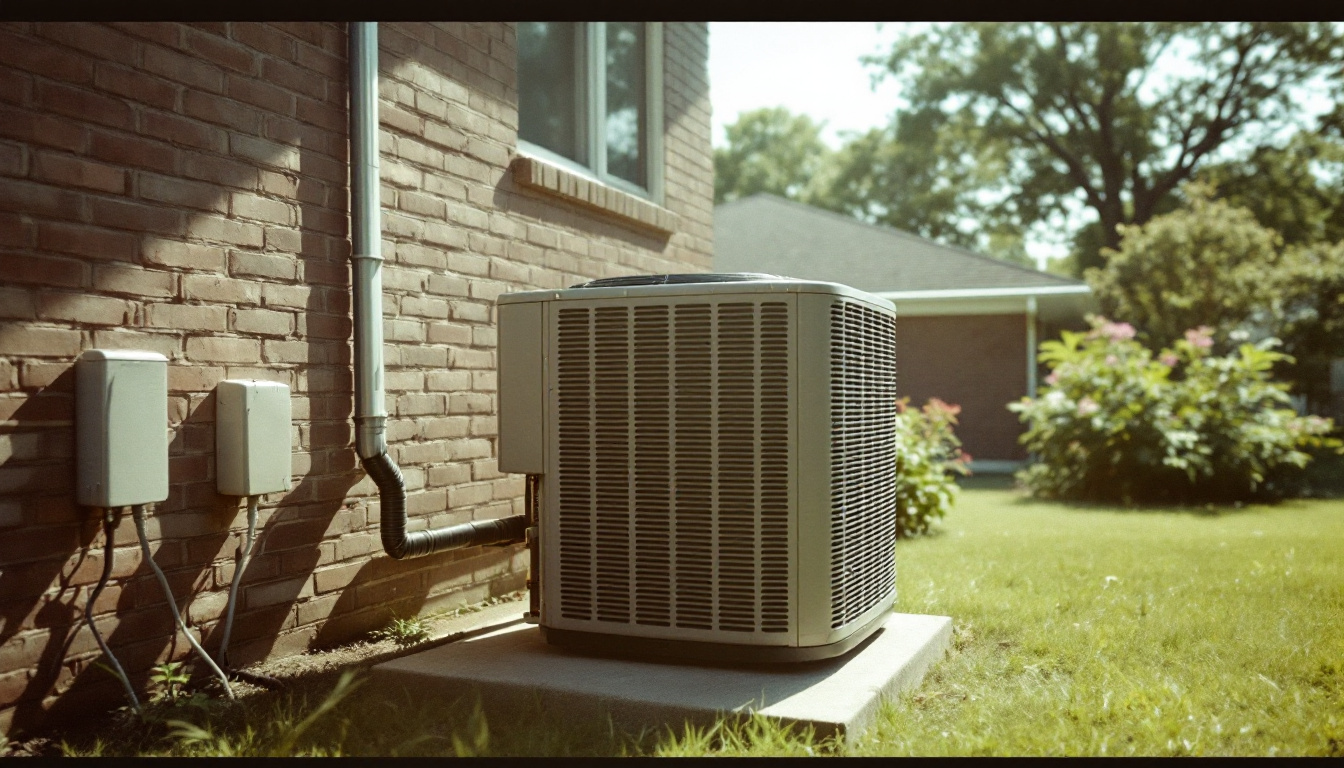
Every central system has the same core parts split between an outdoor cabinet and an indoor section, joined by refrigerant lines and served by ductwork.
| Part | Where it sits | What it does |
|---|---|---|
| Condensing unit | Outdoors, on a pad or bracket | Holds the compressor, condenser coil and fan, and rejects heat outside |
| Evaporator coil | Indoors, on the furnace or inside an air handler | Absorbs heat and removes moisture from house air |
| Blower | In the furnace or air handler | Moves air across the coil and through the ducts |
| Refrigerant lines | Between the two units | Carry refrigerant in a sealed loop |
| Supply and return ducts | Throughout the house | Deliver cooled air and bring room air back |
| Condensate drain | Under the indoor coil | Carries away the water pulled out of the air |
| Thermostat | Living space | Starts and stops the cycle |
The outdoor unit is covered in detail in what an AC condenser does. Ducts decide more of a system’s real performance than most owners expect, which is why ductwork and airflow problems so often get blamed on the equipment.
How many homes have central air
Central equipment is the main cooling system in 66.9% of all US homes. It is close to standard in houses and noticeably less common in apartments.
| Main cooling equipment | Homes (millions) | Share of AC users |
|---|---|---|
| Central air, including central heat pumps | 82.69 | 75.5% |
| Window or wall air conditioner | 21.43 | 19.6% |
| Portable air conditioner | 2.68 | 2.4% |
| Ductless heat pump (mini-split) | 1.76 | 1.6% |
| Evaporative or swamp cooler | 0.95 | 0.9% |
| All homes using air conditioning | 109.51 | 100% |
| Housing type | Homes using AC (millions) | Central as main system (millions) | Central share |
|---|---|---|---|
| Single-family detached | 69.75 | 57.73 | 82.8% |
| Single-family attached | 6.57 | 5.15 | 78.4% |
| Apartment, 2 to 4 units | 7.57 | 3.80 | 50.2% |
| Apartment, 5 or more units | 19.56 | 12.11 | 61.9% |
| Mobile home | 6.07 | 3.90 | 64.3% |
Another 14.02 million homes use no air conditioning at all.
Central air versus the alternatives
The real choice is between systems that need ducts and systems that do not. Central air and central heat pumps need them; mini-splits, window units and portables do not.
| System | Needs ducts | Area served | Also heats |
|---|---|---|---|
| Central air conditioner | Yes | Whole house | No, paired with a furnace |
| Central heat pump | Yes | Whole house | Yes |
| Ductless mini-split | No | One zone per indoor head | Usually, as a heat pump |
| Window or wall unit | No | One room | Some models |
| Portable unit | No | One room | Some models |
A central heat pump is the same machine as central air with a reversing valve added, so it can run the cycle backwards in winter. See how a heat pump works.
Does central air use gas?
No. The compressor, fans and controls all run on electricity. The confusion comes from the furnace: in a house with a gas furnace, central air shares the furnace blower and ducts, so the two look like one appliance.
The word gas also gets used loosely for refrigerant. Refrigerant is a working fluid that circulates in a sealed loop, not a fuel that gets burned, and a correctly working system does not use it up.
What the federal efficiency rules require
New central air conditioners must meet a minimum SEER2 rating set by the Department of Energy, and for split systems the minimum depends on where the system is installed.
| Product | North | Southeast | Southwest |
|---|---|---|---|
| Split air conditioner, under 45,000 Btu/h | 13.4 SEER2 | 14.3 SEER2 | 14.3 SEER2, plus EER2 |
| Split air conditioner, 45,000 Btu/h or more | 13.4 SEER2 | 13.8 SEER2 | 13.8 SEER2, plus EER2 |
| Split heat pump | 14.3 SEER2, 7.5 HSPF2 | 14.3 SEER2, 7.5 HSPF2 | 14.3 SEER2, 7.5 HSPF2 |
Under 10 CFR 430.32, the Southeast covers Alabama, Arkansas, Delaware, Florida, Georgia, Hawaii, Kentucky, Louisiana, Maryland, Mississippi, North Carolina, Oklahoma, South Carolina, Tennessee, Texas, Virginia, the District of Columbia and US territories. The Southwest is Arizona, California, Nevada and New Mexico. The regional rules apply to systems installed on or after January 1, 2023. Our SEER2 guide covers how the rating works.
How old central air systems are
About one in five air conditioned homes runs main cooling equipment that is at least 15 years old: 21.56 million homes, or 19.7%.
| Age of main AC equipment | Homes (millions) | Share of AC users |
|---|---|---|
| Less than 2 years | 15.63 | 14.3% |
| 2 to 4 years | 21.76 | 19.9% |
| 5 to 9 years | 30.08 | 27.5% |
| 10 to 14 years | 20.49 | 18.7% |
| 15 to 19 years | 11.01 | 10.1% |
| 20 years or more | 10.55 | 9.6% |
These bands cover all main cooling equipment, not central systems alone, and ages are as reported by households. RECS publishes the distribution but no average age and no failure rate. Our guide to HVAC lifespan explains what that does and does not tell you.
Frequently asked questions
What is central air?
Central air is a whole-house cooling system with an outdoor condensing unit, an indoor evaporator coil and a blower that sends cooled air through ducts to every room. It is the main cooling system in 82.69 million US homes, 75.5% of homes that use air conditioning, per EIA RECS 2020.
Does central air use gas?
No. Central air runs on electricity. It often shares ductwork and a blower with a gas furnace, which is why the two can seem like one system. Refrigerant is sometimes called gas, but it is a sealed working fluid, not a fuel.
What is the difference between central air and a heat pump?
A central heat pump is a central air conditioner that can also run in reverse to heat the house. Both use an outdoor unit, an indoor coil and ducts. A central air conditioner only cools and relies on a separate furnace or boiler for heat.
How common is central air in the US?
Central equipment is the main cooling system in 82.69 million of 123.53 million US homes, or 66.9%. Among single-family detached houses that use air conditioning the share is 82.8%, and among apartments in buildings with five or more units it is 61.9%.
Methodology and limitations
Household counts are from EIA RECS 2020 table HC7.1, the latest vintage for equipment data, and include central heat pumps in the central category. Efficiency minimums are quoted from the Code of Federal Regulations.
- RECS 2020 is a survey estimate with sampling error, and we do not project it forward.
- Equipment age is reported by households, grouped in bands, and covers all main cooling types.
- We publish no installation prices, because no federal series measures them.
Sources
- US Energy Information Administration, Residential Energy Consumption Survey 2020, table HC7.1.
- Code of Federal Regulations, 10 CFR 430.32(c)(5) and (c)(6), energy conservation standards for central air conditioners and heat pumps.
The HVAC Brief is an independent trade publication. We do not sell equipment, take manufacturer advertising, or accept payment for placement in our research. Corrections welcome.
Leave a Reply