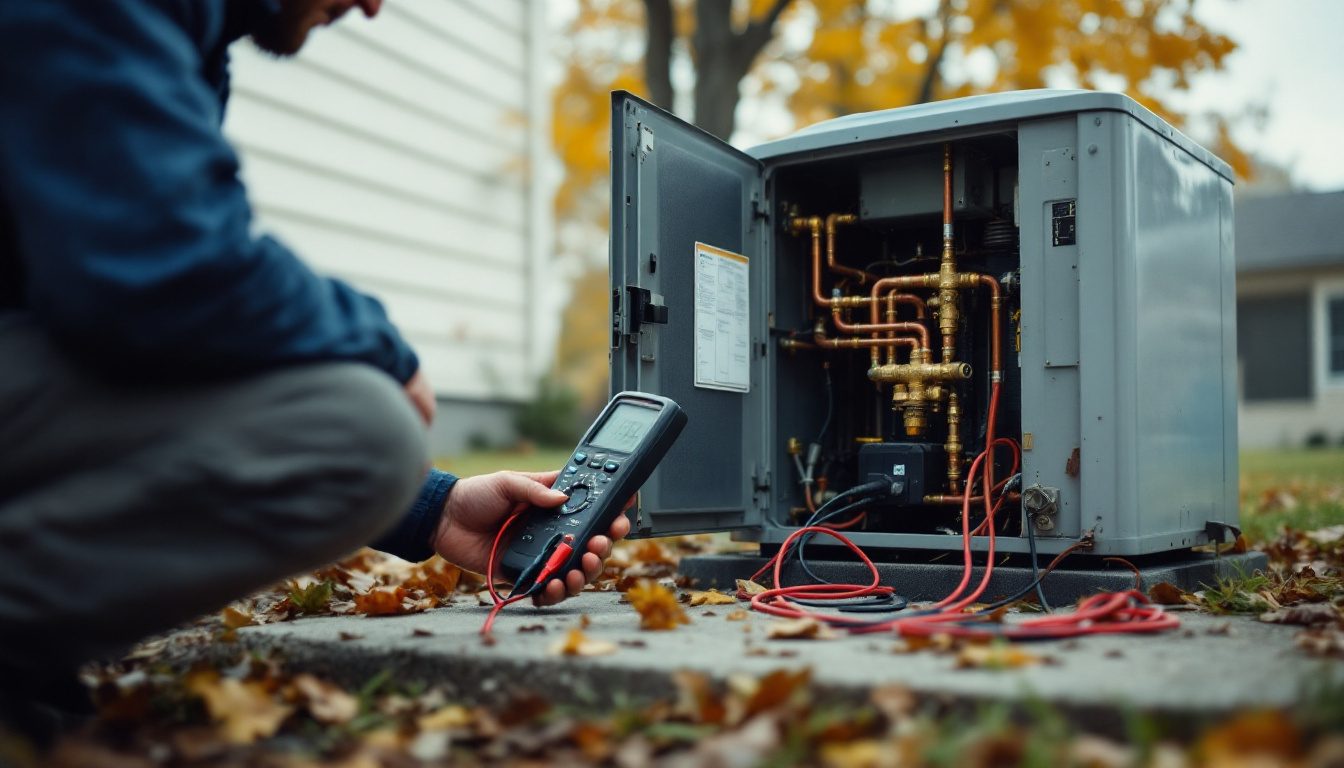
What does the reversing valve do in a heat pump? In a reversing valve heat pump circuit, it reverses refrigerant flow so one system can heat or cool. A small solenoid shifts a pilot valve, and system pressure, at least 40 psi of difference in Ranco’s spec, then slides the main valve over.
Key Takeaways
- Ranco valves need at least 40 psi between high and low side to reverse, and no more than 450 psi (Robertshaw guide, 2025).
- Saginomiya lists a 44 psi (0.3 MPa) minimum for its STF valves, rated for R410A, R32 and R454B (STF datasheet).
- Most heat pumps energize the valve in cooling (O); Rheem and Ruud energize on heating (B), per Honeywell Home.
- Ranco notes a valve energized for cooling goes to heat when its coil fails, and the reverse.
- Replacing the valve body means recovering refrigerant to 0 inches of mercury first on a high-pressure system under 200 pounds (40 CFR 82.156).
- Ranco warns temperatures above 250°F are apt to damage internal parts during brazing.
What does a reversing valve do in a heat pump?
The reversing valve decides which coil receives hot gas from the compressor. Send it to the outdoor coil and the system cools; send it to the indoor coil and it heats. In DOE’s words (archived copy), a heat pump moves heat from the house to the outdoors in summer and from the cool outdoors into the house in winter.
That valve is most of the hardware gap in our heat pump and air conditioner comparison, and it pays: DOE says a heat pump can cut heating electricity by up to 75% versus electric resistance. The full cycle is in our explainer on how the cycle moves heat.
How does a heat pump reversing valve work inside?
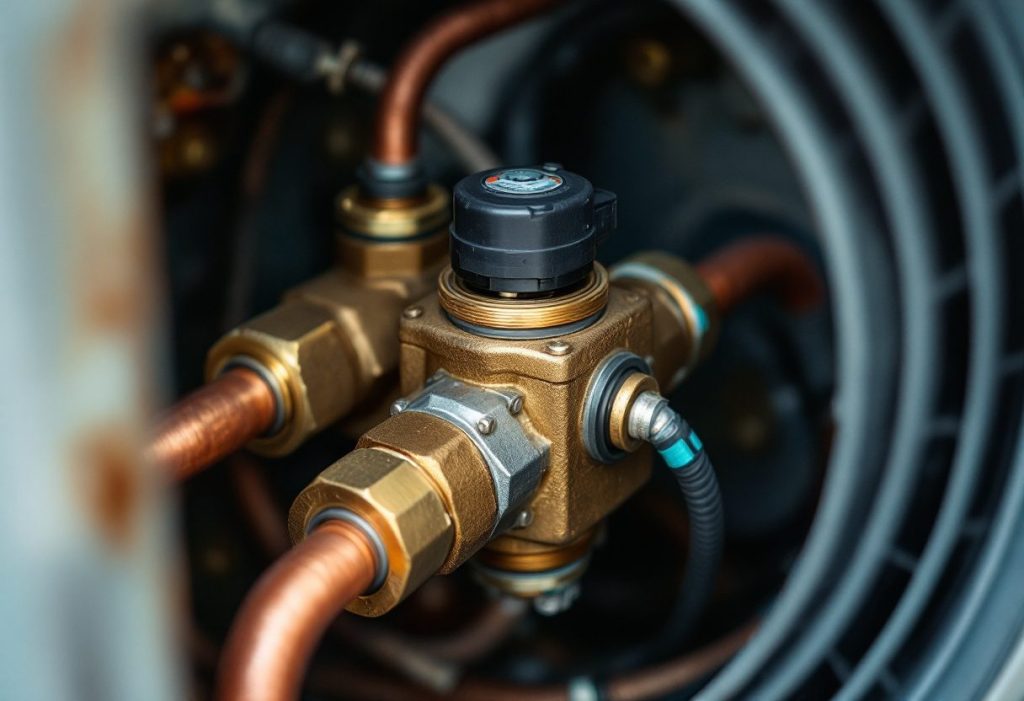
It is a pilot-operated four-way slide valve. Robertshaw describes its Ranco valves as “solenoid operated, slide type, with a 4-way pilot valve” that work under full system pressure. The Danfoss Saginomiya brochure lists three components: pilot valve, main body with slider, and solenoid coil.
The coil only moves the small pilot; compressor pressure moves the slide:
- The thermostat or defrost control powers, or unpowers, the coil.
- The pilot shifts and routes high-pressure gas through capillary tubes to one end of the main valve, venting the other end.
- The pressure difference drives the slide across, so discharge gas now flows to the opposite coil.
Saginomiya’s STF datasheet names the ports D (discharge), S (suction), E and C: powered, D to E and C to S; unpowered, D to C and E to S.
Because pressure moves the slide, there is a working window: Ranco specifies 40 psi minimum and 450 psi maximum to reverse, and Saginomiya’s STF valves 44 psi minimum and 449 psi maximum. A valve that will not shift at low pressure may be healthy.
Is the reversing valve energized in heating or cooling: O or B?
It depends on the brand. Honeywell Home uses an O terminal to energize the valve in cooling and B to energize it in heating, and says “a vast majority” of makers energize O in cooling. The exception: Rheem and Ruud heat pumps must energize on heating, “B on Heat.”
A wrong setting makes the system heat on a cooling call. The convention also predicts the failure mode, because Robertshaw notes many equipment makers pipe the valve so a dead coil leaves the system in a chosen mode.
| Equipment | Valve energized in | Thermostat setting | If the coil fails, runs in |
|---|---|---|---|
| Most heat pump brands (Honeywell Home) | Cooling | O, “O on cool” | Heating |
| Rheem and Ruud heat pumps | Heating | B, “B on Heat” | Cooling |
| Ranco V series valve | Either; equipment piping decides | Not applicable | Opposite of energized mode |
| Danfoss Saginomiya STF (brochure figures) | Heating cycle drawn energized | Not applicable | Cooling, as drawn |
Terminal wiring is in our thermostat wiring color code reference. The defrost control also shifts the valve briefly to clear ice, covered in our guide to the heat pump defrost cycle.
What are the signs of a bad reversing valve?
The clearest sign is a heat pump stuck in one mode: cool air on a heating call, or warm air on a cooling call. Weak capacity in both modes can mean the slide is not seating and hot gas is bypassing to suction; even new Ranco V2 and V3 bodies are allowed 2,000 cc/min of leakage in a factory air test.
- Stuck in heat on an O system, or cool on a B system: the coil’s failure mode, so check the electrical side first.
- Stuck in the energized mode with voltage present: points toward the valve body or low pressure difference.
- Backup heat running hard in mild weather: strips may be covering for a heat pump that is not heating, as our auxiliary heat explainer describes.
These symptoms overlap with low charge or a bad defrost board; our roundup of faults specific to heat pumps lists the other suspects.
Solenoid coil or valve body: how do technicians tell which failed?
Technicians test the electrical side first, because the coil bolts onto the outside of the valve and can be swapped without touching refrigerant. The valve body is condemned only when coil, voltage and pressures check out:
- Confirm the thermostat’s O/B setting matches the brand.
- Measure voltage at the coil when the mode should energize it. Ranco coils operate from 85% to 110% of rated voltage; its LDK coils come in 24, 120, 208/240 and 277 volt versions.
- Check the coil for an open or shorted winding against the coil maker’s spec.
- With gauges on, confirm the compressor builds more than the 40 psi Ranco minimum.
- Look for dents: Robertshaw warns a dented body or capillary can stop the reversing action.
| Finding | Points to | Opens refrigerant circuit? |
|---|---|---|
| Wrong O/B setting | Thermostat configuration | No |
| No voltage at the coil | Thermostat, wiring or control board | No |
| Voltage present, coil winding open | Solenoid coil | No |
| Pressure difference under 40 psi | Charge or compressor | Depends on cause |
| Coil and pressures good, no shift | Valve body | Yes |
On the popular “magnet test”: the Danfoss Saginomiya brochure warns a coil kept energized after removal from the valve body may burn out, so it stays seated whenever power is on.
Why is reversing valve replacement a refrigerant job, and what drives the cost?
The valve body is brazed into the piping, so replacing it opens the refrigerant circuit. 40 CFR 82.154 bars knowingly venting refrigerant, and 40 CFR 82.156 requires recovery to the Table 1 level, verified before the system is opened.
For a split heat pump that level is 0 inches of mercury, the figure for a high-pressure appliance holding under 200 pounds; 82.152 names R-410A as high-pressure, with a saturation pressure of 170 to 355 psia at 104°F. The work needs a Type II certified technician, explained in our EPA 608 certification guide.
Robertshaw says to wrap the body in a wet rag, braze under inert gas and avoid flux, since “even a tiny bit” can damage a new valve. Danfoss Saginomiya sets a 120°C (248°F) body limit, with the coil removed.
We print no price because no federal or national lab source publishes one. The bill is recovery, brazing, evacuation and recharge plus the part; a coil swap needs none of those. On an older system, weigh that labor against our heat pump replacement analysis.
What can a homeowner check safely?
Homeowners can rule out settings; anything past the thermostat involves line voltage or refrigerant and belongs to a technician.
- Confirm the thermostat is on Heat or Cool, not Off or Emergency Heat.
- After a thermostat swap, check the O/B setting: O for most brands, B for Rheem and Ruud.
- Note whether wrong-temperature air is constant or comes in short winter spells, which usually means defrost.
- Do not tap the valve or pull the coil.
Correction
Many repair pages quote one “normal” coil resistance and a flat replacement price. The Ranco and Saginomiya literature we read gives no universal ohm value, and no federal source publishes a repair price. Use the coil maker’s spec and a written quote.
Valve operation belongs on the spring and fall list in our heat pump maintenance guide.
How we researched this
Researched October 8, 2026. We read Robertshaw (Ranco), Saginomiya and Danfoss Saginomiya technical literature, Honeywell Home support pages for O/B, the eCFR text of 40 CFR 82.152, 82.154, 82.156 and 82.161, and an archived DOE page. Manufacturer figures are Tier 2 and describe each maker’s own products. We consulted 17 sources and cite 10. Contractor blogs and AI-written repair sites were excluded because their coil resistance values and prices have no primary source. Reddit was not used: the topic involves line voltage and refrigerant.
Frequently asked questions
What happens when a reversing valve is stuck in heat mode?
The house gets warm air on a cooling call. On most brands, which energize the valve in cooling, heat is where a failed coil leaves it, per Robertshaw’s Ranco guide. A technician checks the O/B setting, coil voltage and the coil before suspecting the valve body.
What should a reversing valve solenoid read in ohms?
There is no universal number. The Ranco and Saginomiya literature we reviewed gives no single resistance, and Ranco coils come in 24, 120, 208/240 and 277 volt versions. An open winding means a failed coil; compare other readings with the coil maker’s specification.
How does the reversing valve magnet test work?
A technician holds a steel tool near the powered coil to confirm it produces a magnetic field. The coil must stay seated on the valve stem: Danfoss Saginomiya warns that a coil kept energized after removal from the body might burn out.
Should my heat pump thermostat be set to O or B?
Most heat pumps use O, energized in cooling. Honeywell Home says Rheem and Ruud heat pumps must energize on heating, so they use B. If the system heats on a cooling call and cools on a heating call, check the O/B setting first.
Can the reversing valve coil be replaced without touching refrigerant?
Yes. The coil mounts outside the valve body, so a swap does not open the refrigerant circuit. Robertshaw notes coils are not interchangeable: LDK coils fit Ranco V series valves, L30 coils fit older ones. Replacing the body requires recovery under 40 CFR 82.156.
How much does reversing valve replacement cost?
We publish no figure because no federal or national lab source reports one. Cost is driven by labor: recovering refrigerant to 0 inches of mercury under 40 CFR 82.156, brazing under inert gas, evacuating and recharging, plus the part. A coil swap avoids all four steps.
How long does a reversing valve last?
Manufacturers rate valves in cycles, not years. Robertshaw lists a minimum of 100,000 life cycles for Ranco V series valves. Every change between heating, cooling and defrost is a cycle, so life depends on climate and how often the system switches.
Sources
- Robertshaw. “Installation Guide: Reversing Valves, 4-Way Pilot Valves (601-00002-001 Rev E).” https://www.robertshaw.com/wp-content/uploads/2026/04/601-00002-001E-Reversing-Valves-4-way-Pilot-Valves-Install-Manual.pdf. Accessed October 2026.
- Saginomiya. “4-Way Reversing Valves Type STF” datasheet. https://www.saginomiya.co.jp/en/auto/catalog/us/s88taj00000003w0-att/stf_us.pdf. Accessed October 2026.
- Danfoss Saginomiya. “STF 4-way reversing valves” technical brochure. https://assets.danfoss.com/documents/latest/85729/AI204886421755en-000801.pdf. Accessed October 2026.
- Honeywell Home. “What is a changeover valve on a heat pump?” https://www.honeywellhome.com/blogs/support/wireless-5-1-1-day-programmable-thermostat-9. Accessed October 2026.
- Honeywell Home. “Why is my RTH8500WF thermostat set to heating, but I feel cool or mild air?” https://www.honeywellhome.com/blogs/support/why-is-my-rth8500wf-wifi-series-wifi-touchscreen-programmable-thermostat-set-to-heating-but-i-feel. Accessed October 2026.
- eCFR. “40 CFR 82.152 Definitions.” https://www.ecfr.gov/current/title-40/chapter-I/subchapter-C/part-82/subpart-F/section-82.152. Accessed October 2026.
- eCFR. “40 CFR 82.154 Prohibitions.” https://www.ecfr.gov/current/title-40/chapter-I/subchapter-C/part-82/subpart-F/section-82.154. Accessed October 2026.
- eCFR. “40 CFR 82.156 Proper evacuation of refrigerant from appliances.” https://www.ecfr.gov/current/title-40/chapter-I/subchapter-C/part-82/subpart-F/section-82.156. Accessed October 2026.
- eCFR. “40 CFR 82.161 Technician certification.” https://www.ecfr.gov/current/title-40/chapter-I/subchapter-C/part-82/subpart-F/section-82.161. Accessed October 2026.
- U.S. Department of Energy, Energy Saver. “Heat Pump Systems” (archived copy). https://web.archive.org/web/2025/https://www.energy.gov/energysaver/heat-pump-systems. Accessed October 2026.
Leave a Reply