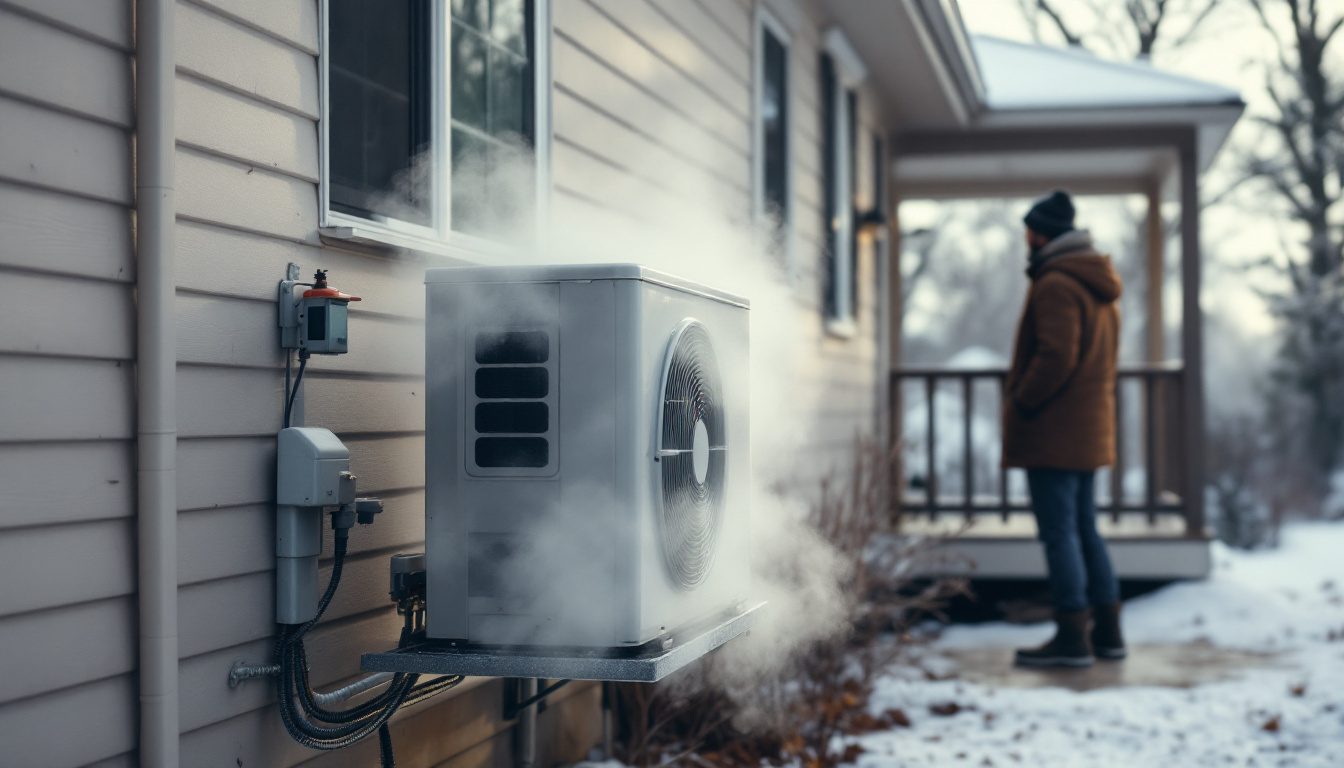
What is a heat pump defrost cycle? It is a short, automatic switch into cooling mode that melts frost off the outdoor coil. Manufacturer documents space cycles 30 to 120 minutes of run time apart, or trigger them on demand, and cap each one at 10 to 15 minutes.
Key Takeaways
- The Carrier 25HNB6 timed board ships at 90 minutes, with 30, 60 or 120 minute options.
- A cycle ends at a coil set point (65°F on that Carrier, 68°F in a Rheem manual) or a 10 minute override.
- A federal demand defrost control must check for frost at least once every ten minutes of run time (10 CFR 430, Appendix M1).
- Steam and a stopped outdoor fan are normal, per the Rheem owner’s manual.
- Across 22 cold climate units, median defrost energy was 5% to 8% of the total between 5°F and 35°F (PNNL-37127, 2025).
- The real failure is ice that survives repeated cycles; in one DOE Building America case, ice crushed a copper tube in the outdoor coil.
What is a heat pump defrost cycle?
A heat pump defrost cycle is the routine that clears frost from the outdoor coil in heating season. The outdoor coil is always colder than the outdoor air, so when it drops below the dew point, moisture condenses on it, and below freezing that water turns to ice, per a 2013 DOE Building America field report.
Frost blocks airflow, so every air source heat pump must shed it. Federal rules treat this as normal: the required H2 frost test in Appendix M1 runs at 35°F outdoors. Our explainer on how a heat pump moves heat covers the refrigeration loop.
How does the heat pump defrost cycle work, step by step?
The heat pump defrost cycle borrows the cooling circuit: the control flips the reversing valve, and hot refrigerant melts the frost. A Trane service publication lists three moves at defrost start: stop the outdoor fan, energize auxiliary heat, reverse to cooling.
- Conditions are met. The Carrier 25HNB6 needs its interval elapsed, a coil below 32°F and outdoor air below 50°F.
- The valve shifts. You hear a whoosh. The White-Rodgers 47D40-801 control for Rheem heat pumps drops the compressor for 5 seconds at each valve change to cut noise.
- The outdoor fan stops and steam rises as the coil warms. Indoors, many systems run strip heat so supply air does not feel cold.
- The cycle terminates at the coil set point or time cap. The valve returns to heating; on the Carrier, the outdoor fan restarts after 20 seconds.
How strip heat is staged, and what it costs, is covered in our guide to AUX versus EM heat.
Timed or demand defrost: what does the defrost board decide?
The defrost board decides when to start and stop. A timed board counts compressor run time, then defrosts if the coil sensor reads cold; Appendix M1 calls that ON-time “generally a fixed value (e.g., 30, 45, 90 minutes)”. A demand board measures frost and defrosts only when performance drops.
The federal demand defrost definition is strict: the control must check a frost parameter at least once every ten minutes of run time, may add timed defrosts only after 6 hours of compressor operation, and systems that vary the interval by outdoor temperature alone are not demand-defrost systems.
| Control (document) | Type | Interval | Ends at | Time cap |
|---|---|---|---|---|
| Carrier 25HNB6 (338054-101, 2012) | Timed | 90 min factory; 30, 60 or 120 min | 65°F coil | Not stated |
| Rheem archive 13 SEER heat pump (708163B, 2008) | Timed | 30 min factory; 60 or 90 min | 68°F coil | 10 min |
| Trane time-temperature controls (34-4101-07) | Timed | 50, 70, or 90 min run time | 55°F or 70°F coil | 10 min |
| Trane demand defrost controls (34-4101-07) | Demand | Learned; below 35°F | Varies | 15 min |
| White-Rodgers 47D40-801 for Rheem (Copeland, 2024) | Demand | Learned; forced after 6 hours | 50, 60, 70 (default) or 80°F | 14 min |
Interval choice follows climate: the Rheem manual recommends 90 minutes for dry southern Arizona and 30 for moist Seattle. DOE Energy Saver (archived copy) advises choosing a demand-defrost control to minimize cycles.
How often and how long should a heat pump defrost?
A heat pump in defrost mode should finish within 10 to 15 minutes. Timed boards wait 30 to 120 minutes of run time between cycles; demand boards wait until frost actually builds, which can be hours in dry cold.
In the DOE Cold Climate Heat Pump Challenge field validation, defrost was most energy intensive between 5°F and 35°F and dropped off significantly above 40°F, per PNNL-37127. One outlier site spent 16% of its time below 40°F in defrost, against a 5% average.
So “too often” is relative to the board setting. Cycles every few minutes, or none while the coil whitens over, need a technician; see our rundown of faults only heat pumps have.
Are steam, a whoosh and a stopped fan normal in defrost mode?
Yes. Steam, a whoosh and a silent outdoor fan are the normal signs of a heat pump defrost cycle. The Rheem owner’s manual says the outdoor fan “will stop” during defrost and that “steam may rise from the outdoor unit as the warm coil causes some melted frost to evaporate.”
| What you notice | Normal? | Why |
|---|---|---|
| White cloud rising from the outdoor unit | Normal | Melted frost evaporating |
| Outdoor fan stopped, compressor still running | Normal | Coil warms faster |
| Whoosh at the start and end | Normal | Reversing valve shifting |
| AUX or heat strip light on the thermostat | Normal | Most common PNNL strategy: fan plus first stage heat |
| Cooler air from the registers | Normal on some models | Fan with no strip heat: supply air averaged below 60°F |
| Coil still iced solid after a cycle | Not normal | Defrost is failing |
The strip heat and cool air rows come from the PNNL study, which notes no occupant complaints about the cooler air.
Myth check: steam is not smoke
A cloud on a cold day is water vapor from melted frost. Smoke that smells burnt is different: switch the system off and call a licensed technician.
How much heat does defrost cost, and do ratings count it?
Defrost costs a few percent of winter heating energy, and federal efficiency ratings already include it. PNNL found the median share of energy spent in defrost was 5% to 8% at outdoor temperatures between 5°F and 35°F, which it calls “a small portion of total energy use.”
A 2013 Building America field test found similar scale: with regular defrosting, its strip heat, typically 5 kW and used mainly in defrost, was about 1% to 3% of total system use.
The HSPF2 rating includes frost. Appendix M1 requires the 35°F H2 test with defrost controls set as typical for climate region IV, and the 2024 text credited demand-defrost units, capped at 12 hours between defrosts. Since July 7, 2025, M1 testing is mandatory and its details come from AHRI 210/240-2024, per the current eCFR text.
The ENERGY STAR cold climate tier adds a 5°F test: a COP of at least 1.75, per the Version 6.2 specification. Our cold climate heat pump guide explains that tier, and our data on heat pump capacity at 5°F covers the listings.
What are the signs a heat pump defrost cycle has failed?
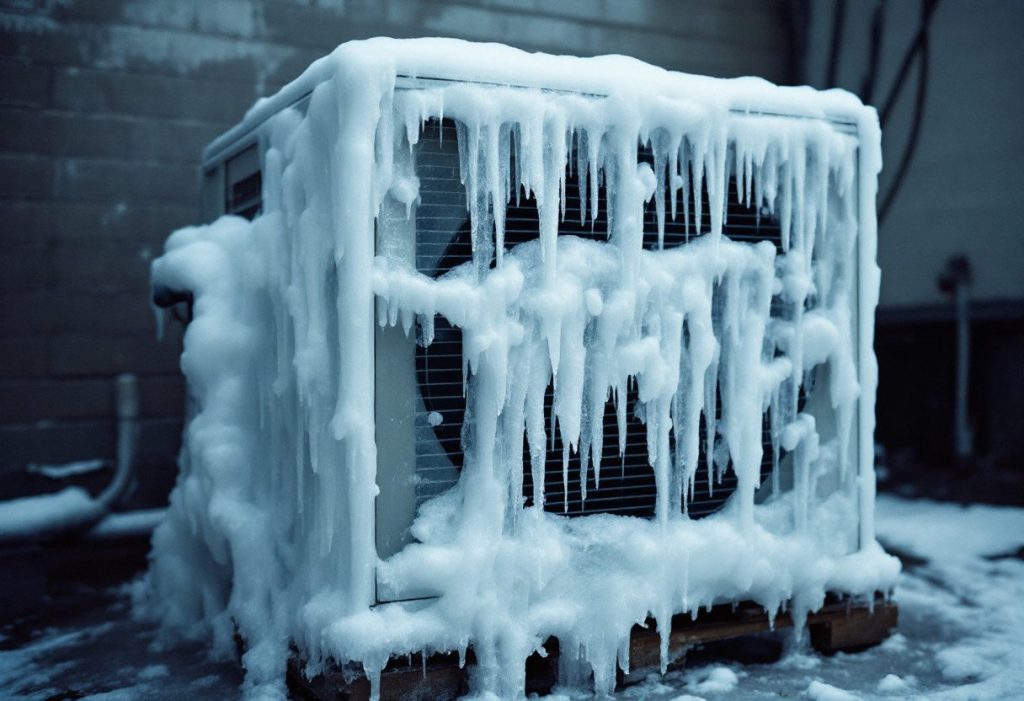
A failed defrost shows as ice that survives: coil, base and cabinet encased in a growing block. Light frost that comes and goes is normal.
At its test house, meltwater from short cycles hit the cold steel frame and refroze until ice blocked much of the coil, and “repeated defrosting could not clear the ice.” The report cites a central Canada installation where ice crushed and cracked a copper tube in the outdoor coil, losing the refrigerant; our guide to refrigerant leak detection covers what follows.
- Watch one full cycle and check whether the coil is clear afterward.
- Clear snow and the drain path. The NYS Clean Heat checklist calls for risers, stands or wall mounts of 6, 12 or 18 inches, with defrost drainage sent to a safe location.
- Do not chip ice off the coil. Use only a method your owner’s manual names; the Building America unit’s manual specified pouring hot water over the coil.
- Call a technician if the block returns. Testing the coil sensor, board, valve and charge is licensed work.
DOE Energy Saver warns that high winds “can cause defrosting problems” and units may need raising for snow, points in our heat pump installation checklist. A seasonal check of the defrost board belongs in routine heat pump maintenance.
How we researched this
Researched October 8, 2026. We read four manufacturer control documents (Carrier, Rheem, Trane and the White-Rodgers control for Rheem units), 10 CFR 430 Appendix M1 via the eCFR versioner API, PNNL’s 2025 field report, a 2013 Building America field test, DOE Energy Saver, ENERGY STAR and a New York State installer checklist. We consulted 16 sources and cite 11.
We excluded contractor blogs and content farms, whose duration and frequency ranges carry no source, and did not use Reddit. Goodman documents could not be retrieved. Settings vary by model; check your unit’s documents.
Frequently asked questions
How often should a heat pump go into defrost mode?
It depends on the control and the weather. The Carrier 25HNB6 timed board ships at 90 minutes, with 30, 60 or 120 minute options. Demand boards defrost only when frost builds, and the White-Rodgers 47D40-801 forces a cycle after 6 hours of frosting at most.
How long should a heat pump defrost cycle last?
Until the coil reaches its set point or a time cap expires, whichever comes first. The Rheem 708163B manual and Trane time-temperature controls cap it at 10 minutes, Trane demand controls at 15 and the White-Rodgers 47D40-801 at 14. The Carrier 25HNB6 ends at a 65°F coil.
Is it normal for a heat pump to steam in winter?
Yes. The Rheem owner’s manual says steam may rise from the outdoor unit as the warm coil evaporates some of the melted frost, and that the outdoor fan stops during defrost. A burnt smell is not steam; switch the system off and call a technician.
Why does AUX heat come on during defrost?
Many systems warm the supply air with strip heat during defrost. In PNNL’s 22 unit study, the most common strategy ran the indoor fan with the first stage of auxiliary heat. AUX during defrost is normal; AUX in mild weather deserves a check.
Does a heat pump defrost in summer?
No. Defrost is a heating mode routine. The Carrier 25HNB6 defrosts only when outdoor air is below 50°F, and Trane demand controls stay in normal operation above 52°F. Summer ice on the copper lines is a separate fault for a technician.
What does a heat pump defrost board do?
It times and runs the cycle: it reads a coil sensor, shifts the reversing valve, stops the outdoor fan and calls backup heat. Trane demand controls use two thermistor sensors and learn frosting conditions. Board and sensor tests are technician work.
Sources
- Carrier. “25HNB6 wiring diagram and unit operation, 338054-101 Rev. B.” 2012. https://www.partstown.com/modelManual/CRR-25HNB6-English_wd.pdf. Accessed October 2026.
- Rheem literature archive. “Outdoor Heat Pump User’s Information/Installation Instructions, 708163B.” 2008. https://files.rheem.com/LiteratureArchive/708163b.pdf. Accessed October 2026.
- Trane. “Heat Pump Defrost Controls, Pub. No. 34-4101-07.” 2002. https://support.trane.com/hc/en-us/article_attachments/4423636411405. Accessed October 2026.
- Copeland. “47D40-801 Demand Defrost Control Instructions.” 2024. https://media.copeland.com/d9f5a9d4-30ab-4f1e-8bb7-b16b00f7d2d1/0037-7200-Instructions-47D40-801%20Demand%20Defrost%20Control.pdf. Accessed October 2026.
- eCFR. “10 CFR 430, Appendix M1 (June 1, 2024 edition).” https://www.ecfr.gov/on/2024-06-01/title-10/chapter-II/subchapter-D/part-430/subpart-B/appendix-Appendix%20M1%20to%20Subpart%20B%20of%20Part%20430. Accessed October 2026.
- eCFR. “10 CFR 430, Appendix M1 (current).” https://www.ecfr.gov/current/title-10/chapter-II/subchapter-D/part-430/subpart-B/appendix-Appendix%20M1%20to%20Subpart%20B%20of%20Part%20430. Accessed October 2026.
- PNNL. “PNNL-37127, Performance Results from DOE Cold Climate Heat Pump Challenge Field Validation.” 2025. https://www.pnnl.gov/main/publications/external/technical_reports/PNNL-37127.pdf. Accessed October 2026.
- DOE Building America. “Measured Performance of a Low Temperature Air Source Heat Pump.” 2013. https://www1.eere.energy.gov/buildings/publications/pdfs/building_america/low_temp_air_source_heat_pump.pdf. Accessed October 2026.
- DOE Energy Saver. “Air-Source Heat Pumps” (archived copy). https://web.archive.org/web/20260107175655/https://www.energy.gov/energysaver/air-source-heat-pumps. Accessed October 2026.
- ENERGY STAR. “Version 6.2 Heat Pump Specification.” 2025. https://www.energystar.gov/sites/default/files/2025-04/ENERGY%20STAR%20Version%206.2%20Heat%20Pump%20Specification%20Rev.%20March%202025.pdf. Accessed October 2026.
- NYS Clean Heat Connect. “ASHP Field Assessment Hot List.” 2025. https://cleanheatconnect.ny.gov/assets/pdf/CHC-CON-ashpQChotlist-fs-1-v2.pdf. Accessed October 2026.
Leave a Reply