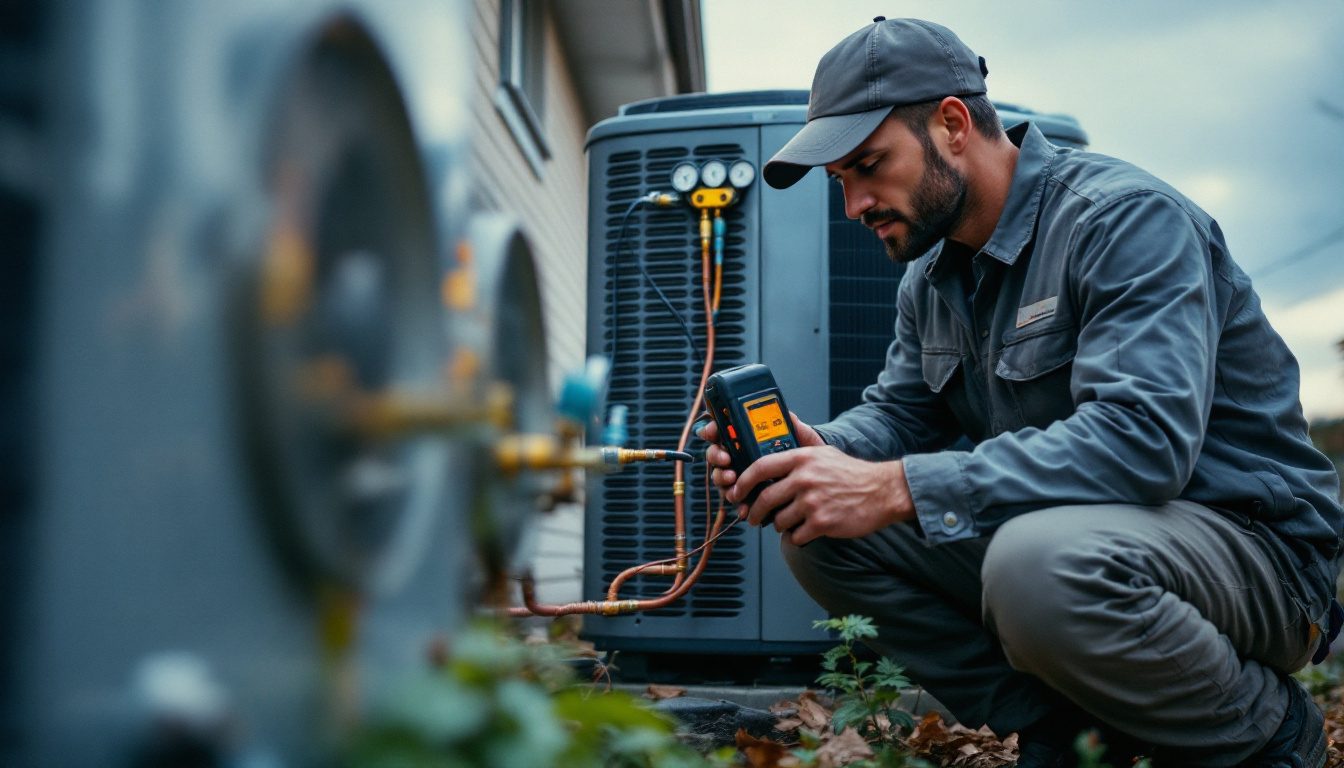
What is refrigerant leak detection? Refrigerant leak detection is finding where refrigerant escapes a sealed system, using an electronic detector, bubble solution, ultrasonic tool or dye. A pressure test proves a leak exists; only a locating method shows where.
Key Takeaways
- EPA’s leak inspection definition at 40 CFR 82.152 lists ultrasonic tests, gas-imaging cameras, bubble tests and electronic detectors; pressure tests alone cannot locate a leak.
- Maker claims: Fieldpiece’s DR58 heated diode detector senses better than 0.03 oz/yr; INFICON’s infrared D-TEK Stratus, 1 g/year under EN14624.
- Per UL Solutions, an A2L refrigerant detection system must respond at 25% of the lower flammability limit within 60 seconds.
- Leak repair rules at 40 CFR 84.106 start at 15 or more pounds and exclude residential and light commercial AC and heat pumps.
- 40 CFR 84.108 requires automatic leak detection only on commercial and industrial process refrigeration of 1,500 pounds or more.
- A 2005 corrosion study archived by DOE’s OSTI library found formic acid attacks copper coil tubing below twenty (20) parts per million.
What is refrigerant leak detection, and why does low charge mean a leak?
Refrigerant leak detection locates the opening a charge escaped through. A sealed air conditioner does not use up refrigerant, so a low charge means a hole somewhere, which is why topping up without a leak search only buys time.
Low charge is common. DOE’s 2018 review of installation research found charge faults of 29-78% undercharge and 4-50% overcharge across studies, though some undercharge is an install error, not a leak.
So the search starts with measurement. Superheat and subcooling readings confirm the charge, and a sticking expansion valve gets ruled out before anyone hunts for a hole.
Which refrigerant leak detection methods work, and how do they compare?
No single method does everything. Electronic detectors sweep fastest, bubbles confirm a joint, and a nitrogen standing test proves a circuit holds without pointing to the leak. Most technicians combine two or three.
| Method | How it works | Sensitivity (as claimed) | Best use | Limits |
|---|---|---|---|---|
| Heated diode detector | Reads refrigerant concentration directly | Better than 0.03 oz/yr (Fieldpiece DR58) | Pinpointing; can be held on a leak | Loses sensitivity with age |
| Infrared detector | Reads a change in concentration | 1 g/year per EN14624 (INFICON D-TEK Stratus) | Sweeps; ignores humidity and oil (Fieldpiece) | Wand must keep moving |
| Bubble solution | Escaping gas blows bubbles | None rated; bubbles take minutes (Fieldpiece) | Confirming a joint or valve | Avoid chlorine detergents (Lennox) |
| Ultrasonic tester | Hears gas escaping under pressure | No oz/yr rating | Listed in EPA’s definition | Needs pressure and quiet |
| UV dye | Dye exits with oil and glows under UV light | Hours to circulate (Fieldpiece) | Slow leaks in a running system | Needs equipment maker acceptance |
| Nitrogen standing test | Pressure held and watched for decay | Whether, not where (EPA) | Proving a repair holds | Pair with a locating method |
Sensitivities are maker claims under each maker’s chosen test. Lennox’s R-454B coil instructions also say compressed air or oxygen shall not be used for purging, which is why standing tests use dry nitrogen.
Heated diode or infrared: how does a refrigerant leak detector work?
A refrigerant leak detector draws air past a sensor and alarms when refrigerant appears. Fieldpiece, which sells both main types, says a heated diode reads absolute concentration, so it keeps beeping on a leak, but loses sensitivity over its life.
Infrared reads a change in concentration, so the wand must keep moving, but Fieldpiece says its sensitivity holds and it ignores humidity and oil. INFICON’s D-TEK Stratus flyer lists EN14624:2012, SAE J2791 and A2L certification.
For A2L refrigerants, Lennox warns that electronic detectors may lack sensitivity or need recalibration, and must not be an ignition source.
How do technicians find a refrigerant leak, step by step?
A technician confirms the charge is low, sweeps with a detector, confirms with bubbles, and falls back to a nitrogen standing test when nothing turns up. Each step narrows the next.
- Confirm low charge by measurement. EPA treats pressure checks and charging charts as proof of a leak, not its location.
- Look for oil stains, ice and damaged tubing.
- Sweep joints, valves and both coils with a detector suited to the refrigerant.
- Confirm the hit with bubble solution.
- Still nothing? Recover the charge, isolate sections and run a nitrogen standing test at the pressure the equipment maker allows.
- Repair, re-test, evacuate and recharge. Lennox requires recovery or isolation before brazing.
Where do refrigerant leaks happen in a home system?
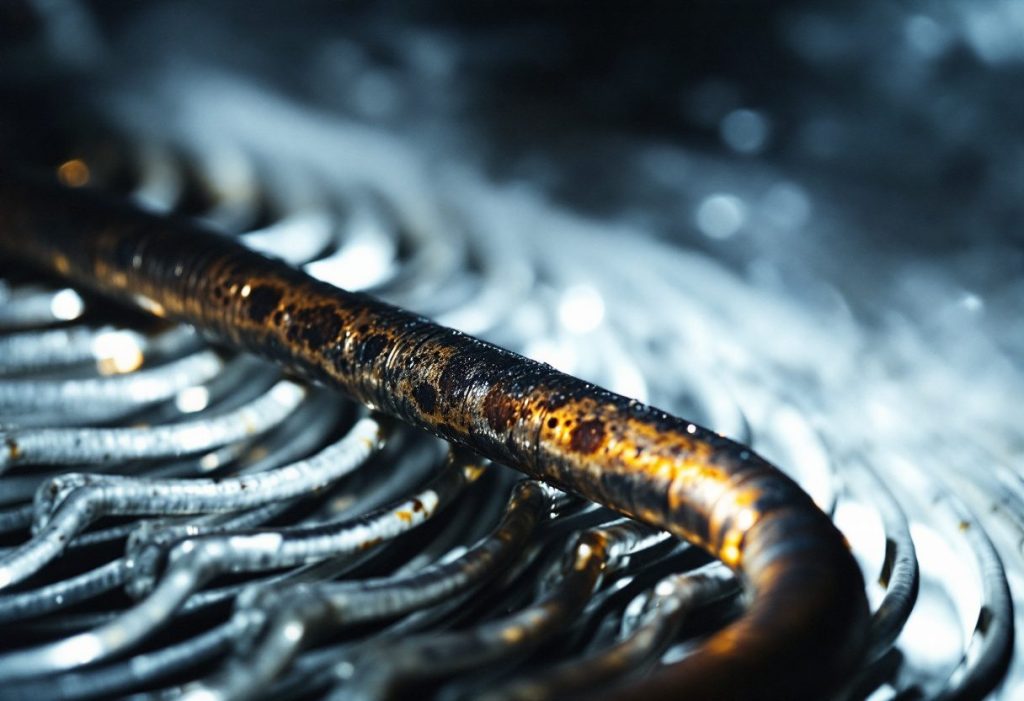
Home leaks cluster at the indoor coil and at mechanical joints. The coil is the hard case: a 2005 Corrosion Testing Laboratories report for the Air-Conditioning and Refrigeration Technology Institute describes formicary pits “not visible to the un-aided eye” in copper tubing.
It puts the formic acid threshold for attack below twenty (20) parts per million and records failures before installation or within several years. It also quotes Notoya: in Japan, approximately 10% of premature copper tube failures are this type. The report is trade funded, so we attribute it.
Pits that small explain why a coil can pass a bubble test yet lose charge, and why coil replacement often ends the search. Lennox ships CK40CT coils with a 10 ± 3 psi dry air holding charge and says to leak check any coil that releases none.
The mechanical suspects are brazed joints, service valves and the flare fittings on a refrigerant line set, standard on the ductless systems in our mini split repair guide.
What is an A2L refrigerant leak detection sensor, and when is one required?
An A2L refrigerant leak detection sensor sits in the indoor unit of an R-454B or R-32 system and, on sensing a leak, runs the blower to dilute it. A2L refrigerants are mildly flammable, as our R-454B explainer sets out.
EPA’s Appendix W to 40 CFR part 82, subpart G allows R-454B in new residential AC and heat pumps only in equipment meeting all requirements of the 3rd edition of UL 60335-2-40. That standard decides when a sensor is needed.
Per UL Solutions, systems in the occupied space above a charge limit set by room size need one, and the limit carries a safety factor of 4. The sensor must trigger a response, which activates the evaporator fan, at 25% of the lower flammability limit within 60 seconds.
Lennox fits a factory-installed sensor to every CK40CT R454B coil and says the unit “must be powered except for service.” Its table pairs a 10 lb charge with 150.9 sq ft of minimum conditioned area. It bans halide torches and caps detector settings at 25 % maximum of LFL. Service lags manufacturing, as our A2L transition status report found.
What are the federal refrigerant leak detection requirements?
Federal refrigerant leak detection requirements target large commercial and industrial systems. The 2026 rule at 40 CFR 84.106 covers appliances of 15 or more pounds and excludes residential and light commercial air conditioning and heat pumps; our leak repair rules explainer covers scope.
Where it applies, passing a leak rate threshold, such as 10 percent for comfort cooling, triggers a leak inspection by a certified technician. Separately, 40 CFR 84.108 requires automatic leak detection on commercial and industrial process refrigeration of 1,500 pounds or more, with 2017 to 2025 installs due by January 1, 2027.
Systems that monitor the appliance itself must alert at a loss of 50 pounds or 10 percent of full charge, whichever is less. For a house, the venting ban is what bites: Appendix W restates that Clean Air Act section 608(c)(2) bars knowingly venting substitute refrigerants, and handling takes EPA 608 certification.
What can a homeowner check without a technician?
A homeowner can spot and report the signs; the circuit is a technician’s job. Long run times, warm air, ice on the coil or suction line, and oily residue at fittings point toward lost charge. Our symptom guide separates these from water leaks.
On an A2L system, leave the power on: Lennox says the unit must be powered except for service. Appendix W says room occupants should evacuate the space immediately after an accidental release.
Myth: dye or sealant is a repair
Dye finds nothing on its own, and sealant is not a located repair. Fieldpiece notes dye can take several hours to circulate. Before any additive goes in, check whether the equipment and compressor makers accept it.
How we researched this
Researched October 8 to 9, 2026. We read 40 CFR 82.152, 82.157, 84.106, 84.108 and Appendix W through the eCFR versioner API, plus UL Solutions, two Lennox R-454B documents, Fieldpiece and INFICON literature, a Bacharach datasheet, a Rheem manual, the 2005 ARTI report and DOE’s 2018 review. Ten are cited. Excluded: the Bacharach sheet (dated 2003), the Rheem manual (an R-22 model), repair prices (no federal series) and Reddit (refrigerant safety topic).
Frequently asked questions
What is a refrigerant leak detection system?
A fixed detector that watches for refrigerant continuously. In an A2L home system it is the factory sensor that runs the blower, responding at 25% of the lower flammability limit per UL Solutions. In large refrigeration, 40 CFR 84.108 requires air-sampling systems that detect 10 ppm and alert at 100 ppm.
Do chillers need a refrigerant leak detection system?
Not under the federal automatic leak detection rule, which names commercial and industrial process refrigeration of 1,500 pounds or more. Comfort-cooling chillers of 15 pounds or more with a GWP above 53 still fall under the 84.106 leak repair rule at a 10 percent leak rate. Local code may add machinery room detectors.
What is the most sensitive refrigerant leak detection method?
Electronic detectors carry the highest rated sensitivity. Fieldpiece claims better than 0.03 oz/yr for its DR58 heated diode unit, and INFICON claims 1 g/year under EN14624 for its infrared D-TEK Stratus. Those are maker figures. Bubble solution has no rating but shows the exact spot once a detector narrows the search.
Can a homeowner use a refrigerant leak detector?
A homeowner can sniff around fittings, but any repair means opening the circuit, which takes a certified technician and refrigerant recovery. Clean Air Act section 608(c)(2) bars knowingly venting substitute refrigerants. On A2L systems, Lennox also bans halide torches and detectors that could ignite the refrigerant.
Does every R-454B system have a leak sensor?
UL 60335-2-40 requires one when the charge in the occupied space exceeds a limit tied to room size, with a safety factor of 4, per UL Solutions. Some makers fit one regardless: Lennox says every CK40CT R-454B coil carries a factory-installed sensor and the unit must stay powered except for service.
Why does my AC keep losing refrigerant after a recharge?
Because the leak was never found and repaired. Coil leaks are the hardest: the 2005 ARTI corrosion report archived by DOE describes formicary pits not visible to the un-aided eye, starting at formic acid levels below twenty (20) parts per million. A nitrogen standing test with the coil isolated often confirms it.
Sources
- eCFR (Office of the Federal Register). “40 CFR 82.152, Definitions.” https://www.ecfr.gov/current/title-40/chapter-I/subchapter-C/part-82/subpart-F/section-82.152. Accessed October 2026.
- eCFR. “40 CFR 84.106, Leak repair.” https://www.ecfr.gov/current/title-40/chapter-I/subchapter-C/part-84/subpart-C/section-84.106. Accessed October 2026.
- eCFR. “40 CFR 84.108, Automatic leak detection systems.” https://www.ecfr.gov/current/title-40/chapter-I/subchapter-C/part-84/subpart-C/section-84.108. Accessed October 2026.
- eCFR. “Appendix W to Subpart G of Part 82.” https://www.ecfr.gov/current/title-40/chapter-I/subchapter-C/part-82/subpart-G/appendix-Appendix%20W%20to%20Subpart%20G%20of%20Part%2082. Accessed October 2026.
- UL Solutions. “Understanding UL 60335-2-40 Refrigerant Detector Requirements.” https://www.ul.com/news/understanding-ul-60335-2-40-refrigerant-detector-requirements. Accessed October 2026.
- Lennox Industries. “CK40CT Series Coils, R454B, Installation Instructions 508448-01 (12/2024).” https://www.lennox.com/dA/adcf7af85d/508448-01.pdf. Accessed October 2026.
- Fieldpiece Instruments. “DR58 Heated Diode Refrigerant Leak Detector.” https://www.fieldpiece.com/product/dr58-heated-diode-refrigerant-leak-detector/. Accessed October 2026.
- INFICON. “D-TEK Stratus product flyer (German edition, distributor copy).” https://www.kaeltefischer.ch/sites/default/files/downloads/D-TEK%20Stratus%20-%20Produktflyer.pdf. Accessed October 2026.
- Corbett and Severance, Corrosion Testing Laboratories for ARTI (DOE OSTI). “Development of a Reproducible Screening Method … Heat Exchange Coils, February 2005.” https://www.osti.gov/servlets/purl/877662. Accessed October 2026.
- U.S. Department of Energy, Building Technologies Office. “Residential HVAC Installation Practices: A Review of Research Findings, June 2018.” https://www.energy.gov/sites/prod/files/2018/06/f53/bto-ResidentialHVACLitReview-06-2018.pdf. Accessed October 2026.
Leave a Reply