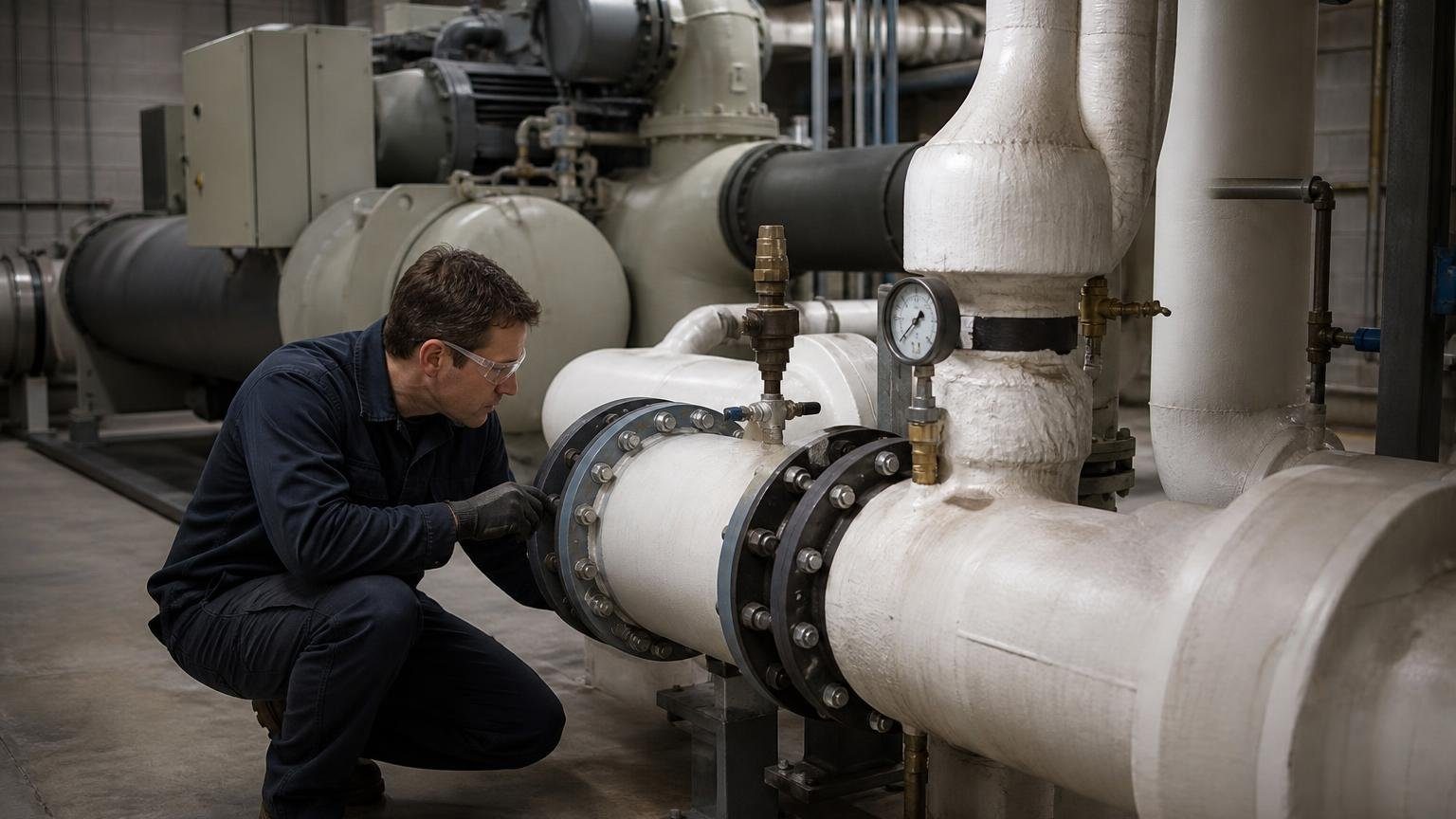
What is a chiller? A chiller is a refrigeration machine that cools water, typically to 42°F to 45°F, then sends it to coils that cool a building’s air. It is the central cooling plant of large commercial buildings, not a household appliance.
Key Takeaways
- A chiller is “a refrigeration system that cools water,” per the DOE FEMP O&M Best Practices Guide.
- Buildings with central chillers were 3.4% of US commercial buildings in 2018 but held 18.5% of the floorspace, by our tabulation of EIA’s 2018 CBECS microdata.
- 41.0% of commercial buildings over 200,000 square feet used chillers in 2018, in the same CBECS tabulation.
- Federal buyers must get a 300 to 399 ton water-cooled centrifugal chiller at 0.544 kW per ton or better at full load, per DOE FEMP.
- Since January 1, 2025, new comfort-cooling chillers may not use an HFC refrigerant with a GWP of 700 or greater, under 40 CFR 84.54.
- A magnetic-bearing centrifugal chiller cut electricity 42.3% against a rotary-screw unit in a 2012 PNNL test for GSA.
What is a chiller in HVAC?
In HVAC, a chiller is the heart of a chilled-water system. It removes heat from water, and pumps carry that water to coils in air handlers and fan coils. The chiller never touches room air.
Chillers are sized in tons, and one ton is 12,000 Btu per hour of heat removal, the same unit used in sizing home air conditioners. The difference is scale: PNNL’s guide for DOE puts typical centrifugal chillers at 100 to 10,000 tons.
So chillers cluster in big buildings. Our weighted tabulation of EIA’s 2018 Commercial Buildings Energy Consumption Survey (CBECS) finds them in about 202,000 of 5.9 million commercial buildings, holding close to a fifth of floorspace, a clear line in how commercial HVAC differs from residential.
How does a chiller work?
A chiller works like any refrigeration machine, with water as the thing being cooled. Refrigerant absorbs heat from building water in the evaporator, the compressor raises its temperature, and the condenser dumps it outdoors. PNNL’s DOE guide names four parts:
- Evaporator. Liquid refrigerant boils on a tube bundle, pulling heat out of the chilled water inside the tubes.
- Compressor. It raises the vapor’s pressure, and with it the temperature.
- Condenser. Hot refrigerant gives its heat to condenser water or outdoor air.
- Expansion valve. Pressure drops back to evaporator level and the cycle repeats.
- The water loops. A pump sends the cold water, typically 42°F to 45°F, to air-handler coils; warmed water returns.
The loop runs on a circulating pump, and cooled air reaches rooms through ducts, often metered by variable air volume boxes. Raising the chilled water setpoint 1°F cuts chiller energy 1.7% for centrifugal and 1.2% for reciprocating machines, per PNNL, if coils can still dehumidify.
Air-cooled vs water-cooled chiller: what is the difference?
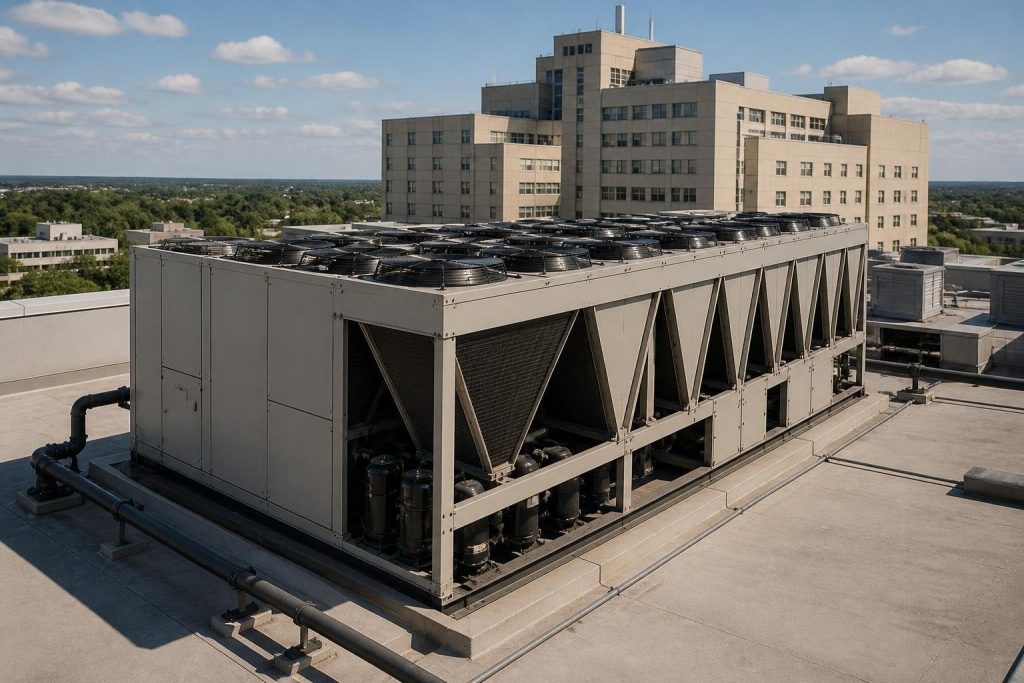
An air-cooled chiller rejects heat through a finned coil and fans, like a giant rooftop condenser. A water-cooled chiller rejects heat into condenser water, which a cooling tower then cools by evaporation.
| Type | Where heat goes | FEMP full-load level | Share of chiller buildings, 2018 | Share of chiller-building floorspace |
|---|---|---|---|---|
| Air-cooled | Outdoor air, via fans and coil | 10.964 EER at 150 tons and up (about 1.09 kW/ton) | 56.0% | 35.4% |
| Water-cooled | Condenser water, then a cooling tower | 0.566 kW/ton, centrifugal, 150 to 299 tons | 44.5% | 67.4% |
| Absorption | Condenser water; driven by heat, usually steam | Not covered by FEMP; about 1.6 Btu of heat per Btu removed | 2.2% | 4.1% |
Sources: DOE FEMP Tables 2.1 and 3.1 (October 2024); kW/ton is 12 divided by EER, our arithmetic. Shares: our weighted EIA 2018 CBECS tabulation; buildings can report several types. Absorption: PNNL-19634.
Water-cooled machines win on the chiller’s own meter, roughly half the kW per ton of air-cooled ones in FEMP’s tables. That leaves out tower fans and pumps, which PNNL says belong in the cost of chilled water. Trane, a maker, says water-cooled units run quieter and air-cooled ones are easier to maintain.
Water-cooled chillers sit in fewer buildings but cover two thirds of chiller floorspace, because they go into the largest ones. EIA separately reports that cooling towers served 3% of commercial buildings and 17% of floorspace in 2018.
What are the main types of chillers?
Types of chillers are named mainly by compressor: centrifugal, screw, scroll, reciprocating and the newer magnetic-bearing centrifugal. Absorption chillers run on heat instead. FEMP’s tables sort electric water-cooled units into two groups, centrifugal and positive displacement.
| Chiller type | How it works | Where it fits | Source |
|---|---|---|---|
| Centrifugal | Spinning impeller, then a diffuser | Typically 100 to 10,000 tons | PNNL-19634 |
| Screw (helical rotary) | Two mating helical rotors squeeze the gas | Historically dominated 100 to 300 tons | PNNL-19634; PNNL for GSA |
| Reciprocating | Pistons; positive displacement | Almost always fixed-speed motors | PNNL-19634 |
| Scroll | Orbiting scroll, positive displacement | One of Trane’s three chiller compressor types (maker claim) | Trane glossary |
| Magnetic-bearing centrifugal | Oil-free shaft levitated on magnetic bearings, built-in variable speed drive | Down to 60 tons | PNNL for GSA |
| Absorption | Heat drives a lithium bromide-water or ammonia-water cycle | Sites with a steam or hot water supply | PNNL-19634 |
The magnetic-bearing design has federal field data. In a PNNL assessment for GSA’s Green Proving Ground, a 150-ton chiller with Danfoss Turbocor compressors replaced a rotary-screw chiller at a federal courthouse in Pine Bluff, Arkansas. Weather-normalized use fell from 294,794 to 170,181 kWh per year, a 42.3% cut.
Part load explains most of it: the plant ran one chiller below 33% load for more than half the cooling season. It is one building monitored for six months in 2012, a demonstration, not a fleet average.
How efficient is a chiller? kW per ton and IPLV, worked out
Chiller efficiency is quoted in kW per ton, electric input per ton of cooling, so lower is better. IPLV, the integrated part-load value, is “a weighted average efficiency at specific partial load factors under rated conditions,” per the PNNL report for GSA. Both are tested under AHRI 550/590.
DOE’s commercial equipment rules in 10 CFR part 431 set no efficiency standard for comfort chillers. Minimums come from ASHRAE Standard 90.1 where an energy code adopts it. FEMP sets a higher federal purchasing bar at the 25th percentile of the most efficient products, paired with ASHRAE 90.1-2022 Path A or Path B minimums.
| Water-cooled centrifugal, capacity | Full load, kW/ton | IPLV, kW/ton |
|---|---|---|
| Under 150 tons | 0.610 | 0.550 |
| 150 to 299 tons | 0.566 | 0.550 |
| 300 to 399 tons | 0.544 | 0.520 |
| 400 to 599 tons | 0.541 | 0.500 |
| 600 tons and up | 0.501 | 0.500 |
Source: DOE FEMP, Table 3.1, full-load-optimized water-cooled electric chillers, updated October 2024. A chiller must meet both columns.
What the gap is worth, in FEMP’s example at 2,000 hours a year:
- A 300-ton chiller at 0.544 kW/ton draws 163.2 kW at full load, or 326,400 kWh a year.
- A less efficient 0.687 kW/ton model draws 206.1 kW, or 412,200 kWh a year.
- The difference is 85,800 kWh a year, about $8,500 at FEMP’s 9.9 cents per kWh.
- Over a 23-year life, discounted, FEMP puts the savings at $128,037.
Chiller vs AC, and chiller vs cooling tower: how do they differ?
An air conditioner cools air directly, with refrigerant boiling inside the coil the air passes over. A chiller adds a water loop: refrigerant cools water, and the water cools the air. A cooling tower is not a chiller at all; it removes the heat a water-cooled chiller rejects.
The water loop lets one central plant serve many air handlers through pipes. Most commercial buildings skip it: by our CBECS tabulation, packaged central units served 43.3% of commercial buildings in 2018, against 3.4% for chillers. VRF systems pipe refrigerant instead.
Which refrigerants can a new chiller use?
Since January 1, 2025, a new comfort-cooling chiller may not use a regulated HFC, or a blend containing one, with a global warming potential of 700 or greater. EPA’s Technology Transitions rule applies it to making, importing and installing chillers, under 40 CFR 84.54(a)(10)(i) and (c)(3).
What this rules out
HFC-134a carries an exchange value of 1,430 in Appendix A to part 84, about twice the limit. Paragraph (b) allows already-made restricted products to be sold for three years. Industrial process chillers follow later dates, starting January 1, 2026. The limits target new equipment, but paragraph (e) treats increasing an existing system’s cooling capacity as a new installation.
The use limits sit on top of the production cuts in the HFC phasedown schedule, which tighten supply for older chillers. Our refrigerant explainer covers the basics.
How we researched this
Research date: October 2026. We opened twelve sources and cite nine. CBECS shares are our weighted tabulation of EIA’s 2018 public-use microdata (6,436 sampled buildings), not EIA-published estimates; we computed no standard errors. Regulation text is the eCFR as of October 1, 2026. FEMP’s worked example calls its 300-ton chiller air-cooled, but its table uses water-cooled centrifugal kW/ton figures, which we follow.
Excluded: installed prices (no federal series exists), contractor and vendor blogs, Wikipedia, and wine, beverage and process chillers. The AHRI 550/590 text blocked our fetches, so rating conditions are named, not quoted. Maker statements are labeled as claims. No Reddit material was used.
Frequently asked questions
Is a chiller a fridge or a freezer?
Neither, in HVAC. A building chiller cools water for air conditioning, typically to 42°F to 45°F according to PNNL’s O&M guide for DOE, which is above freezing. A refrigerator’s chiller drawer or a beverage chiller is a different appliance sharing the name.
What is a chiller used for?
Mostly for cooling large buildings: chilled water is piped to air handlers and fan coils. In EIA’s 2018 CBECS microdata, 41.0% of commercial buildings over 200,000 square feet used central chillers, by our tabulation. Chillers also serve industrial process cooling, which has its own refrigerant dates.
What is a chiller plant?
A chiller plant is the chillers plus everything that supports them: chilled-water pumps, condenser-water pumps, cooling towers and controls. PNNL’s DOE guide warns that tower fans and both sets of pumps belong in the cost of producing chilled water, not just the chiller’s own power draw.
Does a chiller need a cooling tower?
Only a water-cooled chiller does. An air-cooled chiller rejects heat to outdoor air through its own fans and coil. EIA reports that cooling towers served 3% of US commercial buildings, but 17% of commercial floorspace, in 2018, because they concentrate in the largest buildings.
How long does a chiller last?
There is no federal survey of chiller lifespans. For cost-effectiveness math, DOE FEMP assumes a 23-year lifetime and 2,000 operating hours a year. Trane, a manufacturer, says water-cooled chillers can last longer than air-cooled ones when properly maintained; treat that as a maker claim.
What maintenance does a chiller need?
PNNL’s O&M guide for DOE lists removing scale and fouling from heat transfer tubes, purging air from the condenser and keeping condenser water flow and filters clear. Each widens the temperature lift the compressor must overcome. Most of this is commercial service contract work, not a do-it-yourself job.
Sources
- Pacific Northwest National Laboratory for DOE FEMP. “Operations and Maintenance Best Practices: A Guide to Achieving Operational Efficiency, Release 3.0” (PNNL-19634), section 9.4. https://www.pnnl.gov/main/publications/external/technical_reports/PNNL-19634.pdf. Accessed October 2026.
- U.S. Energy Information Administration. “2018 CBECS Survey Data: Microdata.” https://www.eia.gov/consumption/commercial/data/2018/index.php?view=microdata. Accessed October 2026.
- U.S. Energy Information Administration. “Cooling towers in commercial buildings.” https://www.eia.gov/consumption/commercial/reports/2018/cooling/. Accessed October 2026.
- U.S. Department of Energy, FEMP. “Purchasing Energy-Efficient Electric Chillers.” https://www.energy.gov/eere/femp/purchasing-energy-efficient-water-cooled-electric-chillers. Accessed October 2026.
- PNNL for GSA Green Proving Ground. “Variable-speed Oil-free Centrifugal Chiller with Magnetic Bearings Assessment.” https://origin-www.gsa.gov/system/files/GPG_Mag_Lev_FullReport_508_6-17-13.pdf. Accessed October 2026.
- eCFR. “40 CFR 84.54, Restrictions on the use of hydrofluorocarbons.” https://www.ecfr.gov/current/title-40/chapter-I/subchapter-C/part-84/subpart-B/section-84.54. Accessed October 2026.
- eCFR. “Appendix A to Part 84, Regulated Substances.” https://www.ecfr.gov/current/title-40/chapter-I/subchapter-C/part-84/appendix-Appendix%20A%20to%20Part%2084. Accessed October 2026.
- Trane (manufacturer). “What Is a Chiller?” https://www.trane.com/commercial/north-america/us/en/about-us/newsroom/glossary/chillers.html. Accessed October 2026.
- eCFR. “10 CFR Part 431” (searched for chiller standards). https://www.ecfr.gov/current/title-10/chapter-II/subchapter-D/part-431. Accessed October 2026.
Leave a Reply