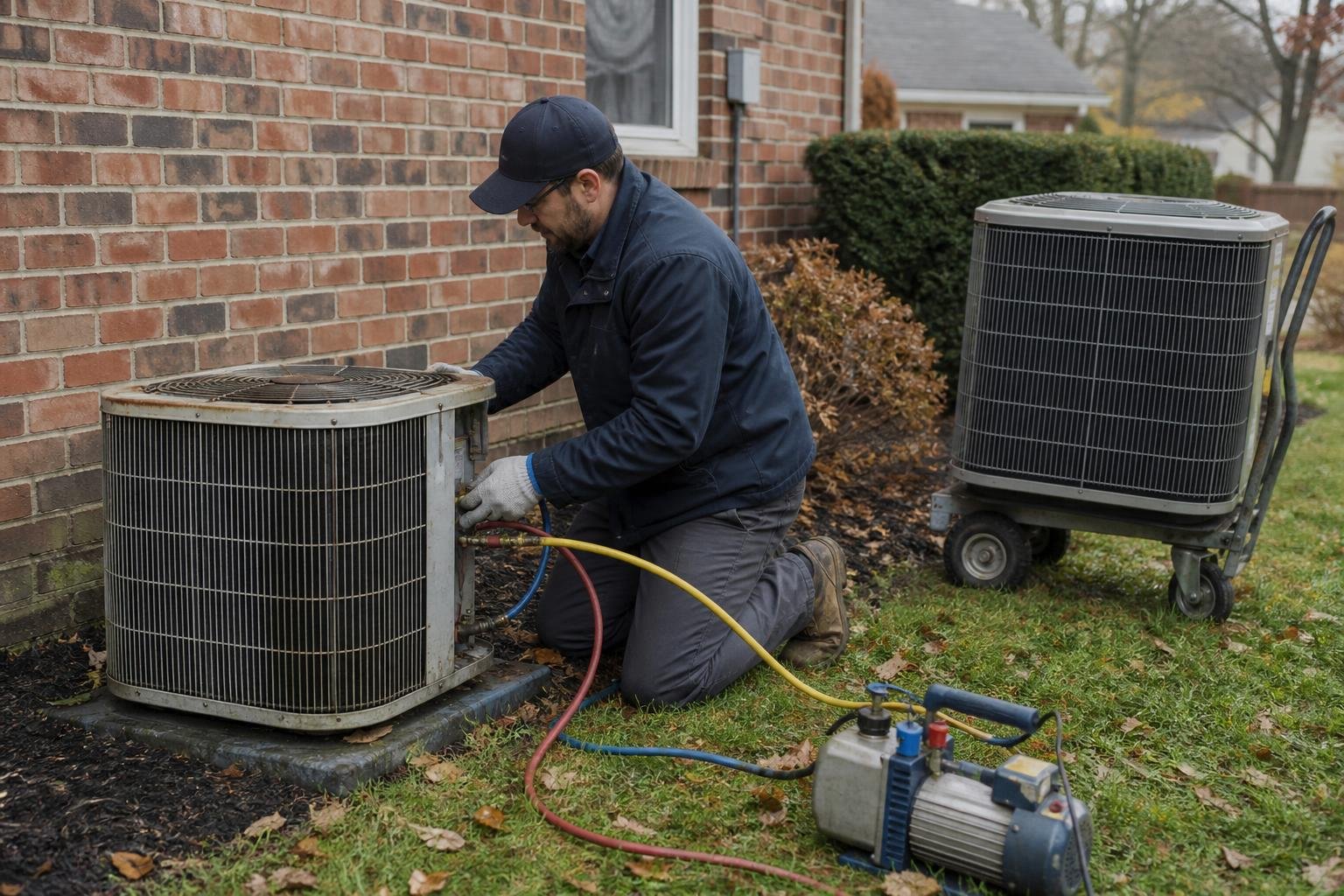
When is heat pump replacement better than repair? Replace when the unit is past EIA’s modelled 15.3 year average life and the fault is a compressor, repeat leak or reversing valve. A rating far below today’s 14.3 SEER2 and 7.5 HSPF2 floor strengthens the case. Otherwise, repair it.
Key Takeaways
- EIA models a 15.3 year average life for a split air source heat pump in its March 2023 equipment cost study.
- EIA’s Weibull parameters imply 27.5 percent of units fail by year 10 and 76.1 percent by year 20 (our calculation).
- Split heat pumps made since 2023 must reach 14.3 SEER2 and 7.5 HSPF2 under 10 CFR 430.32(c)(5).
- At 18.31 cents per kWh (EIA, July 2026), 10 million Btu of heat costs $273.28 at 6.7 HSPF2 and $244.13 at the floor (our arithmetic).
- An EPA rule effective July 27, 2026 lets pre-2025 R-410A equipment keep being installed.
- A2L refrigerants are listed only for new equipment designed for them, so the indoor coil changes too (86 FR 24444).
How long does a heat pump last before replacement is due?
EIA’s modelled answer is 15.3 years for a split air source heat pump. That is an average from a failure curve, so many units die years earlier and some run a decade longer. Age matters most when it coincides with a costly fault.
EIA gives heat pumps one life figure and no range. A footnote supplies the Weibull curve instead: scale 15.88, shape 2, delay 1.
That curve puts the 10th percentile failure at 6.2 years, the median at 14.2 and the 90th percentile at 25.1 (our calculation). The DOE Building America Solution Center says: “The typical lifespan of HVAC equipment is 15 to 20 years.” Our guide to equipment life across system types compares them.
How much does a heat pump replacement save on running costs?
It depends on how far the old unit sits below the 2023 floor. Against EIA’s 2015 installed stock average of 12.4 SEER2 and 6.7 HSPF2, a unit at the federal minimum uses 10.7 percent less electricity for heating and 13.3 percent less for cooling. That is our arithmetic on rated values, not a measured saving.
Each rating is Btu delivered per watt hour, so electricity equals load divided by rating. We used a round 10 million Btu load.
- Heating: 10,000,000 ÷ 6.7 = 1,493 kWh, or $273.28 at 18.31 cents. At 7.5 HSPF2, 1,333 kWh, or $244.13. Gap: $29.15.
- Cooling: 806 kWh, or $147.66, at 12.4 SEER2; 699 kWh, or $128.04, at 14.3 SEER2. Gap: $19.62.
That price is the US residential average for July 2026 (Hawaii: 48.00 cents). Use your own from our state electricity price tracker.
| Unit (EIA, 3 ton split) | SEER2 / HSPF2 | Heat, per 10M Btu | Cooling, per 10M Btu |
|---|---|---|---|
| 2015 installed stock average | 12.4 / 6.7 | 1,493 kWh, $273.28 | 806 kWh, $147.66 |
| 2023 federal minimum | 14.3 / 7.5 | 1,333 kWh, $244.13 | 699 kWh, $128.04 |
| EIA “High” efficiency case | 21.5 / 10.6 | 943 kWh, $172.74 | 465 kWh, $85.16 |
Our arithmetic on EIA ratings and EIA’s July 2026 price.
Units made from 2015 through 2022 met 14 SEER and 8.2 HSPF under 10 CFR 430.32(c)(1), an older test that does not convert one to one. See how the SEER2 minimums work.
Can a heat pump replacement still use R-410A, or must it be A2L?
Both remain legal federally. New R-410A residential systems may not be made or imported after January 1, 2025, but EPA’s rule effective July 27, 2026 lets equipment whose parts predate that cutoff keep being installed, with no end date. Newly made systems use a refrigerant under the 700 limit, such as the A2L R-454B.
Under 40 CFR 84.54(c)(1), systems using a refrigerant with a global warming potential of 700 or greater “may continue to be installed where all specified components of that system are manufactured or imported prior to January 1, 2025.” The rule at 91 FR 31284 removed the earlier end date.
40 CFR 84.52 defines installing as to “complete a field-assembled system’s circuit, including charging with a full charge.” Specified components are condensing units, condensers, compressors, evaporator units and evaporators. Under 84.54(e), raising an existing system’s capacity also counts.
So a failed outdoor unit can be swapped for a same capacity R-410A unit: EPA “did not propose and is not finalizing changes to the treatment of new condensing units used as replacements.” See installing R-410A equipment in 2026.
Legal is not the same as cheap to run
An R-410A system installed today needs R-410A for every future leak repair, and the HFC phasedown steps down again in 2029. Our R-454B explainer covers the replacement.
Why does a heat pump replacement change the indoor coil too?
Because the efficiency rating belongs to the pair. DOE rates single split heat pumps as “Every individual combination distributed in commerce,” so a new outdoor unit on an old coil has no certified rating. A switch to an A2L adds a legal reason.
That rule is 10 CFR 429.16. The Building America guide says to “Verify that the air handler is correctly matched to the outdoor unit.” Ask for the AHRI certificate of the exact pair.
EPA’s 2021 listing at 86 FR 24444 allows A2L refrigerants “only for use in new equipment designed specifically and clearly identified for the refrigerant.” Existing tubing “can be inspected and if suitable re-used,” so, on our reading of that condition, an indoor coil built for R-410A does not qualify for an R-454B system.
A failed coil on a system you keep is a different job: see replacing just the evaporator coil. Charging and commissioning are in what a heat pump install involves.
Should the new heat pump be the same size as the old one?
Not by default. The Building America guide says to size for the design heating or cooling load, whichever is larger, using ACCA Manual J and Manual S. Copying the old nameplate repeats any past sizing error and ignores insulation added since.
A fresh calculation “is especially important if you have done significant air sealing and insulating, which will reduce your heating and cooling load,” the guide adds.
Oversizing costs. EIA notes that when capacity exceeds the load, “the unit starts and stops more frequently, causing wear and tear on the components and an overall loss of efficiency.” See why square footage fails as a sizing rule.
Which failures should tip you toward heat pump replacement?
Three, mainly: a compressor failure out of warranty, a second refrigerant leak, and a failing reversing valve on an older unit. Each opens the sealed refrigerant circuit. Electrical faults rarely justify replacement.
Compressor. It is a specified component under 40 CFR 84.52, so R-410A replacement compressors can still be made and sold. The question is money, and our guide to compressor replacement and warranty terms runs that math.
Repeat leaks. The DOE Energy Saver page (archived copy) warns: “Too much or too little refrigerant, however, reduces heat-pump performance and efficiency.” A second leak on R-410A means buying it again.
Reversing valve. DOE says it “changes the direction of refrigerant flow for cooling and for the winter defrost cycle.” Diagnosis is in our rundown of the faults only heat pumps have.
Repair or heat pump replacement: what does the decision table say?
Repair when the fault is electrical or the unit is young and under warranty. Replace when a sealed system fault hits a unit past about 12 years, when EIA’s curve has 38.1 percent failed. Prices are on our heat pump cost page.
| Situation | Lean | Why |
|---|---|---|
| Capacitor, contactor, fan motor or thermostat fault, any age | Repair | Refrigerant circuit stays closed |
| Any fault under 10 years, parts warranty live | Repair | EIA’s curve has 72.5 percent of units still running at year 10 |
| Compressor failed, out of warranty, over 12 years | Replace | Sealed system job near the 14.2 year median failure |
| Second refrigerant leak on an R-410A system | Replace | Each recharge buys a phased down refrigerant |
| Reversing valve failed, over 12 years | Replace | Sealed system job, limited life left |
| Outdoor unit failed, coil sound, same capacity wanted | Either | Like for like R-410A unit is legal; confirm the pair is AHRI listed |
| Home insulated or air sealed since install | Replace when due, resized | Lower load needs a new Manual J |
Timing is a separate call: see whether to replace now or wait.
How we researched this
Research date: October 5, 2026. We read current eCFR text, the full Federal Register text of both EPA rules, the EIA equipment cost study, EIA Table 5.6.A and the Building America guide. Thirteen sources were consulted and ten are cited.
Percentiles and costs are our arithmetic on EIA values. Excluded: installed prices (no federal series covers replacement jobs), manufacturer life claims, contractor cost surveys and RECS end use averages, which mix heat pumps with resistance heat. Reddit was not used.
Frequently asked questions
How many years should a heat pump last?
EIA models an average life of 15.3 years for a split air source heat pump. Its Weibull parameters (scale 15.88, shape 2, delay 1) imply a median failure at 14.2 years by our calculation, with 10 percent failing by 6.2 years and 10 percent lasting past 25.1 years.
Is it worth replacing a 15 year old heat pump that still works?
Usually not on efficiency alone. Moving from EIA’s 6.7 HSPF2 stock average to the 7.5 HSPF2 floor saves $29.15 per 10 million Btu of heat at 18.31 cents per kWh, by our arithmetic. A quoted sealed system repair on an old unit changes the case.
Can I replace only the outdoor unit of my heat pump?
Legally, often yes on R-410A. EPA’s 2026 rule left replacement condensing units untouched, though under 40 CFR 84.54(e) a capacity increase counts as a new installation. DOE ratings cover only certified pairs, and an A2L outdoor unit needs an indoor coil designed for its refrigerant.
Is R-410A banned for heat pump replacement in 2026?
No. Since January 1, 2025, new R-410A residential systems cannot be made or imported, but 40 CFR 84.54(c)(1) lets systems whose specified components predate that date continue to be installed. EPA’s rule effective July 27, 2026 removed the end date on that inventory.
What efficiency must a replacement heat pump meet?
A split heat pump made since January 1, 2023 must reach at least 14.3 SEER2 and 7.5 HSPF2 under 10 CFR 430.32(c)(5). Heat pumps carry no higher regional minimum. For comparison, EIA’s high efficiency case rates 21.5 SEER2 and 10.6 HSPF2.
Should a replacement heat pump be bigger than the old one?
Only if a load calculation says so. Building America calls for ACCA Manual J and Manual S, sized to the larger of the two loads. EIA notes that oversized units start and stop more often, adding wear and losing efficiency.
Sources
- EIA. “Updated Buildings Sector Appliance and Equipment Costs and Efficiencies,” March 2023. https://www.eia.gov/analysis/studies/buildings/equipcosts/pdf/full.pdf. Accessed September 2026.
- EIA. “Electric Power Monthly, Table 5.6.A, July 2026 and 2025.” https://www.eia.gov/electricity/monthly/epm_table_grapher.php?t=epmt_5_6_a. Accessed September 2026.
- eCFR. “10 CFR 430.32, Energy and water conservation standards and their compliance dates.” https://www.ecfr.gov/current/title-10/chapter-II/subchapter-D/part-430/subpart-C/section-430.32. Accessed September 2026.
- eCFR. “10 CFR 429.16, Central air conditioners and central air conditioning heat pumps.” https://www.ecfr.gov/current/title-10/chapter-II/subchapter-D/part-429/subpart-B/section-429.16. Accessed September 2026.
- eCFR. “40 CFR 84.54, Restrictions on the use of hydrofluorocarbons.” https://www.ecfr.gov/current/title-40/chapter-I/subchapter-C/part-84/subpart-B/section-84.54. Accessed September 2026.
- eCFR. “40 CFR 84.52, Definitions.” https://www.ecfr.gov/current/title-40/chapter-I/subchapter-C/part-84/subpart-B/section-84.52. Accessed September 2026.
- U.S. EPA. “Phasedown of Hydrofluorocarbons: Reconsideration of Certain Regulatory Requirements Promulgated Under the Technology Transitions Provisions,” 91 FR 31284, May 26, 2026. https://www.federalregister.gov/documents/2026/05/26/2026-10387/phasedown-of-hydrofluorocarbons-reconsideration-of-certain-regulatory-requirements-promulgated-under. Accessed September 2026.
- U.S. EPA. “Protection of Stratospheric Ozone: Listing of Substitutes Under the Significant New Alternatives Policy Program,” 86 FR 24444, May 6, 2021. https://www.federalregister.gov/documents/2021/05/06/2021-08968/protection-of-stratospheric-ozone-listing-of-substitutes-under-the-significant-new-alternatives. Accessed September 2026.
- U.S. DOE Building America Solution Center (PNNL). “Traditional Split Heat Pumps.” https://basc.pnnl.gov/resource-guides/traditional-split-heat-pumps. Accessed September 2026.
- U.S. DOE Energy Saver. “Air-Source Heat Pumps,” archived copy. https://web.archive.org/web/2025id_/https://www.energy.gov/energysaver/air-source-heat-pumps. Accessed September 2026.
Leave a Reply