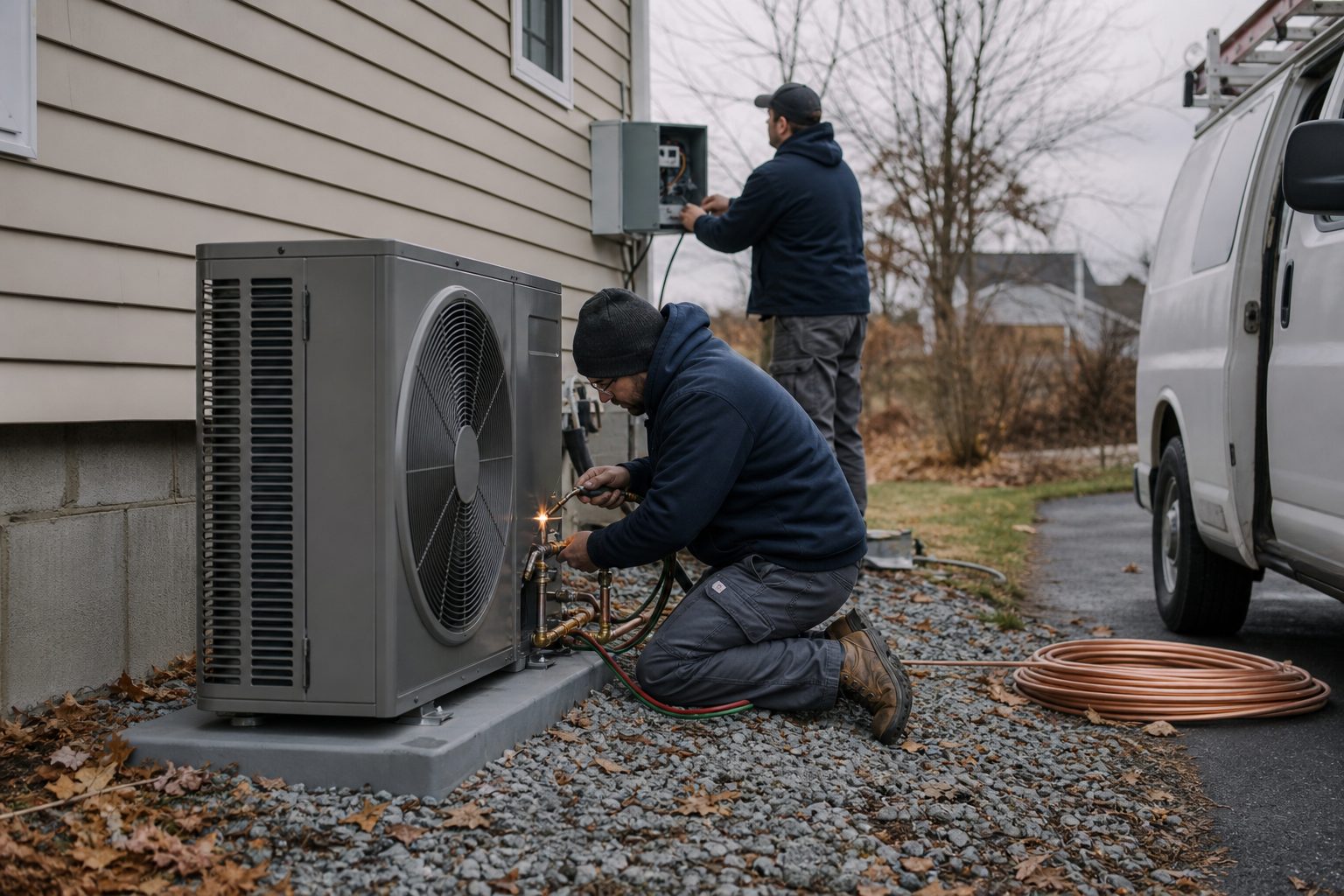
What is the heat pump cost for a whole house? No federal agency measures what installers charge, but the newest federal estimate we located, from EIA, puts a 3-ton ducted air-source heat pump at the 2023 minimum at $6,810 installed, in 2022 dollars. That is a modelled planning figure, not a quote.
Key Takeaways
- EIA models a 3-ton ducted heat pump at $6,810 installed at the 2023 federal minimum, $4,110 of it equipment, in 2022 dollars (EIA, March 2023, p.39).
- DOE’s 2017 model put a 14 SEER split heat pump at $3,875 installed at 2 tons, $4,686 at 3 tons and $7,243 at 5 tons, in 2015 dollars (DOE technical support document, Table 8.2.34).
- LBNL recorded 642 heat pump installations, median $8,027 and $3,387 per ton, in 2019 dollars (LBNL, August 2021).
- Split-system heat pumps must hit 14.3 SEER2 and 7.5 HSPF2 nationally, with no north and south split (10 CFR 430.32(c)(5)).
- HVAC equipment producer prices in August 2026 stood 19.0% above their 2022 average (BLS series PCU333415333415).
What does a heat pump cost in federal data?
One modelled figure carries most of the weight: $6,810 installed for a 3-ton ducted split air-source heat pump at the 2023 federal minimum, in 2022 dollars, from EIA. A national lab benchmark of real projects runs higher, $8,027 median in 2019 dollars.
Neither is a transaction price. EIA’s study, prepared by Guidehouse and Leidos, builds cost from RSMeans data and the AHRI directory. LBNL’s 2021 report recorded 642 heat pump installations from energy program records, a subsidised sample.
The data gap
No federal statistical series measures installed heat pump prices. BLS publishes producer price indexes for the factory gate, not the driveway. Every number below is a regulatory model or a program database, and each carries a dollar year that is not 2026.
The $6,810 also appears in our side by side reading of heat pumps against cooling-only equipment. Here the point is the heat pump figure itself, tier by tier.
How does heat pump cost change with efficiency tier?
By about $1,810 across EIA’s 2023 range. The minimum tier models at $6,810 installed, ENERGY STAR at $6,940, and the high tier at 21.5 SEER2 and 10.6 HSPF2 at $8,620, all in 2022 dollars at 36,000 Btu per hour.
| EIA tier, 3-ton ducted split heat pump | SEER2 | HSPF2 | Equipment (2022$) | Installed (2022$) |
|---|---|---|---|---|
| 2022 standard, now closed | 14.0 SEER | 8.2 HSPF | $3,970 | $6,730 |
| 2023 standard, current floor | 14.3 | 7.5 | $4,110 | $6,810 |
| ENERGY STAR V6.1 | 15.2 | 7.8 | $4,380 | $6,940 |
| ENERGY STAR cold climate criteria | 15.2 | 8.1 | $4,380 | $6,940 |
| High tier | 21.5 | 10.6 | $6,740 | $8,620 |
| 2015 installed base | 12.4 | 6.7 | $3,290 | $5,790 |
Moving from the floor to ENERGY STAR adds $130 in EIA’s model. The high tier adds $1,810, because it means variable-speed hardware rather than a better coil.
The floors are set in the SEER2 rules that replaced SEER in 2023. EIA’s advanced case, in Appendix B, holds every cost identical while raising typical efficiency, summarised on its page 40 as “Higher typical efficiencies with the same costs as reference case despite increased efficiency”. A modelling assumption, not a measurement.
How does heat pump cost scale with capacity?
Less than proportionally overall, and faster than proportionally on labour. In DOE’s 2017 model a 14 SEER split heat pump cost $3,875 installed at 2 tons, $4,686 at 3 tons and $7,243 at 5 tons, in 2015 dollars. The 5-ton unit is 2.5 times the capacity at 1.87 times the cost.
| Split heat pump, 14 SEER and 8.2 HSPF | Installation labour (2015$) | Total installed (2015$) | Labour share |
|---|---|---|---|
| 2 ton, 24,000 Btu per hour | $920 | $3,875 | 23.7% |
| 3 ton, 36,000 Btu per hour | $1,425 | $4,686 | 30.4% |
| 5 ton, 60,000 Btu per hour | $3,031 | $7,243 | 41.8% |
Labour shares are our arithmetic on DOE’s Table 8.2.30 and Table 8.2.34, and DOE states it expresses all costs in 2015 dollars. LBNL points the same way: $3,387 per ton median across 642 installations, and dropping half a ton cut recorded cost by roughly $1,250.
That scaling is the reason to settle capacity before price, and a load calculation sets it, as we cover in why square footage fails as a sizing input. Oversizing by a ton is a four-figure decision in every table above.
Does a ductless heat pump cost less than a ducted one?
Per system yes, per ton roughly the same. EIA prices a single 12,000 Btu per hour ductless mini split at $2,030 installed against $6,810 for the 3-ton ducted system, both in 2022 dollars. Per ton that is $2,030 against $2,270, a far smaller gap than the headline numbers suggest.
The comparison is not like for like, and EIA says so. Its ductless figures came from smaller 24,000 Btu per hour split heat pumps priced against RSMeans 2023 data, and the unit conditions one zone, not a house. LBNL put the ductless median at $4,397 in 2019 dollars, above its ducted figures, because those projects carried higher efficiency and often several heads. More detail is in our mini split cost breakdown.
Duct condition is the hidden variable. A ducted heat pump inherits whatever ducts exist, which is why we treat duct work as its own cost line.
What do the 2023 federal minimums do to the floor price?
They lifted EIA’s modelled floor by $80, from $6,730 to $6,810 in 2022 dollars, and set one national number rather than two. Split-system heat pumps made on or after January 1, 2023 must reach 14.3 SEER2 and 7.5 HSPF2 under 10 CFR 430.32(c)(5).
The regional split that applies to air conditioners does not apply to heat pumps. 10 CFR 430.32(c)(6) imposes the higher southeast and southwest SEER2 levels on air conditioner classes only, so buyers in Georgia and Michigan face the same heat pump minimum. Single-package heat pumps sit lower, at 13.4 SEER2 and 6.7 HSPF2.
So a 2022-dated figure and a 2023-dated figure describe different legal products. The distinction also shapes the separate cooling-only cost picture, where north and south minimums diverge.
Why do cold climate heat pumps cost more?
In EIA’s table they do not, which is itself the finding. EIA gives the ENERGY STAR cold climate criteria column the same $6,940 installed cost as the standard ENERGY STAR column, in 2022 dollars, while raising HSPF2 from 7.8 to 8.1. No premium is modelled.
The performance bar is real even if the price is not separated. To carry the cold climate designation, ENERGY STAR requires a ducted split system to reach 8.1 HSPF2 and 15.2 SEER2, deliver a COP at 5 degrees F of at least 1.75, and hold at least 70% of its 47 degrees F capacity at 5 degrees F. Hardware that does this is generally variable-speed, which is where EIA’s $8,620 high tier sits.
The defensible statement is narrow: federal modelling prices no cold climate premium, and the closest proxy is the gap between the standard and high tiers. The rating mechanics are in our breakdown of what those criteria test.
Which electrical work is often the real budget item?
The service panel. A heat pump adds a heating load the house previously met with gas or oil, and older panels often cannot carry it. LBNL puts a typical 200 amp service upgrade at $1,954, and the two recorded in its database averaged $1,993, both in 2019 dollars.
None of the equipment tables includes that. EIA’s installed cost covers the unit and its installation, and DOE’s covers refrigerant lines, the indoor unit, thermostat wiring and labour. Neither prices a panel swap, a dedicated circuit, a meter change or a utility service upgrade. The literature LBNL reviewed reported electrical upgrades of $600 to $1,000 for ductless projects alone.
So a quote far above the modelled figures may simply include electrical work the model never counted. The load matters before the panel does, so the draw figures by equipment class are the place to start, and the install-day sequence is in what differs when the equipment is a heat pump.
What is a 2022 heat pump cost worth in 2026 dollars?
About $8,110 if the whole bill had tracked equipment prices, and that is our arithmetic, not EIA’s. The BLS producer price index for air-conditioning, refrigeration and forced air heating equipment manufacturing averaged 272.893 in 2022 and reached 324.820 in August 2026, up 19.0%.
- Start from EIA’s modelled installed cost at the 2023 minimum, $6,810 in 2022 dollars.
- Index ratio: 324.820 divided by 272.893 equals 1.1903.
- $6,810 times 1.1903 gives $8,105, which we report as $8,110.
- Equipment alone: $4,110 times 1.1903 gives $4,892, reported as $4,890.
Step 4 is the defensible one, because the index measures equipment. Applying it to the full $6,810 assumes labour, markup and tax moved at the same rate, which the index does not test, so treat $8,110 as an upper reference only. That index is tracked in our August producer price report.
What these heat pump cost figures are not
They are planning inputs, not prices anyone was quoted. Here is what they leave out.
- Not a quote. EIA and DOE build it from manufacturer cost, markups, tax and modelled labour.
- Not today’s dollars. They are 2022 dollars at EIA, 2015 at DOE and 2019 at LBNL.
- Not your region. EIA models one national ducted heat pump, with no state breakdown.
- Not a random sample. LBNL’s 642 installations came from energy program records.
- Not electrical or duct work. Panel upgrades, circuits, permits and duct changes sit outside every table.
- Not the whole system. Replacing a furnace and an air conditioner together is a different job.
- Not net of incentives. The tables are gross of any tax credit or utility rebate.
Those last two have their own pages: our whole-system replacement explainer and our note on the expired 25C credit.
How we researched this
Research date: September 29, 2026. We read the EIA equipment cost study and its Appendix B, the DOE 2017 technical support document, the LBNL retrofit cost report, 10 CFR 430.32, the ENERGY STAR criteria and BLS series PCU333415333415. We consulted 9 sources and cite 7.
Excluded: contractor and vendor price surveys, because no federal or national-lab series stands behind them; AHRI shipment data, because unit counts do not price equipment; and any figure we could not match to a table we opened. Reddit was not used. The labour shares and the inflation adjustment are our calculations and are labelled as such.
Freshness: the regulatory text and the price index are current to 2026, while the dollar years are 2022 for EIA, 2019 for LBNL and 2015 for DOE. EIA’s March 2023 edition is still current. Updates: the price adjustment monthly, the installed figures when EIA or DOE publishes new ones.
Frequently asked questions
How much does a heat pump cost installed?
EIA models a 3-ton ducted air-source heat pump at $6,810 installed at the 2023 federal minimum, in 2022 dollars, of which $4,110 is equipment. LBNL recorded a higher median, $8,027 across 642 real installations in 2019 dollars. Both are planning figures, not quotes.
Is there a federal average price for a heat pump?
No. No federal statistical series measures installed heat pump prices. BLS measures producer prices at the factory gate, and Census measures construction spending, not equipment line items. The federal figures that exist were built to test efficiency standards, which is why each carries a dollar year.
Does a 5-ton heat pump cost twice as much as a 2-ton?
Not quite. In DOE’s 2017 model a 14 SEER split heat pump cost $3,875 installed at 2 tons and $7,243 at 5 tons, in 2015 dollars, so 2.5 times the capacity cost 1.87 times as much. Labour rose fastest, from $920 to $3,031.
Do cold climate heat pumps cost more in federal data?
EIA models no premium. It gives the ENERGY STAR cold climate criteria the same $6,940 installed cost as standard ENERGY STAR, in 2022 dollars, while raising HSPF2 from 7.8 to 8.1. ENERGY STAR separately requires a COP at 5 degrees F of at least 1.75.
What electrical work does a heat pump need?
Usually a dedicated 240 volt circuit, and sometimes a service upgrade. LBNL puts a typical 200 amp panel upgrade at $1,954 in 2019 dollars. No equipment table on this page includes that work, so a quote can exceed the modelled figures for that reason alone.
Are these figures still accurate in 2026?
They are dated, not wrong. HVAC equipment producer prices in August 2026 stood 19.0% above their 2022 average. Adjusting the $4,110 equipment row by that index gives $4,890, and adjusting the whole $6,810 gives $8,110, which is our arithmetic and an upper reference only.
Sources
- US Energy Information Administration. “Updated Buildings Sector Appliance and Equipment Costs and Efficiencies.” https://www.eia.gov/analysis/studies/buildings/equipcosts/pdf/full.pdf. Accessed September 2026.
- US Energy Information Administration. “Appendix B: Advanced Case.” https://www.eia.gov/analysis/studies/buildings/equipcosts/pdf/appendix-b.pdf. Accessed September 2026.
- US Department of Energy. “Technical Support Document: Residential Central Air Conditioners and Heat Pumps.” https://downloads.regulations.gov/EERE-2014-BT-STD-0048-0098/attachment_1.pdf. Accessed September 2026.
- Lawrence Berkeley National Laboratory. “The Cost of Decarbonization and Energy Upgrade Retrofits for US Homes.” https://escholarship.org/uc/item/0818n68p. Accessed September 2026.
- Office of the Federal Register. “10 CFR 430.32.” https://www.ecfr.gov/current/title-10/section-430.32. Accessed September 2026.
- ENERGY STAR. “Heat Pump Equipment Key Product Criteria.” https://www.energystar.gov/products/heating_cooling/heat_pumps_air_source/key_product_criteria. Accessed September 2026.
- US Bureau of Labor Statistics. “Series PCU333415333415.” https://data.bls.gov/timeseries/PCU333415333415. Accessed September 2026.
Leave a Reply