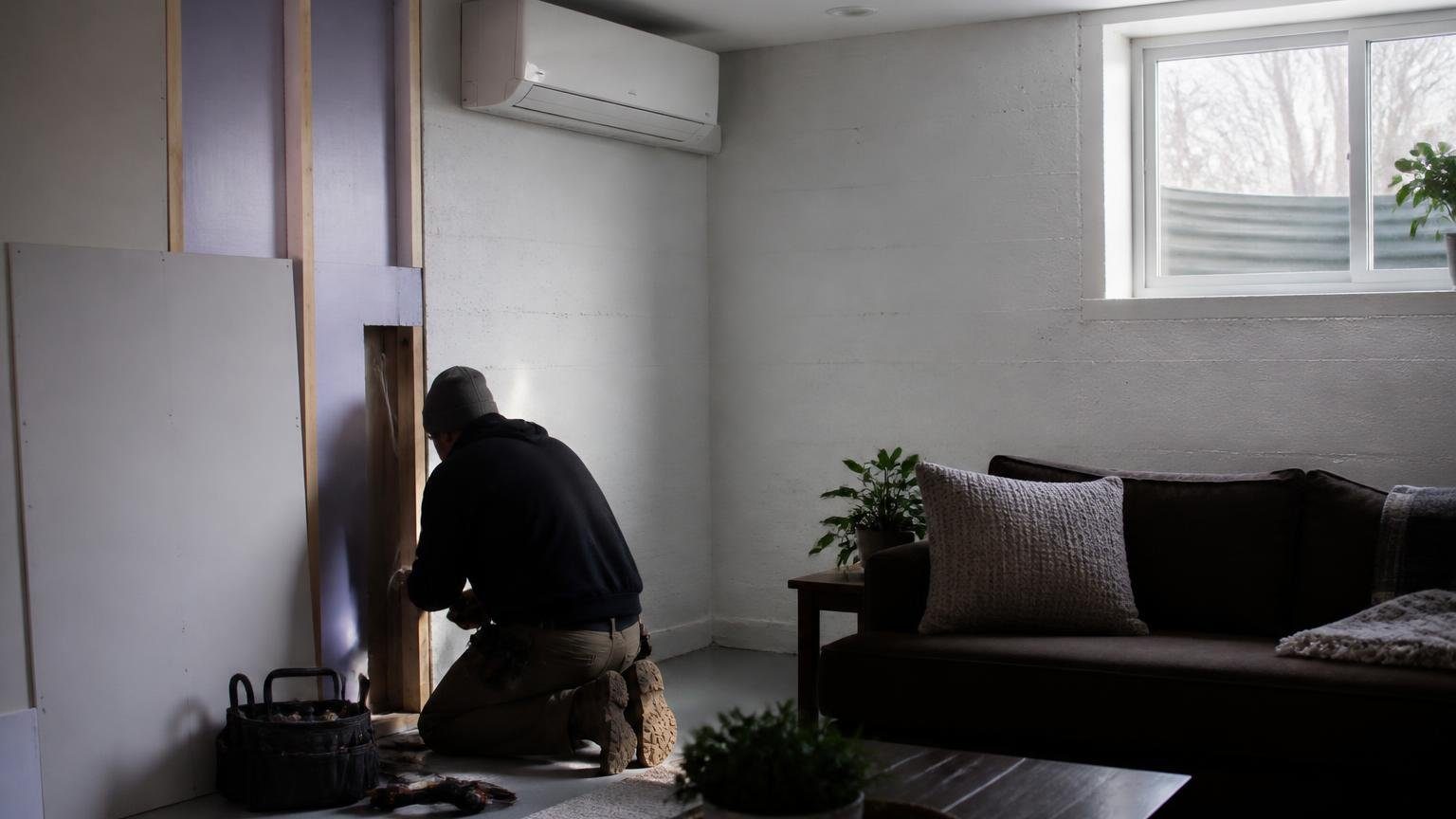
How to heat a basement? Insulate and air-seal the walls first, then extend what the house already has (spare duct capacity or a boiler zone) or add a ductless mini split. At January 2026 US prices, electric resistance heat cost about three times as much per delivered Btu as an 80% gas furnace.
Key Takeaways
- IRC R303.10, as adopted in Washington’s WAC 51-51-0303, requires heat that holds 68°F in habitable rooms; portable heaters do not count.
- The 2021 IECC asks for R-15ci basement wall insulation (or alternatives) in climate zones 5 to 8, per DOE Building America.
- Electric resistance heat costs $51.14 per million Btu delivered at January 2026’s 17.45 cents per kWh (EIA Table 5.3).
- A heat pump at the federal minimum HSPF2 of 7.5 cuts that to $23.27; an 80% gas furnace delivers heat for $16.84 at $13.96 per Mcf (EIA).
- DOE calls mini splits ideal where extending ductwork is not feasible (Energy Saver, archived copy).
- DOE does not recommend unvented combustion space heaters indoors because of carbon monoxide risk (Energy Saver, archived copy).
What is the best way to heat a basement?
The best way to heat a basement depends on what the house already has. If the furnace has spare capacity, extend the ducts; if a boiler serves the house, add a zone; if neither fits, a ductless mini split is the efficient default. Plug-in electric heat is cheapest to buy and costliest to run.
Costs below use US average residential prices for January 2026 and federal minimum efficiencies, so most new equipment beats them.
| Option | Best fit | Cost per million Btu delivered | Watch for |
|---|---|---|---|
| Extend gas furnace ducts | Furnace and blower with spare capacity | $16.84 at 80% AFUE; $14.18 at 95% | Needs a return path and a static pressure check |
| Hydronic zone off a gas boiler | Homes already on hot water heat | $16.04 at 84% AFUE | Boiler output and a zone valve or circulator |
| Ductless mini split | No ducts, or ducts at capacity | $23.27 at HSPF2 7.5 | Also cools; cold-climate rating matters |
| Electric baseboard | Small rooms, low install budget | $51.14 | Circuit capacity at the panel |
| Electric radiant floor | Tile or slab floors, bathrooms | $51.14 | DOE: pays off mainly with thermal mass and time-of-use rates |
| Plug-in electric space heater | Short, occasional use | $51.14 | Cannot satisfy the code heating rule |
| Unvented gas or kerosene heater | None | Not rated | DOE: not recommended indoors (CO) |
Why is a basement hard to heat, and what should you fix first?
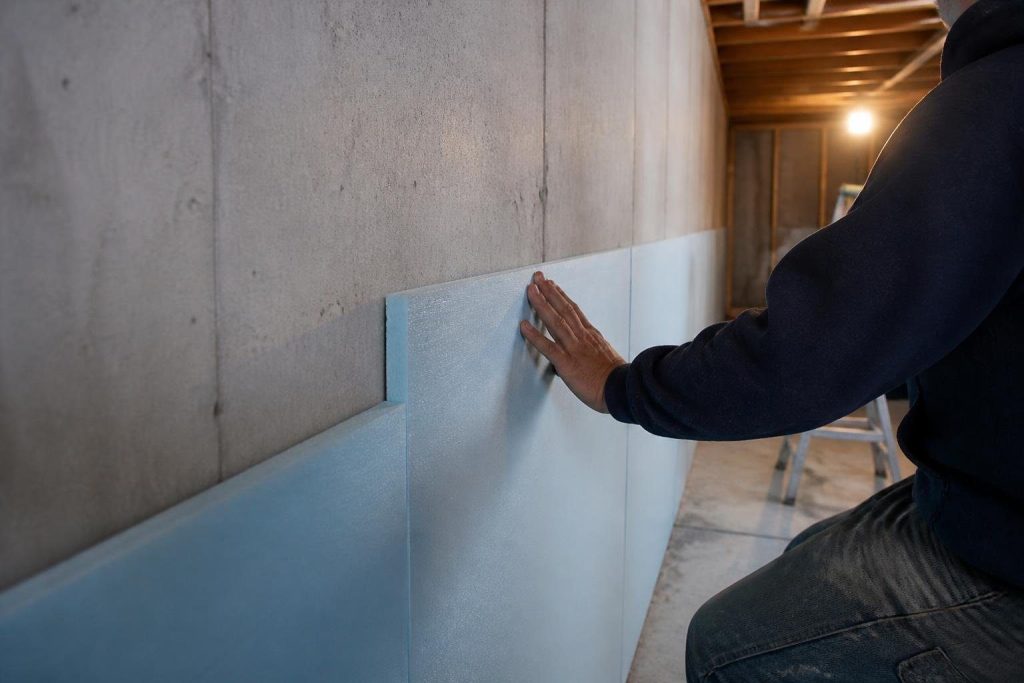
A basement is cold because of bare concrete, a leaky rim joist and no supply or return of its own. Below grade, DOE’s Building America program notes that winter ground temperatures are often warmer than winter air, so a basement loses less heat than the above-grade walls of the house.
So insulate first. The 2021 IECC minimums are below; your state may enforce an older or amended edition.
| IECC climate zone | 2021 IECC basement wall R-value |
|---|---|
| Climate zones 1 and 2 | None required |
| Climate zone 3 | 5ci or 13 |
| Climate zone 4 (except Marine) | 10ci or 13 |
| Climate zones 5, 6, 7, 8 and Marine 4 | 15ci or 19 or 13+5ci |
“ci” means continuous insulation such as foam board; the other figures are stud-cavity insulation. Work in this order:
- Fix water first: grading, gutters and any seepage. Insulating a wet wall traps the problem.
- Air-seal the rim joist and any open penetrations.
- Insulate the walls to at least the value for your zone.
- Control humidity.
- Only then size the heat for the load that is left.
For step 4, use our indoor humidity targets, and handle fresh air and radon in a basement separately from heat.
How do you heat a basement without ductwork?
To heat a basement without ductwork, use a ductless mini split, electric baseboard, a hydronic zone off an existing boiler, or radiant floor heat. DOE describes mini splits as ideal for additions where extending ductwork is not feasible, which describes most finished basements.
Mini split. DOE says the outdoor unit can sit up to 50 feet from the indoor unit and many models run up to four indoor heads from one outdoor unit. It also cools. Our federal mini split cost figures cover price; in zones 5 and colder, a cold climate rated heat pump keeps its output on the coldest nights.
Electric baseboard. Cheap to install and silent, but at the top of the cost table. Our baseboard sizing and wattage guide works through the numbers.
Hydronic zone. If the house already has boiler and baseboard heat, a new basement loop with its own thermostat is often the cheapest heat to run, if the boiler has output to spare.
Radiant floor. DOE says hydronic radiant is the most popular and cost-effective radiant system in heating-dominated climates. It adds that electric radiant floors usually pay off only with thermal mass and time-of-use rates, and that mini splits operate more efficiently. Our hydronic vs electric radiant comparison has the detail.
Should you extend ductwork to the basement?
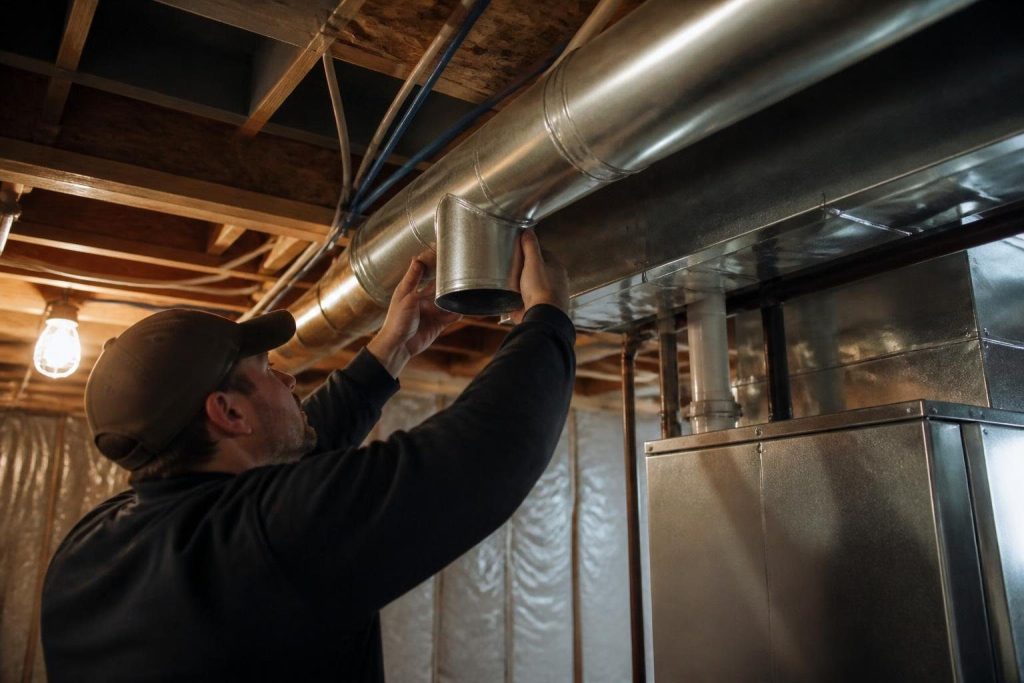
Extend ductwork to the basement only if the furnace and blower have spare capacity and you can add a return. Supply registers with no return path can raise duct pressure and starve upstairs rooms.
Before cutting in, have a technician measure total external static pressure against the furnace nameplate, then rebalance with dampers. One upstairs thermostat can still leave the basement cold; see balancing airflow between floors. DOE notes duct losses can exceed 30% of space-conditioning energy when ducts run through unconditioned space; ducts inside an insulated basement lose their heat into the house instead.
What is the cheapest way to heat a basement?
The cheapest way to heat a basement in winter is usually an extension of a natural gas system, followed by a heat pump; plug-in electric heat is cheapest to buy but costs the most per hour. Rerun the arithmetic with your own bill.
- Electric resistance: 17.45 cents divided by 3,412 Btu, times one million, is $51.14 per million Btu (EIA conversion factors).
- Heat pump: the federal minimum in 10 CFR 430.32 for split heat pumps is HSPF2 7.5, a seasonal efficiency of about 2.2 times resistance heat, so $51.14 becomes $23.27.
- Gas: $13.96 per Mcf divided by 1.036 million Btu is $13.47 of fuel per million Btu. At the 80% AFUE furnace minimum that is $16.84 delivered; at 95% it is $14.18.
- Gas boiler: at the 84% AFUE minimum for gas hot water boilers, $16.04.
A 1,500 watt plug-in heater makes 5,118 Btu per hour; eight hours uses 12 kWh, or $2.09 at the January 2026 average. Our space heater running cost and fire data has more cases.
What does code require when heating a finished basement?
When heating a finished basement with habitable rooms, IRC R303.10 applies wherever a jurisdiction has adopted it and the winter design temperature is below 60°F. The Washington adoption reads: heating must maintain “a minimum room temperature of 68°F” at a point 3 feet above the floor and 2 feet from exterior walls, at design temperature.
The same section adds: “The installation of one or more portable heaters shall not be used to achieve compliance with this section.” So a basement bedroom needs permanent heat, and adding ducts, a boiler zone or a mini split usually needs a permit, depending on local code.
Are basement space heaters safe?
Electric space heaters are reasonably safe for occasional use when plugged straight into the wall; unvented gas, propane or kerosene heaters are not. DOE says electric heaters should be plugged directly into the wall outlet, and if a cord is unavoidable, use the shortest heavy-duty cord of 14-gauge wire or larger. Choose one with a tip-over switch.
Combustion heat below grade
DOE says unvented combustion space heaters are not recommended inside the home because of the risk of carbon monoxide poisoning, and they add water vapor that can lead to mold. For basements, DOE’s Building America guidance strongly recommends sealed combustion equipment plus carbon monoxide detectors. See our CO alarm placement rules.
How we researched this
Researched October 13, 2026. The top three ranking articles (two vendors, one equipment maker) linked no code section, R-value table or reproducible running cost. We consulted 17 primary documents and cited 10: the Washington adoption of IRC R303, DOE Building America and Energy Saver pages (archived copies where live pages now fail), EIA tables and 10 CFR 430.32.
Running costs use January 2026 US averages; local prices differ. Installed prices are excluded: no federal series covers them. Heating oil and propane are left out of the cost table; the same arithmetic works with EIA heat contents of 138,500 Btu per gallon of heating oil and 91,452 for propane. No Reddit or forum content was used, because the topic includes carbon monoxide.
Frequently asked questions
What is the cheapest way to heat a basement?
Extending an existing natural gas furnace or boiler is usually cheapest to run: $16.84 per million Btu delivered at 80% AFUE and January 2026 US prices, against $23.27 for a heat pump at the federal minimum and $51.14 for any electric resistance heater. A plug-in heater suits occasional use only.
How cold will an unheated basement get?
There is no single figure; climate, soil, insulation and furnace heat all change it. DOE’s Building America program notes that winter ground temperatures are often warmer than winter air, so below-grade walls lose less heat than above-grade walls. Insulating to the IECC value for your climate zone narrows the gap.
How do you heat a 1,000 square foot basement?
Start with a load calculation, not square footage. Then pick the source: spare furnace capacity, a boiler zone or a mini split. DOE notes many mini splits run up to four indoor heads from one outdoor unit, which suits a basement with several rooms.
Can a space heater be the only heat in a finished basement?
Not for code purposes. IRC R303.10, as adopted in Washington’s WAC 51-51-0303, states that portable heaters shall not be used to achieve compliance with the 68°F heating requirement for habitable rooms. A finished bedroom or family room needs permanent heat.
Is a mini split good for a basement?
Yes. At the federal minimum HSPF2 of 7.5 it delivers heat for $23.27 per million Btu at January 2026 US prices, less than half the cost of baseboard heat, and it also cools in summer. DOE says the outdoor unit can sit up to 50 feet from the indoor unit.
Should you insulate basement walls before adding heat?
Yes. Insulation shrinks the load, so the heater can be smaller and cheaper to run. The 2021 IECC calls for 10ci or 13 in climate zone 4 (except Marine) and 15ci or 19 or 13+5ci in zones 5 to 8. Fix water problems first, because insulation over a wet wall traps moisture.
Sources
- Washington State Legislature. “WAC 51-51-0303, Section R303: Light, ventilation and heating (state adoption of the International Residential Code).” https://app.leg.wa.gov/WAC/default.aspx?cite=51-51-0303. Accessed October 2026.
- US DOE Building America Solution Center (PNNL). “2009 to 2021 IECC and IRC Minimum Insulation Requirements for New Homes.” https://basc.pnnl.gov/information/2009-2021-iecc-and-irc-minimum-insulation-requirements-new-homes. Accessed October 2026.
- US DOE Building America Solution Center (PNNL). “Air Sealed, Insulated Basements.” https://basc.pnnl.gov/resource-guides/air-sealed-insulated-basements. Accessed October 2026.
- US DOE Energy Saver. “Ductless Mini-Split Heat Pumps (archived copy).” https://web.archive.org/web/20250111013928/https://www.energy.gov/energysaver/ductless-mini-split-heat-pumps. Accessed October 2026.
- US DOE Energy Saver. “Radiant Heating (archived copy).” https://web.archive.org/web/20250102075902/https://www.energy.gov/energysaver/radiant-heating. Accessed October 2026.
- US DOE Energy Saver. “Small Space Heaters (archived copy).” https://web.archive.org/web/20240915192832/https://www.energy.gov/energysaver/portable-heaters. Accessed October 2026.
- US Energy Information Administration. “Electric Power Monthly, Table 5.3: Average Price of Electricity to Ultimate Customers.” https://www.eia.gov/electricity/monthly/epm_table_grapher.php?t=epmt_5_3. Accessed October 2026.
- US Energy Information Administration. “US Price of Natural Gas Delivered to Residential Consumers (monthly).” https://www.eia.gov/dnav/ng/hist/n3010us3m.htm. Accessed October 2026.
- US Energy Information Administration. “Units and calculators explained: British thermal units.” https://www.eia.gov/energyexplained/units-and-calculators/british-thermal-units.php. Accessed October 2026.
- Code of Federal Regulations. “10 CFR 430.32, Energy and water conservation standards and their compliance dates.” https://www.ecfr.gov/current/title-10/chapter-II/subchapter-D/part-430/subpart-C/section-430.32. Accessed October 2026.
Leave a Reply