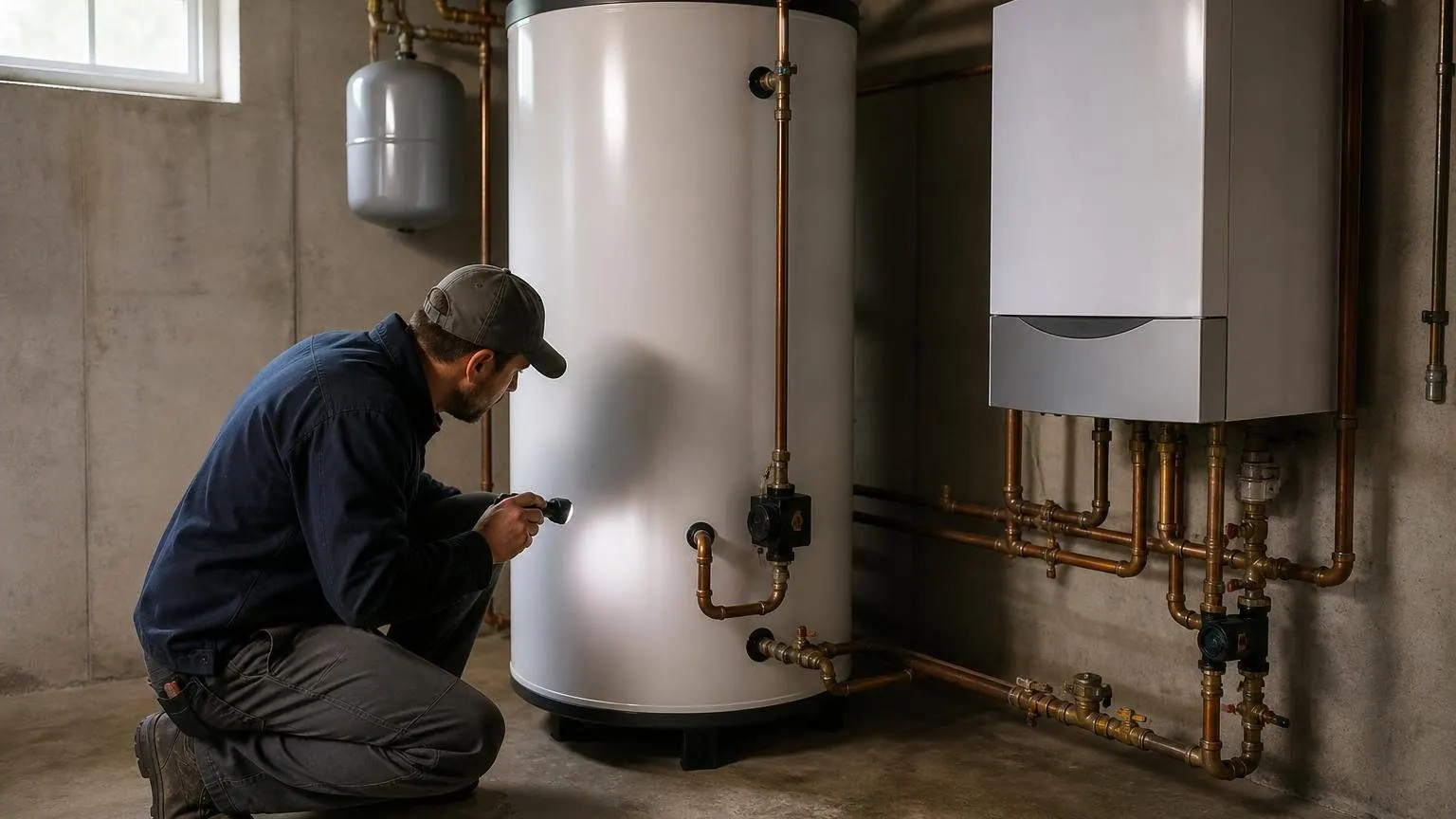
What is an indirect water heater? It is an insulated tank with no burner of its own: hot boiler water runs through a coil inside it and heats your tap water. DOE calls it a more efficient choice for most homes, and federal water heater standards do not cover it.
Key Takeaways
- 10 CFR 430.2 defines water heaters as products using “oil, gas, or electricity.” An indirect tank uses boiler water, and DOE called indirect water heaters “non-covered products” in 2009.
- AHRI certifies indirect tanks of 120 gallons or less under AHRI 1400, testing standby loss, first draw and continuous draw.
- Bradford White rates its 43 gallon SW-2-50R-L at a 210 gallon first-hour delivery, a rating obtained with a 120,000 Btu/h heat source and 180°F boiler water (maker spec sheet).
- Priority wiring holds off space heating until the tank is hot; Amtrol warns a failed circulator or thermostat could delay heat “indefinitely” (BoilerMate manual).
- Published standby losses run 0.6 to 0.9°F per hour on 43 to 50 gallon models from Bradford White and US Boiler (Alliance data sheet).
What is an indirect water heater?
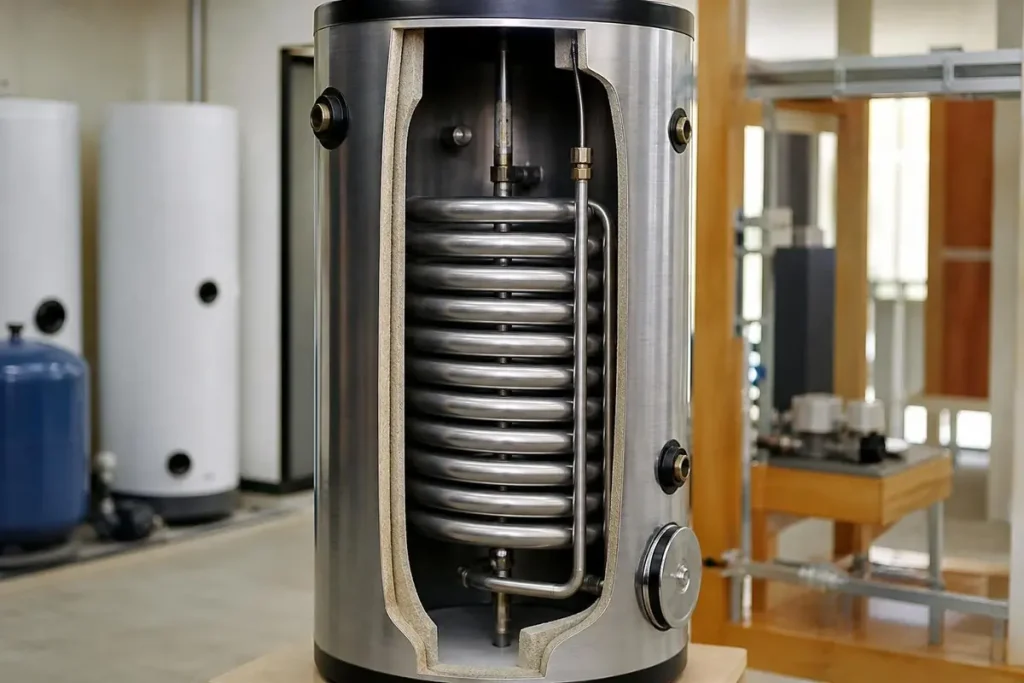
An indirect water heater is a storage tank heated by a boiler instead of its own burner or element. The boiler’s water flows through a coil (or inner tank) inside the vessel and heats the potable water around it, which feeds your faucets.
The two waters never mix. DOE describes the boiler or furnace heating “a fluid that’s circulated through a heat exchanger in the storage tank” (DOE Energy Saver, archived copy). In practice the tank is one zone on a hot water heating system, so it only makes sense in a home with a boiler.
How does an indirect water heater work?
An indirect water heater works as one more heating zone. A thermostat in the tank calls for heat, the boiler fires, and a pump or valve sends boiler water through the tank’s coil until the stored water reaches its setpoint.
- Hot water use drops the tank temperature, and the tank aquastat closes.
- The call starts a dedicated circulator or opens a zone valve on the boiler loop.
- Boiler water, rated at 180°F in most maker tables, passes through the coil and returns to the boiler cooler. Amtrol says that if supply and return differ by less than 20°F during a cold start, the coil may be fouled.
- The aquastat opens at setpoint, the pump or valve stops, and the boiler returns to space heating or shuts off.
Amtrol’s manual recommends a separate circulator; if a zone valve feeds the tank instead, it calls for a full-port valve and 3 to 5 gpm with all zones running.
What is a boiler priority zone, and do you need one?
A boiler priority zone is wiring that serves the indirect tank first: while the tank calls, space-heating zones wait. Amtrol’s BoilerMate manual offers both options. In a non-priority system, the tank “will be supplied just as another zone,” so with every zone calling it may not recover adequately.
Priority fixes that, with a tradeoff Amtrol spells out: space heating waits until the tank reaches setpoint, usually unnoticed, but a circulator or thermostat failure could leave heat “delayed indefinitely” and pipes at risk of freezing (Amtrol BoilerMate manual, 2025). For a boiler that “lacks output for simultaneous heat & hot water,” Amtrol’s fix is priority.
Is an indirect water heater covered by federal water heater standards?
No, as far as the regulation text shows. 10 CFR 430.2 defines a water heater as a product that “utilizes oil, gas, or electricity to heat potable water.” An indirect tank burns nothing; its heat arrives as boiler water.
The Uniform Energy Factor tables in 10 CFR 430.32(d) list gas-fired, oil-fired and electric storage, instantaneous, tabletop and grid-enabled classes, before and after the May 6, 2029 update. The word “indirect” does not appear. DOE’s December 2009 water heater proposal grouped “indirect water heaters and boilers” among “non-covered products,” and its May 2024 final rule found that “a boiler paired with an indirect water heater is not a circulating water heater.”
The regulated part is the boiler. Gas hot water boilers built since January 15, 2021 need 84 percent AFUE and oil models 86 percent, which our boiler replacement guide walks through. Commercial “unfired hot water storage tanks” must carry R-12.5 insulation under 10 CFR 431.110(b), but 10 CFR 431.102 limits that term to industrial equipment.
Correction: an indirect tank has no Energy Factor or UEF. No like-for-like comparison with a gas tank exists. AHRI’s voluntary program rates standby loss in °F per hour plus first and continuous draw, and the draw numbers depend on the boiler behind the tank.
How do you size an indirect water heater?
Size an indirect water heater by its first-hour rating at the boiler output you actually have, not by gallons. Every maker ties the rating to a boiler input and water temperature; Bradford White adds that “other results will be obtained under different conditions.”
| Model (maker data) | Storage | First-hour rating | Boiler output assumed | Standby loss | Rating basis |
|---|---|---|---|---|---|
| Bradford White SW-2-50R-L | 43 gal | 210 gal | 120,000 Btu/h | 0.9°F/hr | 180°F boiler water, 135°F out |
| Bradford White SW-2-80-L | 71 gal | 235 gal | 115,000 Btu/h | 0.6°F/hr | 180°F boiler water, 135°F out |
| US Boiler (Burnham) Alliance AL50SL | 50 gal | 225 gal | 117,000 Btu/h | 0.6°F/hr | 180°F boiler water, 77°F rise |
| HTP SuperStor Ultra SSU-45N | 45 gal | 212 gal | 141,000 Btu/h | under 1/2°F/hr | 180°F boiler water, 90°F rise to 140°F |
| Triangle Tube Smart 40 | 36 gal | 180 gal | 112,000 Btu/h | not stated | 200°F boiler water, 90°F rise |
Sources: Bradford White spec sheet 554, US Boiler Alliance data sheet, HTP lp-787, Triangle Tube Smart brochure 2020-37.
The worked math: HTP gives continuous flow as first-hour rating minus 0.75 times tank capacity, so the SSU-45N delivers 212 minus 33.75, or about 178 gallons per hour of 140°F water, roughly 3 gpm. A shower at the federal cap of 2.5 gallons per minute draws less than that from the tank, because cold water mixes in at the valve.
Hotter boiler water buys more: HTP lists the same tank at 237 gallons with 200°F boiler water and a 161,000 Btu/h boiler. With a smaller boiler than listed, expect less than the table shows.
Indirect water heater vs tankless, tank and heat pump: how do they compare?
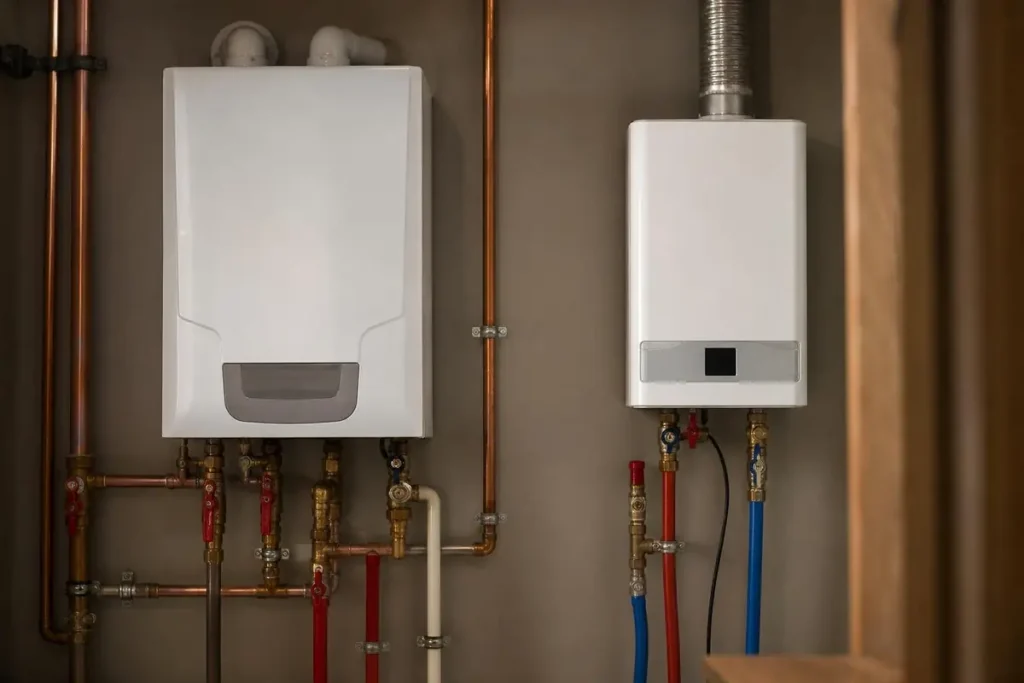
An indirect water heater borrows its heat from the boiler; tank, tankless and heat pump water heaters carry their own heat source and a federal UEF rating.
| Option | Heat source | Federal rating | What sets hot water supply |
|---|---|---|---|
| Indirect tank on a boiler | Boiler water through a coil | None for the tank; boiler rated by AFUE | Boiler output plus stored gallons |
| Gas storage water heater | Own burner, 75,000 Btu/h or less | UEF, 10 CFR 430.32(d) | Burner input plus stored gallons |
| Gas tankless water heater | Own burner, under 200,000 Btu/h | UEF, 10 CFR 430.32(d) | Burner flow rate; no storage |
| Tankless coil inside a boiler | Boiler water, heated as tap water flows | Boiler AFUE; coil boilers exempt from the automatic water temperature rule | Coil size and boiler water temperature |
| Heat pump water heater | Heat pump, up to 24 amperes at 250 volts or less | UEF, 10 CFR 430.32(d) | Heat pump plus stored gallons |
Against a tankless water heater, the indirect tank wins when several fixtures run at once, since stored water covers the peak. DOE says stored energy lets the heating system “turn off and on less often,” while a tankless coil “can be an inefficient choice for many homes, especially for those in warmer climates.”
A heat pump water heater needs no boiler at all. Our combi boiler explainer compares the combi option with an indirect tank on gpm.
What are the pros and cons of an indirect water heater?
The main pros of an indirect water heater are high hot water output from a small tank and fewer boiler cycles; the main cons are total dependence on the boiler and extra controls.
- Pro: output well beyond tank size, such as 210 first-hour gallons from 43 stored on Bradford White’s SW-2-50R-L.
- Pro: no burner, flue or element on the tank, and DOE calls it a more efficient choice for most homes.
- Con: no boiler, no hot water. Amtrol’s troubleshooting chart is blunt: “Boiler must operate to generate hot water,” including all summer.
- Con: a fouled coil slows recovery; Amtrol prescribes cleaning it and installing water treatment equipment.
Installation adds safety parts. Amtrol requires a properly sized thermal expansion tank and ships its control at 120°F, warning that above 120°F “household members can suffer serious or fatal scalding.” Bradford White’s aquastat goes to 160°F, so a tank stored hotter generally calls for a thermostatic mixing valve at the outlet, depending on local code.
Amtrol also cautions that bacteria can grow in storage vessels, especially during non-use. Our water heater temperature guide weighs scald against Legionella risk.
How we researched this
Research date: October 2026. We read 10 CFR 430.2, 430.32, 431.102 and 431.110 (eCFR, October 1, 2026 version), two DOE Federal Register rules, an archived DOE Energy Saver page, AHRI’s program page and five maker documents, all cited below.
Excluded: installed prices (no federal series), untraceable efficiency percentages on a ranking explainer, and an unsourced maker “more hot water” claim. Reddit was not mined.
Frequently asked questions
What are the disadvantages of an indirect water heater?
It needs a working boiler all year; Amtrol’s troubleshooting chart says the “boiler must operate to generate hot water.” Priority wiring can stall space heat if a pump or control fails, and a fouled coil slows recovery until it is cleaned.
Are indirect water heaters worth it?
Usually, if the home already has a boiler. DOE’s Energy Saver calls indirect water heaters “a more efficient choice for most homes,” since stored heat lets the system cycle less. Without a boiler, a heater with its own burner, element or heat pump is simpler.
How long does an indirect water heater take to heat up?
HTP says a correctly sized SuperStor Ultra tank recovers from a cold start in 10 to 13 minutes, when boiler size, flow rate and pressure drop match its chart. A smaller boiler than listed, or non-priority wiring with every heating zone calling, will stretch that time.
Does an indirect water heater have a UEF rating?
No. 10 CFR 430.32(d) sets UEF minimums only for storage, instantaneous, tabletop and grid-enabled water heater classes. Indirect tanks are rated voluntarily under AHRI 1400 for standby loss, first draw and continuous draw, in a program limited to tanks of 120 gallons or less.
What temperature should an indirect water heater be set to?
Amtrol ships its BoilerMate control at 120°F and warns that above that “household members can suffer serious or fatal scalding.” Bradford White’s PowerStor aquastat adjusts from 80°F to 160°F. Storing water hotter than 120°F generally calls for a mixing valve, depending on local code.
Can an indirect water heater run on something other than gas?
Yes. DOE says indirect systems “can be fired by gas, oil, propane, electric, solar energy, or a combination of any of these.” AHRI’s certification program, though, covers only tanks designed for a hot water boiler as the only heat source, so check maker literature first.
Sources
- eCFR. “10 CFR 430.2 Definitions.” https://www.ecfr.gov/current/title-10/chapter-II/subchapter-D/part-430/subpart-A/section-430.2. Accessed October 2026.
- eCFR. “10 CFR 430.32 Energy and water conservation standards.” https://www.ecfr.gov/current/title-10/chapter-II/subchapter-D/part-430/subpart-C/section-430.32. Accessed October 2026.
- eCFR. “10 CFR 431.110 Energy conservation standards.” https://www.ecfr.gov/current/title-10/chapter-II/subchapter-D/part-431/subpart-G/section-431.110. Accessed October 2026.
- US DOE. “Energy Conservation Standards for Residential Water Heaters,” 74 FR 65852 (2009). https://www.federalregister.gov/documents/2009/12/11/E9-28774/energy-conservation-program-energy-conservation-standards-for-residential-water-heaters-direct. Accessed October 2026.
- US DOE. “Energy Conservation Standards for Consumer Water Heaters,” 89 FR 37778 (2024). https://www.federalregister.gov/documents/2024/05/06/2024-09209/energy-conservation-program-energy-conservation-standards-for-consumer-water-heaters. Accessed October 2026.
- US DOE Energy Saver. “Tankless Coil and Indirect Water Heaters,” archived copy. https://web.archive.org/web/2025id_/https://www.energy.gov/energysaver/tankless-coil-and-indirect-water-heaters. Accessed October 2026.
- AHRI. “Indirect Water Heaters (IWH).” https://ahrinet.org/certification/ahri-certification-programs/indirect-water-heaters-iwh. Accessed October 2026.
- Bradford White. “PowerStor Series Residential Single-Wall Indirect Water Heater.” https://docs.bradfordwhite.com/Spec_Sheets/554_Current.pdf. Accessed October 2026.
- HTP. “SuperStor Ultra Submittal and Specification,” lp-787. https://htproducts.com/literature/lp-787.pdf. Accessed October 2026.
- U.S. Boiler Company. “Alliance LT and SL Indirect Water Heaters.” https://s3-us-west-2.amazonaws.com/catsy.782/Alliance+LT++SL+Product+Data+Sheet.pdf. Accessed October 2026.
- Triangle Tube. “Smart Series” brochure 2020-37. https://cdn.triangletube.com/wp-content/uploads/2022/08/04172221/2020-37-Smart-Brochure_6-22.pdf. Accessed October 2026.
- Amtrol. “BoilerMate Installation and Operation Instructions.” https://www.amtrol.com/wp-content/uploads/2025/08/9040-586-07_25-BOILERMATE-IO.pdf. Accessed October 2026.
Leave a Reply