What is R290 refrigerant? R290 refrigerant is refrigerant-grade propane, a hydrocarbon with a GWP of 3 and ASHRAE safety class A3, the highest flammability group. In US air conditioning, EPA allows it only in new self-contained room units, capped at 1,000 g. It is not being phased out.
Key Takeaways
- EPA’s SNAP table lists R-290 at ODP 0, GWP 3, class A3, acceptable only in self-contained room air conditioning.
- A room air conditioner may never hold more than 1,000 g of propane, and a portable unit 300 g, under Appendix R to 40 CFR Part 82, Subpart G.
- Commercial cases built to UL 60335-2-89 may hold 494 g open or 304 g with doors, as EPA restated in its June 13, 2024 SNAP rule.
- Class 3 refrigerants, R-290 and “22a” products included, have been unacceptable for split-system retrofits since January 3, 2017.
- Propane is not among the 18 HFCs in Appendix A to 40 CFR Part 84, so the AIM Act phasedown does not cover it.
- At 40°F, R-290 reads 64.0 psig against 68.5 for R-22 and 121.0 for R-32 on Hudson Technologies PT charts.
What is R290 refrigerant?
R-290 is propane, C3H8, sold in a refrigerant grade. Hudson Technologies describes it as more than 99.5% propane with a boiling point of -43.8°F at one atmosphere. The National Refrigerants safety data sheet lists the gas as odorless, so a leak cannot be smelled the way a fuel tank leak can.
Its climate numbers explain the interest. EPA rates it ODP 0 and GWP 3, against 675 for HFC-32 and 2,090 for R-410A on the same SNAP table. The trade-off is flammability: ASHRAE class A3 means lower toxicity but higher flammability, a stricter group than the mildly flammable A2L refrigerants covered in our R-454B explainer and our page on difluoromethane, R-32.
Where is R-290 refrigerant allowed in the US?
R-290 is allowed only in new equipment designed for it, in a short list of self-contained end uses. In air conditioning, EPA put it plainly in a November 10, 2025 proposal: R-290 “is listed as acceptable for use in self-contained room AC only and is not an available substitute for any of the other end-uses within the sector.”
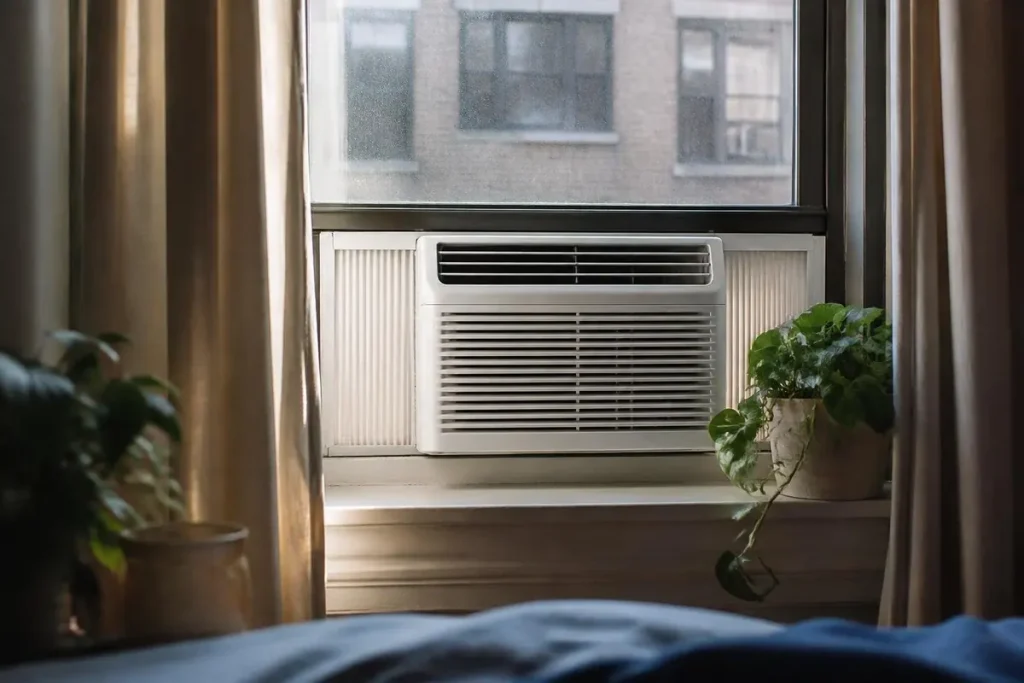
The room AC listing names window units, portable room air conditioners, and packaged terminal air conditioners and heat pumps as examples. That is the category a window heat pump falls into. Ducted split systems, mini splits and packaged rooftop units have no R-290 listing, whatever propane heat pumps sell abroad.
In refrigeration, the listings cover household refrigerators, stand-alone retail cases, vending machines, self-contained ice machines, very low temperature equipment, water coolers and, since July 15, 2024, food processing and dispensing equipment.
What are the R290 charge limits?
There is no single R-290 charge limit; each end use has its own, set in the CFR or by the UL standard the CFR adopts. Where a listing defers to a UL standard without a number, we say so rather than guess.
| End use (new equipment) | Charge limit | Where it is set |
|---|---|---|
| Self-contained room AC (window, PTAC, PTHP) | Room-size formula in UL 484 Appendix F; never above 1,000 g (35.3 oz) | App. R, listing 7 |
| Portable room AC | Never above 300 g (10.6 oz) | App. R, listing 7 |
| Stand-alone retail cases, designs from September 30, 2024 | 494 g open, 304 g with doors or drawers (13 and 8 times the LFL) | UL 60335-2-89, as restated by EPA |
| Stand-alone cases in public corridors and lobbies | 114 g (3 times the LFL) | ASHRAE 15-2022, as restated by EPA |
| Older stand-alone retail designs (UL 471 path) | 150 g per circuit | App. R, listing 2 |
| Vending machines | 150 g | App. R, listing 6 |
| Very low temperature equipment | 150 g per circuit | App. V, listing 4 |
| Water coolers | 60 g per circuit (130 g proposed November 2025) | App. V, listing 5 |
| Household refrigerators and freezers | Set by UL 60335-2-24; no gram figure in the listing | App. R, listing 1 |
EPA’s June 2024 rule moved new commercial cases from the old 150 g cap to UL 60335-2-89. Answering commenters, the agency wrote that the standard limits R-290 “to 13 times the LFL for open appliances (494 g)” and eight times for closed ones. New self-contained ice machines moved off the 150 g cap the same way. Remote condensing units and supermarket systems, the setup behind many a walk-in cooler, have no R-290 listing.
Can you put R-290 in an R-22, R-410A or R-134a system?
No. Every R-290 listing covers only new equipment “clearly identified for the refrigerant,” and each bars its use as a conversion or retrofit refrigerant in existing equipment. For split air conditioners and heat pumps, the ban is explicit and dates to January 3, 2017.
Myth check: “22a” and propane drop-ins
Cans sold as R-22a, 22a, HC-22a, MX-22a and similar names are hydrocarbon products, often marketed as an R-22 swap. EPA’s SNAP table states that all ASHRAE Class 3 refrigerants, naming R-290 and these “22a” products, “are listed as Unacceptable for use in retrofit unitary split air conditioning systems and heat pumps as of January 3, 2017.” Similar pressures do not make a retrofit legal.
The pull is real because propane’s pressures sit close to R-22’s, as the next section shows. The legal replacements for an R-22 system are covered in our R-22 replacement guide; propane is not one of them.
How do R290 refrigerant pressures compare with R-22, R-134a and R-32?
R-290 runs at pressures close to R-22, well above R-134a and roughly half of R-32. At 100°F saturation, Hudson Technologies’ PT charts give 173.9 psig for R-290, 196.0 for R-22, 124.0 for R-134a and 325.7 for R-32.
| Saturation temp | R-290 | R-22 | R-134a | R-32 |
|---|---|---|---|---|
| 40°F | 64.0 psig | 68.5 psig | 35.0 psig | 121.0 psig |
| 70°F | 110.2 psig | 121.0 psig | 71.2 psig | 205.8 psig |
| 100°F | 173.9 psig | 196.0 psig | 124.0 psig | 325.7 psig |
| 120°F | 227.8 psig | 260.0 psig | 171.0 psig | 429.3 psig |
These are saturation values, not target operating pressures; superheat and subcooling still come from the manufacturer’s data. For R-410A and the A2L blends, use our refrigerant pressure chart.
Is R290 refrigerant being phased out?
No. The AIM Act phasedown and EPA’s Technology Transitions program limit hydrofluorocarbons, and propane is not one. Appendix A to 40 CFR Part 84 lists 18 regulated HFCs, among them HFC-32 and HFC-134a; R-290 is not on it.
The same rules make R-290 look good on paper. Since January 1, 2025, new self-contained residential AC and heat pump products cannot use an HFC with a GWP of 700 or more, and the GWP table in 40 CFR 84.64 lists propane at 3.3. What limits R-290 is the SNAP listing scope and the charge caps, not a phase-out. For where the A2L switch stands, see our A2L transition status report.
How do technicians service R-290 equipment safely?
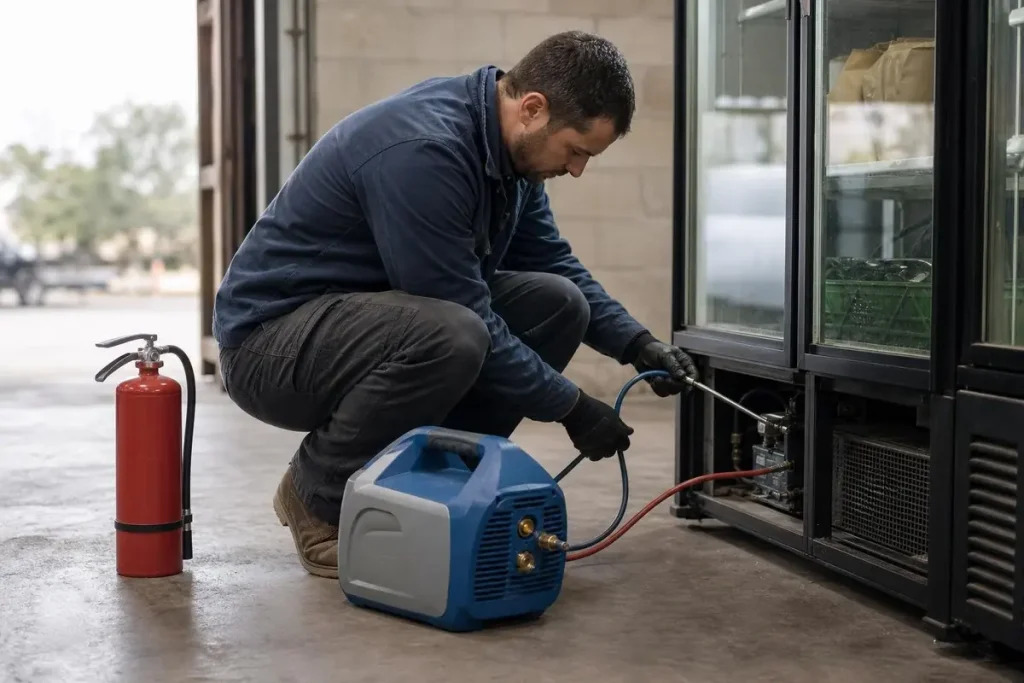
Treat every R-290 unit as a factory-charged flammable system: identify it, keep ignition sources away, monitor the air, and use tools rated for flammable gas.
- Identify it. Service ports and process tubes must be marked red, Pantone #185 or RAL 3020, and the unit carries “DANGER: Risk of Fire or Explosion” labels.
- Check the fitting. EPA’s guidance says any added service port should differ from non-flammable fittings by at least 1/16 inch in diameter or by reversed thread, and should not be accessed with an adapter.
- Monitor the air. EPA’s guidance says to evacuate if refrigerant in the surrounding air passes one-fourth of the lower flammability limit. The SDS gives propane a vapor density of 1.6 times air, so it settles low; a refrigerant leak detector that responds to propane is the practical way to know.
- Use spark-proof tools and keep a Class B dry powder extinguisher nearby, as the listings advise.
- Recover or release properly. EPA says recovery equipment should be designed for flammable refrigerants; standard refrigerant recovery machines are not automatically rated for A3 gas.
Venting is the surprise. 40 CFR 82.154(a)(1)(viii) exempts propane in the listed end uses from the federal venting prohibition. EPA’s listings still say releases should happen in a well-ventilated area, such as outside a building, and state or local fire codes may be stricter.
How we researched this
We read 40 CFR Part 82, Subpart G, Appendices R and V, section 82.154, and 40 CFR Part 84 through the eCFR versioner API, plus four Federal Register rules and proposals and EPA’s SNAP table, on October 28, 2026. We consulted 18 sources and cite 10. Pressures come from Hudson Technologies PT charts; flammability limits from the National Refrigerants SDS. Excluded: vendor efficiency and cost claims, cylinder prices, European charge rules and commenter market estimates. Flammable gas is a safety topic, so no Reddit or forum material was used.
Frequently asked questions
Is R290 just propane?
Yes, in refrigerant grade. Hudson Technologies lists R-290 as more than 99.5% propane, and the National Refrigerants SDS names the product propane and lists it as odorless. Refrigerant-grade gas has no added odorant, so technicians cannot rely on smell to find a leak.
Is R290 highly flammable?
Yes. It sits in ASHRAE class A3, the higher flammability group. The National Refrigerants SDS gives a lower explosive limit of 2.2% and an upper limit of 9.5% by volume in air, and an auto ignition temperature of 874°F. That is why every listing caps the charge.
Can you replace R290 with R134a?
No. Service a unit with the refrigerant on its nameplate. EPA’s R-290 listings are for new equipment only, and the pressures differ: at 40°F, R-134a reads 35.0 psig against 64.0 psig for R-290 on Hudson Technologies’ charts. SNAP also bars R-290 as a conversion refrigerant.
Is R290 better than R32?
They do different jobs. R-290 has a GWP of 3 but, in US air conditioning, is listed only for self-contained room units. R-32, GWP 675 and class A2L, is listed for split systems and is under the 700 GWP cap that took effect January 1, 2025. Neither can replace the other in existing equipment.
Are R290 heat pumps legal in the US?
Only as self-contained room units such as window heat pumps and packaged terminal heat pumps. EPA wrote in a November 2025 proposal that R-290 is not an available substitute for the other residential and light commercial air conditioning and heat pump end uses, which covers ducted splits and mini splits.
Why do sources list different GWP values for R290?
They use different references. EPA’s SNAP table lists 3, the GWP table in 40 CFR 84.64 lists 3.3, and the Hudson Technologies chart prints 5 with a note to check EPA or ASHRAE. All agree it is a tiny fraction of R-410A, which EPA lists at 2,090.
Do you need special certification to work on R290?
EPA’s listings say only technicians specifically trained in handling flammable refrigerants should service propane equipment. That advice sits in the listings’ further-information column, not in the binding use conditions. See our guide to EPA 608 certification types, then check the manufacturer’s training requirements.
Sources
- US EPA. “Substitutes in Residential and Light Commercial Air Conditioning and Heat Pumps.” https://www.epa.gov/snap/substitutes-residential-and-light-commercial-air-conditioning-and-heat-pumps. Accessed October 2026.
- eCFR. “40 CFR Part 82, Subpart G, Appendix R.” https://www.ecfr.gov/current/title-40/chapter-I/subchapter-C/part-82/subpart-G/appendix-Appendix%20R%20to%20Subpart%20G%20of%20Part%2082. Accessed October 2026.
- eCFR. “40 CFR Part 82, Subpart G, Appendix V.” https://www.ecfr.gov/current/title-40/chapter-I/subchapter-C/part-82/subpart-G/appendix-Appendix%20V%20to%20Subpart%20G%20of%20Part%2082. Accessed October 2026.
- eCFR. “40 CFR 82.154, Prohibitions.” https://www.ecfr.gov/current/title-40/chapter-I/subchapter-C/part-82/subpart-F/section-82.154. Accessed October 2026.
- eCFR. “40 CFR Part 84, Appendix A, Regulated Substances, and section 84.64, Global warming potentials.” https://www.ecfr.gov/current/title-40/chapter-I/subchapter-C/part-84. Accessed October 2026.
- Federal Register. “Listing of Substitutes Under the SNAP Program in Commercial and Industrial Refrigeration,” 89 FR 50410, June 13, 2024. https://www.federalregister.gov/documents/2024/06/13/2024-11690. Accessed October 2026.
- Federal Register. “Listing of Substitutes Under the SNAP Program in Refrigeration and Air Conditioning and Fire Suppression” (proposed), 90 FR 50766, November 10, 2025. https://www.federalregister.gov/documents/2025/11/10/2025-19812. Accessed October 2026.
- US EPA. “Technology Transitions.” https://www.epa.gov/hfcs/technology-transitions. Accessed October 2026.
- Hudson Technologies. “Pressure Temperature Charts” for R-290, R-22, R-134a and R-32. https://www.hudsontech.com/pdfs/pt-charts/R-290-Pressure-Temperature-Chart.pdf. Accessed October 2026.
- National Refrigerants, Inc. “Safety Data Sheet: R-290 Propane.” https://refrigerants.com/wp-content/uploads/2019/12/SDS-R290-Propane.pdf. Accessed October 2026.
Leave a Reply