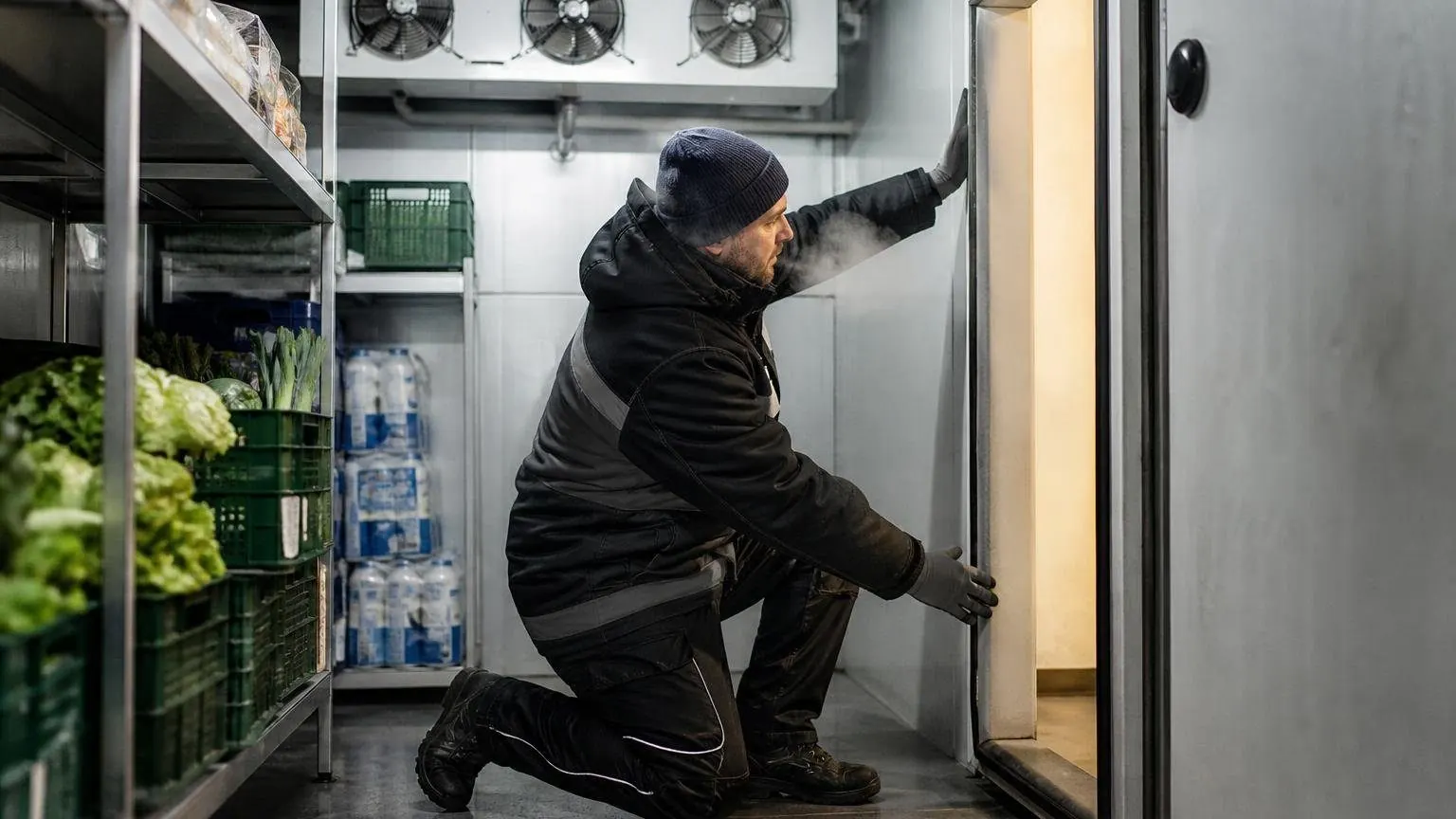
What is a walk in cooler? A walk in cooler is a refrigerated room you can step into, held above 32°F, with under 3,000 square feet of chilled storage under federal rules. It is built from insulated panels, doors and a refrigeration system, and food inside should stay at 41°F or colder.
Key Takeaways
- A walk-in cooler is refrigerated above 32°F, a freezer at or below it, both under 3,000 square feet of chilled storage, per 10 CFR 431.302.
- Cooler walls, ceilings and doors need R-25 and freezers R-32 since January 1, 2009, under 10 CFR 431.306.
- An indoor medium-temperature condensing unit needs at least 5.61 AWEF since June 5, 2017, per the same federal section.
- DOE’s December 2024 walk-in standards were withdrawn on May 20, 2025 after congressional disapproval; older limits still apply.
- New retail food remote condensing units are capped below GWP 1,400 from July 27, 2026, under 40 CFR 84.54.
- The FDA Food Code 2022 sets cold holding at 41°F or less.
What is a walk-in cooler?
A walk-in cooler is an insulated room with its own refrigeration, big enough to walk into. Federally it must be refrigerated above 32°F with under 3,000 square feet of chilled storage, per 10 CFR 431.302. At or below 32°F it is a walk-in freezer. Medical, scientific and research rooms are excluded, and water-cooling central plants are a different machine, the chiller that serves large buildings.
DOE regulates walk-ins by component: panels, doors and refrigeration system, each labelled for cooler or freezer duty with wording such as “This panel is designed and certified for use in walk-in cooler applications,” per DOE compliance guidance.
What temperature should a walk-in cooler be?
A walk-in cooler holding food should keep it at 41°F or colder. The FDA Food Code 2022, section 3-501.16, requires cold time/temperature control for safety (TCS) food at 5°C (41°F) or less. It is a model code adopted by state and local jurisdictions, so your inspector enforces the local version.
Operators set the box colder for margin; an NREL grocery guide for DOE says common refrigerator settings are between 35°F and 38°F (archived copy). Master-Bilt and Norlake recommend 35°F and Polar King lists 35°F to 55°F; those are maker claims, not standards.
Food Code section 4-204.112 puts the thermometer sensor in the warmest part of a refrigerated unit, not in the cold air leaving the coil.
How does a walk-in cooler refrigeration system work?
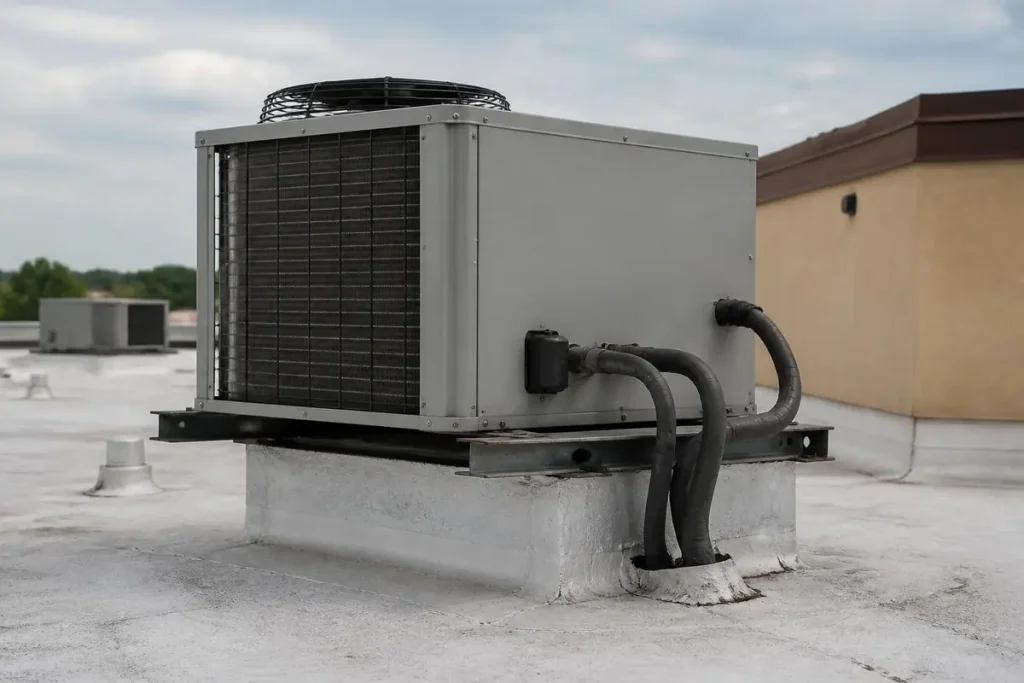
A walk-in cooler refrigeration system is split in two. A condensing unit (compressor, condenser coil and fan) sits outdoors or in a machine room, and a unit cooler (evaporator coil and fans) hangs inside the box. A metering device, often a thermostatic expansion valve, feeds the evaporator.
EPA describes store remote condensing units as typically 0.3 to 5.7 refrigeration tons, serving display cases and walk-in rooms in convenience stores, bakeries and butcher shops, in its May 2026 final rule.
Under 10 CFR 431.306, evaporator fan motors under 1 horsepower and under 460 volts must be electronically commutated or 3-phase, and condenser fan motors under 1 horsepower must be electronically commutated, permanent split capacitor or 3-phase. System efficiency is rated as annual walk-in energy factor (AWEF), in Btu/W-h.
What do DOE regulations require for a walk-in cooler?
DOE regulations require every walk-in cooler built since January 1, 2009 to meet prescriptive rules Congress set in the Energy Independence and Security Act of 2007 (EISA 2007), plus later performance limits for doors and refrigeration systems, all in 10 CFR 431.306.
| Component | Federal minimum | Built on or after | 10 CFR 431.306 |
|---|---|---|---|
| Walls, ceiling and doors | R-25 cooler, R-32 freezer | Jan 1, 2009 | (a)(3) |
| Floor | R-28 freezer; no cooler minimum | Jan 1, 2009 | (a)(4) |
| Door closers | Auto close from within 1 inch (doors up to 3 ft 9 in by 7 ft) | Jan 1, 2009 | (a)(1) |
| Infiltration | Strip doors, spring hinged doors or similar | Jan 1, 2009 | (a)(2) |
| Interior lights | 40 lumens per watt, or off within 15 minutes when empty | Jan 1, 2009 | (a)(7) |
| Glass in cooler doors | Double pane with reflective coating and gas fill, or triple pane | Jan 1, 2009 | (b)(2) |
| Display and non-display doors | Maximum kWh per day by door area | June 5, 2017 | (c), (d) |
| Medium-temperature refrigeration | AWEF 5.61 indoor, 7.60 outdoor, 9.00 unit cooler | June 5, 2017 | (e) |
| Low-temperature refrigeration | AWEF set by capacity | July 10, 2020 | (e) |
Correction: DOE published tougher standards on December 23, 2024, with compliance dates of December 23, 2027 for non-display doors and December 31, 2028 for refrigeration systems (89 FR 104616). A joint resolution of disapproval was signed on May 9, 2025, and DOE withdrew the rule as of May 20, 2025, stating it has “no force or effect.” The limits above remain the law.
That rule never touched panels: DOE was “not amending energy conservation standards for display doors or panels.” Maker pages citing R-32 panels are meeting the freezer minimum, which also clears the cooler minimum of R-25. Future rules may also change shape, since DOE has proposed new procedures for setting standards.
Walk-in cooler vs walk-in freezer: what changes?
A walk-in freezer runs at or below 32°F, so it needs thicker insulation, better glass and an insulated floor, while a walk-in cooler can sit on the slab. DOE explained in 2024 that “the majority of walk-in coolers have concrete floors and no insulated floor panels,” so it set no cooler floor standard (89 FR 104616).
| Feature | Walk-in cooler | Walk-in freezer |
|---|---|---|
| Federal temperature line | Above 32°F | At or below 32°F |
| Wall, ceiling and door insulation | R-25 minimum | R-32 minimum |
| Floor insulation | No federal minimum | R-28 minimum |
| Glass in doors | Double or triple pane | Triple pane |
| Anti-sweat heater cap, no controls | 3.0 W per sq ft of door | 7.1 W per sq ft of door |
| Most common setting (NREL) | 35°F to 38°F | -14°F to -8°F |
| Refrigeration AWEF dates | June 5, 2017 | July 10, 2020 |
Freezer coils frost up, and NREL notes their defrost cycles typically run on a time-based schedule whether needed or not, so it lists smart defrost controls as a retrofit.
Which refrigerants can a new walk-in cooler use?
A new walk-in cooler on a store remote condensing unit cannot be installed with refrigerant at a global warming potential (GWP) of 1,400 or more from July 27, 2026, under 40 CFR 84.54(c)(11). On January 1, 2032 the cap drops to 150 for systems holding 200 pounds or more, and 300 for smaller systems.
This is a relaxation. The 2023 rule had set January 1, 2026 for those limits; EPA’s May 2026 final rule swapped in the interim 1,400 cap, which EPA says “allows for the use of nonflammable options such as R-448A and R-449A.” A 1,400 limit keeps legacy blends such as R-404A out of new systems. It is one step in the wider HFC phasedown schedule.
Which subsector applies depends on the system, so confirm with the maker before ordering; cold storage warehouse systems carry a GWP 700 cap from July 27, 2026. EPA expects many retailers to buy 2032-ready units early; commenters cited new A2L units, the mildly flammable class in our R-454B primer.
Since January 1, 2026, appliances with a full charge of 15 or more pounds of HFC refrigerant must be repaired when a commercial refrigeration leak rate exceeds 20 percent, under 40 CFR 84.106. See our 2026 leak repair rules guide.
What does walk-in cooler maintenance involve?
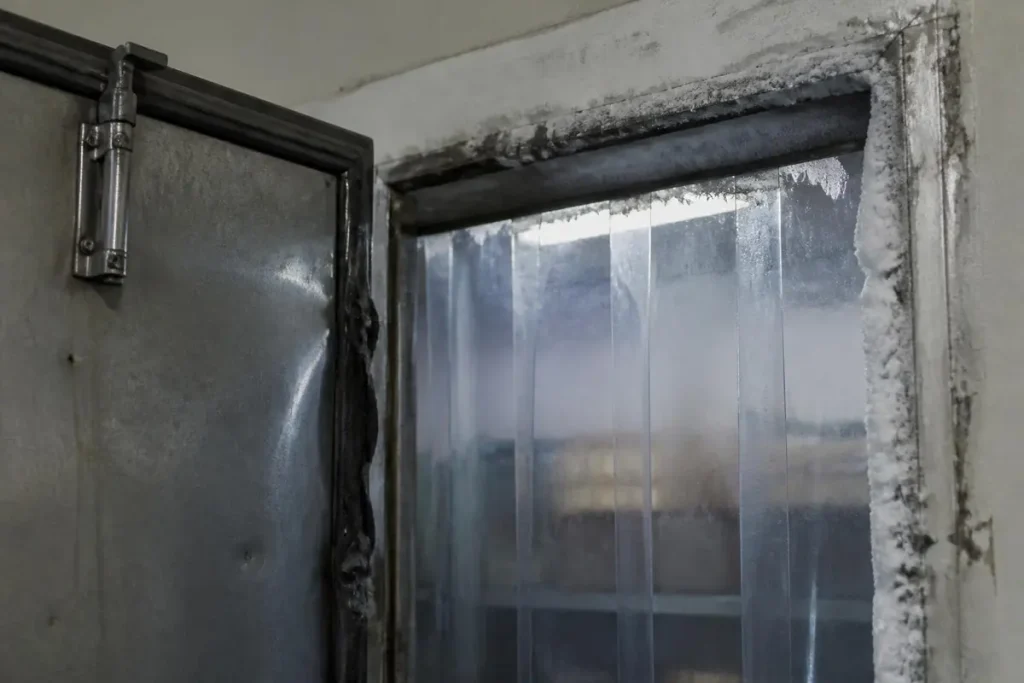
Walk-in cooler maintenance means keeping warm air out and heat moving. This checklist follows the NREL grocery guide for DOE (archived copy) and federal door rules.
- Log the air temperature at the warmest spot regularly and compare it with 41°F.
- Replace worn door gaskets right away; confirm the closer shuts the door from 1 inch open.
- Keep strip curtains complete. In a model NREL cites, strip curtains saved over 5,000 kWh a year on an 80 sq ft freezer using 15,600 kWh.
- Clean condenser and evaporator coils; dirt cuts airflow and capacity.
- Keep unit cooler drain pans free of ice and draining.
- Clean fan blades yearly; lubricate bearings per the maker, usually at no more than 6 month intervals.
- Check refrigerant charge and find leaks; over and undercharge both cut efficiency.
Coil work mirrors our coil cleaning guide; leak hunting follows our leak detection comparison.
DOE estimated an average 8.5 years of life for walk-in refrigeration systems and modeled panels at 2 to 25 years, averaging 12 years, in its 2024 analysis. Owners without in-house staff can fold upkeep into a commercial service agreement.
How we researched this
Research date: October 14, 2026. We read 10 CFR 431.302, 431.306, 40 CFR 84.54 and 84.106 via the eCFR API (October 1, 2026 version), DOE’s 2024 rule and its 2025 withdrawal, EPA’s May 2026 final rule, the FDA Food Code 2022 and NREL’s grocery guide. We consulted 13 sources and cite 10.
Excluded: vendor price ranges (no federal price series exists), maker energy savings claims, contractor blogs and Reddit. Master-Bilt, Norlake and Polar King statements appear only as labelled maker claims.
Frequently asked questions
How cold should a walk-in cooler be?
At 41°F or below for food, the FDA Food Code 2022 limit in section 3-501.16. NREL’s grocery guide for DOE says common refrigerator settings run 35°F to 38°F, which leaves margin for door openings. Measure at the warmest spot in the box.
What R-value do walk-in cooler panels need?
At least R-25 for walls, ceilings and doors of walk-in coolers built since January 1, 2009, under 10 CFR 431.306(a)(3). Freezers need R-32. Glazed portions of doors are exempt from the R-value rule.
Does a walk-in cooler need an insulated floor?
Not under federal rules. DOE set an R-28 floor minimum only for freezers, noting that most walk-in coolers have concrete floors and no insulated floor panels. Local codes or slab conditions may still call for one.
Are the 2027 and 2028 DOE walk-in standards still coming?
No. DOE’s December 2024 rule set those dates, but a joint resolution of disapproval was signed on May 9, 2025, and DOE withdrew the rule as of May 20, 2025. The older limits in 10 CFR 431.306 remain in force.
Can a new walk-in cooler still use R-404A?
Not on a new retail food remote condensing unit installed on or after July 27, 2026, when 40 CFR 84.54 caps GWP below 1,400. EPA says that limit keeps legacy blends such as R-404A out of new systems, while R-448A and R-449A remain allowed.
Does the EPA leak repair rule cover walk-in coolers?
It covers appliances with a full charge of 15 or more pounds of HFC refrigerant, from January 1, 2026, under 40 CFR 84.106. Commercial refrigeration repair is triggered above a 20 percent leak rate, so check the nameplate charge.
Sources
- U.S. Government Publishing Office, eCFR. “10 CFR 431.306, Energy conservation standards and their effective dates.” https://www.ecfr.gov/current/title-10/chapter-II/subchapter-D/part-431/subpart-R/section-431.306. Accessed October 2026.
- U.S. Government Publishing Office, eCFR. “10 CFR 431.302, Definitions concerning walk-in coolers and walk-in freezers.” https://www.ecfr.gov/current/title-10/chapter-II/subchapter-D/part-431/subpart-R/section-431.302. Accessed October 2026.
- U.S. Department of Energy. “Energy Conservation Standards for Walk-In Coolers and Walk-In Freezers, Final Rule, 89 FR 104616.” https://www.govinfo.gov/content/pkg/FR-2024-12-23/html/2024-28474.htm. Accessed October 2026.
- U.S. Department of Energy. “Energy Conservation Standards for Walk-In Coolers and Walk-In Freezers, Final Rule; Withdrawal.” https://www.federalregister.gov/documents/2025/05/20/2025-09029/energy-conservation-program-energy-conservation-standards-for-walk-in-coolers-and-walk-in-freezers. Accessed October 2026.
- U.S. Department of Energy. “Certification and Compliance Obligations for Walk-in Coolers and Freezers.” https://www.energy.gov/sites/prod/files/2017/06/f34/certification-and-compliance-obligations-for-walkin-coolers-and-freezers-2017-5-6_0.pdf. Accessed October 2026.
- U.S. Government Publishing Office, eCFR. “40 CFR 84.54, Restrictions on the use of hydrofluorocarbons.” https://www.ecfr.gov/current/title-40/chapter-I/subchapter-C/part-84/subpart-B/section-84.54. Accessed October 2026.
- U.S. Environmental Protection Agency. “Phasedown of Hydrofluorocarbons: Reconsideration of Certain Regulatory Requirements Promulgated Under the Technology Transitions Provisions, 91 FR 31284.” https://www.federalregister.gov/documents/2026/05/26/2026-10387/phasedown-of-hydrofluorocarbons-reconsideration-of-certain-regulatory-requirements-promulgated-under. Accessed October 2026.
- U.S. Government Publishing Office, eCFR. “40 CFR 84.106, Leak repair.” https://www.ecfr.gov/current/title-40/chapter-I/subchapter-C/part-84/subpart-C/section-84.106. Accessed October 2026.
- U.S. Food and Drug Administration. “Food Code 2022.” https://www.fda.gov/media/164194/download. Accessed October 2026.
- National Renewable Energy Laboratory for DOE. “Advanced Energy Retrofit Guide: Grocery Stores (2013), archived copy.” https://web.archive.org/web/2024id_/https://www.nrel.gov/docs/fy13osti/54243.pdf. Accessed October 2026.
Leave a Reply