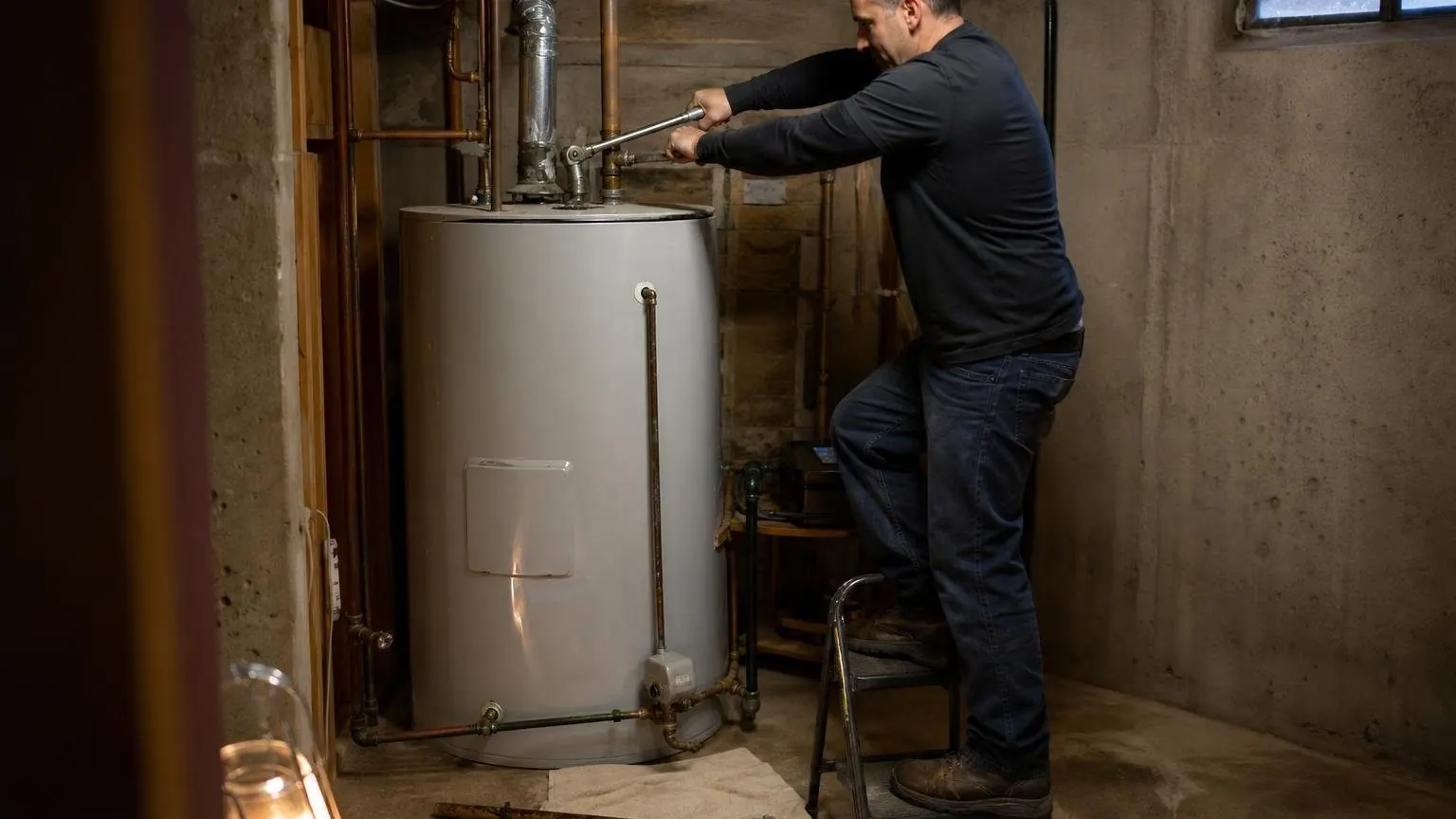
What is a water heater anode rod? A water heater anode rod is a sacrificial magnesium or aluminum rod that corrodes so the steel tank does not. A.O. Smith says to inspect it within three years, then every year, and to replace it once the core wire shows or the rod thins to 3/8 inch.
Key Takeaways
- A.O. Smith says to inspect the anode after a maximum of three years and annually thereafter, and yearly on softened water.
- Rheem says to replace it when more than 6 inches of core wire is exposed at either end.
- Bradford White’s rule, replace at half the original 3/4 inch diameter, matches A.O. Smith’s 3/8 inch line.
- Minnesota’s health department says a magnesium anode can supply electrons that aid the conversion of sulfate to hydrogen sulfide.
- A.O. Smith and Rheem say running without an anode voids or excludes tank warranty coverage.
- Rheem’s ProtectionPlus kit adds a second magnesium anode and turns a 6-year tank warranty into a 10-year one.
What does a water heater anode rod do?
A water heater anode rod is a metal rod threaded into the top of the tank, or built into the hot outlet nipple, that corrodes in place of the steel tank. Federal tank rules define this as cathodic protection: making the protected surface the cathode of an electrochemical cell, using galvanic anodes or impressed current (40 CFR 280.12).
State Water Heaters’ Bulletin 43 galvanic series lists magnesium, zinc and aluminum above steel at the “corroded end,” so they give up metal first. A.O. Smith says that once the rod is depleted “the tank will start to corrode, eventually developing a leak,” the failure our guide to a leaking water heater traces.
Correction: anodes do not catch sediment
Several top ranking pages say magnesium rods work by attracting sediment. None of the four maker manuals we read says so. Sediment is a separate job for flushing the tank.
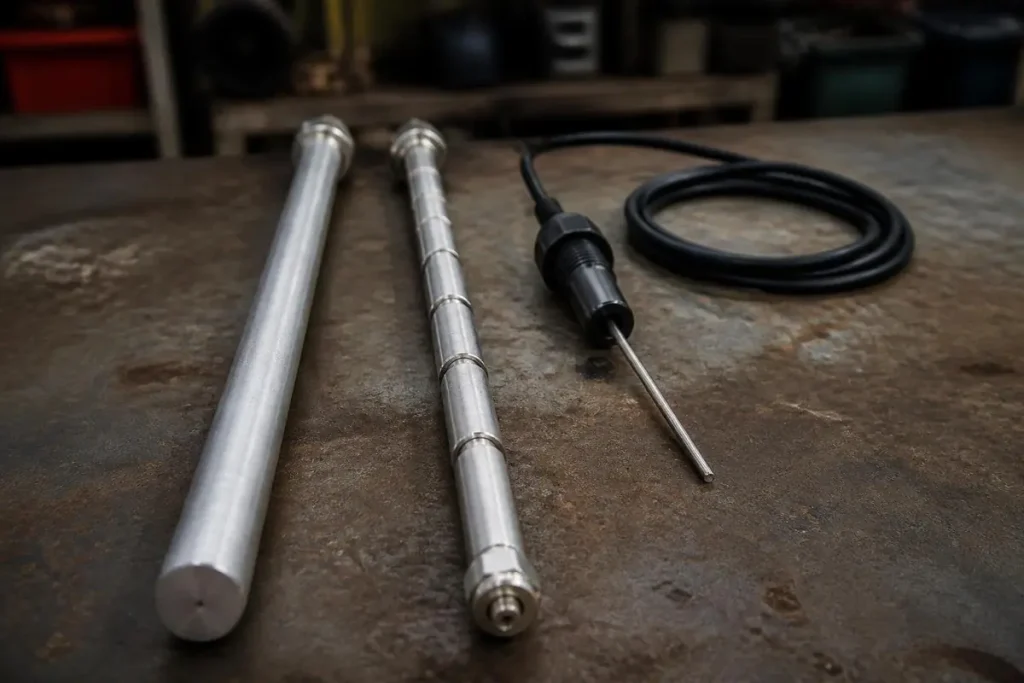
Magnesium vs aluminum vs powered anode rod: which fits your water?
Magnesium is the usual factory rod and the most active metal on the list; aluminum or aluminum zinc is the common swap for smelly hot water; a powered anode uses impressed current from a control circuit instead of a sacrificial metal. Your water chemistry decides.
| Anode type | How it protects | Odor and water notes | Source |
|---|---|---|---|
| Magnesium | Sacrificial; top of State’s galvanic list | Can aid sulfate to hydrogen sulfide conversion | State Bulletin 43; Minnesota Dept. of Health |
| Aluminum or aluminum zinc | Sacrificial; less active than magnesium | Ends odor (Penn State); can gel in pH 8+ water (State) | Penn State Extension; State service handbook |
| Powered (impressed current) | Titanium electrode with a metal-oxide coating, fed by a control circuit | Control circuit limits current to prevent hydrogen buildup | A.O. Smith patent 7,372,005; 40 CFR 280.12 |
| No anode | None | Rheem: greatly shortens tank life, excludes warranty | Rheem Use and Care Manual |
Penn State says replacing the magnesium rod with an aluminum rod “should eliminate the rotten egg odor while maintaining corrosion protection.” In alkaline water the trade reverses: State’s service handbook says pH 8+ can turn an aluminum anode into gel, and its fix is magnesium.
How often should you check or replace the anode rod?
Check it within three years of installation, then yearly; replace it when core wire shows or the rod has worn to half its thickness. DOE’s Energy Saver page (archived copy) listed every three to four years, so the stricter maker rule is the safe one.
| Document | Inspect | Replace when |
|---|---|---|
| A.O. Smith gas manual 326940 | Within 3 years, then yearly; yearly on softened water | Most of the rod under 3/8 inch, or support wire visible on about 1/3 of its length |
| Rheem Use and Care Manual | Yearly | More than 6 inches of core wire exposed at either end |
| Bradford White service manual 238-54711-00 | Not stated | Depleted to half the original 3/4 inch diameter, or any steel core exposed |
| State electric service handbook (2004) | Yearly | Large “gouges” in the surface |
The arithmetic: Bradford White puts a new rod at about 3/4 inch, and half of 3/4 is 3/8, the line A.O. Smith draws. A.O. Smith says adverse water, hotter settings, heavy use, hydronic heating and water softening all speed depletion; our water heater temperature setting guide covers the scald side of running hot.
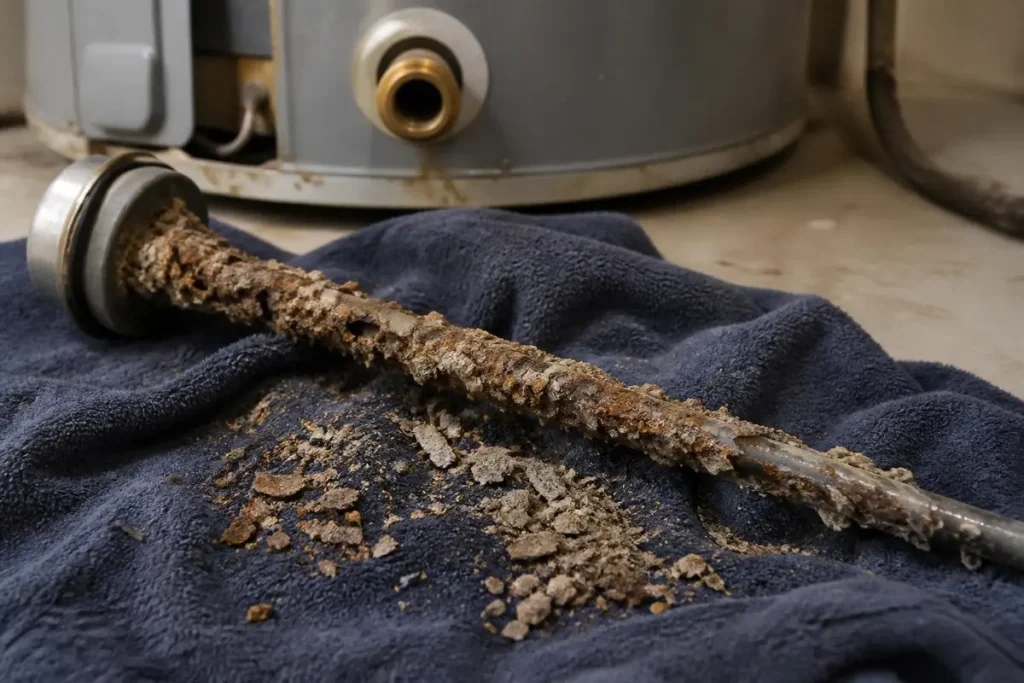
How do you know if a water heater anode rod is bad?
You know a water heater anode rod is bad only by pulling it and looking. A rotten egg smell on the hot tap points at the anode’s chemistry, not its wear, and State’s handbook says rusty water is most often iron bacteria.
Signs the rod is spent, from the maker manuals:
- Most of the rod is thinner than 3/8 inch (A.O. Smith).
- Core wire is exposed: any for Bradford White, over 6 inches for Rheem, about a third of the length for A.O. Smith.
A.O. Smith puts the rod under a cap on the tank top, sometimes under foam; Bradford White’s electric manual uses a combination outlet nipple/anode at the hot outlet. If the water is just lukewarm, start with our water heater not heating checklist.
Why does hot water smell like rotten eggs, and is the anode rod to blame?
Yes, often. A.O. Smith says the odor needs four factors at once: sulfate in the supply water, little or no dissolved oxygen, sulfate reducing bacteria in the tank, and excess active hydrogen produced by the anode’s protective action. Remove one and it stops.
Confirm the source: Minnesota’s health department says to smell hot and cold taps after you have been away a few hours; NDSU Extension says odor only from the hot water tap means sulfates reacting with the magnesium anode. Penn State says most people detect hydrogen sulfide well below 0.5 mg/L.
The fixes:
- Swap magnesium for a less active rod such as aluminum, then chlorinate tank and lines (A.O. Smith).
- Chlorinate: one gallon of household bleach per 25 gallons of tank, held one hour or more (State Bulletin 23).
- Raise the thermostat: A.O. Smith says 140°F can reduce the smell, with a mixing valve; Minnesota suggests 160°F for several hours.
- If odor persists, chlorinate or aerate the water supply (A.O. Smith).
Do not just pull the rod
Penn State and NDSU mention removing the rod. A.O. Smith says that leaves the tank unprotected and “all warranty on the water heater tank is voided.” Swap it; do not delete it.
Safety: A.O. Smith warns hydrogen gas can build in a system unused for two weeks or more. Run the farthest hot faucet several minutes, no flame nearby, first.
How to replace a water heater anode rod
Replacing a water heater anode rod means shutting off fuel and water, relieving pressure, draining some water and breaking the hex loose with a 1-1/16 inch socket. These steps follow A.O. Smith’s gas manual.
- Turn the gas control and gas shut-off OFF, or the power on an electric unit.
- Shut the cold water supply and open a nearby hot faucet to depressurize the tank.
- Drain through a hose until the level is below the fitting, then close the drain.
- Remove the cap and enough insulation or foam to reach the hex.
- Turn the rod counterclockwise with a 1-1/16 inch socket (State specifies 6-point).
- Tape or seal the new threads, hand tighten, then snug water tight.
- Refill with a hot faucet open until 3 minutes after steady flow; check for leaks.
- Restore gas or power only once the tank is full.
Anode rod size starts with clearance: A.O. Smith plans 24 inches above the heater for changing anodes, and a full-length rigid rod may not come out without it, so ask the maker what fits. Also check the temperature and pressure relief valve; on electric units, a dry-fired element burns out, as our water heater element guide explains.
Does replacing the anode rod extend water heater life?
Makers act as if it does, but nobody publishes how many years a new rod adds. A.O. Smith ties leaks to a depleted anode, and Rheem’s ProtectionPlus kit adds a magnesium combination anode/hot nipple and turns a 6-year limited tank warranty into 10 years, and an 8-year one into 12.
That is a warranty term on Rheem’s own terms (sheet dated 06/18), not a measured life gain; we found no federal or independent study that quantifies one. A new rod cannot undo corrosion under way; if the tank weeps, see our water heater replacement guide and weigh a tankless water heater.
A.O. Smith marks a thermal expansion tank as required for all closed systems; see our expansion tank explainer and water heater installation checklist.
How we researched this
Researched October 14, 2026. We read A.O. Smith, Rheem, Bradford White and State manuals (maker claims), Minnesota Department of Health, Penn State and NDSU pages, 40 CFR 280.12, DOE Energy Saver (archived copy) and A.O. Smith’s powered anode patent. The 3/8 inch cross-check is our arithmetic.
Excluded: price ranges (no federal series covers anode replacement), contractor blogs with unsourced lifespans, and Reddit. State’s handbook dates from 2004; we cite it where newer maker text agrees or is silent.
Frequently asked questions
How long does a water heater anode rod last?
No maker we read gives a life in years, because water chemistry drives it. A.O. Smith says to inspect within three years and then annually, sooner on softened water. DOE’s archived Energy Saver page suggested checking every three to four years. Pull it and measure rather than guess.
Can I replace an anode rod myself?
Many owners do; A.O. Smith’s owner manual includes the steps, while Bradford White marks its procedure for qualified service providers. You need fuel and water off, the tank depressurized and partly drained, a 1-1/16 inch socket, and roughly 24 inches of headroom above the tank.
Will a new anode rod fix rotten egg smelling hot water?
Often, if the new rod is less active than magnesium. Penn State says aluminum should eliminate the odor while keeping protection. A.O. Smith pairs the swap with chlorinating the tank and lines, and says its special rod may reduce but not eliminate odor.
Is it safe to remove the anode rod to stop the smell?
It stops the reaction but costs the tank. A.O. Smith says it voids all tank warranty, Rheem says it excludes warranty coverage, and the Minnesota Department of Health warns removal may significantly decrease heater life. Swapping metals is the route makers approve.
Does a water softener wear out the anode faster?
A.O. Smith says yes. It calls artificially softened water exceedingly corrosive because the process substitutes sodium ions for magnesium and calcium ions, and it requires annual anode inspection on softened water rather than waiting up to three years after installation.
What is the blue or green gel in my faucet aerators?
State’s service handbook blames aluminum hydroxide: where water pH is relatively high (8+), an aluminum anode reacts and forms gel beads in the tank and at aerators. State’s fix is flushing the tank thoroughly and switching to a magnesium anode.
Sources
- A.O. Smith. “Residential Gas Water Heaters, Direct Vented, Manual 326940.” https://assets.aosmith.com/damroot/Original/10001/326940.pdf. Accessed October 2026.
- Rheem. “Use and Care Manual, HG/GP/PG Series,” pp. 19 to 20 (archive copy). https://www.manualsdir.com/manuals/196563/rheem-hg-series-gp-series-pg-series.html?page=19. Accessed October 2026.
- Bradford White. “Service Manual 238-54711-00, Residential Electric.” https://docs.bradfordwhite.com/Service_Manual/238-54711-00_Current.pdf. Accessed October 2026.
- State Water Heaters. “Residential Electric Water Heater Service Handbook” (2004). https://assets.statewaterheaters.com/damroot/Original/10008/320990-000.pdf. Accessed October 2026.
- State Water Heaters. “Technical Bulletin 43: Cathodic Protection.” https://www.StateWaterHeaters.com/lit/bulletin/bulletin43.pdf. Accessed October 2026.
- Rheem. “ProtectionPlus Feature Sheet” (form dated 06/18). https://resource.gemaire.com/is/content/Watscocom/Gemaire/protech_sp20078_article_1368704740659_en_war.pdf?fmt=pdf. Accessed October 2026.
- Minnesota Department of Health. “Hydrogen Sulfide in Well Water.” https://www.health.mn.gov/communities/environment/water/wells/waterquality/hydrosulfide.html. Accessed October 2026.
- Penn State Extension. “Hydrogen Sulfide (Rotten Egg Odor) in Water Wells.” https://extension.psu.edu/hydrogen-sulfide-rotten-egg-odor-in-water-wells. Accessed October 2026.
- NDSU Extension. “Rotten Egg Odor Only From the Hot Water Tap.” https://www.ag.ndsu.edu/waterquality/documents/rotten-egg-odor-only-from-the-hot-water-tap. Accessed October 2026.
- eCFR. “40 CFR 280.12 Definitions.” https://www.ecfr.gov/current/title-40/chapter-I/subchapter-I/part-280/subpart-A/section-280.12. Accessed October 2026.
- U.S. Department of Energy. “Storage Water Heaters,” Energy Saver (archived copy). https://web.archive.org/web/2025id_/https://www.energy.gov/energysaver/storage-water-heaters. Accessed October 2026.
- U.S. Patent 7,372,005. “Water Storage Device Having a Powered Anode” (A.O. Smith, 2008). https://patents.google.com/patent/US7372005. Accessed October 2026.
Leave a Reply