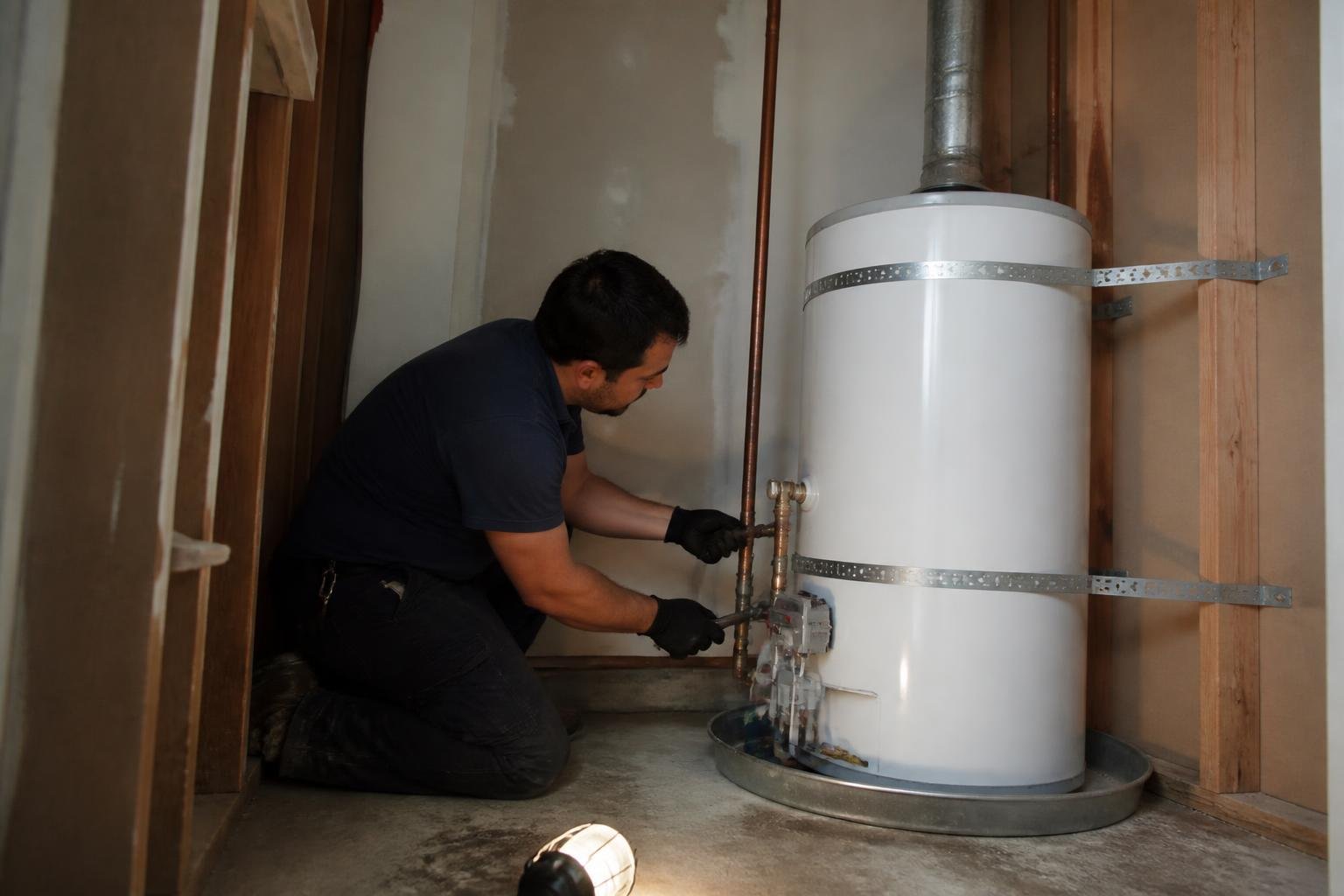
What does a correct water heater installation include? A code-correct water heater installation is a set of checkable items: a relief line piped full size to within 6 inches of the floor, expansion control, a vent rising 1/4 inch per foot, a gas shutoff, union and sediment trap, combustion air, and, where required, straps, a pan and a permit.
Key Takeaways
- The relief valve line must end within 6 inches of the floor, per the DOE Building America gas tank checklist.
- Garage gas heaters need the ignition source 18 inches up unless FVIR listed, under IRC G2408.2 in the 2021 Seattle Residential Code.
- California requires residential water heaters up to 120 gallons to be braced, anchored or strapped, under Health and Safety Code 19211.
- Above 80 psi a regulator is required, and a closed system needs an expansion tank, per the City of Dublin, California 2026 handout.
- Where a leak would cause damage, a pan 1 1/2 inches deep with a 3/4 inch drain is required, per Danville, California (CPC 507.5).
- CPSC estimates 9 non-fire CO deaths were associated with water heaters in 2022, per its May 2026 report.
What does a correct water heater installation include?
A correct water heater installation is ten checkable items, and the final inspector looks at most of them. Building departments publish them as checklists; those from The Colony, Texas (IRC) and Danville and Dublin, California (California Plumbing Code) agree on the core.
This guide covers storage tanks. Choosing the unit belongs to our replacement sizing guide; the technologies have their own pages on tankless units and heat pump water heaters.
| Item | What the inspector looks for |
|---|---|
| Relief valve line | Full size, downhill, ends within 6 inches of the floor or outdoors |
| Thermal expansion | Expansion tank on a closed system; regulator above 80 psi |
| Vent connector | Rises 1/4 inch per foot; screwed joints; clearances |
| Gas connection | Shutoff within 6 feet, union, sediment trap |
| Combustion air | Room volume or high and low openings |
| Seismic straps (California) | Upper and lower thirds of the tank |
| Drain pan | Where a leak would damage the building |
| Garage elevation | Ignition source 18 inches up unless FVIR |
| Electrical and bonding | Dedicated circuit; water and gas pipes bonded |
| Permit | Issued before work; final inspection passed |
How should the relief valve and its discharge pipe be installed?
Every storage water heater needs a listed temperature and pressure relief valve whose discharge pipe runs full size and downhill to a visible, harmless end. The DOE Building America checklist requires the discharge tube to terminate within 6 inches of the floor.
Dublin requires the line to match the valve outlet and never be smaller than 3/4 inch copper or galvanized pipe; an outdoor end sits 6 to 24 inches above the ground, pointing down (CPC 504.6, 608.5). The Colony requires relief and pan lines to “extend full size.”
The common mistake
A relief line that shrinks, runs uphill or ends in a wall cavity fails everywhere we checked. The valve is a backstop, not a thermostat; the set point is covered in our 120 versus 140 degree analysis.
When does a water heater installation need an expansion tank?
A water heater installation needs an expansion tank on a closed system, where a check valve, backflow preventer or pressure reducing valve stops heated water from pushing back to the main. Dublin requires a listed, adequately sized tank or equivalent device on such systems (CPC 608).
Above 80 psi of static pressure, a regulator preceded by a strainer must bring it to 80 psi or less. DOE’s checklist says the same: on a closed supply, “provisions shall be made to control thermal expansion.”
How is a gas water heater vented, and why can it not share every vent?
A standard gas tank is natural draft: flue gas rises through a draft hood into a vent connector that must slope upward at least 1/4 inch per foot with no dips, under IRC G2427.10.8 as adopted in Seattle. Joints take sheet metal screws.
Dublin checks 6 inches of clearance to combustibles for single wall connector and 1 inch for double wall, a vent 12 inches above the roof, and at least 5 feet of total vent height.
The sharing rule matters most. IRC G2427.3.3 says natural draft connectors “shall not be connected into any portion of mechanical draft systems operating under positive pressure.” An atmospheric tank cannot tie into the pressurized vent of a high efficiency furnace or boiler.
When a furnace upgrade leaves the tank alone on a chimney, DOE Building America warns the flue may be oversized and draft poorly. Power vent and direct vent tanks avoid this; DOE says “combustion gases cannot spill into the home”. Our boiler installation walkthrough covers the same orphaned chimney.
What gas piping and combustion air does a water heater installation need?
A gas water heater installation needs three fittings ahead of the appliance and enough air to burn cleanly. The IRC fuel gas chapter, as adopted in Seattle, sets the order:
- Shutoff valve in the same room, within 6 feet, upstream of the union or connector (G2420.5.1).
- Sediment trap: a tee with a capped vertical nipple, as close to the inlet as practical (G2419.4).
- Union within 6 feet on rigid pipe (G2422.1.4); The Colony caps flexible connectors at 60 inches.
- Leak test of the gas line once installation is complete, per DOE’s checklist.
The standard indoor air method needs 50 cubic feet of room volume per 1,000 Btu/h of appliance input (G2407.5.1). A smaller enclosure gets two openings, one within 12 inches of the top and one within 12 inches of the bottom, per Danville (CPC 506). A spilling draft hood makes carbon monoxide, so place alarms per our CO alarm placement rules.
Where are seismic straps, drain pans and garage elevation required?
These items depend on location. California requires new, replacement and existing residential water heaters of up to 120 gallons to be “braced, anchored, or strapped to resist falling or horizontal displacement due to earthquake motion” (HSC 19211), and sellers must certify compliance.
Dublin wants two straps, in the upper and lower thirds, with the lower strap at least 4 inches above the controls; a third strap above 52 gallons; and no plumber’s tape. Danville requires a pan at least 1 1/2 inches deep with a 3/4 inch drain wherever a leak would damage the structure.
In a garage, IRC G2408.2 puts the ignition source 18 inches above the floor unless the heater is listed flammable vapor ignition resistant. Rooms that open directly into the garage count as garage, and G2408.3 adds protection from vehicle impact. See our attached garage ventilation guide for the air side.
What do electric and heat pump units need on the electrical side?
An electric or heat pump water heater installation needs its own circuit sized to the nameplate. ENERGY STAR says a 240V heat pump model “typically utilizes a 30-amp circuit breaker and 10-gauge electrical wire, just like a standard electric storage water heater.”
Plug-in 120V heat pump units for gas replacements typically need to be sized up two sizes, ENERGY STAR says, and most 240V models need at least 700 cubic feet of air space plus a condensate drain or pump. Every fuel needs bonding: Danville specifies a #8 bare copper wire joining the hot, cold and gas lines. If the new unit then fails to heat, use our gas and electric fault guide.
Does a water heater installation need a permit, and what does it cost?
Most jurisdictions require a permit for a water heater installation, including a like for like swap. Dublin’s handout opens: “A permit is required for all water heater installations, including replacement units.” The Colony also requires a permit and a city registered contractor; our permit explainer covers what skipping one risks.
No federal statistical series publishes installed water heater prices, so we print no dollar figure; contractor quotes are the only price evidence. The federal data tracks units, which we follow in our 2026 water heater shipments report.
How we researched this
Research completed October 5, 2026: we consulted 13 sources and cited 10. Code text comes from jurisdictions that publish it, because the ICC code site blocks automated access: Seattle’s adopted IRC fuel gas chapter, inspection handouts from Dublin and Danville, California and The Colony, Texas, plus DOE Building America and ENERGY STAR. Safety data is CPSC only.
This is a combustion, scald and carbon monoxide topic, so we skipped Reddit and forum anecdotes entirely. Contractor blogs and vendor price surveys were excluded; no federal series publishes installed prices. Local amendments vary, so confirm with your building department.
Frequently asked questions
Can a homeowner do their own water heater installation?
It depends on the jurisdiction. The Colony, Texas requires a contractor registered with the city, and Dublin, California requires a permit for every installation, including replacements. Gas work also needs a leak test after installation under the DOE Building America checklist, whoever does the job.
Do I need an expansion tank without a check valve?
Dublin ties the requirement to a check valve, backflow preventer or other normally closed device, which makes the system closed. Without one, local code decides. Separately, static pressure above 80 psi requires a regulator, and that regulator itself closes the system, so the tank follows.
How high off a garage floor must a gas water heater sit?
The ignition source must be at least 18 inches above the floor under IRC G2408.2, unless the heater is listed flammable vapor ignition resistant. Rooms that open directly into the garage are treated as part of it, so a utility closet that opens into the garage counts.
Where should the relief valve drain?
DOE Building America requires the discharge tube to end within 6 inches of the floor. Dublin and The Colony also allow an outdoor end 6 to 24 inches above grade, piped full size and never smaller than 3/4 inch, pointing down.
Can a gas water heater share a vent with a high efficiency furnace?
Not if the furnace vent runs under positive pressure. IRC G2427.3.3 bars natural draft connectors from any mechanical draft system operating under positive pressure, so the tank needs its own vent, a vent shared only with other natural draft appliances, or a power vent model.
How many straps does a water heater need in California?
Dublin requires two, in the upper and lower thirds of the tank, with the lower strap at least 4 inches above the controls, and a third above 52 gallons. State law, HSC 19211, covers standard tanks up to 120 gallons, new and existing.
Does every water heater need a drain pan?
No. A pan is required where a leak would damage the structure, such as an attic or upper floor. Danville specifies a corrosion resistant pan at least 1 1/2 inches deep with a drain of at least 3/4 inch to an approved location.
Sources
- US Department of Energy, Building America Solution Center. “Gas Tank Water Heater” checklist. https://basc.pnnl.gov/home-improvement-expert/checklists/gas-tank-water-heater. Accessed October 2026.
- US Department of Energy, Building America Solution Center. “Gas-Fired Tankless Water Heaters.” https://basc.pnnl.gov/resource-guides/gas-fired-tankless-water-heaters. Accessed October 2026.
- US Department of Energy, Building America Solution Center. “Direct/Power Vent Water Heater.” https://basc.pnnl.gov/building-science-measures/directpower-vent-water-heater. Accessed October 2026.
- ENERGY STAR. “Best Practices: Installing Heat Pump Water Heaters.” https://www.energystar.gov/sites/default/files/2025-08/HPWH%20Installation%20Guide.pdf. Accessed October 2026.
- US Consumer Product Safety Commission. “Non-Fire Carbon Monoxide Deaths Associated with the Use of Consumer Products, 2022 Annual Estimates.” May 2026. https://www.cpsc.gov/s3fs-public/Non-Fire-Carbon-Monoxide-Deaths-Associated-with-the-Use-of-Consumer-Products-2022-Annual-Estimates.pdf. Accessed October 2026.
- California Legislature. “Health and Safety Code Section 19211.” https://leginfo.legislature.ca.gov/faces/codes_displaySection.xhtml?lawCode=HSC§ionNum=19211. Accessed October 2026.
- City of Seattle. “2021 Seattle Residential Code, Chapter 24: Fuel Gas.” https://www.seattle.gov/documents/Departments/SDCI/Codes/SeattleResidentialCode/2021SRCChapter24.pdf. Accessed October 2026.
- City of Dublin, California. “Residential Water Heaters: Permit and Inspection.” 2026. https://dublin.ca.gov/DocumentCenter/View/12578. Accessed October 2026.
- Town of Danville, California. “Water Heater Requirements.” Revised February 2026. https://www.danville.ca.gov/DocumentCenter/View/5173/Water-Heater-Requirements-PDF. Accessed October 2026.
- City of The Colony, Texas. “Residential Replacement Water Heater Requirements.” https://www.thecolonytx.gov/DocumentCenter/View/650/Replacement-Water-Heater-PDF. Accessed October 2026.
Leave a Reply