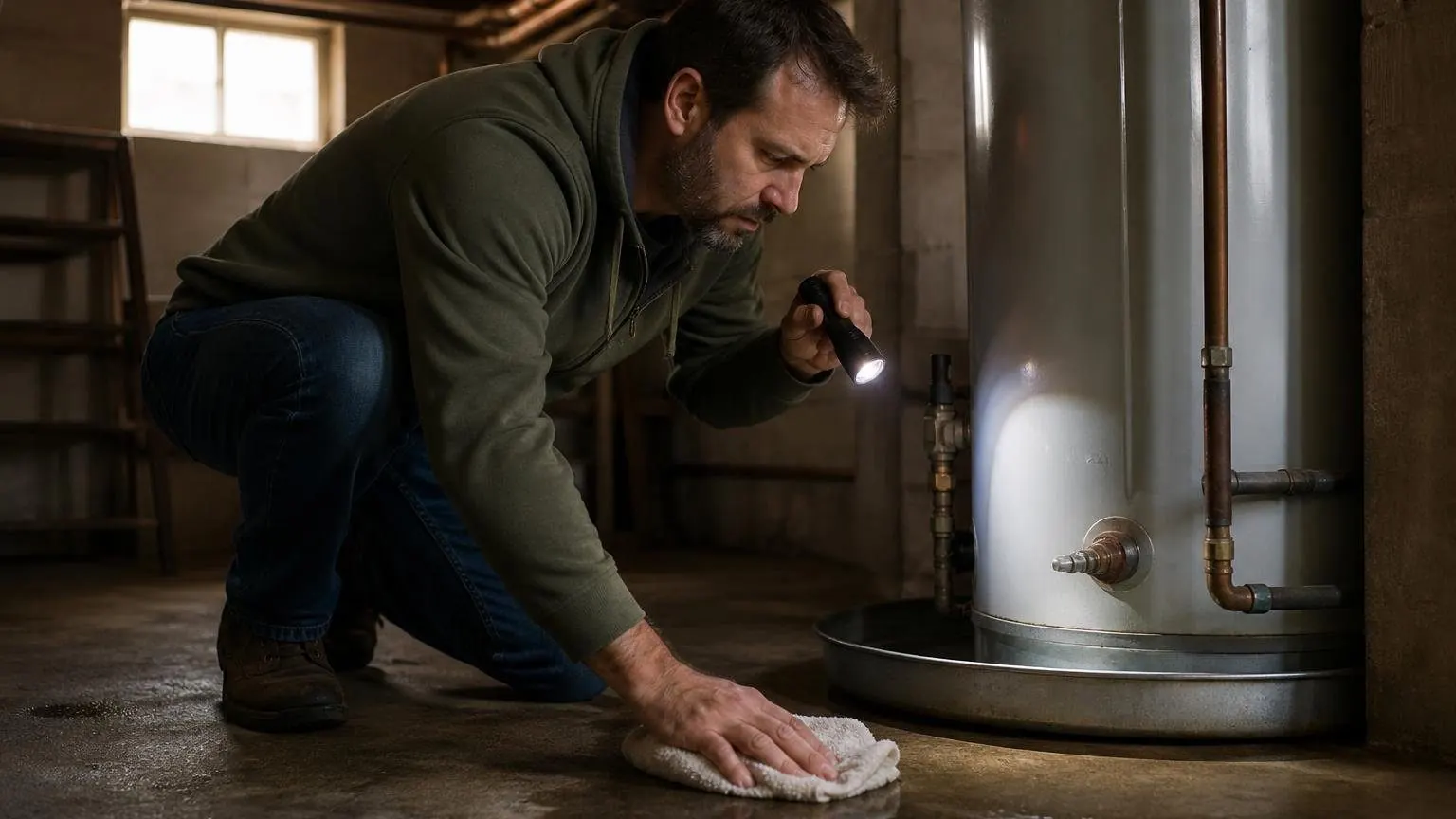
Water heater leaking? Find the source before buying anything. A water heater leaking from fittings, the drain valve or the relief valve is usually a repair; drips that stop within 1 to 2 hours of a cold refill are condensation; water from the tank shell means the tank has failed.
Key Takeaways
- A.O. Smith’s manual says “All water heaters eventually leak” yet many suspected “leakers” are not leaking tanks.
- Gas tank condensation after a cold refill clears in about 1 to 2 hours, per the A.O. Smith manual.
- Bradford White’s 2026 manual states condensation “is normal and does not indicate a leak.”
- Florida’s 2026 plumbing code requires a pan at least 1.5 inches deep with a 3/4 inch drain where a leak would cause damage; the IRC rule is Section P2801.6.
- DOE estimates the average storage water heater lasts around 15 years (2024 final rule).
- IBHS reports that one in every sixty insured homes filed an interior water damage claim in 2016 to 2020 (Insurance Information Institute data).
Is a leaking water heater dangerous?
A leaking water heater is a property risk first and a safety risk second. A slow drip rots flooring; a split tank releases its contents. IBHS flags heaters installed in attics and above the first floor as a concern in its December 2024 State of the Risk report.
The safety risk depends on what the water touches. Water near electric elements means power off at the breaker; water on a gas burner means gas control off. Relief valve discharge can be scalding; our guide to tank temperature settings covers the scald numbers.
What to do if your water heater is leaking: the first hour
Shut off energy, then water, then relieve pressure. That order keeps elements and the burner from firing on an emptying tank.
- Turn power off at the breaker (electric) or the gas control to OFF (gas). A.O. Smith says never relight before the tank is completely full.
- Close the cold water valve on the line feeding the heater. Florida’s 2026 plumbing code, Section 503.1, requires that valve to serve only the heater, so the house keeps cold water.
- Open a hot tap somewhere in the house to drop tank pressure.
- Contain the water with towels or a wet vacuum. Rheem says using heat to dry a leak is not permitted; a fan is fine.
- If the tank shell is leaking, drain it through a hose to a floor drain or outdoors, as in our flushing walkthrough. A fitting leak may not need draining.
- Photograph the heater, rating plate and damage before cleanup if you may claim on insurance.
Where is the water heater leaking from?
The location of the water tells you the fix. Dry the tank and floor, then watch where water reappears. A.O. Smith’s leakage checkpoints say not to replace the heater “until a full inspection of all possible water sources is made.”
| Where the water is | Usual cause | Documented in | Verdict |
|---|---|---|---|
| Hot or cold pipe connections on top | Loose connection or sweating pipe | A.O. Smith checkpoint E | Repair |
| Anode port on top | Anode fitting threads | A.O. Smith checkpoint F | Repair |
| Relief valve or its discharge pipe | High pressure, thermal expansion, or leaking threads | A.O. Smith checkpoints G and H; Bradford White | Repair |
| Drain valve at the base | Valve slightly open or fitting leak | A.O. Smith checkpoints I and J | Repair |
| Burner area or floor after a cold refill (gas) | Condensation | A.O. Smith checkpoint K; Bradford White | Wait and watch |
| Vent pipe assembly (gas) | Vent problem | A.O. Smith checkpoint D | Call the gas utility |
| Tank shell or bottom, all else ruled out | Corroded inner tank | A.O. Smith checkpoint L | Replace the heater |
Is it a leak or condensation?
Condensation looks like a leak but stops once the tank is hot. All three major makers describe it, with the same trigger: a tank full of cold water after installation or a large draw.
- A.O. Smith: combustion vapor condenses on the cool tank, sizzles on the burner and “may be diagnosed as a tank leak”; it should clear in about 1 to 2 hours.
- Bradford White: condensation “is normal and does not indicate a leak.”
- Rheem (electric tanks): it can form after a heavy draw with very cold inlet water; if it continues, examine the piping and fittings for leaks.
Myth check: “A puddle under the tank means the tank is dead.” Not per A.O. Smith, which says water in the heater bottom may be condensation, loose connections or the relief valve. Dry everything, run the heater two hours without hot water use, then judge.
Heat pump models also make condensate by design, through a separate drain; see our heat pump water heater explainer.
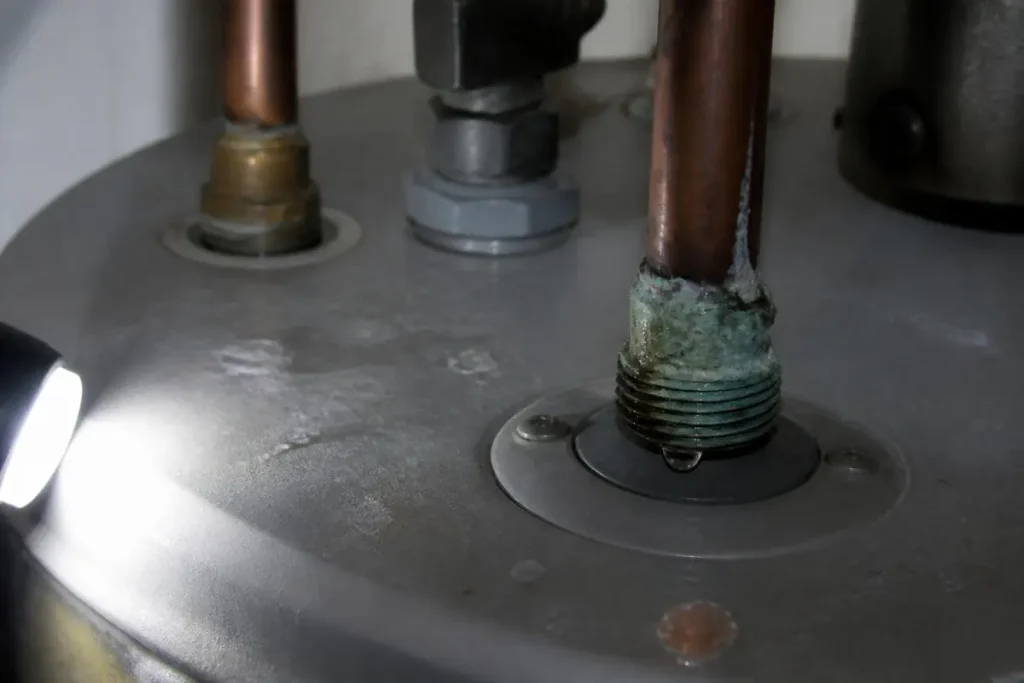
Water heater leaking from the top: pipes, nipples and the anode port
A water heater leaking from the top is almost always a fitting, not the tank: the hot and cold connections, the anode port or the relief valve. A.O. Smith’s test is a cotton swab pushed between the jacket opening and the fitting; a wet swab means leaking threads.
Connections can usually be tightened or resealed after draining a few gallons. The anode port gets opened for inspection, every 2 years per Bradford White; our anode rod guide covers resealing. On electric tanks, water behind a side access panel points to an element port, sealed by a heating element gasket in Rheem’s parts list; cut power, then see our element testing and replacement guide.
Water heater leaking from the relief valve or drain valve
Water from the relief valve pipe or the drain valve is a part repair. But a relief valve that discharges is reporting a pressure or temperature problem you must solve first.
Bradford White says a valve that discharges periodically may reflect thermal expansion in a closed system: do not plug the outlet. Florida’s code, Section 504.4, says the relief valve “shall not be used as a means of controlling thermal expansion.” The usual fix is a sized thermal expansion tank. DOE’s Energy Saver guidance (archived copy) suggests checking the valve every six months. Testing and replacement are in our relief valve guide.
For the drain valve, close it by hand and cap the hose thread. A drip from the spout means a worn valve; water around its base means the tank fitting.
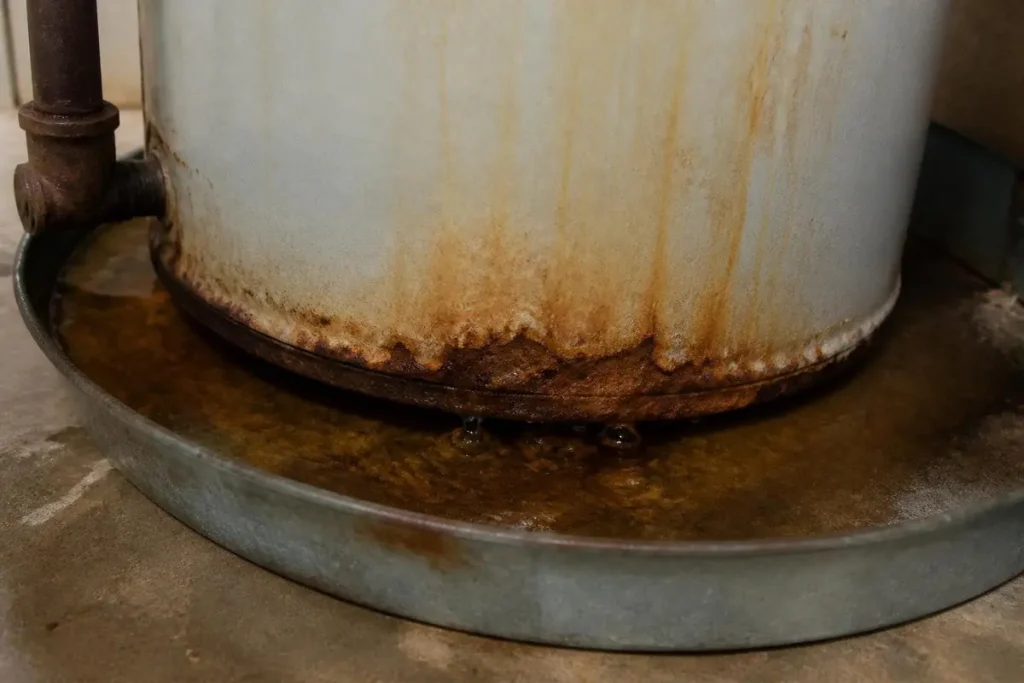
Water heater leaking from the bottom: when the tank has failed
A water heater leaking from the bottom of the tank itself, with condensation, the drain valve and the relief pipe ruled out, has a failed inner tank. There is no repair; the leak only grows. Turn it off and drain it.
DOE’s 2024 rule estimates average storage heater life at around 15 years. A.O. Smith warns thermal expansion can cause premature tank failure that its limited warranty does not cover. Check the rating plate date and warranty, then plan the replacement: sizing and fuel choice.
What does code require to catch a leak?
Where a tank leak would cause damage, code requires a drained pan. The IRC rule is Section P2801.6, per the ICC-ES pan certificate PMG-1384 (June 2026). We quote the equivalent state text in the Florida Building Code, Plumbing, 9th Edition (2026), Section 504.7; local amendments vary.
- Material: steel or aluminum at least 0.0236 inch thick, or plastic at least 0.036 inch (no plastic pan under gas).
- Size and drain: at least 1.5 inches deep, drained by an indirect waste pipe at least 3/4 inch in diameter.
- Termination: a receptor or floor drain, or outdoors 6 to 24 inches above grade.
- Replacements: where no pan drain existed, one is not required for a replacement water heater.
- Relief valve: no higher than 210°F and 150 psi; discharge ends no more than 6 inches above the floor and is readily observable (504.5, 504.6).
Makers add pan rules: A.O. Smith, 1 inch wider than the jacket and a maximum depth of 1.75 inches; Rheem, diameter plus 2 inches; Bradford White, 4 inches greater than the diameter. DOE’s Building America gas tank water heater checklist asks for a 3/4 inch pan drain and relief discharge within 6 inches of the floor. Our inspector’s checklist for tank installs covers the rest.
How we researched this
Research date: October 14, 2026. We read the leak, condensation and pan sections of three current owner manuals (A.O. Smith 326940, Bradford White 238-51007-00R, Rheem AP21980 and AP23657), the Florida Building Code, Plumbing (2026) Chapter 5 sample, ICC-ES certificate PMG-1384, DOE’s 2024 water heater final rule, DOE Energy Saver (archived copy), the Building America checklist and IBHS’s 2024 interior water report. Maker statements are labeled as maker claims. Excluded: repair and replacement prices (no federal series), contractor blogs, and Reddit, because this topic involves gas and electrical safety.
Frequently asked questions
What should I do if my water heater is leaking?
Turn off power or gas, close the cold water valve feeding the heater, open a hot tap to relieve pressure, then find the source. A.O. Smith says not to replace the heater until every possible water source has been checked, because many suspected leaks are condensation or fittings.
Can I still use water if the water heater is leaking?
Yes, cold water. Florida’s plumbing code, Section 503.1, requires a cold water valve serving only the heater, so closing it stops supply to the tank while the rest of the house keeps cold water. You will have no hot water until the leak is fixed.
How long will a water heater last once it starts leaking?
There is no published figure. A fitting or valve leak can be repaired and the heater keeps working. A leak from the tank shell cannot be repaired and only grows, so plan replacement now. DOE puts average storage heater life at around 15 years.
Is it safe to leave a leaking water heater on?
Not if water reaches the burner, elements or wiring, or if the tank shell is leaking. Shut it off. A fitting drip with dry controls is lower risk in the short term, but Rheem’s manual says to examine piping and fittings if water persists.
Why is my new water heater leaking from the bottom?
Most likely condensation. A.O. Smith says condensate is common when a new heater is first filled with cold water and should disappear in about 1 to 2 hours once the water warms. If water persists, check the drain valve and relief pipe.
Does homeowners insurance cover a leaking water heater?
It depends on your policy wording; our guide to what homeowners policies actually say explains the clauses. IBHS reports one in every sixty insured homes filed an interior water claim in 2016 to 2020.
Sources
- A.O. Smith. “Residential Gas Water Heaters Installation and Operating Manual 326940-001.” https://assets.aosmith.com/damroot/Original/10001/326940.pdf. Accessed October 2026.
- Bradford White. “Installation and Operation Manual, Gas-Fired Water Heater 238-51007-00R.” https://docs.bradfordwhite.com/I&O/238-51007-00_Current.pdf. Accessed October 2026.
- Rheem. “Use & Care Manual AP21980, Electric Residential Water Heaters.” https://files.rheem.com/blobazrheem/wp-content/uploads/sites/2/AP21980-Rev-02-Electric-Residential-WH-with-e-control-HIGH-TIER.pdf. Accessed October 2026.
- International Code Council. “Florida Building Code, Plumbing, 9th Edition (2026), Chapter 5 sample.” https://shop.iccsafe.org/media/wysiwyg/material/5621L26-Sample.pdf. Accessed October 2026.
- ICC-ES. “PMG-1384 Product Certificate, Water Heater Drain Pans.” https://icc-es.org/wp-content/uploads/report-directory/PMG-1384.pdf. Accessed October 2026.
- U.S. Department of Energy. “Energy Conservation Standards for Consumer Water Heaters,” 89 FR 37778. https://www.federalregister.gov/d/2024-09209. Accessed October 2026.
- U.S. Department of Energy. “Storage Water Heaters,” Energy Saver (archived copy). https://web.archive.org/web/2025id_/https://www.energy.gov/energysaver/storage-water-heaters. Accessed October 2026.
- PNNL, Building America Solution Center. “Gas Tank Water Heater” checklist. https://basc.pnnl.gov/home-improvement-expert/checklists/gas-tank-water-heater. Accessed October 2026.
- Insurance Institute for Business & Home Safety. “State of the Risk: Interior Water Damage” (December 2024). https://ibhs1.wpenginepowered.com/wp-content/uploads/Interior-Water-White-Paper.pdf. Accessed October 2026.
Leave a Reply