How to flush a water heater? Turn off the gas or breaker, run the hot water cool, drain the tank through a garden hose, then flow cold water through until it runs clear. Refill completely before gas or power goes back on. Maker manuals set intervals from monthly to yearly.
Key Takeaways
- Maker intervals disagree: an A.O. Smith gas manual says drain and flush every 6 months, while Bradford White says drain off a gallon monthly.
- The US Department of Energy lists flushing a quart every three months and says to read your owner’s manual.
- Refill before power: Bradford White says an element in an air pocket can dry fire within seconds.
- Drain water can scald: the CPSC says 150°F water causes third-degree burns in two seconds.
- Draining alone can take 20 to 60 minutes depending on tank size, per Alberta Health Services.
- Tankless units are descaled, not drained: Rinnai circulates four gallons of white vinegar for at least 1 hour.
How often should you flush a water heater?
Flush a tank water heater as often as its manual says: from a gallon a month to a full yearly flush, more with hard water. No single federal interval exists.
| Source (document) | Recommended interval | What gets drained |
|---|---|---|
| A.O. Smith direct vent gas manual 326940 | Every 6 months | Full drain and flush |
| A.O. Smith gas use and care guide 100400765 | After the first six months, then at least annually by water hardness | Full drain and flush, plus anode check |
| Rheem gas and electric use and care manuals | Every month | A few quarts |
| Bradford White gas manual 238-51007-00R | Monthly | A gallon |
| US DOE Energy Saver | Every three months | A quart |
| LADWP (Los Angeles utility) | At least once a year | Pressure flush until clear |
| City of Blaine, MN | Every one to three years | Full drain and refill |
Makers want small, frequent drains plus a full flush at six to twelve months. A.O. Smith’s use and care guide says to flush after the first six months to gauge sediment, then repeat at least annually depending on hardness. The web’s “every 6 months for everyone” traces to one manual, not a rule.
What do you need before you start, and how hot is the water?
You need a garden hose, a floor drain or outdoor spot lower than the tank, and a bucket. The real hazard is heat: the tank holds water at thermostat temperature.
That is why A.O. Smith says to be sure the water runs cool before draining, and why the hose should end where nobody stands. CPSC urges a 120°F setting anyway, a choice we weigh in our guide to the right water heater thermostat setting.
How to flush a gas water heater, step by step
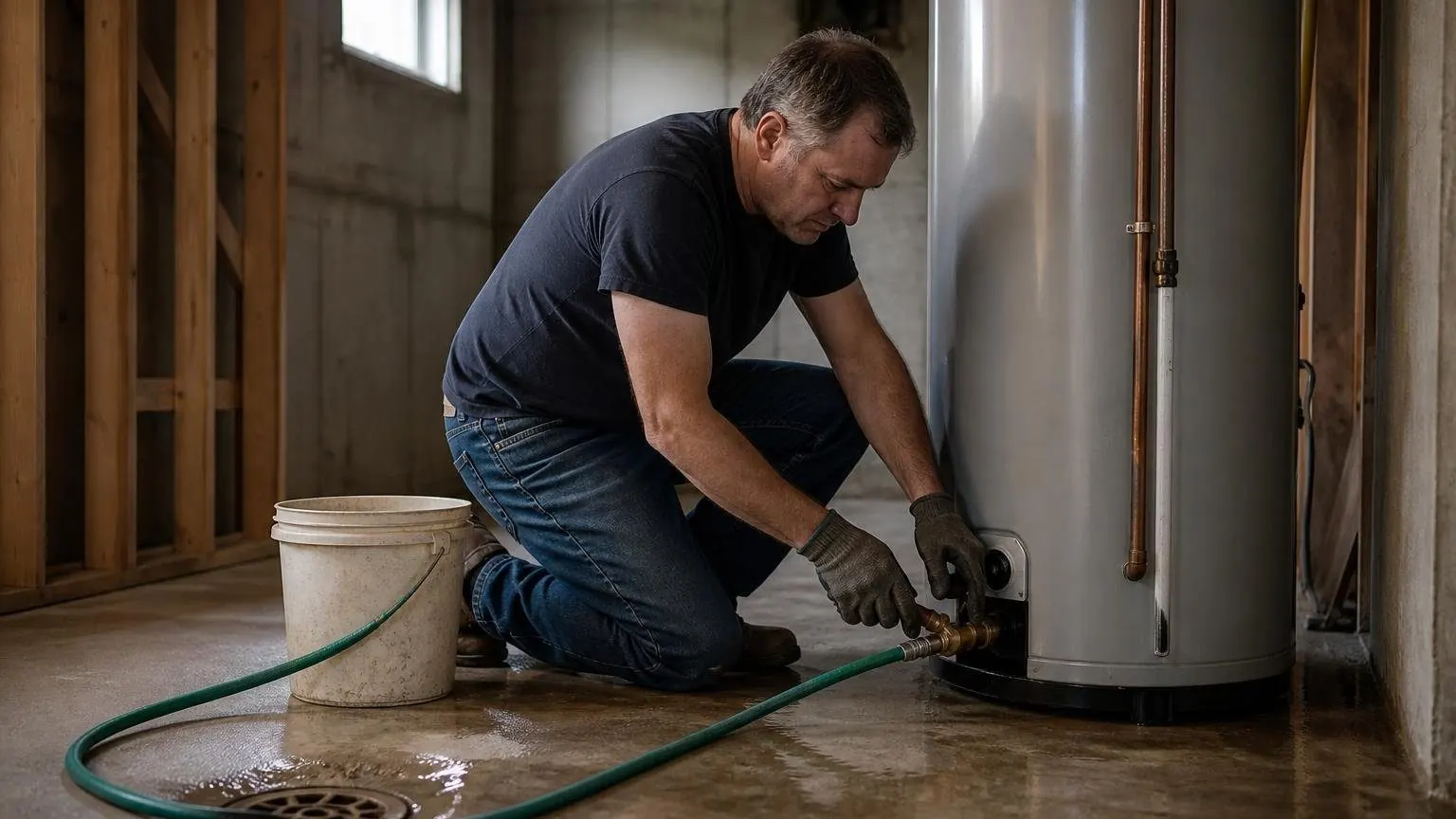
To flush a gas water heater, shut off the gas, cool and drain the tank, then let cold supply water push through the open drain until it runs clean. These steps follow A.O. Smith’s manual 326940.
- Turn the gas control knob to OFF and close the manual gas shutoff. Rheem also says to shut off gas before draining.
- Run a hot faucet until the water runs cool.
- Close the cold water inlet valve.
- Connect a garden hose to the drain valve, secure it, and run it to a drain or outdoors.
- Open a hot faucet, ideally upstairs, so air can enter. Open the drain valve and empty the tank.
- Flush: with the drain open, open the cold inlet and let system water pressure carry sediment out until the stream runs clean. Alberta Health Services suggests cycling the cold valve 3 times to stir it.
- Close the drain valve. Open the cold inlet with a hot faucet open, and keep it running 3 minutes after a constant flow.
- Turn the gas on, relight per the label, and watch several heating cycles.
A.O. Smith’s caution: do not turn on the gas unless the tank is full. For a standing pilot, our water heater pilot light walkthrough covers relighting and what to check if it will not stay lit.
How to flush an electric water heater without burning out an element
Flushing an electric water heater uses the same steps with two changes: switch the power off at the circuit breaker, and refill the tank completely before switching it back on. Elements burn out in air.
| Step | Gas tank | Electric tank |
|---|---|---|
| Shut off | Gas control to OFF, close manual gas valve | Breaker OFF or fuses out (A.O. Smith) |
| Let air in | Open a hot faucet | Hot faucet, or lift the relief valve lever (Rheem) |
| Refill check | Tank full before gas on | Steady stream at the faucets before power on |
| Restart | Relight per label | Breaker ON |
| Risk if rushed | Firing an unfilled tank | Dry fired element |
Bradford White’s manual says the tank is filled when a steady stream flows from the faucets. A.O. Smith’s support site says a burned out upper element on a new heater is almost always dry fire. Rheem’s manual says never to turn the heater on unless it is filled with water; its electronic control flashes three red blinks for an unfilled tank.
Bradford White’s service manual also traces slow recovery to lime around the element. If hot water still runs short after a flush, test the parts with our water heater element guide.
How long does it take to flush a water heater?
Draining a typical tank takes 20 to 60 minutes depending on its size, according to Alberta Health Services. Add cool-down, flushing and refill time. Clarity, not a clock, says when you are done.
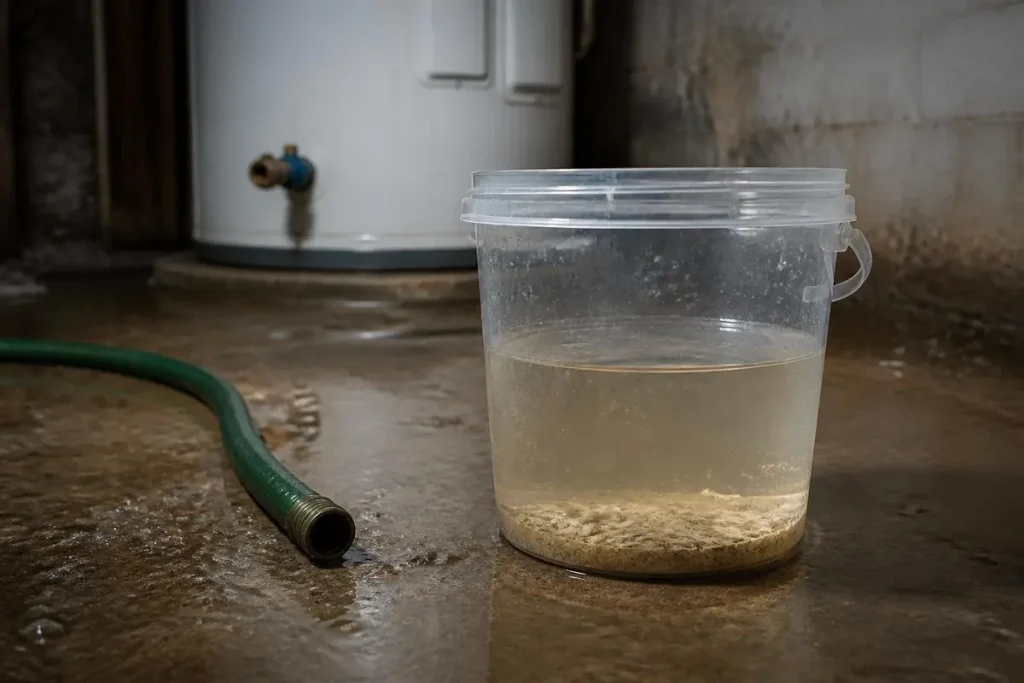
The Los Angeles Department of Water and Power test: after five minutes of flushing, fill a bucket, let it stand a minute and look for sand-like material. Repeat until nothing settles.
What if the drain valve clogs, drips or will not open?
A drain valve that trickles or stops usually has sediment behind it. A.O. Smith says sediment may clog the valve, and to contact a qualified person if the tank will not drain. Never force the handle: LADWP warns a plastic draincock on a heater several years old may break.
A.O. Smith’s manual includes a drain valve washer replacement for drips afterward. If water appears elsewhere, use our water heater leak diagnosis.
Correction: the relief valve shortcut
Some guides lift the relief valve lever to let air in. Rheem permits it, but A.O. Smith says a valve that fails to reset afterward must be replaced. A hot faucet avoids that risk.
If the relief valve discharges after the refill, A.O. Smith names thermal expansion in a closed system as the most common cause. Our pages on the temperature and pressure relief valve and on sizing a thermal expansion tank cover both fixes.
How do you flush a tankless water heater?
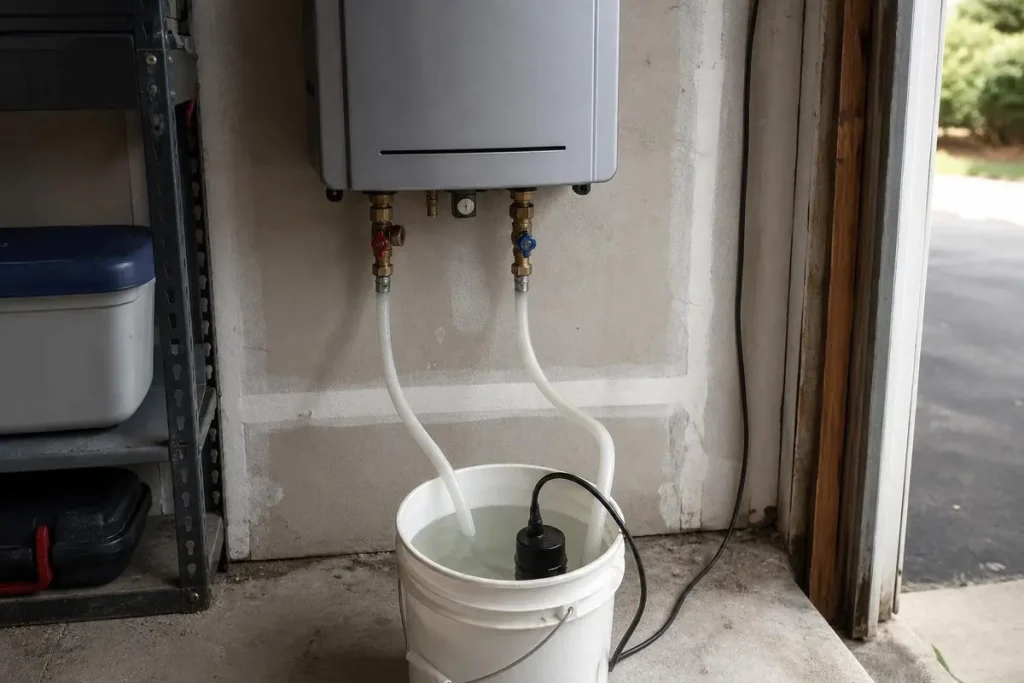
You flush a tankless water heater by pumping descaler through its heat exchanger, not by draining a tank. Rinnai’s N Series manual uses isolation valves, a pump and white vinegar, and says lime damage is not covered by the warranty.
- Turn the unit off and disconnect its power.
- Close the hot and cold shutoffs. Connect the pump hose to the cold service valve and a drain hose to the hot service valve.
- Put both hose ends in a pail holding four gallons of undiluted food grade white vinegar.
- Open the service valves and circulate for at least 1 hour at four gallons per minute.
- Rinse with fresh water for five minutes, clean the inlet filter, reset the valves and restore power.
Rinnai ties the schedule to water quality: it lists total hardness up to 200 mg/L as its limit and shows an SS (Service Soon) code when a flush is due. Navien describes the same pump method and notes water screens on the cold inlet. Our tankless water heater guide covers sizing and the federal rules.
Is flushing a water heater worth it?
Yes. Flushing a water heater is worth it because every tank manual we read calls for it. A.O. Smith says sediment or lime buildup can reduce the efficiency of your water heater, heavy deposits can damage it, and skipped flushes can deteriorate the tank and drain valve.
A.O. Smith links rumbling sounds, and less hot water than usual, to sediment. If a flush does not restore hot water, our checklist for a water heater not heating picks up from there.
One limit: we found no federal source that puts a percentage on efficiency lost to sediment, so we give none. The Department of Energy says only that maintenance can extend life and minimize loss of efficiency, and puts water heating at about 18% of home energy use.
DOE says storage water heaters last 10 to 15 years, so an older tank that rumbles and drains brown may be due for our water heater replacement guide. Check the anode rod too; A.O. Smith pairs it with the first flush.
How we researched this
Researched October 14, 2026. We opened 19 documents and cite 16: A.O. Smith, Rheem, Bradford White and Rinnai manuals (maker claims), CPSC, DOE (archived copies), LADWP, Alberta Health Services, Blaine and Navien. Excluded: Reddit (safety topic), contractor blogs with unsourced intervals, and any efficiency loss percentage, since no federal source publishes one.
Frequently asked questions
Can I flush my hot water heater myself?
Yes. Makers write the drain and flush steps for owners, and A.O. Smith’s manual covers gas off, drain, flush and relight. LADWP advises a licensed plumber if you are not comfortable, and A.O. Smith says to call a qualified person if the tank will not drain.
How do I know if my water heater needs to be flushed?
A.O. Smith names rumbling or percolating sounds, and less hot water than you are used to, as signs of sediment. LADWP adds yellowish or brownish hot water or sand-like material. With no symptoms, still follow the interval in your own manual.
Should I flush a 7 year old water heater?
Yes, carefully. DOE puts storage tank life at 10 to 15 years, so a 7 year old tank has service left. LADWP warns that an older plastic draincock may break if forced, so open it gently and call a qualified person if it will not drain.
How often should you flush a tankless water heater?
Follow the water, not the calendar. Rinnai’s manual shows an SS (Service Soon) code when the heat exchanger is due, calls for treatment and more frequent flushing where water is hard, and lists total hardness up to 200 mg/L as its limit.
Can you flush a water heater with vinegar?
Vinegar is the tankless method: Rinnai circulates four gallons of undiluted white vinegar through the heat exchanger. The tank manuals we read flush with plain water, and A.O. Smith says its recommended delimer comes through authorized servicers or distributors. Use only what your manual names.
Do you turn off the water heater to flush it?
Yes, in the maker procedures. A.O. Smith turns the gas off first, and its support site says to switch electric models off at the circuit breaker. LADWP’s quick flush leaves gas and water on, but the tank stays full that way.
Sources
- A.O. Smith. “Residential Gas Water Heaters manual, 326940.” https://assets.aosmith.com/damroot/Original/10001/326940.pdf. Accessed October 2026.
- A.O. Smith. “Gas Water Heater Use and Care Guide, 100400765.” https://assets.hotwater.com/damroot/Original/10017/100400765.pdf. Accessed October 2026.
- A.O. Smith at Lowe’s. “Check the Heating Element.” https://www.aosmithatlowes.com/support/help/voltage-was-correct/23. Accessed October 2026.
- Rheem. “Gas Water Heater Use and Care Manual.” https://res.cloudinary.com/dzhpkjoqj/RheemNew/PROClassicGas_UseInstall. Accessed October 2026.
- Rheem. “Electric Water Heater Use and Care Manual, AP21980.” https://files.rheem.com/blobazrheem/wp-content/uploads/sites/2/AP21980-Rev-02-Electric-Residential-WH-with-e-control-HIGH-TIER.pdf. Accessed October 2026.
- Bradford White. “Gas Water Heater manual, 238-51007-00R.” https://docs.bradfordwhite.com/I&O/238-51007-00_Current.pdf. Accessed October 2026.
- Bradford White. “Service Manual, Electric Water Heaters, 238-54711-00A.” https://docs.bradfordwhite.com/Service_Manual/238-54711-00_Current.pdf. Accessed October 2026.
- Rinnai. “N Series Tankless manual, 100000467.” https://media.rinnai.us/salsify_asset/s-6b715523-18d3-43c0-ab28-1ef5090e137c/100000467-N%20Series%20Residential%20Condensing%20Installation%20and%20Operation%20Manual.pdf. Accessed October 2026.
- Navien. “Simple tips for maintaining your Navien unit.” https://www.navieninc.com/blog/simple-tips-for-maintaining-your-navien-unit. Accessed October 2026.
- US CPSC. “Avoiding Tap Water Scalds.” https://www.cpsc.gov/s3fs-public/5098.pdf. Accessed October 2026.
- US Department of Energy. “Storage Water Heaters” (archived copy). https://web.archive.org/web/20260101015337id_/https://www.energy.gov/energysaver/storage-water-heaters. Accessed October 2026.
- US Department of Energy. “Water Heating” (archived copy). https://web.archive.org/web/20260101030026id_/https://www.energy.gov/energysaver/water-heating. Accessed October 2026.
- US Department of Energy. “Tankless Water Heaters” (archived copy). https://web.archive.org/web/20260101101910id_/https://www.energy.gov/energysaver/tankless-or-demand-type-water-heaters. Accessed October 2026.
- LADWP. “How to Flush a Water Heater.” https://webprod.ladwp.com/sites/default/files/documents/How_to_Flush_a_Water_Heater.pdf. Accessed October 2026.
- Alberta Health Services. “Flushing Your Water Heater.” https://myhealth.alberta.ca/alberta/pages/Flushing-Your-Water-Heater.aspx. Accessed October 2026.
- City of Blaine, MN. “Water Heater Flushing.” https://www.blainemn.gov/1395/Water-Heater-Flushing. Accessed October 2026.
Leave a Reply