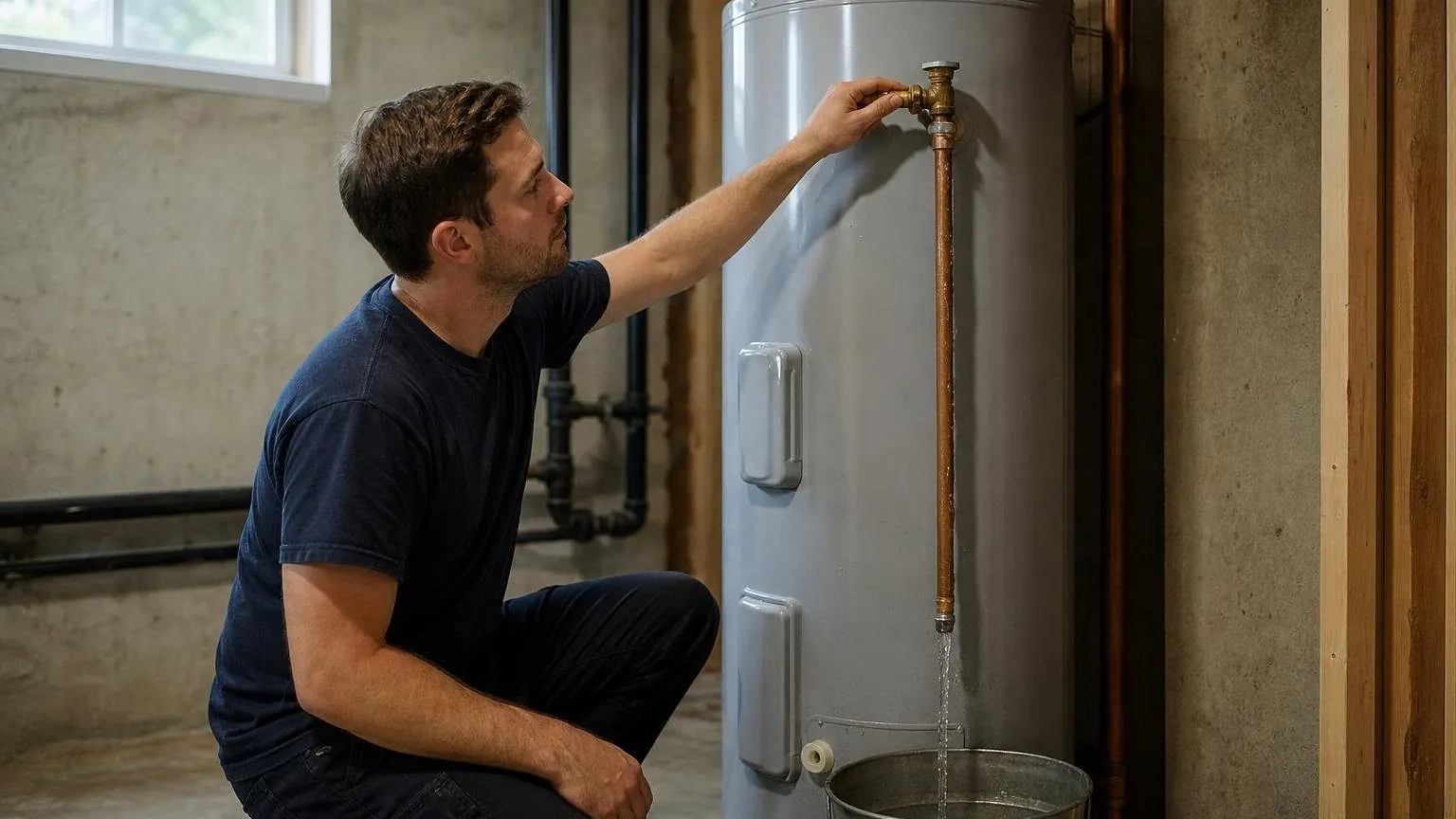
What is a water heater relief valve? It is the temperature and pressure (T&P) safety valve near the top of the tank. It opens when stored water reaches 210°F or pressure reaches its setting, usually 150 psi, and dumps water through a discharge pipe so the tank cannot rupture.
Key Takeaways
- Standard settings are 150 psi and 210°F, certified to ANSI Z21.22/CSA 4.4 (Cash Acme NCLX specification).
- Watts says lift the lever once a year and have the valve removed and inspected every three years (Watts LF100XL sheet).
- A dripping valve usually means high house pressure or no expansion tank (A.O. Smith Use & Care Guide, 2025).
- IRC P2804.6.1 sets 14 discharge pipe rules, including an end no more than 6 inches above the floor (ICC CodeNotes).
- Michigan tightens that to 4 inches and 210°F rated pipe (Mich. Admin. Code R. 408.30530).
- CPSC: 150°F water gives most adults third-degree burns in two seconds (CPSC Publication 5098).
What does a water heater relief valve do?
A water heater relief valve is the backup if the thermostat or gas control fails. A spring opens it on pressure; a probe reaching into the tank opens it on temperature. Watts requires that probe to sit within the top 6 inches of water (Watts LF100XL).
It is not an operating control. The International Code Council says: “Any water discharge from the relief valve is an indication of a water distribution system problem, a water heater problem or that the relief valve is malfunctioning” (ICC CodeNotes). Our leak diagnosis guide separates valve leaks from tank leaks.
What are T&P valve ratings, and who certifies them?
A residential T&P valve carries a pressure setting, most often 150 psi, and a 210°F temperature setting. Makers certify it to ANSI Z21.22/CSA 4.4, the standard for relief valves on hot water supply systems, and many add an ASME Section IV capacity rating (Cash Acme NCLX).
Watts offers 75, 100, 125 and 150 psi settings and rates its LF100XL for heaters up to 105,000 BTU/hr. A.O. Smith sets the key limit: relief pressure “must not exceed the working pressure rating of the water heater as stated on the rating plate” (A.O. Smith).
Watts also says “Maximum system operating pressure must not exceed 75% of valve set pressure.” Worked through, 150 × 0.75 = 112.5 psi. A.O. Smith notes most codes cap incoming water at 80 psi, well below that.
Why is my water heater relief valve dripping?
A water heater relief valve dripping slowly is usually reacting to pressure, not failing. A.O. Smith says a dripping T&P valve “is usually caused by the home’s water pressure being too high and/or lack of a Thermal Expansion Tank” (A.O. Smith). A gush of very hot water is more serious.
A State Water Heaters bulletin separates the two: the valve “relieves water slowly when actuating on pressure” and “relieves water quickly when actuating on temperature,” and for the fast hot discharge, “The only cause of this problem is a malfunctioning thermostat” (State Bulletin 52). Heated water expands, and a closed system has nowhere to put it; our expansion tank explainer covers that.
| What you see | Likely cause | What it usually means |
|---|---|---|
| Slow weeping after heating cycles | Pressure relief: thermal expansion or high supply pressure | Check house pressure and the expansion tank |
| Sudden discharge of very hot water | Temperature relief: failed thermostat | Shut off power or gas; call service |
| Water at the valve threads | Failed thread seal | Remove and reseal the valve |
| Seeping at the welded tank fitting (spud) | Tank fitting failure | Not repairable; replace the heater |
| Steady drip after a test or long weeping | Mineral deposits on the seat | Inspect; replace if it will not reseat |
Table sources: State Water Heaters Bulletin 52 (rows 1 to 4); A.O. Smith (row 5). For thermostat checks, see our temperature setting guide or the electric element and thermostat test.
How do you test a water heater relief valve?
To test a water heater relief valve, lift the lever once a year until water flows, hold it 5 to 10 seconds, then release and confirm the flow stops. That is Rheem’s tag procedure; Watts and A.O. Smith set the same annual interval.
- Confirm the discharge pipe runs to a safe drain, or “personal injury may result” (Watts).
- Keep hands and feet clear of the outlet; the water is scalding.
- Lift the lever “far enough to cause an outflow of water to the drain” and hold 5 to 10 seconds (Rheem valve tag).
- Release the lever. The flow should stop.
- No flow means the valve is inoperative: turn off the heater and call a plumber (Watts).
- Wipe up water in the drain pan (A.O. Smith).
Watts adds a deeper check: valves “should be inspected AT LEAST ONCE EVERY THREE YEARS” by a licensed plumber, who removes the valve to look for mineral deposits. A.O. Smith pairs the annual test with flushing the tank and an anode rod inspection.
What does code require for the relief valve discharge pipe?
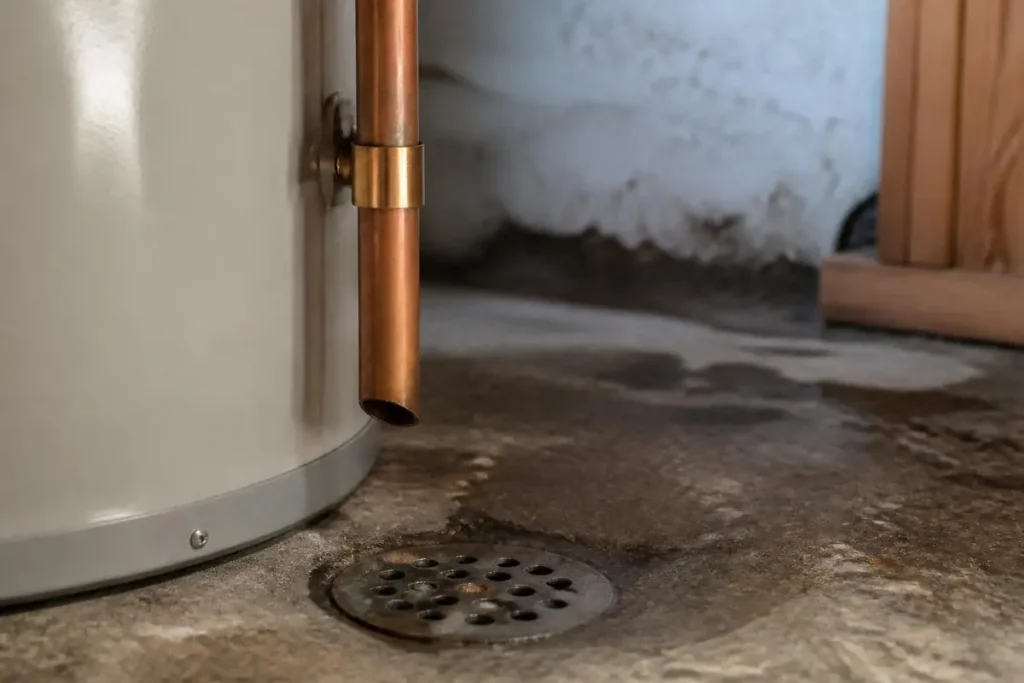
The water heater relief valve discharge pipe is governed by IRC Section P2804.6.1 and IPC Section 504.6, which the International Code Council summarizes as 14 items: full size throughout, one valve per pipe, gravity drainage with no traps, no valves or tees, no threaded end, and an end no more than 6 inches above the floor or receptor (ICC CodeNotes).
States amend the model code. Michigan requires an end “not more than 4 inches” from the floor and rigid pipe rated for 210°F (Mich. Admin. Code R. 408.30530). Makers add their own conditions; see our installation checklist.
| Rule | IRC P2804.6.1 (2021, per ICC) | Michigan R 408.30530 | A.O. Smith guide (2025) | Rheem valve tag |
|---|---|---|---|---|
| End height | 6 inches max above floor or receptor | 4 inches max from floor | 6 inches max above floor drain | At least 6 inches above floor |
| Pipe size | Not smaller than valve outlet | Same inside diameter as outlet | At least ¾ inch inside, no reducer | Same size or larger |
| Pipe rating | 100 psi at 180°F minimum | Rigid, 210°F minimum | Copper or CPVC, 210°F; no PVC or hose | 250°F or more |
| Valves and end | No valves or tees; unthreaded | No valves; unthreaded | No cap, plug or valve | No shutoff; unthreaded |
Note the height conflict: the Rheem tag and Watts sheet say “at least” 6 inches, the model code says no more than 6. The code your jurisdiction adopted controls, so ask the inspector.
Never cap or plug the discharge pipe
The ICC bans threaded ends because they “would make it easy for someone to screw on a cap or valve to stop the dripping.” A.O. Smith warns “An explosion could occur if the T&P Relief Valve or discharge pipe is blocked.” Fix the cause of the drip instead.
When should a temperature and pressure relief valve be replaced?
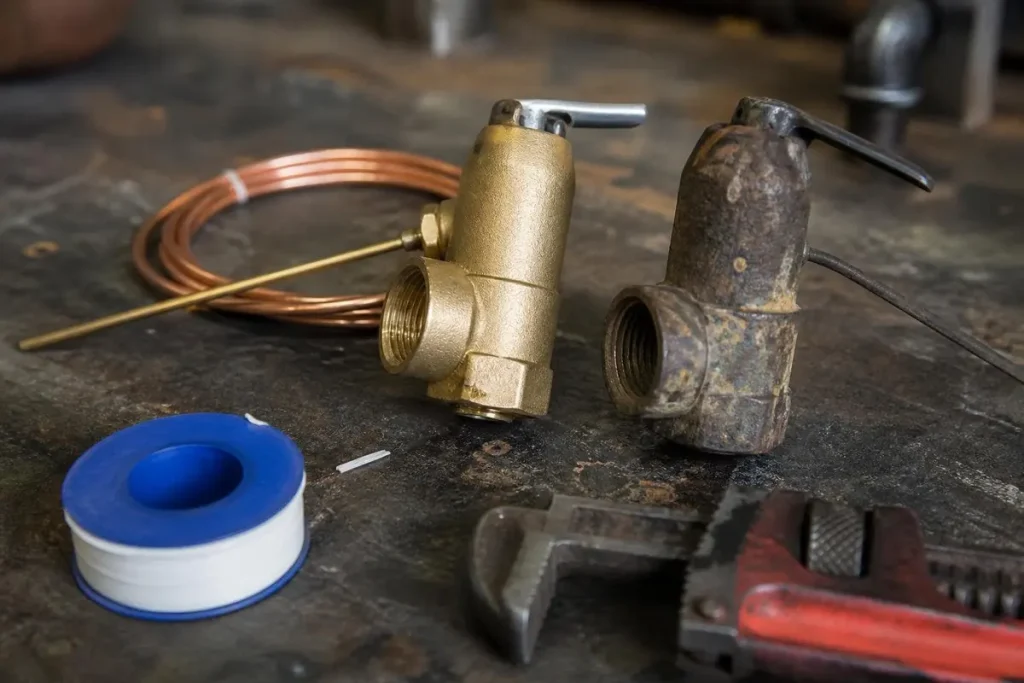
Replace a temperature and pressure relief valve when the lever test gives no flow, when it keeps dripping after pressure and expansion are fixed, or when an inspection finds corrosion or mineral buildup. Rheem’s tag notes that “Repair or alteration of the valve in any way is prohibited by national safety standards.”
Valves do fail. In December 2009 CPSC announced a recall of about 900 Watts 140X-9 valves for large heaters because the valve “can fail to reduce pressure and avert failure or rupture of the water heater tank” (CPSC recall).
The new valve must match the heater: setting at or below the rating plate pressure, BTU capacity above the heater’s input (Watts and Cash Acme specifications), and a probe reaching the top 6 inches. State Water Heaters warns a wrongly sized valve voids the warranty, and A.O. Smith says “Do not reuse an old T&P Relief Valve.” A seeping tank fitting means the replacement guide instead. We publish no valve price because no federal survey covers it.
Is a water heater relief valve the same as a boiler relief valve?
No. A water heater relief valve trips on temperature and pressure, usually 210°F and 150 psi. A hot water heating boiler uses a pressure relief valve set far lower: Taco’s Dual Control, for example, “is set to relieve at 30 psi” (Taco sheet 102-006). The valves are not interchangeable; our boiler pressure guide covers boiler settings.
How we researched this
We read 13 documents on October 14, 2026 and cite 10: ICC CodeNotes on IRC P2804.6.1, Michigan’s adopted rule, two CPSC documents, Watts and Cash Acme specification sheets, the A.O. Smith guide, Rheem’s valve tag, a State Water Heaters bulletin and a Taco sheet. Maker figures are maker data for the named product.
The ANSI Z21.22 text and codes.iccsafe.org were not accessible, so ratings come from certified makers’ sheets. Contractor blogs, retailer pages and price surveys were excluded. Reddit was skipped because this is a safety topic.
Frequently asked questions
What is the 3 rule for pressure relief valves?
We found no code section or maker manual defining a “3 rule” for water heater relief valves. The closest written rule is Watts’ instruction that relief valves be inspected at least once every three years by a licensed plumber, on top of an annual lever test. Watts also keeps system pressure under 75% of the valve setting.
How do I know if my water heater pressure relief valve is bad?
Suspect the valve if no water flows when you lift the lever, if flow will not stop after release, or if it keeps dripping once house pressure is under the 80 psi cap A.O. Smith cites and an expansion tank is fitted. Watts says a valve with no flow is inoperative: turn off the heater and call a plumber.
When should I open the pressure relief valve on my water heater?
Once a year. Watts, Rheem and A.O. Smith all call for annual manual operation. Rheem’s tag says to hold the lever open 5 to 10 seconds so water flushes the seat, then check that the flow stops when you let go. Confirm the discharge pipe ends at a safe drain first.
Can the relief valve discharge pipe go into the drain pan?
Under the model code, yes: IRC P2804.6.1 lets the pipe discharge to the floor, the heater’s pan, a waste receptor or outdoors. A.O. Smith’s 2025 guide is stricter and tells installers to pipe it to a separate drain unless local and state codes allow the pan. Michigan’s rule also lists the pan.
Can I use PVC or a hose for the discharge pipe?
No. A.O. Smith allows only copper or CPVC approved for discharge use and bans PVC, iron, flexible plastic and any type of hose. The model code requires a rating of at least 100 psi at 180°F, Michigan requires rigid pipe rated for 210°F, and Rheem’s valve tag asks for 250°F.
How hot is the water from a T&P valve?
When the valve opens on temperature, it releases water near its 210°F setting; State Water Heaters calls it “very hot” water. CPSC says 150°F water causes third-degree burns in most adults in two seconds, and it urges owners to set water heaters at 120°F.
Sources
- International Code Council. “CodeNotes: Water Heater Safety in the I-Codes.” https://www.iccsafe.org/wp-content/uploads/22-22035_PMG_CodeNotes_WaterHeaterSafety_FINAL.pdf. Accessed October 2026.
- Michigan LARA via Cornell LII. “Mich. Admin. Code R. 408.30530, Requirements for discharge pipe.” https://www.law.cornell.edu/regulations/michigan/Mich-Admin-Code-R-408.30530. Accessed October 2026.
- Watts. “ES-LF100XL Temperature and Pressure Relief Valves.” https://cdn11.bigcommerce.com/s-h7xitcpvze/content/products/specifications/ES-LF100XL%20spec%20sheet.pdf. Accessed October 2026.
- Cash Acme. “NCLX T&P Relief Valve, Specification BA001.” https://res.cloudinary.com/dzhpkjoqj/Reliance_Worldwide/NCLX_Spec.pdf. Accessed October 2026.
- A.O. Smith. “Residential Gas Water Heater Installation Instructions and Use & Care Guide.” https://assets.hotwater.com/damroot/Original/10017/100400765.pdf. Accessed October 2026.
- Rheem. “Temperature & Pressure Relief Valve” instruction tag. https://images.thdstatic.com/catalog/pdfImages/1d/1d9fad8f-be45-481d-a08a-268946d94ae3.pdf. Accessed October 2026.
- State Water Heaters. “Technical Bulletin 52: Leaking Temperature and Pressure Relief Valve.” https://www.StateWaterHeaters.com/lit/bulletin/bulletin52.pdf. Accessed October 2026.
- U.S. CPSC. “Temperature and Pressure Relief Valves for Large Water Heaters Recalled by Watts.” https://www.cpsc.gov/Recalls/2009/temperature-and-pressure-relief-valves-for-large-water-heaters-recalled-by-watts. Accessed October 2026.
- U.S. CPSC. “Avoiding Tap Water Scalds, Publication 5098.” https://www.cpsc.gov/s3fs-public/5098.pdf. Accessed October 2026.
- Taco. “Instruction Sheet 102-006, Boiler Feed Valves and Dual Controls.” https://s3.amazonaws.com/s3.supplyhouse.com/manuals/1319637262560/67032_PROD_FILE.pdf. Accessed October 2026.
Leave a Reply