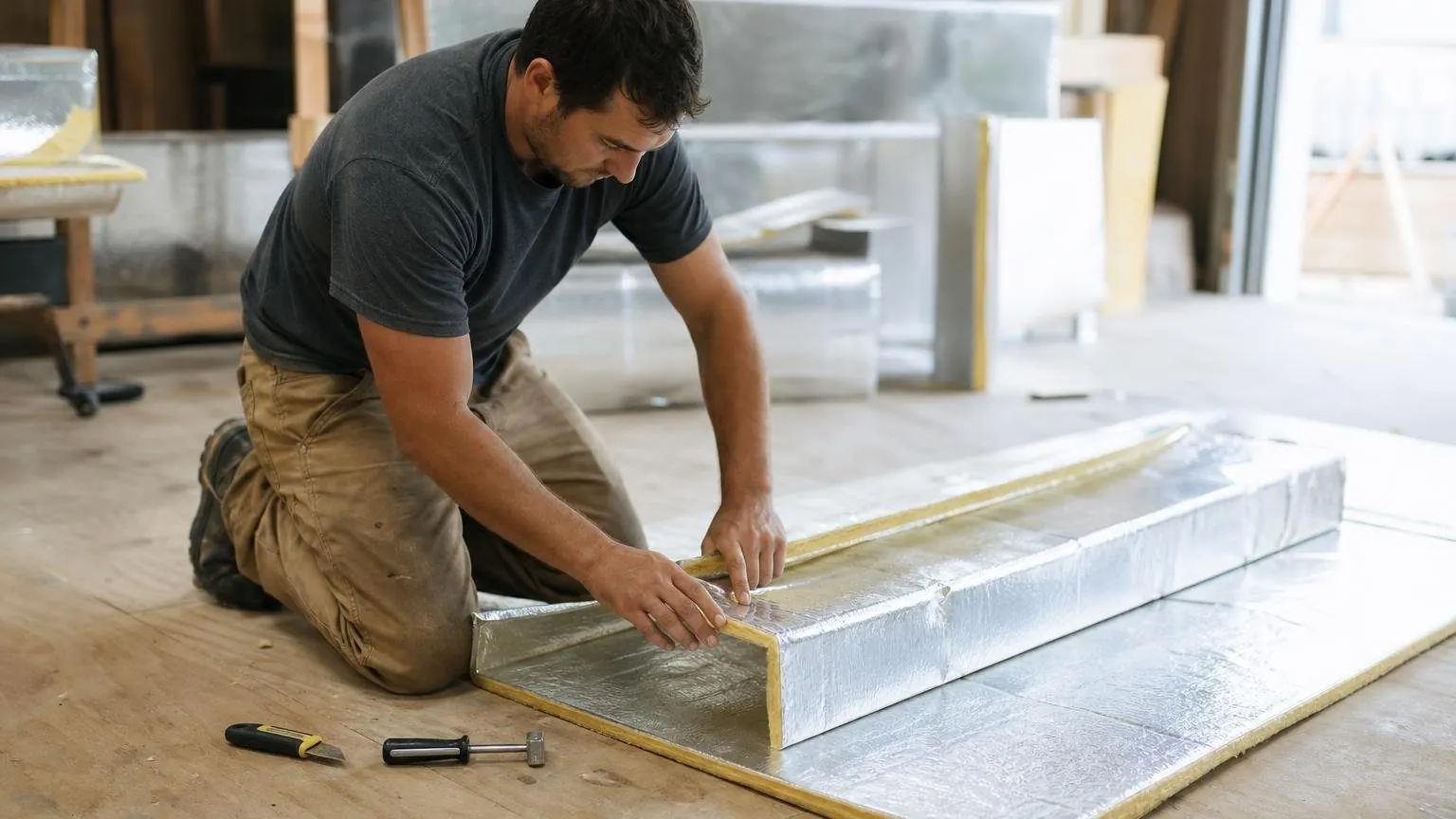
What is duct board? Duct board is rigid fiberglass board with a foil facing that contractors cut, fold and tape into rectangular supply and return ducts. It is its own insulation: maker data sheets list R-4.3 at 1 inch, R-6.5 at 1.5 inches and R-8.7 at 2 inches.
Key Takeaways
- Duct board is rated R-4.3, R-6.5 and R-8.7 at 1, 1.5 and 2 inches in the Johns Manville SuperDuct RC data sheet (2024); Knauf lists the same values.
- Four makers list a 2 inch w.c. pressure limit and 5,000 to 6,000 fpm velocity limit under UL 181 (JM: 6000 fpm).
- Only closures marked 181A-P, 181A-H or 181A-M may seal the joints, per 2024 IRC M1601.4.1.
- NAIMA’s residential standard covers 40°F to 250°F air at up to 1/2 inch w.g., and rules out exhaust, outdoor and buried runs (AH119).
- A 1997 review found fiber levels near outdoor background only when board stays clean and dry; NAIMA helped fund it (Woods and Goodwin).
- EPA says wet or moldy duct insulation “cannot be effectively cleaned” and should be replaced (EPA).
What is duct board, and what is it made of?
Duct board, also written ductboard, is resin-bonded glass fiber in 4 by 8 or 4 by 10 foot sheets with a foil-scrim-kraft (FSK) facing. The Department of Energy’s Building Science Education page calls it “inherently insulating, with an R-value of 4.3 per inch.”
Contractors groove, fold, staple and tape it into rectangular ducts. It is one of three common residential duct types, with round metal such as spiral duct and wire-helix flexible duct.
The facing is the vapor retarder: Johns Manville lists its FSK at 0.02 perms, so a torn facing on a cold supply duct invites condensation.
What do the UL 181 labels on duct board mean?
A UL 181 Class 1 label means the board passed the Underwriters Laboratories test for factory-made rigid air ducts, including fire, erosion and mold-growth checks. UL 181A is the separate listing for closures, and the duct keeps its rating only with a listed closure.
Johns Manville lists a maximum flame spread index of 25 and smoke developed index of 50. Its sheet notes ASTM C1071 tests at 2.5 times rated velocity and reports no erosion at 15,000 fpm.
| Mark on the closure | UL 181A part | What it is | Maker note |
|---|---|---|---|
| 181A-P | Part I | Pressure-sensitive foil tape | JM: 1 inch wider than board; heat seal below 40°F |
| 181A-H | Part II | Heat-activated tape | Sealing iron per tape maker |
| 181A-M | Part III | Glass fabric embedded in mastic | JM: 4 inch coat, mesh, second coat |
Johns Manville’s AHS-30 fabrication sheet says any other closure makes “the UL 181 Class 1 air duct rating, and the Johns Manville product warranty” void. Knauf adds that rubber-based tape adhesives are not approved, the same logic behind our ductwork installation standards guide.
What R-value does fiberglass duct board have?
Duct board R-value depends on thickness: maker data puts 1 inch board at R-4.3, 1.5 inch at R-6.5 and 2 inch at R-8.7 at a 75°F mean temperature. Retailers often round 1.5 inch board to “R-6.”
| Maker and product | R-value (1 / 1.5 / 2 in) | Max pressure | Max velocity | Max temperature |
|---|---|---|---|---|
| Johns Manville SuperDuct RC | 4.3 / 6.5 / 8.7 | 2″ w.c. | 6000 fpm | 250°F |
| Owens Corning QuietR Duct Board | Not in brochure | ±2 in. w.g. | 6,000 fpm | 265°F inside, 150°F outside |
| Knauf Performance+ Air Duct Board | 4.3 / 6.5 / 8.7 | ±2″ w.g. | 5,000 fpm | 250°F |
| CertainTeed Ultra*Duct Black | Not in fabrication sheet | 2″ w.g. | 5000 fpm | 250°F |
Maker claims from each company’s own documents, read October 2026; not independent tests.
Thickness matters for code. Under the 2021 IECC as adopted in Washington (WAC 51-11R-40320), ducts 3 inches and larger outside conditioned space need R-8, so only 2 inch board clears the line. See our duct insulation requirements by location.
Duct board vs sheet metal vs flex duct: which fits the job?
Duct board suits low-pressure rectangular trunks and plenums where built-in insulation and quiet air matter; sheet metal suits higher pressure, heat and wear; flex duct suits short final branches.
| Factor | Fiberglass duct board | Sheet metal | Flex duct |
|---|---|---|---|
| Insulation | Built in, R-4.3 to R-8.7 | None; wrap or liner added | Owens Corning jackets: R 4.2, R 6, R 8 |
| Joints | Staple flap, 181A tape or mastic | Mechanical joint plus mastic | Strap and listed tape |
| Pressure and heat | 2″ w.c., 250°F (maker limits) | Higher classes by gauge | Per listing; sag adds drag |
| Wet or dirty | Porous; replace if moldy (EPA) | Non-porous surface | Insulated; replace if moldy |
| Sound | Absorbs noise | Louder unless lined | Some absorption |
Is duct board cheaper than sheet metal? No federal or national-lab source publishes installed prices for either, so we quote no vendor ranges; our ductwork cost data gap report explains what exists.
Most complaints trace to workmanship: crushed corners, torn facing and peeling tape make board leak, which is why duct leakage testing matters more than the material.
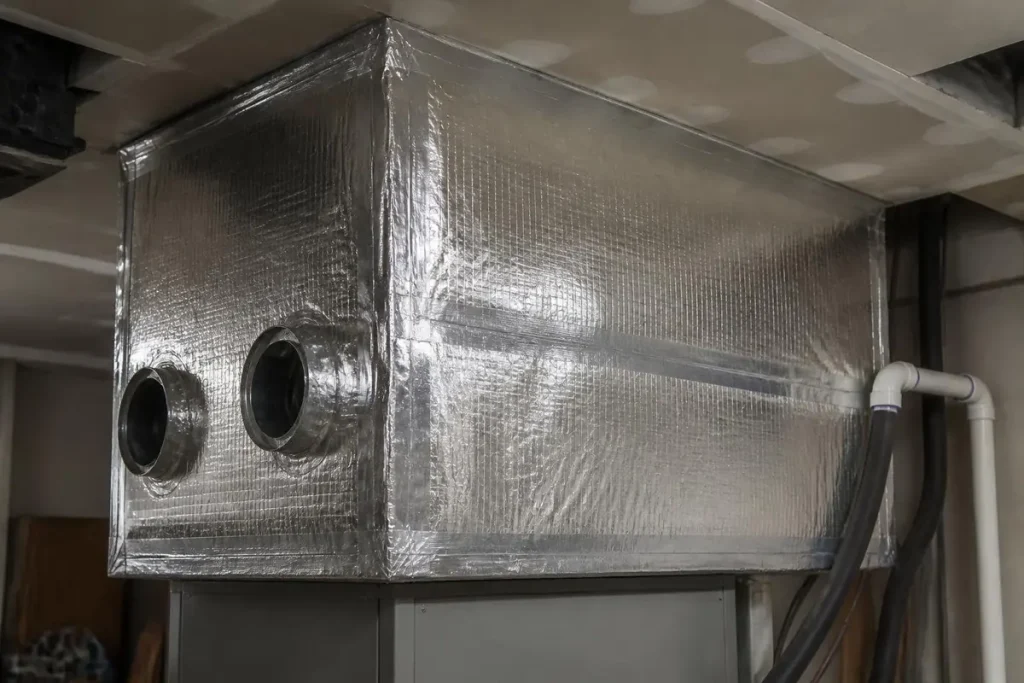
How is a duct board plenum built and sealed?
A duct board plenum is laid out flat from its inside dimensions, grooved, folded, stapled and taped. Johns Manville’s AHS-30 covers straight duct; for plenums and fittings it points to the NAIMA Fibrous Glass Duct Construction Standards.
- Mark each side’s inside dimension plus the maker’s fold allowances.
- Cut the closure rabbet, then shiplap grooves at the three corners.
- Strip 1½ inches of fiber from the facing to form the staple flap.
- Fold, seat the edge, and staple the flap with outward-clinch staples about 2 inches on center.
- Tape seams with a 181A closure, rubbing until the scrim shows through.
- Fix metal collars with screws ½ inch longer than the board and 1 inch washers.
NAIMA’s residential standard covers ducts at 1/2 inch w.g. or less with a 36 inch maximum unreinforced span for 475 and 800 EI board. Higher total external static pressure or wider spans need the commercial standard and reinforcement.
Where duct board does not belong
NAIMA AH119 rules out kitchen or fume exhaust, buried or in-concrete runs, outdoors, risers serving more than two stories, and coal or wood equipment, with a 40°F minimum air temperature. DOE advises against it for ventilation ducts in humid climates.
Is fiberglass duct board safe for indoor air?
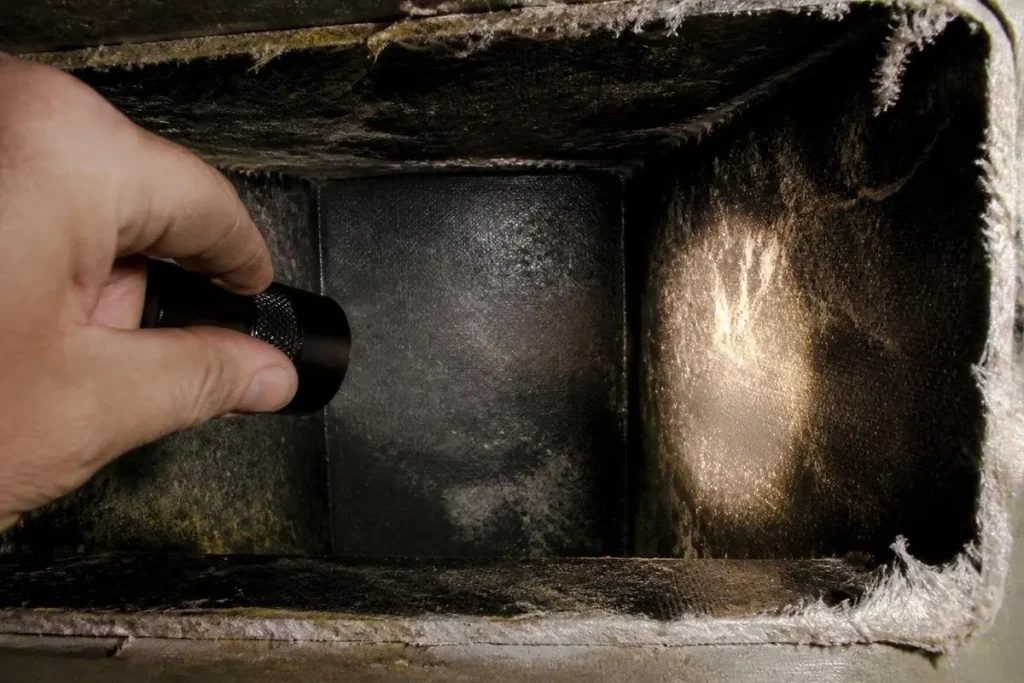
Is fiberglass duct board safe? Limited evidence says intact, clean, dry board adds little glass fiber to room air, but wet or dirty board becomes a mold problem that cannot be cleaned out.
On fibers, the key work is a Virginia Tech review by Woods and Goodwin (1997). It found fiber levels near outdoor background “only if care is provided to maintain these materials in clean and dry conditions,” and asked for better field studies. NAIMA helped fund it.
IARC’s 2002 evaluation placed insulation glass wool in Group 3, “not classifiable as to their carcinogenicity to humans.” That is not a safety finding, and special-purpose glass fibers stayed in Group 2B.
Moisture is the larger risk. EPA says no biocides are registered for fiber glass duct board and that wet or moldy insulation should be replaced. Holding humidity in the range that limits mold, filtering well and using dry methods from our air duct cleaning guide are the controls.
Where does code allow duct board?
Model codes allow duct board when it is UL 181 listed, built to the NAIMA or SMACNA fibrous glass standard and kept at or below 250°F, but some cities restrict it.
IMC section 603.5, quoted from the 2012 IMC as adopted in Lawrence, Kansas, requires “Class 0 or Class 1 duct material in accordance with UL 181,” SMACNA or NAIMA construction and a 250°F cap. For homes, 2024 IRC M1601.1.1 requires UL 181 listing and the same standards; M1601.4.1 sets the 181A marks.
Local rules can go further. Lawrence Ordinance 9630 added IMC 603.5.2: “Rigid fibrous glass duct is prohibited,” except in R occupancies where it is “readily accessible for repair or cleaning.” Your mechanical permit review is where that gets settled, depending on local code.
How we researched this
Researched October 14, 2026. We cite 14 documents: four maker data sheets or fabrication sheets (Johns Manville, Owens Corning, Knauf, CertainTeed), the NAIMA residential duct standard, code text from Kansas and Washington adoptions, EPA, DOE, IARC and one academic literature review. Maker figures are labeled as maker claims. Excluded: retail and vendor price listings (no federal price series), contractor blogs, and a CertainTeed web page whose R-values did not match its own data. Reddit was not used.
Frequently asked questions
What is duct board used for?
It is used to build rectangular supply and return trunks, plenums and fittings in heating and cooling systems. Johns Manville describes its board for new commercial or residential construction and for renovating older sheet metal systems. NAIMA’s residential standard limits it to comfort systems running 40°F to 250°F air.
What can I use instead of duct board?
Sheet metal, round or spiral metal duct, and flexible duct are the usual alternatives. Bare sheet metal has no insulation of its own, so outside conditioned space it needs wrap; under the 2021 IECC as adopted in Washington, ducts 3 inches and larger there need R-8. Flex jackets are sold at R 4.2, R 6 and R 8 by Owens Corning.
What tape do you use on duct board?
Use a closure listed to UL 181A and marked 181A-P (pressure-sensitive), 181A-H (heat-activated) or 181A-M (mastic with glass fabric), as 2024 IRC M1601.4.1 requires. Johns Manville specifies tape at least 1 inch wider than the board thickness, rubbed until the facing scrim shows, and heat sealing below 40°F.
Can mold grow on fiberglass duct board?
Yes. The coatings resist mold in lab tests, but Johns Manville’s own data sheet says microbial growth may occur in accumulated duct-system dirt. EPA says wet or moldy duct insulation cannot be effectively cleaned and should be removed and replaced, and that no biocides are registered for fiber glass duct board.
Can duct board be used in an attic?
Yes, where local code allows it, but thickness matters. Under the 2021 IECC as adopted in Washington, ducts 3 inches and larger outside conditioned space need R-8. By maker data, 2 inch board is R-8.7 and 1.5 inch board is R-6.5, so only the 2 inch board meets that line.
How long does duct board last?
No federal agency or national lab publishes a service life for duct board, so we give no figure. Its life is set by moisture and handling: NAIMA requires board to absorb no more than 5% water vapor by weight in its test, and EPA says any wet or moldy duct insulation should be replaced.
Sources
- Johns Manville. “SuperDuct RC Data Sheet (HVAC-200, 08/22/24).” https://www.jm.com/content/dam/jm/global/en/hvac-insulation/duct-board/superduct-rc/JM_HVAC_SuperDuct_RC_Data_Sheet_EN.pdf. Accessed October 2026.
- Johns Manville. “Fiberglass Duct Board Fabrication Instructions (AHS-30).” https://www.jm.com/content/dam/jm/global/en/hvac-insulation/resources/AHS-30_Fiberglass-Duct-Board-Fabrication-Instructions.pdf. Accessed October 2026.
- Owens Corning. “Air Distribution Solutions brochure (QuietR Duct Board).” https://www.buildsite.com/pdf/owenscorning/QuietR-Duct-Board-Summary-Brochure-2410427.pdf. Accessed October 2026.
- Knauf Insulation. “Performance+ Air Duct Board data sheet.” https://www.buildsite.com/pdf/knauf/Performance-Air-Duct-Board-with-ECOSE-Technology-Product-Data-2968929.pdf. Accessed October 2026.
- CertainTeed. “Ultra*Duct Black Duct Board Fabrication Instructions.” https://www.certainteed.com/download/product-documents-group/206911/installGuide. Accessed October 2026.
- NAIMA. “Fibrous Glass Residential Duct Construction Standard, 3rd ed..” https://insulationinstitute.org/wp-content/uploads/2015/11/AH119.pdf. Accessed October 2026.
- Wichita-Sedgwick County. “2024 Residential Code, Chapter 16.” https://up.codes/viewer/wichita-sedgwick/irc-2024/chapter/16/duct-systems. Accessed October 2026.
- City of Lawrence, KS. “Ordinance 8797, 2012 IMC.” https://assets.lawrenceks.org/agendas/cc/2013/01-08-13/fai_ds_icodes_imc_ordinance_8797.html. Accessed October 2026.
- City of Lawrence, KS. “Ordinance 9630, 2018 codes.” https://assets.lawrenceks.org/agendas/cc/2019/05-07-19/pds_a_2018_codes_ord_9630.html. Accessed October 2026.
- Washington State. “WAC 51-11R-40320.” https://lawfilesext.leg.wa.gov/law/WAC/WAC%20%2051%20%20TITLE/WAC%20%2051%20-%2011R%20CHAPTER/WAC%20%2051%20-%2011R-40320.htm. Accessed October 2026.
- US EPA. “Should You Have the Air Ducts in Your Home Cleaned?.” https://www.epa.gov/indoor-air-quality-iaq/should-you-have-air-ducts-your-home-cleaned. Accessed October 2026.
- US DOE Building Science Education. “HVAC Fiber Board Ducts.” https://bsesc.energy.gov/energy-basics/hvac-fiber-board-ducts. Accessed October 2026.
- Woods JE, Goodwin AK (AIVC). “Glass Fiber Emissions From HVAC Ductwork: A Review of the Literature, 1997.” https://www.aivc.org/sites/default/files/airbase_12973.pdf. Accessed October 2026.
- IARC. “Monographs Vol. 81, Man-made Vitreous Fibres, Summary.” https://www.inchem.org/documents/iarc/vol81/81.html. Accessed October 2026.
Leave a Reply