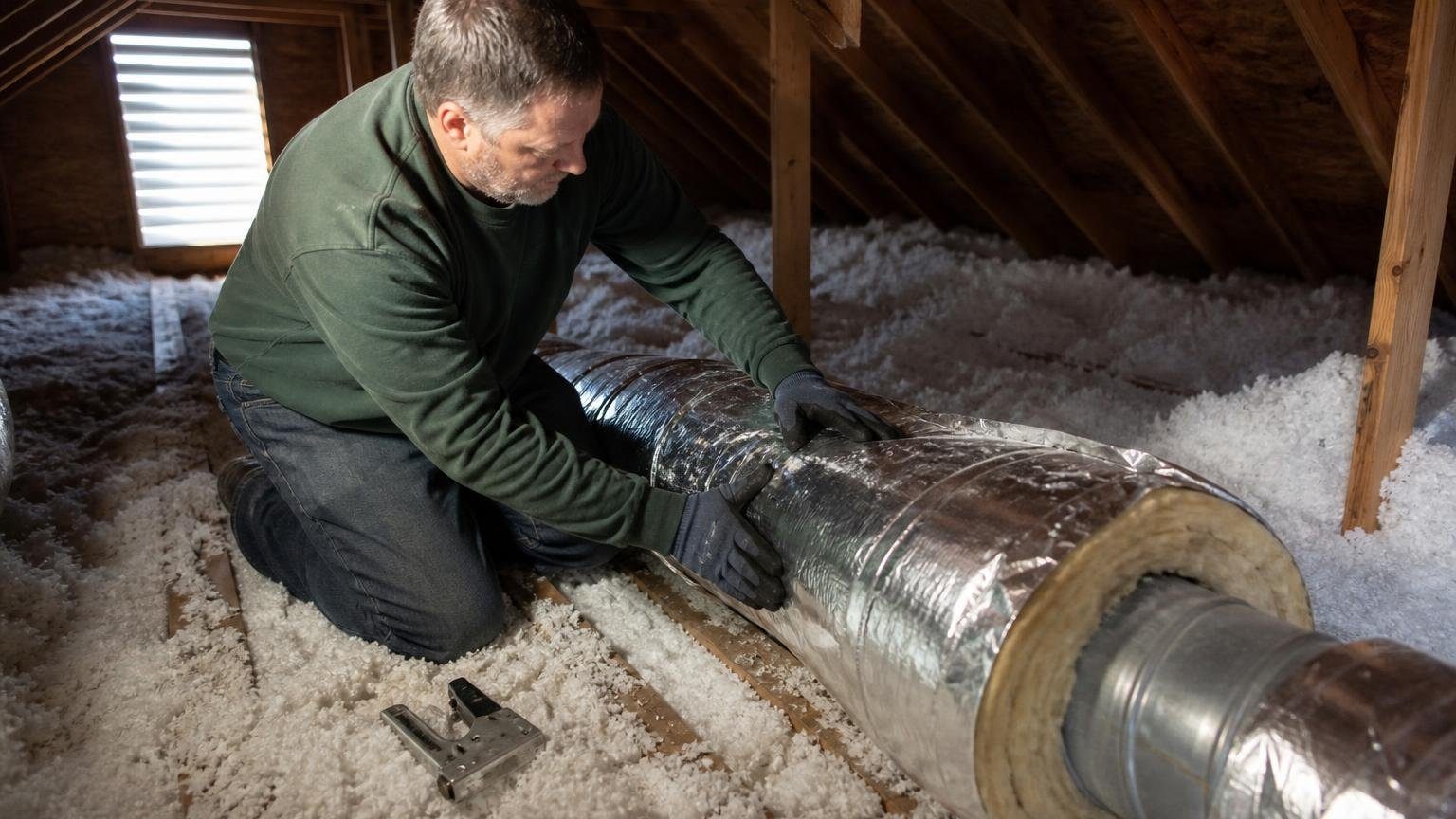
What duct insulation R-value is required? Duct insulation must be at least R-8 on ducts 3 inches and larger outside conditioned space under the 2021 IECC, and R-6 on smaller ducts. The 2018 code required R-8 only in attics and R-6 elsewhere. Ducts inside the thermal envelope are exempt.
Key Takeaways
- The 2021 IECC (R403.3.1) requires R-8 on ducts 3 inches and larger outside conditioned space, per Washington’s WAC 51-11R-40320.
- The 2018 IRC (N1103.3.1) set R-8 for attic ducts and R-6 elsewhere, with R-6 and R-4.2 for ducts under 3 inches (Knox County code sheet).
- Ducts buried in attic insulation need R-8 duct insulation plus at least R-19 of ceiling insulation summed above and below the duct (New York DOS TB-7006).
- About 20 to 30 percent of the air moving through a typical duct system is lost to leaks, holes and poor connections (ENERGY STAR).
- An NREL Building America report puts duct losses in unconditioned spaces at 10% to 45% of heating and cooling loads.
- California’s Energy Code assumes duct wrap is compressed to 75 percent of its nominal thickness,, so installed wrap rates below its out-of-package R-value.
What R-value does duct insulation need?
Under the 2021 IECC, R-8 is the duct insulation minimum for any duct 3 inches or larger outside conditioned space, and R-6 for smaller ducts.
The 2018 IRC required R-8 in attics but only R-6 in “other portions of the building,” with R-6 and R-4.2 for ducts under 3 inches. Minnesota’s code advisory group confirmed in December 2023 that the 2021 section keeps R-6 for ducts under 3 inches.
Which edition applies depends on local adoption, so a crawl space duct can be R-6 in one county and R-8 in the next; the permit inspection is where that gets checked.
Duct insulation requirements by location: attic, crawl space, garage, buried
Location decides the number. Attic ducts need R-8 under both editions; crawl space, garage and unconditioned basement ducts rose from R-6 to R-8 in the 2021 IECC; ducts fully inside the thermal envelope need none.
| Duct location (3 in. and larger) | 2018 IRC N1103.3.1 | 2021 IECC | Section and condition |
|---|---|---|---|
| Vented attic, supply | R-8 | R-8 | R403.3.1 |
| Vented attic, return | R-8 | R-8 | R403.3.1; both editions name “supply and return” |
| Vented crawl space | R-6 | R-8 | R403.3.1; Seattle’s code says crawl space ducts never count as inside the envelope |
| Garage or unconditioned basement | R-6 | R-8 | R403.3.1; garage ducts also need 26 gauge steel or approved material, no openings (IRC R302.5.2) |
| Buried in attic insulation | R-8; buried option added in 2018 | R-8 duct plus R-19 sum | R403.3.3; supply within 3 ft of the outlet exempt |
| Deeply buried (modeling credit) | Modeled as R-25 | Modeled as R-25, performance path only | R403.3.3.1; R-30 or more blown insulation, duct top at least 3.5 in. below its surface |
| Inside conditioned space | None | None | Exception; New York’s 2025 code requires it for new homes, or a code buried-duct option |
| Any duct under 3 in. | R-6 attic, R-4.2 elsewhere | R-6 | R403.3.1 |
Sources: Knox County 2018 IRC sheet; WAC 51-11R-40320 (2021 IECC, Washington); Seattle Energy Code; New York DOS TB-7006; Insulation Institute (NAIMA) for 2018 buried-duct options.
The buried-duct rules interact with the ceiling R-value your climate zone requires. New York’s buried option also requires attic duct leakage of no more than 1.5 cfm per 100 square feet of conditioned floor area. Crawl space ducts are another reason to weigh a sealed rather than vented crawl space.
Code point: states move the line
North Carolina’s 2018 code required R-8 in all unconditioned space, then Session Law 2022-6 temporarily let attic ducts drop to R-6 and other unconditioned ducts to R-4.2, an allowance the State Fire Marshal’s office said expired March 17, 2024. Ask your building department which table it enforces.
How much heat does an uninsulated attic duct pick up?
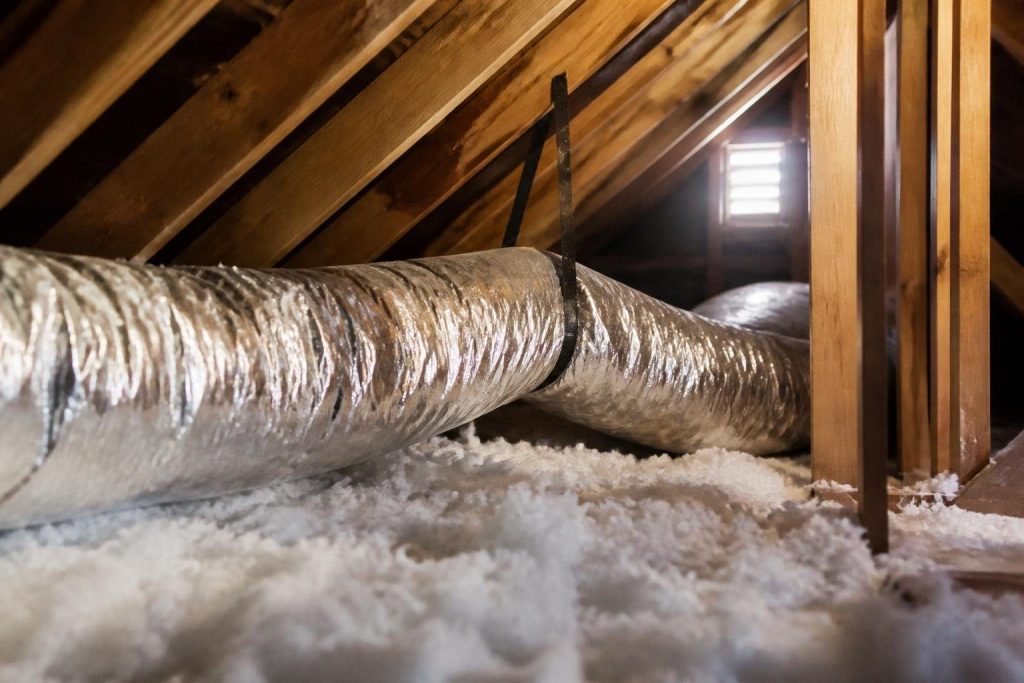
By our arithmetic, a bare 8 inch metal supply duct running 25 feet through a summer attic picks up about 4,000 Btu per hour; wrapped to R-8, about 385. That is roughly 90 percent less, before leakage.
The conditions come from NREL’s Building America report, which describes 55°F supply air separated from 120°F attic air by insulation “as low as R-4.2.” The formula is Q = A x ΔT ÷ R (A is duct surface area, R is total resistance).
- Surface area: π x 0.667 ft x 25 ft = 52.4 square feet.
- Temperature difference: 120°F minus 55°F = 65°F.
- Bare duct resistance is just its air films, using Washington energy code defaults: R-0.17 (exterior value, applied to moving air inside) plus R-0.68 (still air), total R-0.85.
- Bare: 52.4 x 65 ÷ 0.85 = 4,004 Btu per hour.
- Insulated: add the wrap R to the films. R-4.2 gives 674, R-6 gives 497, R-8 gives 385 Btu per hour.
The bare figure is an upper bound (the air warms as it travels), but the gap is why duct problems get blamed on the equipment. In NREL’s three Florida homes, attic ducts cost 15% to 35% of annual heating and cooling energy.
Why do uninsulated ducts sweat in humid attics?
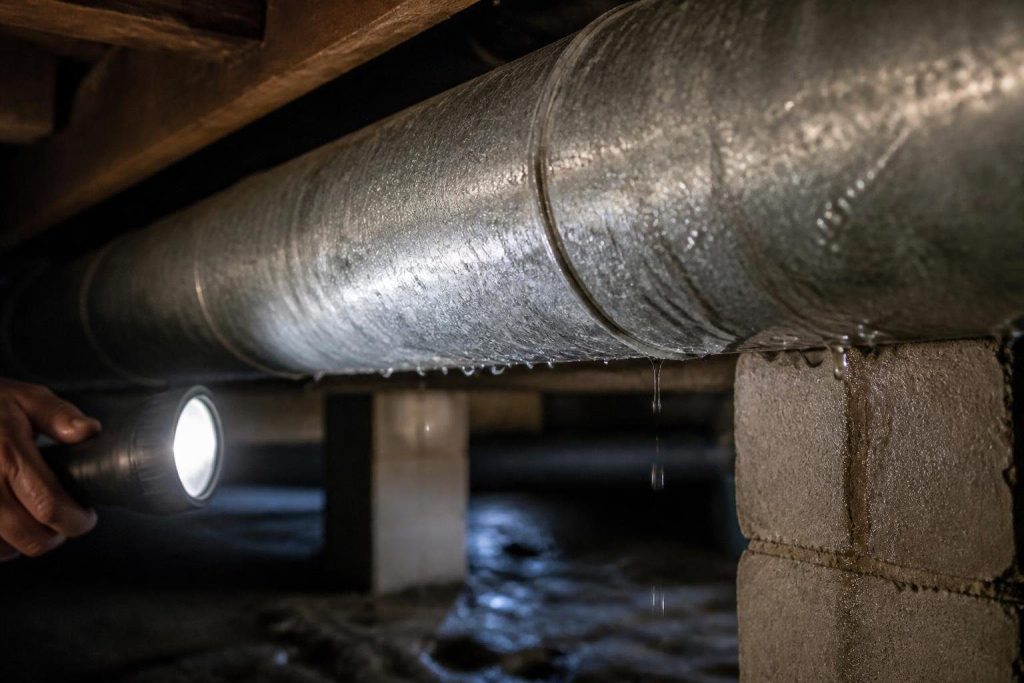
A cooling duct sweats when its outer surface is colder than the dew point of the air around it. In the example above, the bare duct’s surface sits near 68°F by our arithmetic, while the jacket of an R-8 wrap stays near 115°F, comfortably above the 80°F design dew point that federal research treats as the limit.
The NREL report says buried ducts work in hot-dry climates (field tests in Phoenix and Sacramento found no condensation), but in hot-humid climates “condensation on the duct jacket can occur when the humidity in the attic is high.” It cites laboratory testing that ducts “cannot safely be fully buried in insulation when design dew point temperatures approach 80°F.”
That is why the Building America Solution Center calls for R-8 duct insulation with an integral vapor barrier before burial, and spray foam encapsulation first in humid and marine climates. DOE’s Energy Saver adds: “Be sure a well-sealed vapor barrier exists on the outside of the insulation on cooling ducts.” The same physics drives suction line insulation on the refrigerant piping.
Should you seal ducts before insulating them?
Yes. Insulation hides joints but does nothing about air escaping through them. ENERGY STAR estimates that 20 to 30 percent of the air in a typical duct system is lost to leaks, and duct wrap makers require ducts “tightly sealed at all joints and seams” before wrapping.
The DOE Energy Saver guide (archived copy) says sealing “is even more important if the ducts are located in an unconditioned area such as an attic or vented crawlspace.” It prefers mastic, which “will not bridge gaps over ¼ inch,” over cloth-backed duct tape. If a leakage test shows disconnected runs or crushed flex, that is a repair or replacement decision before it is an insulation job.
Even sealed and insulated, traditional duct systems commonly lose “approximately 10% of the heating and cooling loads,” NREL notes, which is why DOE says many efficient new homes keep ducts inside conditioned space, a choice made during new ductwork installation.
How to insulate ductwork so the duct wrap R-value holds
Buy duct wrap by installed R-value, not by the out-of-package number, because wrapping compresses the blanket. California’s Energy Code, section 150.0(m)5, states that “the installed thickness of insulation must be assumed to be 75 percent of the nominal thickness due to compression.”
Owens Corning’s SOFTR duct wrap data sheet, which assumes 25% compression, shows the penalty.
| SOFTR Type 75 nominal thickness | Out-of-package R | Installed thickness | Installed R |
|---|---|---|---|
| 1.5 in. | R-5.1 | 1.125 in. | R-4.2 |
| 2 in. | R-6.8 | 1.5 in. | R-5.6 |
| 2.2 in. | R-7.4 | 1.625 in. | R-6.0 |
| 3 in. | R-10.0 | 2.25 in. | R-8.3 |
Source: Owens Corning SOFTR glass fiber duct wrap product data sheet (manufacturer data). Other products and densities differ.
So 2 inch wrap of this type misses even R-6 once installed, and an R-8 attic duct needs the 3 inch roll. The sequence for an existing metal duct:
- Confirm the required R-value with your building department.
- Seal every joint and seam with mastic or UL-marked foil tape, then have leakage tested if the house will be rated or permitted.
- Cut the wrap to the manufacturer’s stretch-out length so it wraps without squeezing, facing out, with a 2 inch overlap flap.
- Staple seams about 6 inches on center and tape them so the vapor retarder facing is continuous.
- Patch every tear in the facing on cooling ducts, and keep wrap clear of any soffit vent baffles you disturb.
Flex duct arrives insulated, and the International Mechanical Code (section 604.7, quoted in a RESNET interpretation) requires the R-value printed at intervals of no more than 36 inches, based on insulation only, “excluding air films.”
How we researched this
Researched October 9, 2026. We read code text from state and local adoption documents (Washington, New York, North Carolina, Seattle, Knox County) and cite 15 sources of about 20 consulted. The heat-gain and surface-temperature figures are our arithmetic. Excluded: installed prices (no federal series), ASHRAE 90.1-2001 duct tables still circulating online (superseded), contractor blogs and Reddit.
Frequently asked questions
Do return ducts need to be insulated?
Yes, outside conditioned space. The 2018 IRC required R-8 on “supply and return ducts in attics,” and the 2021 IECC requires R-8 on supply and return ducts 3 inches and larger anywhere outside conditioned space.
Should I insulate ducts in an unfinished basement?
Not always. DOE’s Energy Saver warns that “insulating ducts in the basement will make the basement colder,” and that water pipes there could freeze. If the basement is inside the thermal envelope, the code requires no duct insulation.
Is attic duct insulation worth it?
Usually. DOE says insulating ducts in unconditioned spaces “is usually very cost-effective.” In NREL’s Florida study, attic duct losses equaled 6% to 25% of the homes’ total annual utility bills before retrofit. No federal series publishes installed prices; our ductwork cost review explains the gap.
Can you spray foam ductwork?
Yes, by encapsulating it in closed-cell foam. NREL’s modeling found 1.5 inches of closed-cell foam lifts R-4.2 flex duct to between R-9 and R-13, and burying the encapsulated duct raises it to between R-16 and R-31. Building America recommends this before burial in humid climates.
Does bubble wrap or foil count as duct insulation?
Only if its labeled R-value meets code. IMC section 604.7 bases duct insulation R-values on the insulation only, “excluding air films,” labeled every 36 inches. A rating that counts an air space or air film does not meet that definition, so check the label.
What is the R-value of uninsulated ductwork?
Close to nothing: a bare duct has only its surface air films. Using Washington’s default film values, we estimate about R-0.85, which is why our 25 foot attic example gains roughly ten times the heat of an R-8 duct.
Sources
- Washington State Legislature. “WAC 51-11R-40320, Section R403.3, Ducts.” https://lawfilesext.leg.wa.gov/law/WAC/WAC%20%2051%20%20TITLE/WAC%20%2051%20-%2011R%20CHAPTER/WAC%20%2051%20-%2011R-40320.htm. Accessed October 2026.
- Knox County Code Administration. “2018 IRC: Duct Installation and Insulation.” https://www.KnoxCounty.org/codes/pdfs/construction_info/DuctInstallation.pdf. Accessed October 2026.
- New York Department of State. “TB-7006: Duct Location and Insulation Requirements.” https://dos.ny.gov/tb-7006-duct-location-and-insulation-requirements. Accessed October 2026.
- Minnesota Department of Labor and Industry. “Residential Energy Code TAG Meeting Notes, December 11, 2023.” https://www.dli.mn.gov/sites/default/files/pdf/121123-res-code-TAG-notes.pdf. Accessed October 2026.
- Seattle Department of Construction and Inspections. “2015 Seattle Energy Code, Residential Chapter 4.” https://www.seattle.gov/documents/departments/sdci/codes/seattleenergycode/2015secresidentialchapter4.pdf. Accessed October 2026.
- Seattle Department of Construction and Inspections. “2015 Seattle Energy Code, Appendix A: Default Heat Loss Coefficients.” https://seattle.gov/documents/departments/sdci/codes/seattleenergycode/2015secappendixa.pdf. Accessed October 2026.
- NC Office of the State Fire Marshal. “Temporary Reduction in Duct Insulation Levels for Residential Construction.” https://ncosfm.gov/sl-2022-46-temporary-reduction-duct-insulation-levels-residential-buildings/open. Accessed October 2026.
- Energy Code Ace (California). “4.4 Air Distribution System Ducts, Plenums, Fans, and Filters.” https://energycodeace.com/content/44114-air-filtration-a-href-1500-m-12b-air-filtrat. Accessed October 2026.
- NREL, Shapiro, Magee and Zoeller. “Reducing Thermal Losses and Gains With Buried and Encapsulated Ducts in Hot-Humid Climates (NREL/SR-5500-55876), 2013.” https://www.osti.gov/biblio/1067903. Accessed October 2026.
- DOE Building America Solution Center. “Ducts Buried in Attic Insulation.” https://basc.pnnl.gov/resource-guides/ducts-buried-attic-insulation. Accessed October 2026.
- ENERGY STAR. “Duct Sealing.” https://www.energystar.gov/saveathome/heating-cooling/duct-sealing. Accessed October 2026.
- U.S. Department of Energy. “Minimizing Energy Losses in Ducts (archived copy).” https://web.archive.org/web/2025id_/https://www.energy.gov/energysaver/minimizing-energy-losses-ducts. Accessed October 2026.
- Owens Corning. “SOFTR Glass Fiber Duct Wrap Product Data Sheet.” https://resource.gemaire.com/is/content/Watscocom/Gemaire/owens-corning_670732_article_1365692185649_en_ss.pdf?fmt=pdf. Accessed October 2026.
- Insulation Institute (NAIMA). “More Options for HVAC Duct Design.” https://insulationinstitute.org/?p=10004. Accessed October 2026.
- RESNET. “MINHERS Interpretation 2019-02: Duct Insulation Inspection.” https://www.resnet.us/wp-content/uploads/IR-MINHERS-2019-002-Duct-Insulation-Inspection-Response-2019.09.pdf. Accessed October 2026.
Leave a Reply