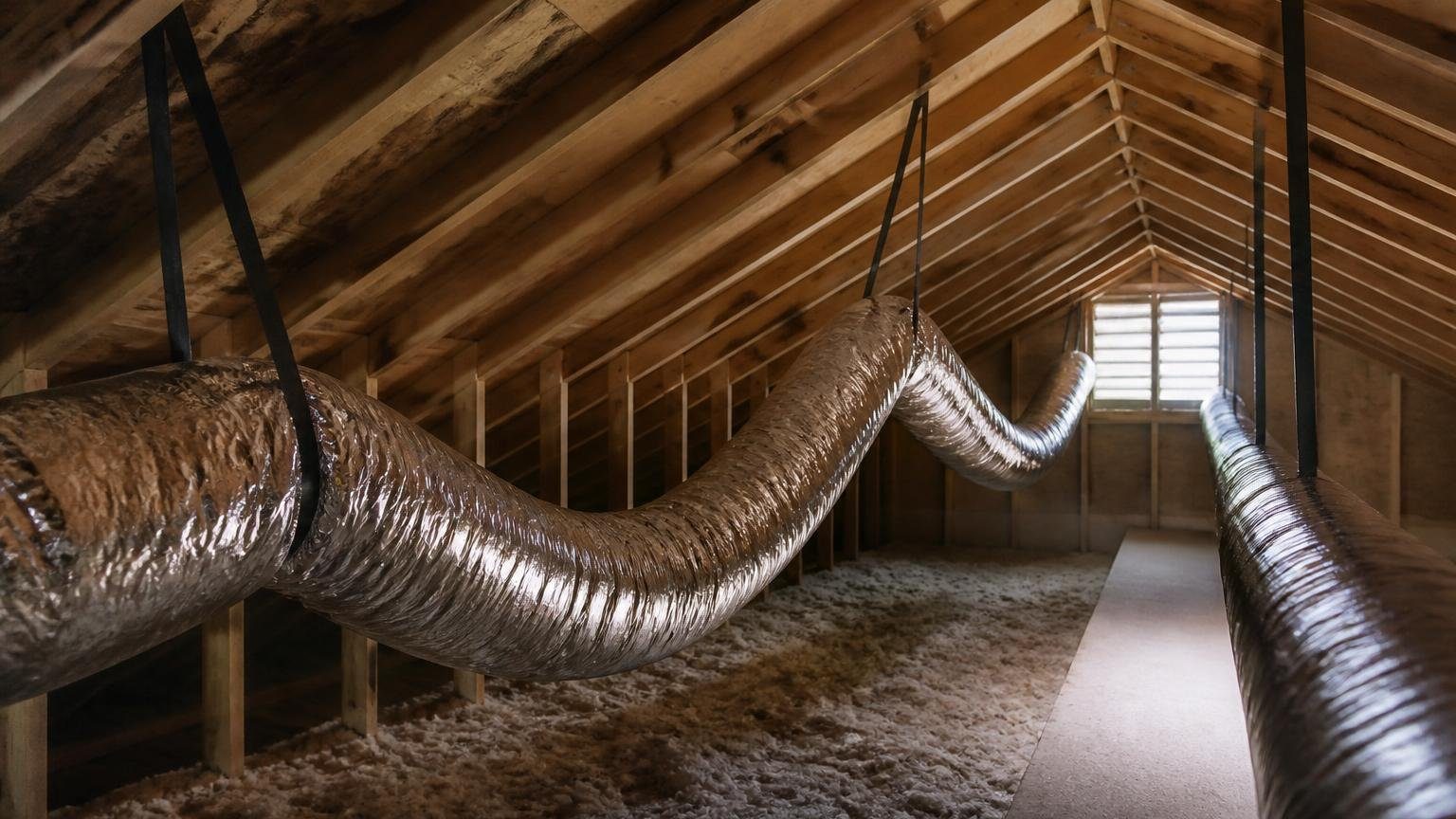
What is flex duct? Flex duct is round, factory-made HVAC duct: a plastic liner on a steel wire helix, wrapped in fiberglass and a vapor barrier jacket. Pulled taut, it moves air about as well as sheet metal. Compressed or sagging, lab tests measured 2 to 10 times the pressure loss.
Key Takeaways
- Fully stretched flex lost within 2% of rigid sheet metal in Texas A&M tests; past 4% compression, losses ran 2 to 10 times higher (Weaver and Culp).
- About 15% compression, typical in the field, can raise pressure drop by a factor of four (LBNL, Abushakra et al.).
- DOE guidance: supports no more than 4 feet apart, at least 1.5 inches wide, sag no more than 1/2 inch per foot (Building America Solution Center).
- A listed flexible air duct has no code length limit; a flexible air connector stops at 14 feet (NC State Fire Marshal).
- Atco sells the same duct with R-4.2, R-6.0 or R-8.0 jackets, rated to 5,000 FPM (Atco spec sheet).
- EPA says wet or moldy insulated duct cannot be effectively cleaned and should be replaced (EPA).
What is flex duct, and how is it built?
Flex duct is round duct that bends by hand. DOE’s Building America Solution Center describes it as a plastic inner liner on a metal wire helix, covered by fiberglass blanket insulation and a foil or plastic vapor barrier. In most houses it runs from a trunk or plenum to each supply boot.
EPA notes a significant rise in flexible duct use since the early 1970s and calls it very low cost. That economy is why it fills attics and crawl spaces, and why installation, not the product, usually decides performance. Our guide to duct static pressure covers the system view.
A typical product, Atco’s #031, is a UL 181 Class 1 air duct: a double polyester core around a steel helix, fiberglass insulation, and a scrim reinforced metallized polyester jacket. That is maker data, not our test.
Flexible air duct or air connector: what does the UL 181 label mean?
The UL 181 label says whether the product is a flexible air duct or a flexible air connector, and that decides how long a run may be. North Carolina’s State Fire Marshal, interpreting 2012 Mechanical Code section 603.6, says a duct label is rectangular and reads “Listed Air Duct,” while a connector label is circular and reads “Listed Air Connector.”
Both are listed to UL 181. A connector is limited to 14 feet; a flexible air duct has no length limit. The Air Diffusion Council’s Fifth Edition standard (2010) defines a connector as flex not tested for flame penetration, puncture and impact. Atco lists its Class 1 ducts at flame spread 25 max and smoke developed 50 max.
Tape counts too. Owens Corning’s guide specification calls for closures listed to UL 181B, the standard for flex duct closure systems. Code editions vary by jurisdiction, so the inspector on your mechanical permit has the final word.
How much do compression and sag raise flex duct pressure drop?
Compression and sag raise flex duct pressure drop sharply. Lawrence Berkeley National Laboratory found that about 15% compression, which it calls typical of field installations, can raise pressure drop by a factor of four, and heavier compression by factors close to ten. Texas A&M measured 2 to 10 times the loss of sheet metal once compression passed 4%.
Compression means length lost against the fully stretched duct. Texas A&M notes flex relaxes to about 4% on its own: 25 feet of duct running 24 feet. Its rig hung duct over 1.5 inch supports on 24 inch centers, and at 45% compression a 6 inch duct sagged 11.5 inches at midspan over time.
| Duct and airflow | Fully stretched | 4% compression, joists | 15% compression, joists | 30% compression, natural sag |
|---|---|---|---|---|
| 6 in. flex at 100 cfm | 0.081 | 0.222 | 0.841 | 1.745 |
| 8 in. flex at 200 cfm | 0.073 | 0.123 | 0.537 | 0.974 |
| 10 in. flex at 300 cfm | 0.054 | 0.132 | 0.329 | 0.639 |
Values are measured static pressure loss in inches of water column per 100 feet, from Table 3 of the Texas A&M paper. At 45% compression the 6 inch duct reached 2.609. The paper reports its 30% case lost 11.3 times what a 1994 Atco duct calculator predicted.
LBNL found two more traps. A compressed duct can lose more per foot than a fully stretched duct of a smaller diameter, and uncorrected ACCA Manual D charts underpredicted compressed cases by an average of 73%. That loss comes out of the blower’s budget, which is why weak airflow per ton and an overworked blower motor often trace back to the attic.
Myth: flex duct restricts airflow by design
Pulled taut, it does not. Texas A&M measured fully stretched flex within 2% of rigid sheet metal, and LBNL found the ACCA chart overpredicted fully stretched loss by an average of 21%. The penalty comes from slack, sag and crushing.
Flex duct vs rigid duct: which performs better?
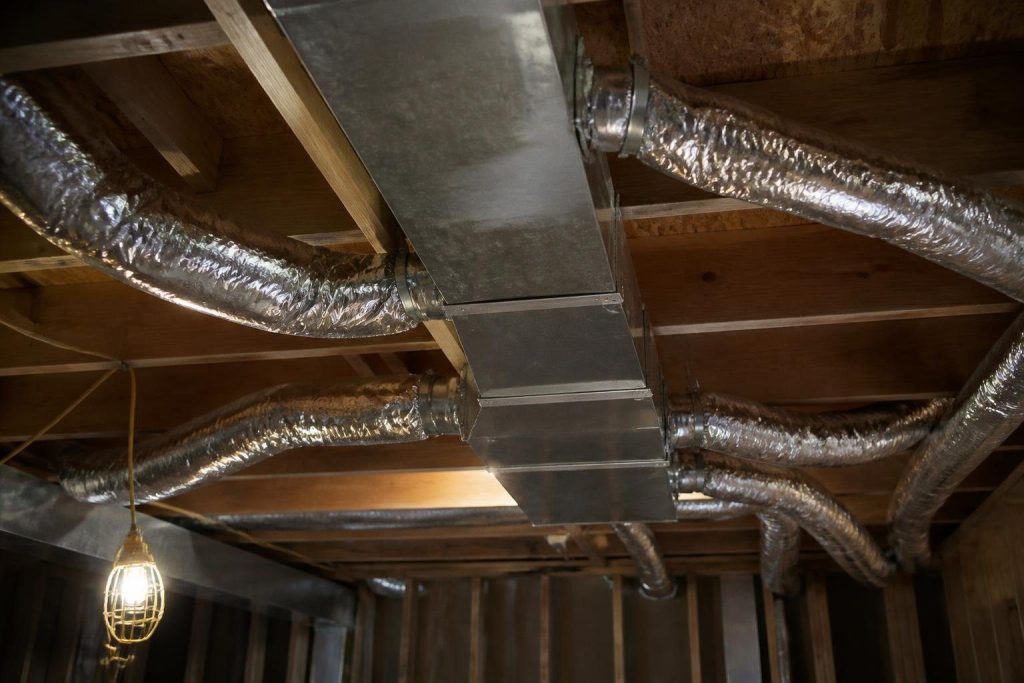
Flex duct vs rigid duct is mostly a contest of installation. Taut flex matches sheet metal on friction, but loose flex loses far more, and rigid metal is easier to clean. EPA calls flexible duct very low cost; no federal series tracks either price, as our ductwork cost review explains.
| Factor | Flex duct | Rigid sheet metal | Source |
|---|---|---|---|
| Friction, straight and taut | Within 2% of sheet metal | Reference baseline | Texas A&M |
| Friction, installed with slack | 2 to 10 times sheet metal past 4% compression | Fixed shape, no slack | Texas A&M |
| Turns | Bend radius must exceed duct diameter | Metal elbows; suggested at boots and equipment | DOE BASC |
| Insulation | Factory jacket, R-4.2, R-6.0 or R-8.0 | Wrapped separately outside conditioned space | Atco; code |
| Mold cleanup | Wet or moldy insulation replaced | Mold on bare metal much easier to treat | EPA |
What do the flex duct installation rules require?
Flex duct installation rules come down to four words: taut, supported, gradual, uncrushed. DOE’s Building America Solution Center, citing ACCA, points installers to the Air Diffusion Council standard, 5th edition, 2010, Sections 4 and 5. Our ductwork installation guide covers hangers and the ENERGY STAR checklist items in depth.
- Pull the inner core fully stretched and cut to length. BASC says do not loop excess duct.
- Support at the maker’s interval, never more than 4 feet apart, with straps at least 1.5 inches wide.
- Limit sag to 2.5 inches per 5 feet of span (1/2 inch per foot).
- Keep every bend radius larger than the duct diameter. One 90 degree bend adds 15 feet of equivalent length at 700 fpm, per Manual D.
- In unconditioned space, keep flex out of cavities smaller than its outer duct diameter; use a metal elbow at tight boots.
- Balance airflow with dampers, not loops of extra duct.
Owens Corning’s guide specification allows supports up to 5 ft apart, so the DOE figure is the stricter rule. For the balancing step, see our explainer on HVAC dampers.
Which flex duct R-value and size do you need?
Insulated flex duct comes in R-4.2, R-6 and R-8 jackets, and the code sets the floor by location. Atco says its R-values are certified by the Air Diffusion Council and classified by UL, tested to ASTM C-518 at installed wall thickness. Our duct insulation requirements page lists which applies to an attic or crawl space.
Atco makes every diameter from 3 to 10 inches, plus even sizes from 12 to 22 inches, in 25 and 50 foot lengths. Texas A&M treated 100 cfm for 6 inch, 200 cfm for 8 inch and 300 cfm for 10 inch duct as typical residential flows. Room by room sizing belongs in a Manual D design, and uneven rooms are an air balancing question.
How long does flex duct last, and what makes it fail?
No federal or national lab source publishes a flex duct lifespan, so we do not quote one. Atco’s warranty runs five years from purchase, and only if the duct is installed per its instructions; a warranty is not a service life. Atco rates its duct for indoor use, from -20°F to 140°F continuous at maximum pressure.
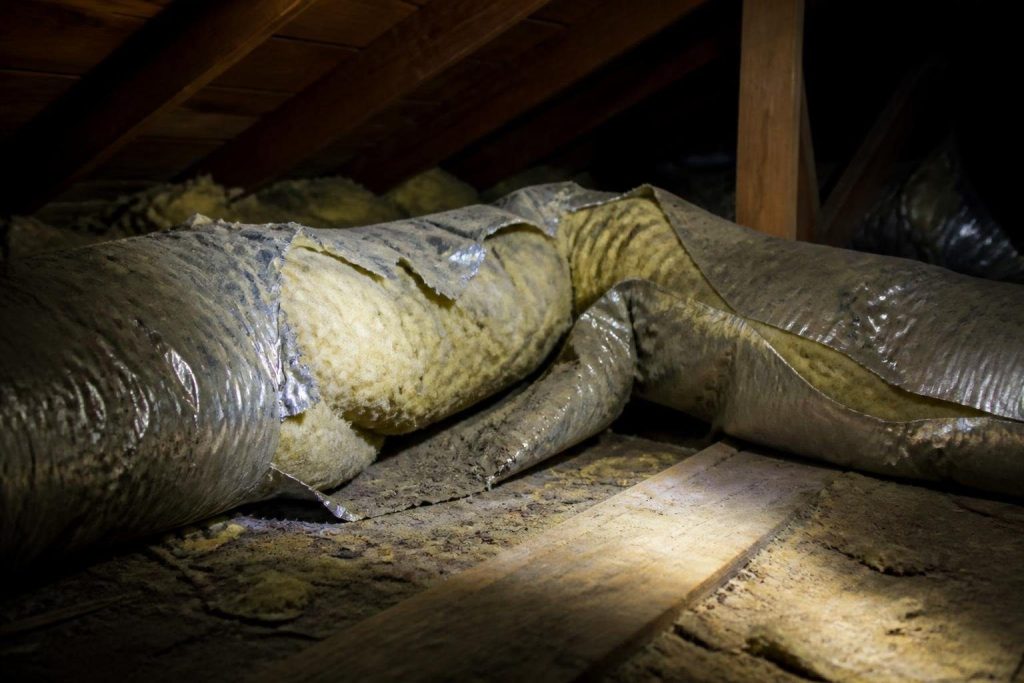
The sourced failure modes are physical. BASC warns that straps or floors compressing the insulation create cold spots where condensation forms in humid attics. EPA says wet or moldy duct insulation cannot be effectively cleaned and should be replaced, so duct cleaning is not the fix. A crushed or torn run calls for the leakage and pressure tests in our duct repair guide.
We found no primary test data on jacket sunlight damage or rodent damage, so we put no number on either.
How we researched this
Researched October 2026. We read the LBNL and Texas A&M papers in full, four DOE Building America Solution Center guides, the Atco sheet, the Owens Corning specification, the NC State Fire Marshal interpretation and EPA’s duct guidance; all are cited. The ADC standard is sold, not free, so we cite it through BASC and its published glossary. Excluded: installed prices (no federal series), contractor blogs and Reddit. Maker figures are maker data, not our tests.
Frequently asked questions
Is flexible ductwork any good?
Yes, when installed taut. Texas A&M measured fully stretched non-metallic flex within 2% of rigid sheet metal losses. The same duct with slack or sag lost 2 to 10 times more, so the installer matters more than the duct material itself.
Can mold grow in flex ducts?
Yes, mainly where moisture gets in. DOE’s Building America Solution Center warns that compressed insulation creates cold spots where condensation forms in humid attics. EPA says insulation that gets wet or moldy cannot be effectively cleaned and should be removed and replaced.
Is flex duct cheaper than metal ductwork?
EPA describes flexible duct as very low cost. No federal or national lab source publishes installed prices for either type, so we give no dollar figure. Compare written quotes that name the duct type, jacket R-value and the support method used.
Should I buy R6 or R8 flex duct?
Buy what your local code requires for the duct’s location. Atco sells the same construction with R-4.2, R-6.0 and R-8.0 jackets, certified under the Air Diffusion Council program. Where the code edition requires R-8 in attics, R-6 will fail inspection.
How long can a flex duct run be?
A listed flexible air duct has no code length limit, per North Carolina’s State Fire Marshal reading of Mechanical Code section 603.6. A flexible air connector, with a circular label, is limited to 14 feet. Shorter, straighter runs still cost less static pressure.
What tape should be used on flex duct?
Use closures listed to UL 181B, the standard for closure systems on flexible air ducts and connectors, as Owens Corning’s guide specification calls for. Follow the duct maker’s connection instructions; Atco says joints must be made as its UL 181 listing requires.
Sources
- Lawrence Berkeley National Laboratory, Abushakra, Walker and Sherman. “Compression Effects on Pressure Loss in Flexible HVAC Ducts” (LBNL-49012). https://escholarship.org/uc/item/0d76400v. Accessed October 2026.
- Texas A&M University, Weaver and Culp. “Static Pressure Losses in 6, 8, and 10 inch Non-Metallic Flexible Duct” (archived copy). https://web.archive.org/web/20130506175409id_/http://www.mmmfg.com/pdfs/060601_CC-KW_DuctTechPaper.pdf. Accessed October 2026.
- DOE Building America Solution Center. “Support Intervals for Flex Ducts.” https://basc.pnnl.gov/resource-guides/support-intervals-flex-ducts. Accessed October 2026.
- DOE Building America Solution Center. “No Kinks or Sharp Bends in Flex Duct Installation.” https://basc.pnnl.gov/resource-guides/no-kinks-or-sharp-bends-flex-duct-installation. Accessed October 2026.
- DOE Building America Solution Center. “No Excessive Coiled or Looped Flex Ducts.” https://basc.pnnl.gov/resource-guides/no-excessive-coiled-or-looped-flex-ducts. Accessed October 2026.
- DOE Building America Solution Center. “Sufficient Cavity Space for Flex Ducts.” https://basc.pnnl.gov/resource-guides/sufficient-cavity-space-flex-ducts. Accessed October 2026.
- NC Office of the State Fire Marshal. “Clarification of Flexible Air Duct and Flexible Air Connector.” https://ncosfm.gov/mechanical/06036-clarification-flexible-air-duct-and-flexible-air-connector/open. Accessed October 2026.
- Air Diffusion Council. “Flexible Duct Performance and Installation Standards, Fifth Edition” (glossary transcription). https://pdf4pro.com/view/flexible-duct-performance-amp-installation-standards-6ec902.html. Accessed October 2026.
- Atco Rubber Products. “Flexible Duct Systems, #030, #036, #031.” https://resource.gemaire.com/is/content/Watscocom/Gemaire/atco_13602404_article_1375441723966_en_cl.pdf?fmt=pdf. Accessed October 2026.
- Owens Corning. “Flexible HVAC Ducts Guide Specification.” https://inspectapedia.com/Fiberglass/Flexible-HVAC-Ducts-Guide-Spec-OwensCorning.pdf. Accessed October 2026.
- US EPA. “Should You Have the Air Ducts in Your Home Cleaned?” https://www.epa.gov/indoor-air-quality-iaq/should-you-have-air-ducts-your-home-cleaned. Accessed October 2026.
Leave a Reply