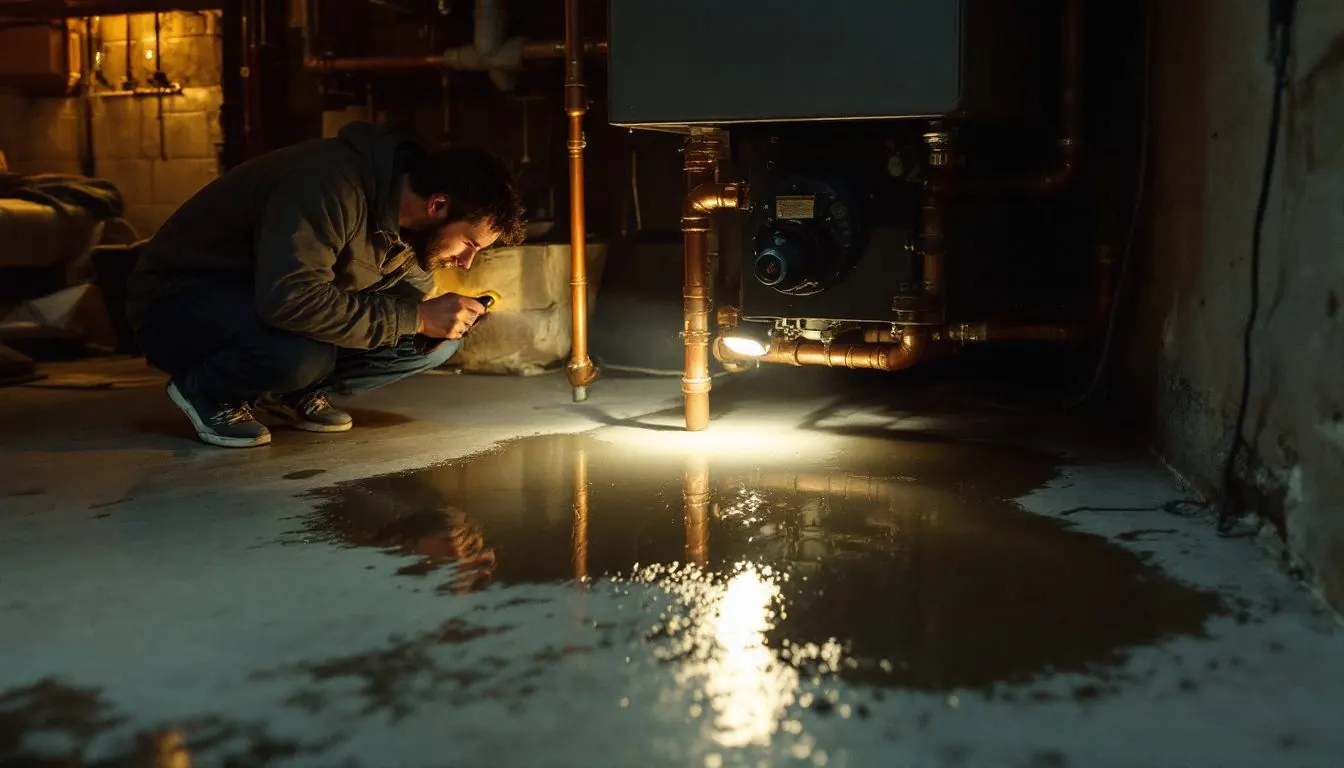
A boiler leaking water from the bottom is usually one of seven things, and where the water first appears tells you which: the relief valve pipe (pressure reaching 30 psi), the condensate tube of a condensing boiler, the pump flanges, the drain valve, startup condensation, a leaking section, or the fill valve.
Water runs along pipes and down the jacket before it drops, so the puddle proves little. Dry everything, then watch the first minutes after a cold start and an hour after shutdown. The numbered point that gets wet first, and whether it drips only while firing, narrows it to one or two causes.
Which part is wet: the side pipe, the pump, the drain valve or the boiler base?
Only row 6 means the boiler itself is failing; the rest are parts a technician repairs or replaces, or drainage and temperature problems.
| Where the water is | When it drips | Likely cause, per the maker’s manual | First check |
|---|---|---|---|
| 1. Pipe down from the relief valve | While heating | Pressure reaching the valve rating (30 psi on the Burnham ES2): expansion tank (Weil-McLain), fill valve set too high or leaking tankless coil (Peerless) | Gauge hot: Weil-McLain’s ceiling is 24 psig |
| 2. Condensate tube under a condensing boiler | Only while firing | Normal condensate; overflow means a blocked trap, line or neutralizer | Does the drain line run freely to its end? |
| 3. Circulator pump flanges | Hot or cold | Gasket; Taco warns flat rubber gaskets on the 007e mean “leaks may result” | Wipe dry, see which flange beads |
| 4. Drain valve outlet | Steady | Valve not closed or seat worn (Burnham supplies a ¾ in NPT valve) | Hand tighten; a hose cap is temporary |
| 5. Inside a cast iron boiler, cold starts | Dries once hot | Flue gas condensing; Peerless wants return water at 130°F or more | Does it stop at full temperature? |
| 6. Inside the jacket, steady | Even when off | Section or heat exchanger leak; Burnham: “THE BOILER MAY LEAK WATER at the end of its useful life” | Fill valve closed: does cold pressure fall overnight? |
| 7. Fill valve or threaded joints | Hot or cold | Fitting leak; Lennox says GWB9 aluminum threads “will not seal themselves” | Dried mineral crust at a joint |
Compiled by The HVAC Brief from the Weil-McLain 550-142-301, Peerless 211A, Burnham ES2, Navien NCB-H, Taco 007e and Lennox GWB9 manuals listed in Sources.
Is water from the relief valve pipe a boiler leak?
No. It is the safety valve doing its job; the fault is upstream. Weil-McLain’s 550-142-301 manual says that if the valve often weeps on a water boiler, “the expansion tank may not be working properly.” Peerless’s 211A table adds a fill valve “set for too high a cold fill pressure, causing relief valve to weep” and a leaking tankless coil pushing city pressure into the boiler.
Gauge readings and tank tests sit on our boiler pressure guide and expansion tank page. One rule belongs here: never cap that pipe. Weil-McLain requires a metal discharge line run “to a safe place of disposal to avoid water damage or scalding.”
Is the puddle under a condensing boiler just condensate?
Often, yes. A condensing boiler makes water every time it fires: DOE’s Building America guide calls it “highly acidic (pH of 2),” and Navien puts NCB-H condensate at pH 3 to 5. It is a leak only when that water escapes its route: a cracked tube, a clogged trap or neutralizer, a sagging line, or an outdoor run frozen in a cold snap. Navien and Lennox want the line pitched down at least ¼ in per foot, and Navien warns condensate “can damage the boiler” if it cannot drain.
How much water is normal? We calculated the most that natural gas combustion can make if all the vapor condensed:
| Boiler input (Btu/h) | Gas burned per hour | Most condensate per hour of full fire |
|---|---|---|
| 60,000 | 57.9 cu ft | 0.66 gal (about 10½ cups) |
| 80,000 | 77.1 cu ft | 0.88 gal (about 14 cups) |
| 100,000 | 96.4 cu ft | 1.10 gal (about 17½ cups) |
| 120,000 | 115.7 cu ft | 1.32 gal (about 21 cups) |
| 199,000 | 191.9 cu ft | 2.18 gal (about 35 cups) |
HVAC Brief calculation: input ÷ 1,037 Btu per cu ft (EIA’s 2025 average heat content) = cu ft of gas; gas treated as methane, which yields 2 lb mol of water per lb mol burned (379.5 cu ft per lb mol at 60°F), so 0.0949 lb of water per cu ft; converted at 3.785 L per gallon. An upper bound: the share that actually condenses falls as return water warms.
Navien tells installers to size a condensate pump for “up to 2 GPH of drainage for each boiler,” close to our 2.18 gal at 199,000 Btu/h. So a few cups on the floor after a long run points to a backed-up drain, not a burst; our condensate pump page covers pump failures. Never plug a dripping trap: Weil-McLain says it “must be filled with water during all times of boiler operation” or flue gas escapes through the drain line.
Why does an old cast iron boiler drip only when it first fires?
Because flue gas is condensing on cold iron. When the water returning from the house is cold, the sections sweat and drip into the base. Peerless’s 211A manual draws the line at 130°F of return water: below it “for extended periods,” condensation “will damage the boiler and the burners,” while “occasional cold start-ups” have limited effects.
Weil-McLain lists “Metal flakes found in vent outlet or vent” as a sign of condensation in the sections, and Burnham’s ES2 code Err 57 “can result from excessive flue gas condensation,” with “Adjust setpoint higher” among its fixes. Peerless says systems often cooled to room temperature by night setback need “a Variable Low Temperature piping and control arrangement.” The setpoint lives on the aquastat; the piping fix is a technician’s job.
Can a leaking pump flange or drain valve be fixed without replacing the boiler?
Yes, and leaving them dripping is the costly choice. Weil-McLain says “continual fresh makeup water reduces boiler life”: minerals build up, cast iron overheats and sections fail. Peerless blames the same water for “liming and oxygen corrosion.” A weeping flange usually needs a new gasket; Taco also warns that pulling the 007e motor housing off its casing can damage the casing O-ring. If the pump also hums without moving water, see our boiler circulator pump diagnosis. A drain valve that will not seat gets replaced once the boiler has cooled.
When does water from inside the boiler mean it needs replacing?
When the leak is in the heat exchanger or a cast iron section. Burnham’s ES2 manual warns the boiler “may leak water at the end of its useful life.” A section leak drips hot or cold and pressure keeps falling with the fill valve closed, unlike startup sweat, which dries once the boiler is hot.
Stop-leak is no bridge on these boilers. Weil-McLain says “Do not use petroleum-base stop-leak compounds,” Peerless says its gaskets “will be damaged by petroleum or its derivatives,” and Lennox writes “DO NOT use stop leak compounds.” If a technician confirms a section leak, the boiler replacement guide covers the efficiency floors and venting that decide what goes in next.
Is a leaking boiler dangerous, and can the heat stay on tonight?
A slow drip at a fitting or a weeping relief valve is a repair call, not an emergency, but four things change that. First, if water reaches the burner, controls or wiring, shut the boiler off at its service switch: Weil-McLain says a boiler whose wiring has touched water gets replaced. Second, a relief valve pouring hot water, which can scald.
Third, low water. Let the boiler cool before topping up, because Weil-McLain warns “Thermal shock can cause the heat exchanger to crack.” A working low water cutoff should stop the burner first. Fourth, November cold: Burnham warns a lockout leaves the boiler unlit and “in winter, your pipes may freeze”; for an empty house below 32°F it says to shut off the main water and drain the pipes.
Frequently asked questions
Why is my boiler leaking water from the bottom when the heating is on?
Heat expands the water, so pressure climbs only while the boiler fires, and a drip that starts mid-cycle points to the relief valve pipe or a joint that opens as it warms. Weil-McLain says a water boiler gauge should not exceed 24 psig; a higher hot reading points to the expansion tank or gauge.
Why is my boiler leaking water from the overflow pipe?
In UK guides, overflow pipe usually means the relief valve discharge pipe. On a US boiler that pipe drains a safety valve such as the 30 psi one Burnham ships on the ES2. Peerless lists a waterlogged expansion tank and a fill valve set for too high a cold fill pressure as the usual reasons the valve weeps.
Why is my boiler leaking water from the drain pipe?
On a condensing boiler the drain pipe is usually the condensate line, and water in it while the burner runs is normal. Navien connects that line to a ½ in fitting at the boiler bottom and wants it pitched at least ¼ in per foot. Water on the floor means the line, trap or neutralizer is blocked, cracked or frozen.
Why is my furnace leaking water from the bottom in winter?
A condensing gas furnace makes water from its exhaust just as a condensing boiler does; our calculation caps it near 0.66 gal per hour for a 60,000 Btu/h unit at full fire. A blocked or frozen condensate drain is the usual winter cause, and the furnace leaking water page sorts the causes by season and furnace type.
How we researched this
On 20 November 2026 we searched six maker manuals for every leak, relief valve, condensate and stop-leak instruction: Weil-McLain 550-142-301, Peerless 211A, Burnham ES2, Navien NCB-H, Lennox GWB9 and Taco 007e. DOE Building America supplied condensate pH and EIA the gas heat content behind our shown calculation. We excluded contractor blogs and forums as sources for any figure, and UK pressures in bar. Annual checks are on our boiler service page.
Sources
- Weil-McLain. “CGa, CGi, EG, PEG and LGB User’s Manual 550-142-301/0224.” https://www.weil-mclain.com/wp-content/uploads/Users-Manual-CGa-S3-CGi-S4-EG-PEG-S6-LGB-S2-S3-0224.pdf. Accessed November 2026.
- Peerless Boilers. “Series 211A Installation, Operation and Maintenance Manual (GG8052).” https://www.peerlessboilers.com/wp-content/uploads/2023/04/GG8052-211A-WATER-REV1_-R12_IOM-1025.pdf. Accessed November 2026.
- Burnham (U.S. Boiler Company). “ES2 Installation, Operating and Service Instructions 103780-07.” https://res.cloudinary.com/dzhpkjoqj/US%20Boiler%20%2D%20Burnham/ES2_IO_Manual_ht4xvg.pdf. Accessed November 2026.
- Navien. “NCB-H Condensing Combi-Boiler Installation and Operation Manual.” https://res.cloudinary.com/dzhpkjoqj/Navien/NCB-H_Installation___Operation_Manual_EN_201130_xo5ni5.pdf. Accessed November 2026.
- Lennox. “GWB9 Installation, Operation and Maintenance Manual.” https://www.lennox.com/lib/legacy-res/pdfs/installation_maintenance/lennox_gwb9_iom.pdf. Accessed November 2026.
- Taco. “007e Circulator Submittal and Instruction Manual.” https://jacksonsystems.com/wp-content/uploads/2023/08/Taco_007e_Submittal_Instruction_Manual.pdf. Accessed November 2026.
- U.S. Department of Energy, Building America Solution Center (PNNL). “Condensing Boilers.” https://basc.pnnl.gov/resource-guides/condensing-boilers. Accessed November 2026.
- U.S. Energy Information Administration. “How do I convert natural gas prices in dollars per cubic feet to dollars per British thermal unit or therm?” https://www.eia.gov/tools/faqs/faq.php?id=45&t=8. Accessed November 2026.
Leave a Reply