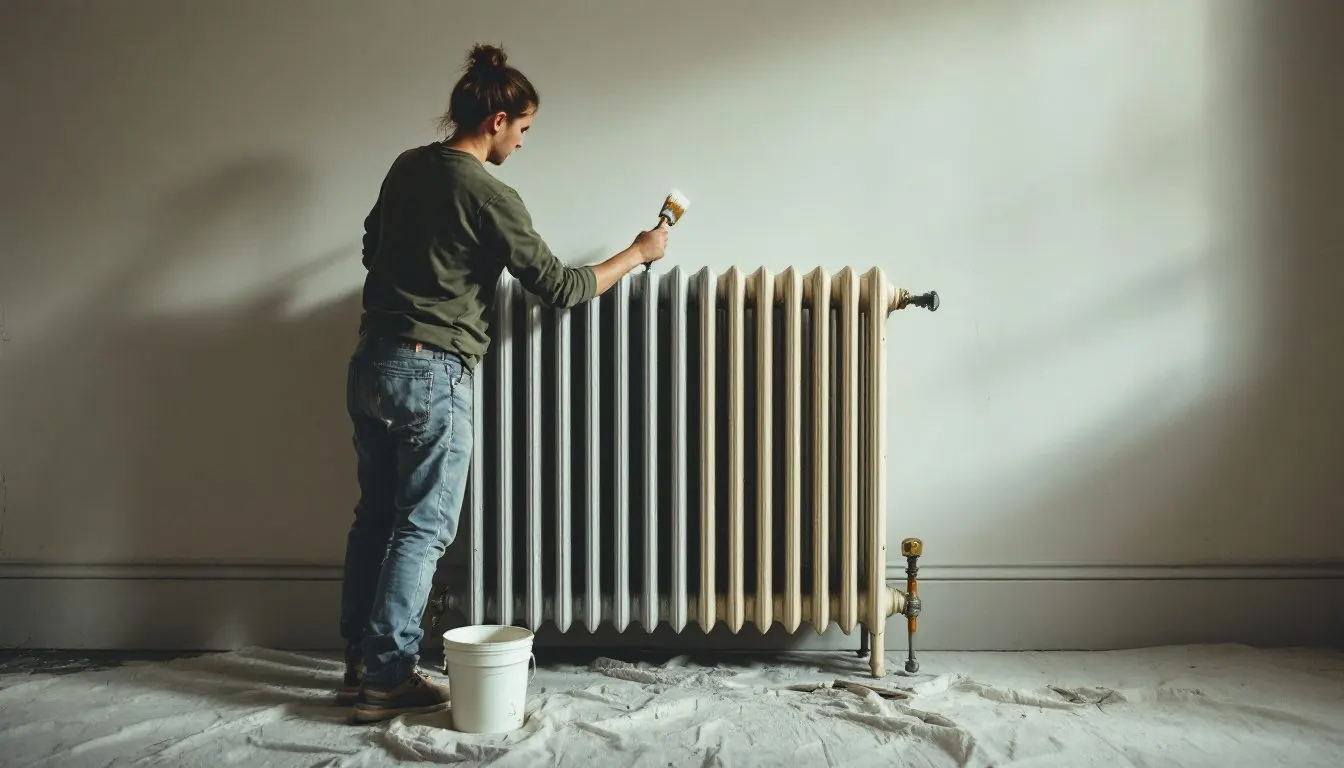
Yes, you can paint cast iron radiators, and any non-metallic paint (white, black or any color) leaves heat output essentially unchanged. The paint to avoid is aluminum or bronze: National Bureau of Standards tests found a metallic top coat cuts a typical radiator’s output by about one sixth. Check the paint’s temperature rating against steam (215°F) or hot water.
Which paints are rated for a 215°F steam radiator, and which only for hot water?
Many ordinary enamels stop at 200°F, which clears a hot water radiator but not a steam one. U.S. Boiler Company’s Heating Helper puts steam at 1 psig at 215°F and rates cast iron at 170 Btu per square foot on 180°F average water. If you are unsure which you have, telling a steam radiator from a hot water one takes a minute at the radiator.
| Coating (maker data sheet) | Maker’s heat limit | Steam radiator, 215°F | Hot water radiator, 180°F | Effect on heat output |
|---|---|---|---|---|
| Rust-Oleum Stops Rust spray (SRT-01) | Not on surfaces over 200°F | Over the limit | Within the limit | None in a color |
| Rust-Oleum 5200 DTM Acrylic, water-based (CM-07) | Dry heat resistance 200°F | Over the limit | Within the limit | None in a color |
| Flügger Interior Radiator Finish (Danish acrylic) | 80°C (176°F) | Over the limit | Over at 180°F; fine on cooler water | None in a color |
| Rust-Oleum Specialty High Heat (SPC-09) | 1200°F; spray needs a 450°F cure | Within; never reaches the cure | Same | None in black, white, almond or green; Silver, if metal flake, takes the penalty below |
| Any aluminum or bronze (metal flake) paint | Varies by product | Costs output | Same | About 1/6 less heat; about 10% on large 7-tube radiators (NBS) |
Two rows surprise people. A paint sold for radiators can have a low limit: Flügger’s Interior Radiator Finish “withstands temperatures up to 80 °C,” or 176°F. And Rust-Oleum’s SPC-09 data sheet says the high heat spray “must be heat cured at 450ºF for one hour” for full cure, a temperature no radiator reaches; the brush version only needs 24 hours of drying before heating.
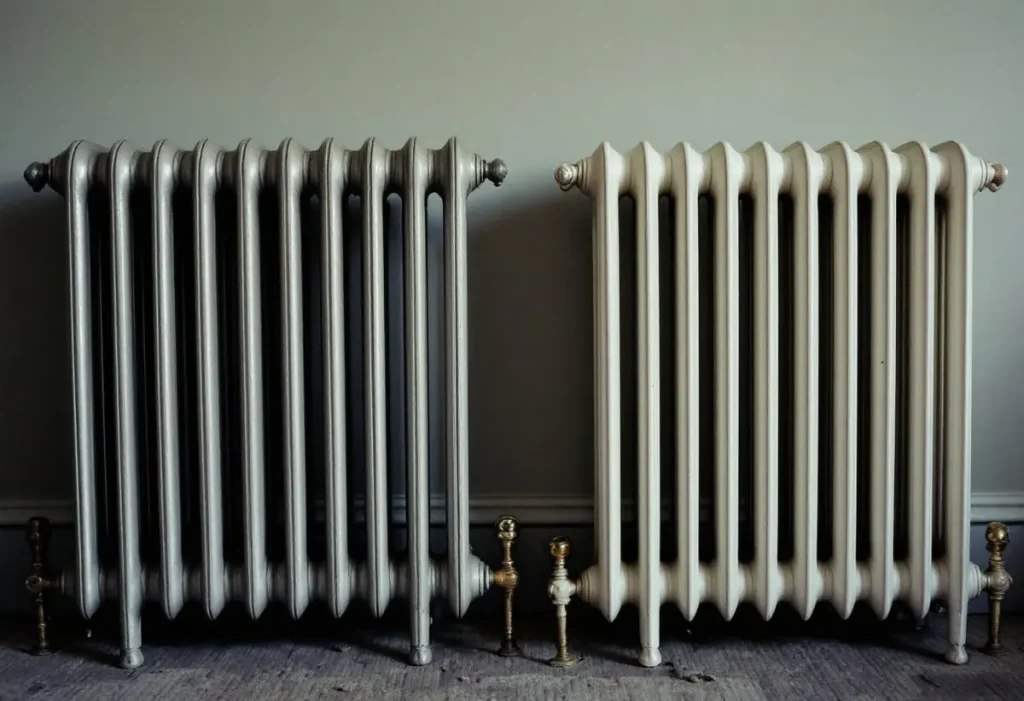
Does painting a radiator reduce its heat output, and by how much?
Only a metallic top coat reduces it, by roughly 10% to 17% per the National Bureau of Standards (NBS); color changes almost nothing. The NBS Letter Circular LC-445 (July 19, 1935) worked the numbers for a sectional cast iron radiator giving 180 Btu per hour per square foot with non-metallic paint.
About 2/3 of that, 120 Btu, warms the air rising through the sections, and paint does not change it. The other 60 Btu leaves as radiant heat set by the last coat; with aluminum or bronze the radiator “may be able to radiate only 30 Btu,” so it delivers 150. NBS called this “equivalent to removing 1/6 of the radiator,” and a large tubular radiator with 7 tubes per section loses only about 10%, since more than 3/4 of its heat leaves by convection.
The lab data came first. NBS Technologic Paper 254 (1924) measured that “aluminum paint emits only 30 to 50 per cent as much thermal radiation” as white paint, while white lead and black lampblack paints matched “within 4 per cent,” so black is no hotter than white. It reported Allen’s 2-column radiator test at 347 Btu per unit surface for aluminum against 428 Btu for non-metallic, and expected “a gain of only 10 to 15 per cent” from dropping metallic paint, not the threefold gain then given “considerable publicity.”
What does a one-sixth loss mean for a real radiator?
Roughly the output of one or two sections. We applied the NBS figure to a 26-inch, three-column, 10-section radiator, which the Heating Helper rates at 3-3/4 square feet per section, or 37.5 square feet.
| Operating condition | Rate per sq ft | Non-metallic paint | Aluminum or bronze top coat | Heat lost to the metallic coat |
|---|---|---|---|---|
| Steam, 215°F (1 psig) | 240 | 9,000 Btu/h | 7,500 Btu/h | 1,500 Btu/h |
| Hot water, 180°F average | 170 | 6,375 Btu/h | about 5,310 Btu/h | about 1,060 Btu/h |
| Hot water, 140°F average (outdoor reset, mild day) | 90 | 3,375 Btu/h | about 2,810 Btu/h | about 560 Btu/h |
The loss bites hardest on marginal radiators, such as a hot water system run on cooler water. NBS noted that if one room stays cold in a house of aluminum-painted radiators, repainting that radiator white or a color means “the heat emitted by it can be increased from 10 to 20%.” The fuel bill does not follow, though: LC-445 says “no appreciable saving in fuel will result from the use of non-metallic rather than metallic paints,” because every Btu still ends up in the house. Foil behind the radiator is a different question, covered in whether radiator reflectors work.
Do you have to strip the old silver paint before repainting a radiator?
Not for heat output. NBS found that “the last coat of paint on a radiator is the only one which has an appreciable effect,” so one non-metallic coat over old aluminum recovers the radiant share on a steam heating system or a hot water one. Technologic Paper 254 explains why: the aluminum layer’s high conductivity makes it “simply part of the metal wall of the radiator.”
Strip only for looks or adhesion. Rust-Oleum’s Stops Rust data sheet wants previous coats “sound” and says glossy finishes “should be scarified by sanding.” If a radiator goes out for blasting and powder coating, ask for a pressure test before it goes back: pros on the HeatingHelp forum report section joints leaking after the bake.
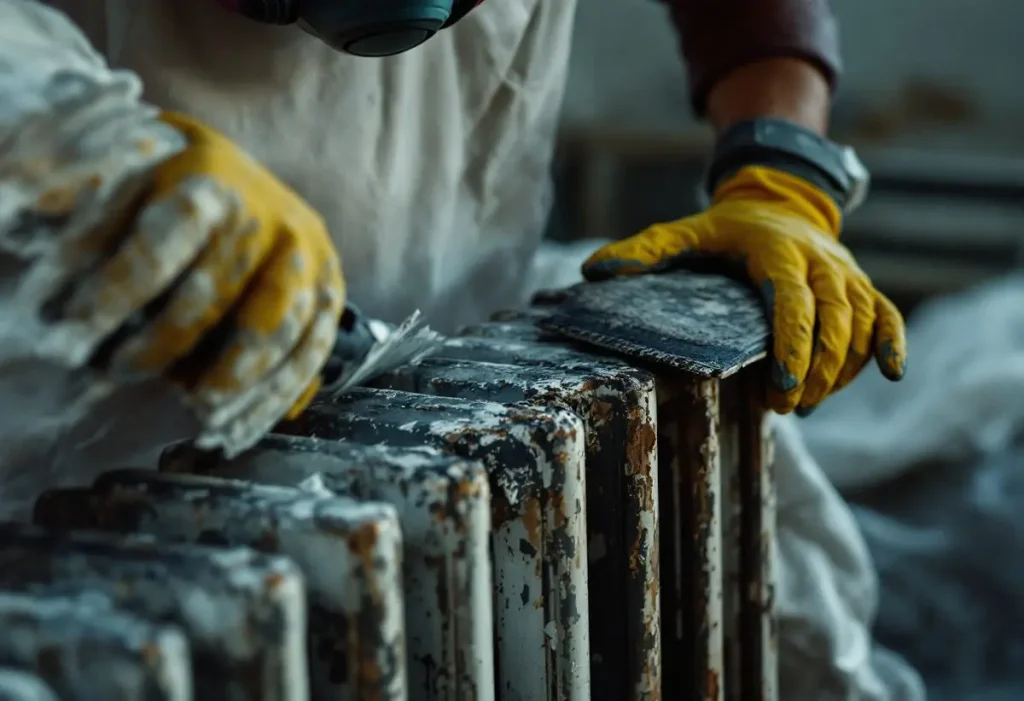
Is the old paint on a radiator lead, and what do EPA rules require before sanding it?
Assume it may be in any home built before 1978: the 1935 NBS circular itself named “white lead paints” as a non-metallic finish. Paid work that disturbs it is regulated.
- Which homes: EPA’s Renovation, Repair and Painting (RRP) rule covers “target housing,” defined in 40 CFR 745.103 as housing “constructed prior to 1978,”, with narrow exceptions.
- Who: 40 CFR 745.82 applies the rule to “renovations performed for compensation.” Owners working on their own homes fall outside that wording; the dust does not.
- The small-job cutoff: 40 CFR 745.83 exempts minor work that disturbs “6 square feet or less” of interior painted surface per room. NBS puts a 10-section radiator at 20 to 80 square feet, so stripping a whole one exceeds that by 3 to 13 times.
- Banned methods: 40 CFR 745.85 prohibits “open-flame burning or torching,” allows heat guns only “below 1,100 degrees Fahrenheit,” and bars power sanding or blasting without a shroud and HEPA vacuum.
Testing can end the question: a certified renovator’s EPA recognized test kit or a lab paint chip result below 1.0 mg/cm² or 0.5% by weight takes the radiator out of the rule.
Should you paint a radiator hot or cold, on or off the wall?
Paint it cold. Flügger says “paint only on cold surfaces; on hot surfaces the paint does not flow optimally,” and Rust-Oleum’s sprays list a 50 to 90°F range: in November, shut off that one radiator and let it cool.
Off the wall you reach the backs; in place, use a long-handled radiator brush. Mask the working parts: the air vent on a steam radiator (see steam radiator hissing for what a blocked vent does), the bleed screw on hot water, and the packing nut a leaking radiator valve repair needs.
Buy paint by surface area. On 20 to 80 square feet, Rust-Oleum’s stated coverage means 3 to 12 cans of Specialty High Heat spray (7 to 8 square feet per can) or 2 to 14 cans of Stops Rust (6 to 10) per coat, by our arithmetic. Ventilate on the first firing; Rust-Oleum warns “the new paint finish may emit smoke.”
Frequently asked questions
Can you spray paint cast iron radiators?
Yes. Spray reaches between sections better than a brush, but it takes many cans: with 20 to 80 square feet of surface on a 10-section radiator (NBS LC-445) and 7 to 8 square feet per can of Rust-Oleum Specialty High Heat spray, one coat needs 3 to 12 cans. Spray cold, between 50 and 90°F, in a ventilated room.
What kind of paint do you use on cast iron radiators?
Use a non-metallic metal enamel whose heat limit is above your radiator’s temperature. Common enamels such as Rust-Oleum Stops Rust stop at 200°F, enough for hot water radiators but not for 215°F steam. Avoid aluminum or bronze finishes, which NBS found cut output by about one sixth.
Can you paint old cast iron radiators?
Yes, and stripping is not needed for heat output because NBS found only the last coat has an appreciable effect. In homes built before 1978, assume old coats may contain lead: a paid contractor disturbing more than 6 square feet per room falls under EPA’s RRP rule in 40 CFR 745, and open-flame stripping is prohibited.
Is painting radiators a good idea?
It is when the color is non-metallic and the radiator was silver: NBS LC-445 says repainting a metallic radiator in white or a color can raise its output 10 to 20%, enough to fix a room that runs cold. It will not cut fuel use, because the same heat still reaches the house.
Can you paint cast iron pipes?
Yes. NBS Technologic Paper 254 suggested non-metallic paint on pipes in heated rooms and aluminum paint on basement piping to hold heat in, while LC-445 called aluminum a poor substitute for pipe insulation about an inch thick. For steam mains, insulation does more than any paint.
How we researched this
In November 2026 we read NBS Technologic Paper 254 (1924) and Letter Circular LC-445 (1935, a scan hosted by HeatingHelp), the U.S. Boiler Company Heating Helper for steam temperatures and cast iron ratings, maker data sheets for four paints, and 40 CFR 745 on eCFR. We did not read Allen’s original tests or any I=B=R rating notes; Allen’s figures are as Paper 254 reports them. Blogs and forums were excluded for figures.
Sources
- National Bureau of Standards. “Painting of Steam and Hot Water Radiators,” Letter Circular LC-445, July 19, 1935. https://heatinghelp.com/assets/Uploads/US_Standards_Painting_Radiators_1935.pdf?vid=5. Accessed November 2026.
- Bureau of Standards (Coblentz and Hughes). “Emissive Tests of Paints for Decreasing or Increasing Heat Radiation from Surfaces,” Technologic Paper 254, 1924. https://nvlpubs.nist.gov/nistpubs/nbstechnologic/nbstechnologicpaperT254.pdf. Accessed November 2026.
- U.S. Boiler Company. “The Heating Helper, 2024 to 2025 Edition.” https://s3-us-west-2.amazonaws.com/catsy.782/Heating+Helper.pdf. Accessed November 2026.
- Rust-Oleum. “Specialty High Heat, Technical Data SPC-09.” https://www.rustoleum.com/-/media/8F454BFA6E1B434D9DDC51CDA8CF6151.ashx. Accessed November 2026.
- Rust-Oleum. “Stops Rust Enamel Sprays, Technical Data SRT-01.” https://www.rustoleum.com/-/media/B5D269408B114C65A67188A3AD9F4154.ashx. Accessed November 2026.
- Rust-Oleum. “5200 System DTM Acrylic, Technical Data CM-07.” https://www.rustoleum.com/-/media/97D3847DBB6F4CD593B156CB8D4E059E.ashx. Accessed November 2026.
- Flügger. “Interior Radiator Finish, Product Data Sheet.” https://assets.flugger.dk/static/ir/757715/TDS_INT%20RAD_en.pdf. Accessed November 2026.
- U.S. EPA via eCFR. “40 CFR 745.82 Applicability” and “40 CFR 745.83 Definitions.” https://www.ecfr.gov/current/title-40/chapter-I/subchapter-R/part-745/subpart-E/section-745.82. Accessed November 2026.
- U.S. EPA via eCFR. “40 CFR 745.85 Work practice standards.” https://www.ecfr.gov/current/title-40/chapter-I/subchapter-R/part-745/subpart-E/section-745.85. Accessed November 2026.
- U.S. EPA via eCFR. “40 CFR 745.103 Definitions (target housing).” https://www.ecfr.gov/current/title-40/chapter-I/subchapter-R/part-745/subpart-F/section-745.103. Accessed November 2026.
Leave a Reply