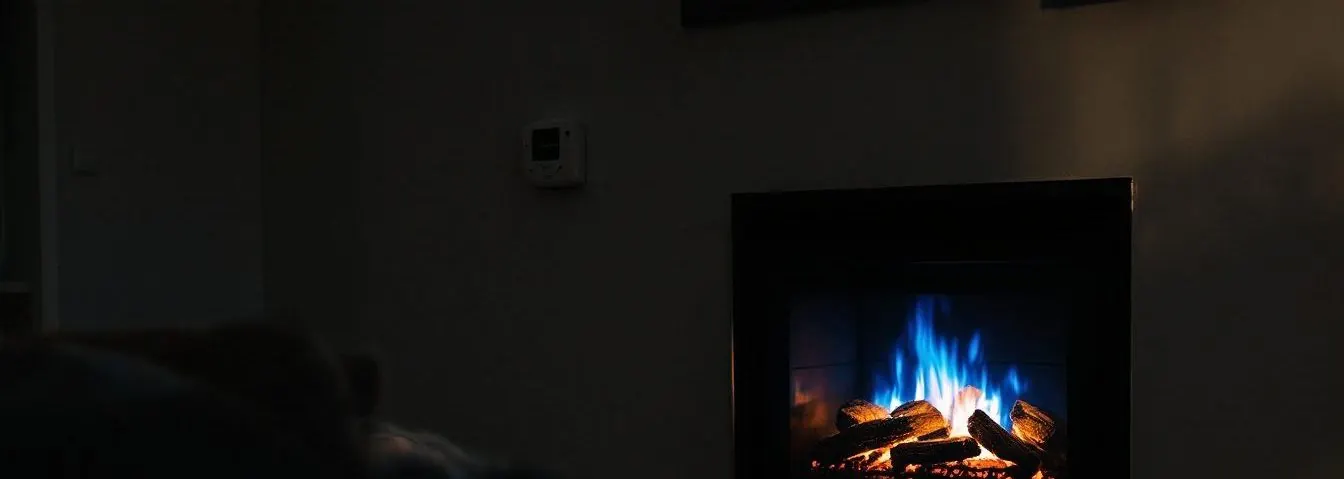
Can you leave a gas fireplace on overnight? Only a sealed direct vent unit, and only if its manual allows it, the glass barrier is on and a CO alarm guards the bedrooms. Vent-free logs and gas logs in an open wood fireplace should be off before anyone sleeps; Peterson’s vent-free manual says so in capitals.
Which gas fireplace do you have, and may it burn all night?
The fireplace type decides it, not the fuel: natural gas and propane follow the same rules. Find your unit by what you can see, then check the rating plate. Venting types and efficiency are explained in our gas fireplace venting guide.
| Fireplace type and how to spot it | Listing standard (2021 IRC) | All night? | What the maker or code says |
|---|---|---|---|
| Direct vent fireplace or insert: fixed glass, two-layer pipe to an outside wall or roof | ANSI Z21.88 fireplace heater (G2435.1) or Z21.50 (G2434.1) | Yes, if the manual allows | Empire’s Tahoe manual offers four thermostat controls and no run-time limit; Valor’s Plus and Max remotes drop to pilot after 8 hours untouched |
| B-vent (natural draft) fireplace: glass front, draft hood, burns room air | Z21.50 vented gas fireplace (G2434.1) | Only with a sound draft and a CO alarm | Allowed in a bedroom only if the room meets the volume rule of G2407.5 (G2406.2 item 2) |
| Vent-free (unvented) logs or fireplace: no flue, ODS pilot, exhaust stays in the room | ANSI Z21.11.2 unvented room heater (G2445.1) | No | Peterson Real Fyre G18: “MUST NOT be left burning when unattended or while anyone is sleeping”; code: never the sole heat (G2445.2) |
| Gas logs in a wood-burning fireplace: open firebox, damper clamped open | ANSI Z21.60 decorative appliance (G2432.1) | No | Hargrove: glass doors fully open while burning, screen in place, damper fixed open at all times |
Compiled by The HVAC Brief from the 2021 IRC fuel gas chapter (Seattle reprint) and the Empire, Valor, Peterson and Hargrove documents under Sources; “All night?” is our reading.
Does a direct vent manual allow running it all night or all day?
Generally yes: a direct vent fireplace heater is built to hold a room temperature, and the manual we read sets no run-time cap. Empire Comfort Systems certifies its Tahoe Premium direct vent line to ANSI Z21.88/CSA 2.33 as a “Direct Vent Gas Fireplace Heater” and lists four optional thermostat controls, including a “Millivolt Wireless Wall Thermostat” and a “Battery Operated Remote Control with Programmable Thermostat.” The same manual contains no unattended or sleeping warning.
Valor’s remote control page says the Plus and Max systems let you “set timers to turn off your fireplace after you go to bed,” and that if the flame height has not changed and the remote has not been used for eight hours, the system “automatically turns your fireplace down to pilot.” The Valor 10 does so after three hours, “on select fireplaces.”
Direct vent fireplace inserts follow the same listing. It is also the only gas fireplace type the 2021 IRC allows in a bedroom with no input cap (G2406.2 item 1).
Will the remote shut the fireplace off by itself overnight?
Only some will; most “safety” shutoffs are not run timers. Skytech’s 3301P2 remote shuts the fireplace down only after a 2-hour (120 minute) countdown with no signal from the handset. With the handset nearby and good batteries, the fireplace keeps running.
Its receiver also shuts down at 130 ºF to protect itself, a hot hearth warning rather than a bedtime feature. Valor’s 8-hour turndown or a programmed off timer is what actually ends an overnight burn; without one, the fireplace runs until you switch it off.
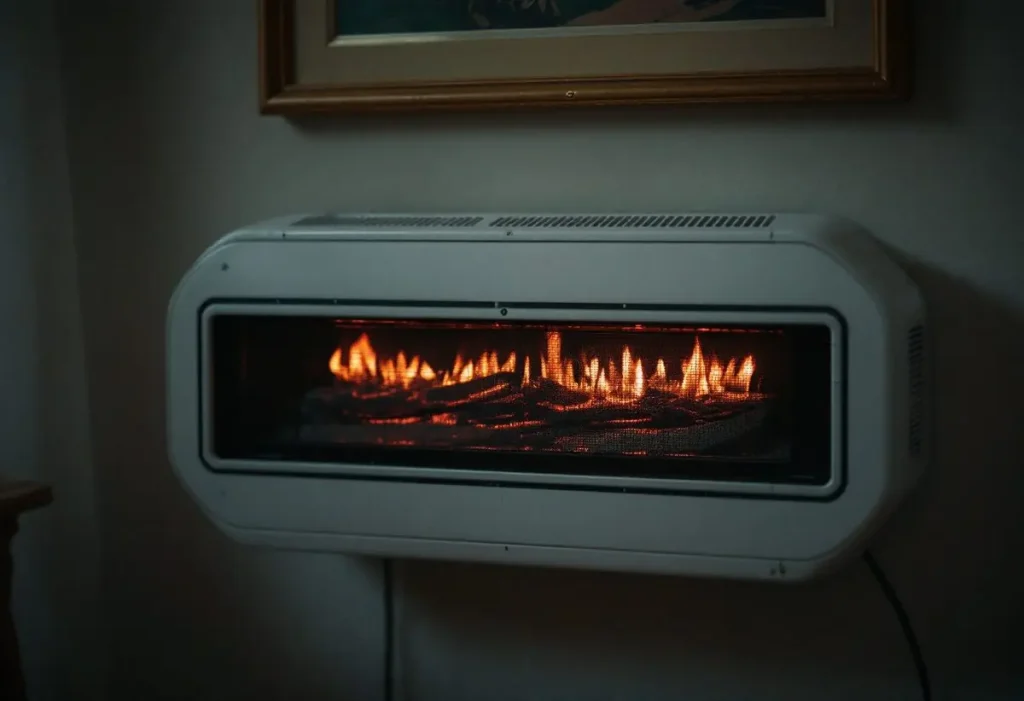
Why do vent-free makers say never while anyone is sleeping?
All exhaust stays in the house, and the built-in guard senses oxygen, not CO. Robert H. Peterson’s manual for its Real Fyre G18 unvented log sets calls the product “an attended appliance” and states: “Adults MUST be present when this gas appliance is operating. This appliance MUST NOT be left burning when unattended or while anyone is sleeping.”
The code treats them as part-time heat. IRC G2445.2 says unvented room heaters “shall not be used as the sole source of comfort heating in a dwelling unit,” G2445.3 caps them at 40,000 Btu/h, and G2445.6 requires an oxygen depletion sensor that trips no lower than 18 percent oxygen. A field study of 30 homes with unvented gas fireplaces (Francisco and colleagues, Indoor Air, 2010) found CO above EPA’s 8-hour 9 ppm standard in 20% of homes, and that “nearly half of the fireplaces were used at least once for longer than 2 h, counter to manufacturers’ intended usage as supplemental heating.” NO2 and moisture data are in our ventless gas heater safety guide.
G2445.5 allows no more than 20 Btu/h per cubic foot of room, so a 30,000 Btu/h log set needs at least 1,500 cubic feet, about 188 square feet under an 8 foot ceiling. An all-night burn keeps adding water too; Peterson warns of moisture problems “when operated for extended periods of time,” one cause of high humidity in a house in winter.
Can a ventless gas fireplace go in a bedroom at all?
Only a single wall-mounted unvented heater of 10,000 Btu/h or less, with an ODS, in a bedroom that meets the room volume rule; a bathroom unit is capped at 6,000 Btu/h. That is IRC G2406.2 items 3 and 4, and the volume rule means a 10,000 Btu/h bedroom unit needs at least 500 cubic feet. Vent-free log sets are not wall-mounted heaters, so they fall outside both exceptions, which is why GHP Group’s VFL2 manual states: “This heater shall not be installed in a bedroom or bathroom.” Some states go further; the local inspector decides.
Can gas logs in a wood-burning fireplace stay lit all night?
They should not, and the manual explains why. Hargrove’s Olde World Basket manual, for vented logs certified to ANSI Z21.60, says the realistic yellow flame “produces carbon monoxide and soot,” that the set must burn “with the damper completely open,” and that glass fireplace doors must be “fully open to allow for proper combustion air and to keep control valves from overheating.”
The damper is the hidden overnight risk. Hargrove requires a damper stop so the chimney keeps a permanent free opening at all times: in a 6 foot masonry chimney that is 17.6 square inches at 20,000 Btu/h and 33.8 at 40,000. Our fireplace damper guide covers clamps and heat loss. Fumes or soot with the damper fully open mean, per Hargrove, a defective draft: stop using the logs.
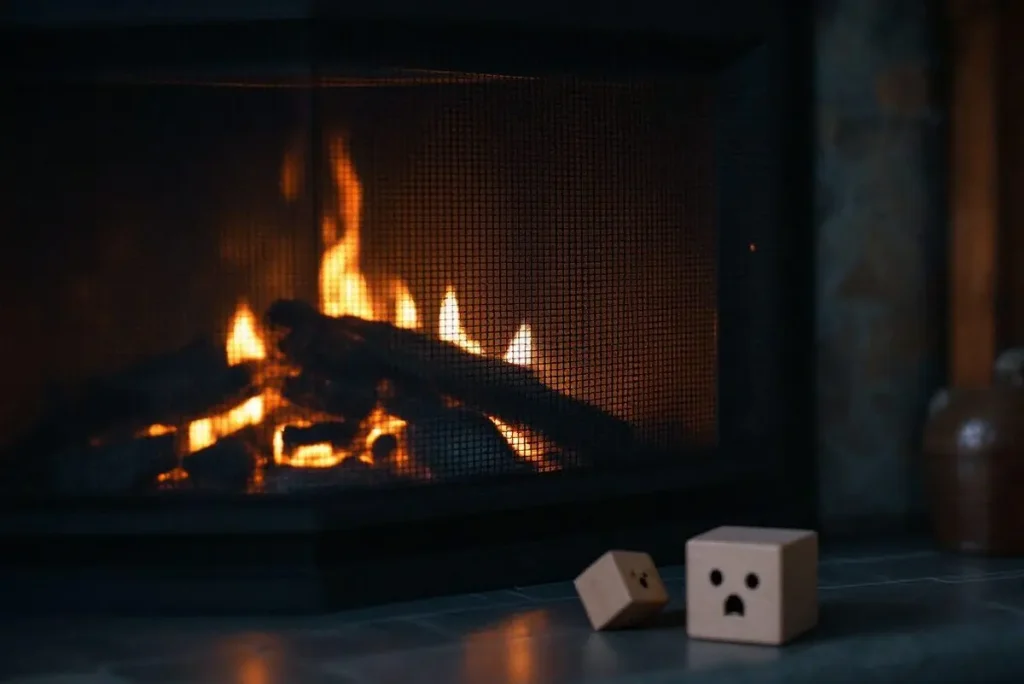
How hot does the glass get, and what about the pilot left on?
Hot enough that vented units with glass above 172°F must ship with a protective barrier. CPSC Chairman Inez Tenenbaum’s April 30, 2013 statement says the revised ANSI Z21.88 and Z21.50 standards, due to take effect in January 2015, require that barrier, and that it must prevent contact with the glass and not be a burn hazard itself. Empire’s manual repeats the label: “HOT GLASS WILL CAUSE BURNS. DO NOT TOUCH GLASS UNTIL COOLED.”
The standing pilot is designed to stay on. Empire’s millivolt instructions say “the standing pilot burns continuously even when the main burner is OFF”; Valor’s SmartPilot shuts its pilot off after seven days with no activity. A pilot that keeps dropping out is diagnosed in gas fireplace pilot won’t stay lit.
What does running it 4 or 8 hours cost in natural gas?
About $1.42 to $4.74 at full input, using EIA’s 2025 residential price of $15.34 per thousand cubic feet and 1,036 Btu per cubic foot. Thermostat cycling costs less.
| Unit and input | 4 hours | 8 hours (overnight) |
|---|---|---|
| Empire Tahoe Premium direct vent, 24,000 Btu/h maximum | $1.42 | $2.84 |
| GHP Group VFL2 vent-free logs, 30,000 Btu/h | $1.78 | $3.55 |
| Vented gas logs at 40,000 Btu/h (top column of Hargrove’s damper table) | $2.37 | $4.74 |
HVAC Brief calculation: input Btu/h × hours ÷ 1,036 Btu per cubic foot ÷ 1,000 × $15.34 per Mcf. Example: 24,000 × 8 = 192,000 Btu, or 0.185 Mcf, or $2.84. Propane prices differ and are not included.
What should be in place before a direct vent unit runs overnight?
A CO alarm outside the sleeping rooms, the barrier on, a thermostat or timer, and an annual service. The technician checks the glass gasket and vent joints, runs a spillage test on a B-vent unit with exhaust fans on, and measures room CO; a rising reading means it stays off. Mount the alarm per our CO detector placement guide.
Stop line: smell gas or hear the CO alarm, and everyone leaves before anyone calls the utility. For an electric alternative, see the rules on sleeping with a space heater on.
Frequently asked questions
Can you leave a gas fireplace on when not home?
Not a vent-free or gas log set: Peterson’s G18 manual says adults must be present whenever it operates. A direct vent unit has no such warning in the Empire manual we read, but no one is there to hear a CO alarm. Valor’s Plus and Max remotes cut it to pilot after 8 hours untouched; turning it off before you leave is simpler.
Can you leave a gas fireplace pilot on all the time?
Yes, a standing pilot is designed to burn continuously. Empire’s millivolt instructions say the standing pilot burns continuously even when the main burner is off and tell owners to leave the valve on through the operating season. Turning it off in summer saves gas. Valor’s SmartPilot shuts its pilot off by itself after seven days with no activity.
Can you leave a ventless gas fireplace on all night?
No. Peterson’s Real Fyre G18 manual says the unit must not be left burning while anyone is sleeping, and the 2021 IRC bars unvented heaters as a home’s sole heat (G2445.2). Its oxygen depletion sensor trips at no lower than 18 percent oxygen, but it does not measure carbon monoxide, so a CO alarm is still needed.
Is it safe to sleep with a gas fireplace on in the bedroom?
Only with a direct vent unit, which IRC G2406.2 item 1 allows in a bedroom when installed per its listing. A vented B-vent unit needs a room that meets the G2407.5 volume rule, and an unvented heater is limited to one wall-mounted unit of 10,000 Btu/h or less with an ODS. Fit a CO alarm in or near the room either way.
How we researched this
On November 21, 2026 we read the 2021 IRC fuel gas chapter (Seattle reprint), manuals from Empire, Peterson, GHP Group, Sure Heat, Hargrove and Skytech, Valor’s remote instructions, two CPSC records on hot glass, the Francisco 2010 abstract and EIA price data. We excluded contractor blogs and forums, which cite no maker document; one top result calls the oxygen sensor a CO detector. We did not read the paywalled ANSI standards and attribute them to CPSC and the code.
Sources
- Seattle Department of Construction and Inspections. “2021 Seattle Residential Code, Chapter 24: Fuel Gas.” https://seattle.gov/documents/Departments/SDCI/Codes/SeattleResidentialCode/2021SRCChapter24.pdf. Accessed November 2026.
- Empire Comfort Systems. “Tahoe Premium Contemporary Direct Vent Installation Instructions 39583.” https://cdn2.shopify.com/s/files/1/1403/4773/files/TAHOE_PREMIUM_CONTEMPORARY_INSTALLATION_MANUAL.pdf?4543. Accessed November 2026.
- Valor Fireplaces. “Gas Fireplace Remote Control Instructions.” https://valorfireplaces.com/blog/gas-fireplace-remote-control-instructions.php. Accessed November 2026.
- Skytech. “Model 3301P2 Installation and Operating Instructions.” https://cdn.shopify.com/s/files/1/0285/6825/6564/files/3301P2_Instr.pdf. Accessed November 2026.
- Robert H. Peterson Co. “G18 Unvented Gas Log Sets Installation and Owner’s Manual.” https://cdn.shopify.com/s/files/1/1403/4773/files/G18_manual.pdf. Accessed November 2026.
- Hargrove. “Installation and Operation Guide for Olde World Basket Vented Decorative Appliance.” https://fireplacedoorsonline.com/images/companies/1/Manuals/Hargrove/OLDE%20WORLD%20BASKET%20VENTED%20_New_.PDF. Accessed November 2026.
- GHP Group. “Vent-Free Gas Log Set Model VFL2 Owner’s Manual.” https://images.homedepot-static.com/catalog/pdfImages/30/3077e40a-c163-4ca3-bd84-32d098d0b0fe.pdf. Accessed November 2026.
- U.S. Consumer Product Safety Commission. “Statement of Chairman Inez M. Tenenbaum on Vented Gas Fireplaces, April 30, 2013.” https://cpsc.gov/s3fs-public/pdfs/TenenbaumVentedGasFireplaceStatement.pdf. Accessed November 2026.
- Francisco PW, Gordon JR, Rose B. “Measured concentrations of combustion gases from the use of unvented gas fireplaces.” Indoor Air, 2010. https://pubmed.ncbi.nlm.nih.gov/20590920/. Accessed November 2026.
- U.S. Energy Information Administration. “U.S. Price of Natural Gas Delivered to Residential Consumers.” https://www.eia.gov/dnav/ng/hist/n3010us3a.htm (Btu factor from EIA’s Btu explainer). Accessed November 2026.
Leave a Reply