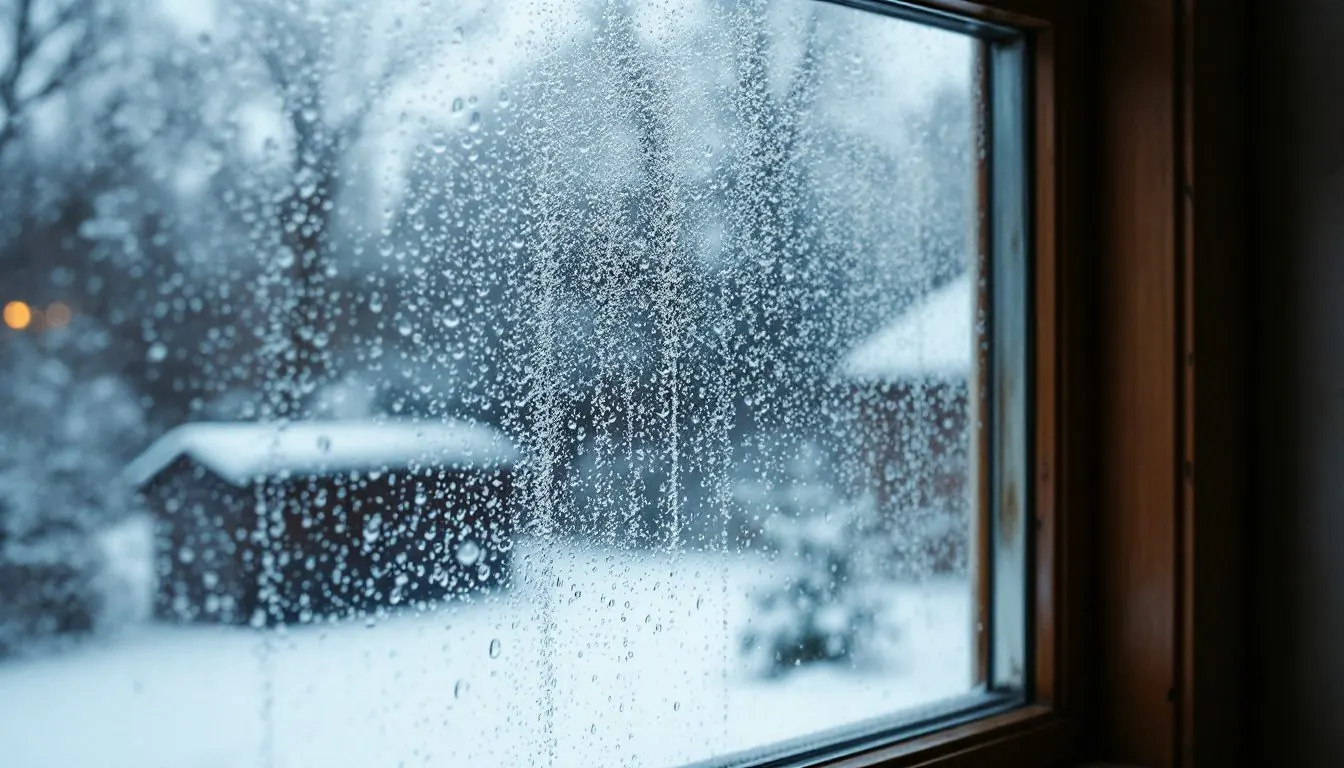
High humidity in a house in winter means water is being added indoors faster than cold, dry outdoor air can carry it away. Check the meter first, then find the source: a humidifier stuck on, a vent-free gas heater, laundry, a wet basement, a new house drying out, or bath and kitchen fans that do not exhaust.
Winter outdoor air is the driest air your house will see all year, so a reading above 50% at 68 to 72°F is a sign of a source, not of weather. The University of Minnesota Extension says that when relative humidity is more than 50%, moisture problems may occur, and it puts the healthy winter level near 25%. Check in this order, cheapest test first.
Is your winter humidity really high, or is the hygrometer wrong?
Test the meter before you chase a source. A jar holding a damp slurry of table salt settles at 75.29% RH at 25°C (77°F), per the NIST compilation by Greenspan (1977). Our hygrometer accuracy guide walks through the test.
Wet glass is independent proof: our window condensation limits show clear double glass holds only about 41% at 0°F outside.
So is 60% humidity high in a house in winter? Yes. The EPA mold guide says to keep indoor humidity below 60 percent (ideally between 30 and 50 percent), and our winter humidity targets run lower as it gets colder. A true 60% at 70°F puts the dew point near 55°F, so any surface colder than that will sweat; the dew point explainer has the arithmetic.

Where does a closed-up house get 2 to 4 gallons of water a day?
Mostly from the people living in it. A 2001 paper by Anton TenWolde of the USDA Forest Products Laboratory and Iain Walker of Lawrence Berkeley National Laboratory averaged measured homes and IEA data at 7.2 kg/day (about 16 lb, or 1.9 gallons) for one to two adults, with a 3 bedroom design rate of 14 kg/day. In 2012 ASHRAE Addendum b to Standard 160 called those rates “very high” and cut the 3 bedroom value to 10 L/day.
| Source | How much water | How to confirm it | First fix |
|---|---|---|---|
| People: breathing, showers, cooking | 7.2 kg/day for 1 to 2 adults; 10 L/day design, 3 bedrooms | RH peaks evenings and mornings, falls when the house is empty | Bath fan and range hood on every time |
| Vent-free gas heater or logs | About 9.2 lb (1.1 gal) per therm; 3.5 gal per 8 hours at 40,000 Btu/h | RH rises while it burns | Shut it off; use vented heat |
| Humidifier set high or stuck on | Adds water until the control or valve stops it | Water runs to the drain with the control off | Humidistat down; replace a leaking solenoid valve |
| Laundry on racks, or a dryer vented indoors | IRC M1502.2: dryer exhaust must “convey the moisture to the outdoors” | RH spikes on laundry days | 4 inch metal duct to a dampered outdoor hood |
| Damp basement or crawl space, firewood, plants | Listed by UMN Extension; normal foundation moisture is already in the rates above | Basement reads higher than upstairs; musty smell | Gutters and grade away from walls, ground cover, firewood outside |
| New construction | Not quantified; TenWolde and Walker call it “the cause of a significant number of problems” | Sweating windows in early winters, no other source | Continuous ventilation until it dries |
The gas rows are our arithmetic: methane burns to two molecules of water for each molecule of fuel, and the EIA conversion factor of 1 cubic foot = 1,036 Btu puts 96.5 cubic feet in a therm, which yields 9.16 lb of water. A vent-free heater at the 40,000 Btu/h cap in IRC G2445.3, run for 8 hours, burns 3.2 therms and adds about 29 lb of water: more than the 22 lb a day that ASHRAE now assumes for a whole 3 bedroom household.
Which winter-only sources push a house past 60%?
The big two are a humidifier nobody turned down and an unvented gas appliance. Aprilaire’s Model 600 installation instructions warn installers not to set humidity “above recommended or to recommended level if condensation exists on inside windows,” and that excess humidity can allow “the possibility for mold growth in the home.” If water keeps running through the pad with the control off, the valve is the fault, and our humidifier troubleshooting guide covers the solenoid and humidistat checks.
For gas, the US Department of Energy says unvented combustion space heaters “can also introduce water vapor into the home, which can result in mold” (archived copy). Our ventless gas heater code limits page lists the states that ban them. A heater that soots or smells needs a technician with a combustion analyzer and a CO alarm nearby, not a dehumidifier.
Below grade, UMN Extension lists “damp soil under basements and crawl spaces,” stored firewood and plants among the sources. If a basement hygrometer reads clearly higher than an upstairs one, the ground is the source; our crawl space moisture guide covers ground covers and when sealing beats venting.
How much outdoor air does it take to dry a house when it is 20°F outside?
Less than most people expect: about 47 cfm of continuous outdoor air holds a 3 bedroom household at 40% RH, by our calculation. Cold air carries little water, so each cubic foot of indoor air that leaks or is blown out takes more water with it than the outdoor air replacing it brings in. We used the National Weather Service vapor pressure formula and the TenWolde and Walker mass balance.
| Continuous outdoor air (leakage plus fans) | Indoor RH at 70°F | Against the EPA range |
|---|---|---|
| 25 cfm (a very tight house, no ventilation) | 64% | Above the 60% ceiling |
| 50 cfm | 38% | Inside 30 to 50% |
| 75 cfm | 29% | Just under 30% |
| 100 cfm | 25% | Below 30%, at the UMN 25% winter level |
The model reproduces the paper’s own example: a 2,200 square foot, 4 bedroom Madison, Wisconsin home at 0.2 air changes per hour, which TenWolde and Walker put at about 44% RH in January; our script returns 43%. The same arithmetic shows 50 cfm of 20°F air removes about 3.86 gallons of water a day from a 70°F, 50% house, which is why the winter fix is air exchange.
What should you fix first: the source, the fans, the ventilation or a dehumidifier?
UMN Extension gives the rule: “first identify and remove the source,” and only then ventilate or dehumidify.
- Remove the source. Humidistat down, vent-free heater off, laundry into a vented dryer, firewood outside.
- Make spot exhaust work. The base 2021 IRC sets 50 cfm intermittent or 20 cfm continuous for a bathroom and 100 cfm intermittent or 25 cfm continuous for a kitchen (Table M1505.4.4.1, base text shown struck in Seattle’s 2021 reprint, which amends it). Section M1505.2 bars bath exhaust from discharging “into an attic, crawl space or other areas inside the building.” Confirm the outdoor flap opens; our bathroom exhaust fan guide has the sizing.
- Add continuous ventilation. The DOE notes that an energy recovery ventilator “transfers some of the moisture from the exhaust air to the usually less humid incoming winter air”, so in a house that is too wet in winter an HRV removes more water. Our ERV vs HRV comparison covers the choice.
- Dehumidify last. DOE rates portable dehumidifiers at 65°F and 60% RH (10 CFR 430, Appendix X1), so the pints per day on the box is a test-room number, not a promise for a 45% bedroom. Our dehumidifier sizing guide covers basements.
Can high winter humidity cause health problems or damage the house?
Yes, through mold and hidden condensation. The EPA says molds “produce allergens (substances that can cause allergic reactions), irritants, and in some cases, potentially toxic substances,” and can trigger asthma attacks in people allergic to mold. The damage you cannot see is worse: the DOE warns that when a supply ventilation system pressurizes a house in winter, humid indoor air forced out through leaks can condense “in the attic or cold outer parts of the exterior wall, resulting in mold, mildew, and decay.”
Frequently asked questions
Is a humidity of 70 in a house in winter bad?
Yes. A true 70% at a normal room temperature is well past the EPA ceiling of below 60 percent, and ASHRAE Addendum b to Standard 160 says indoor design humidities above 70% RH “would likely lead directly to indoor mold.” Confirm the reading with a salt test, then look for a humidifier, vent-free heater or wet basement first.
How high should humidity be in a house in winter?
Lower than in summer. The EPA range is 30 to 50 percent, and the University of Minnesota Extension puts a healthy winter level near 25%. The colder it is outside, the lower your windows let you go: clear double glazing starts to fog at about 41% when it is 0°F outdoors, so let the glass set the upper limit.
How to get rid of high humidity in house in winter fast?
Run every bath and kitchen fan that vents outdoors, turn off any humidifier and vent-free heater, and crack a window for a short time, as UMN Extension suggests. By our calculation, 50 cfm of 20°F outdoor air removes about 3.86 gallons of water a day from a 70°F, 50% house, far more than a small dehumidifier in a cold room.
Should I turn on AC if humidity is high?
In summer, a running air conditioner removes water while its coil is colder than the indoor dew point. In winter, outdoor air is the better dryer: at 0°F outside, our calculation shows 50 cfm of ventilation removes about 4.56 gallons a day. Use exhaust fans or an HRV in cold weather and save the AC for the cooling season.
How we researched this
Researched November 21, 2026. We read the TenWolde and Walker moisture load paper, ASHRAE Addendum b to Standard 160, the EPA mold guide, two DOE pages and the UMN Extension page (archived copies), 10 CFR 430 Appendix X1, EIA heat content, the NWS vapor pressure formula, 2021 IRC Chapters 15 and 24 (Seattle reprints), Aprilaire’s Model 600 instructions and the NIST salt tables. Our moisture balance script reproduces the paper’s Madison example within 1 point of RH. We excluded forum threads and contractor blogs from the results page as sources for any figure, and cut a per-shower breakdown we could not trace to a primary source.
Sources
- TenWolde, A. and Walker, I. S. (USDA Forest Service, Forest Products Laboratory; LBNL). “Interior Moisture Design Loads for Residences.” Buildings VIII, 2001. https://research.fs.usda.gov/download/treesearch/25691.pdf. Accessed November 2026.
- ASHRAE. “Addendum b to ANSI/ASHRAE Standard 160-2009, Criteria for Moisture-Control Design Analysis in Buildings.” https://www.ashrae.org/File%20Library/Technical%20Resources/Standards%20and%20Guidelines/Standards%20Addenda/160_2009_b_Published.pdf. Accessed November 2026.
- US EPA. “A Brief Guide to Mold, Moisture and Your Home.” https://www.epa.gov/mold/brief-guide-mold-moisture-and-your-home. Accessed November 2026.
- University of Minnesota Extension. “Controlling moisture problems in your home.” Archived copy: https://web.archive.org/web/2025id_/https://extension.umn.edu/garden-and-home/home-maintenance/caring-for-a-home/controlling-moisture-problems-in-your-home. Accessed November 2026.
- US Department of Energy. “Whole-House Ventilation.” Archived copy: https://web.archive.org/web/20260101021416/https://www.energy.gov/energysaver/whole-house-ventilation. Accessed November 2026.
- US Department of Energy. “Portable Heaters.” Archived copy: https://web.archive.org/web/2025id_/https://www.energy.gov/energysaver/portable-heaters. Accessed November 2026.
- US EIA. “British thermal units (Btu).” https://www.eia.gov/energyexplained/units-and-calculators/british-thermal-units.php. Accessed November 2026.
- National Weather Service. “Vapor Pressure.” https://www.weather.gov/media/epz/wxcalc/vaporPressure.pdf. Accessed November 2026.
- Seattle Department of Construction and Inspections. “2021 Seattle Residential Code, Chapter 15: Exhaust Systems.” https://www.seattle.gov/documents/Departments/SDCI/Codes/SeattleResidentialCode/2021SRCChapter15.pdf. Accessed November 2026.
- eCFR. “10 CFR Part 430, Subpart B, Appendix X1: Uniform Test Method for Measuring the Energy Consumption of Dehumidifiers.” https://www.ecfr.gov/current/title-10/chapter-II/subchapter-D/part-430/subpart-B/appendix-Appendix%20X1%20to%20Subpart%20B%20of%20Part%20430. Accessed November 2026.
- Aprilaire. “Model 600 Series Installation Instructions.” https://documents.alpinehomeair.com/product/Aprilaire%20600%20Series%20Installation%20Instructions%2001.08.pdf. Accessed November 2026.
- Seattle Department of Construction and Inspections. “2021 Seattle Residential Code, Chapter 24: Fuel Gas” (Section G2445.3). https://seattle.gov/documents/Departments/SDCI/Codes/SeattleResidentialCode/2021SRCChapter24.pdf. Accessed November 2026.
- Greenspan, L. (NBS). “Humidity Fixed Points of Binary Saturated Aqueous Solutions.” Journal of Research of the NBS 81A(1), 1977. https://nvlpubs.nist.gov/nistpubs/jres/81A/jresv81An1p89_A1b.pdf. Accessed November 2026.
Leave a Reply