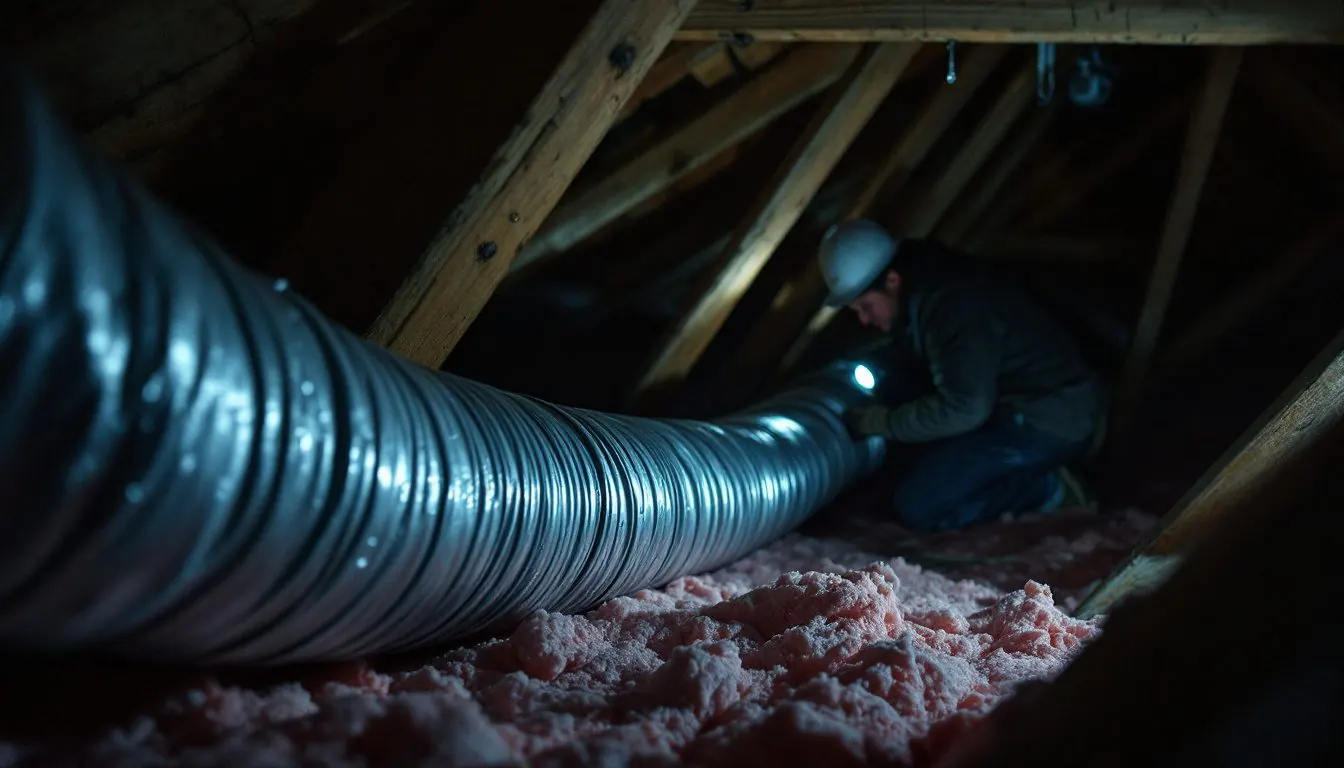
Condensation on ductwork in winter comes from warm, moist house air reaching a duct that has cooled toward attic, crawl space or outdoor temperature. A 70°F house at 40% RH has a 44.6°F dew point, so an idle attic duct below that sweats or frosts. Seal the openings first, then insulate.
Where is the wet duct, and is the heat running? Match your case
Where the water is and when it appears point to the cause. Summer AC sweating is a different problem, covered with the R-values in our duct insulation guide.
| Where it is wet | When you see it | Most likely cause | What fixes it |
|---|---|---|---|
| Ceiling register below an attic AC duct, in a house heated by a boiler or baseboard | After a cold snap, often on the first mild day | Frost inside an unused cooling duct (NAIMA AH107) | Tape or plastic over every supply and return opening for the heating season |
| Outside of an attic supply duct, wet insulation or frost on the roof deck nearby | During long heating cycles in freezing weather | Supply leaks pushing humid house air into the attic (EPA 2013) | Seal joints with UL 181 listed mastic or tape (IRC M1601.4.1), then insulate |
| Stain ring on the ceiling around a register | Cold nights, all winter | Boot not sealed to the drywall (PNNL code brief) | Seal the boot to the ceiling; 2018 IECC/IRC require it |
| Droplets on a furnace or heat pump supply duct in an attic, crawl space or garage | Between cycles in very cold weather | Duct with no warm air moving cools to near the space temperature (NAIMA) | Seal, insulate with an intact jacket, or move the duct inside (DOE) |
| Duct in the basement that runs to an outside wall | Whenever it is cold outdoors | HRV/ERV or fresh air duct carrying cold outdoor air | Insulated flex with the vapor barrier taped tight (Bryant ERV manual) |
| Duct seams near a whole-house humidifier | While the furnace and humidifier run | Leak or stuck solenoid, not condensation | Turn the control to Off; if it keeps running, service (Aprilaire manual) |
Compiled by The HVAC Brief from NAIMA AH107, EPA 402-F-13053, the PNNL register boot code brief, IRC Chapter 16 (Seattle 2021 printing), the Bryant ERVBBSVA1100 manual and the Aprilaire 350 to 700M owner’s manual.
How cold does a duct have to get before 70°F house air condenses on it?
Below the dew point of the air touching it, and winter house air has a dew point in the high 30s to high 40s °F. Using the National Weather Service vapor pressure formula, we computed the highest indoor RH a 70°F house can hold before a duct at each surface temperature wets; the method is on our dew point explainer.
| Duct surface temperature | Highest indoor RH at 70°F before it wets |
|---|---|
| 55°F | 59% |
| 50°F | 49% |
| 45°F | 41% |
| 40°F | 34% |
| 32°F | 24% |
| 20°F | 15% |
| 10°F | 10% |
| 0°F | 6% |
HVAC Brief calculation: RH limit = es(surface) ÷ es(70°F) × 100, NWS formula over water. Below 32°F the vapor pressure over ice is lower, so the true frost limits are slightly lower still. Script: cdw-calc.py.
At 70°F, 30% RH gives a 37.2°F dew point and 50% gives 50.5°F, while an idle attic duct can fall below freezing overnight. Humidity control narrows that gap but cannot close it, so every fix starts with keeping house air off the cold metal.
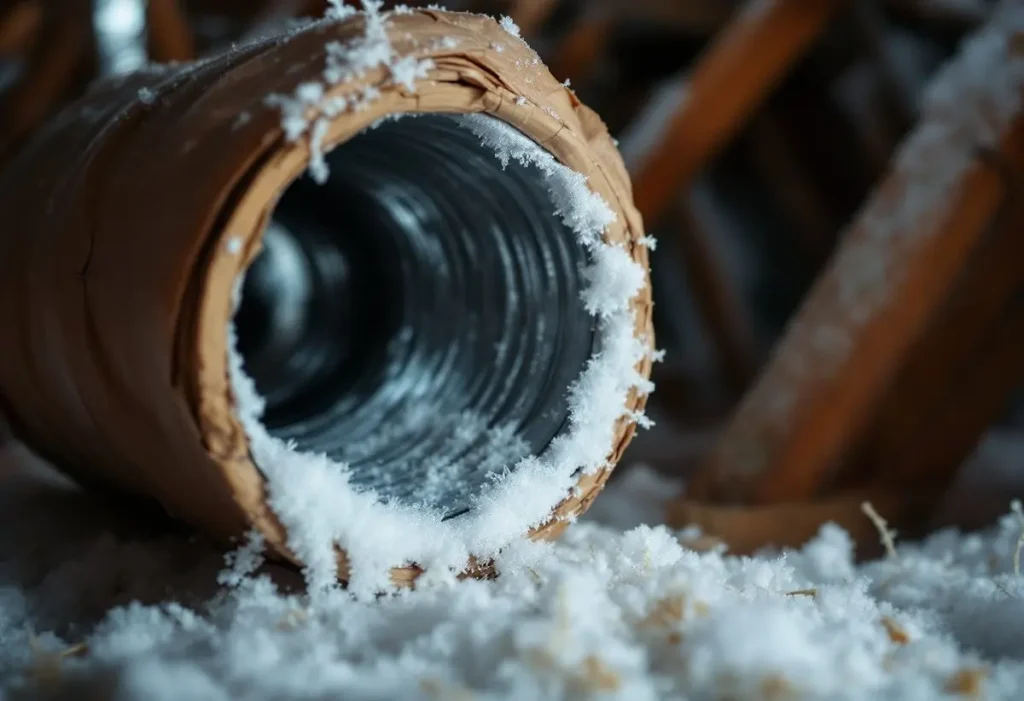
Why do unused AC ducts in the attic fill with water or frost by January?
Because nothing warms them. NAIMA’s fact sheet AH107 says unused air conditioning ducts in unconditioned spaces “can become saturated with water” in the heating season, and “Insulation, by itself, will not keep unused duct temperatures elevated or stable.”
This is the classic case in a house with a boiler or baseboard heat plus a separate attic air handler for summer. Warm house air drifts up through the ceiling registers, gives up its water in the cold duct and, per NAIMA, forms “frost and ice.” Nothing shows until the ice melts, which is the drip from a ceiling register after a cold night; our ceiling vent drip guide separates it from a roof leak or a frozen furnace drain.
NAIMA’s fix is to seal “all duct openings, supplies and returns” for winter with tape or plastic sheeting. “Just closing register dampers will probably not be sufficient,” it says, and running the fan all winter “may even aggravate the problem.”
Is it the supply ducts or the return ducts that wet a winter attic?
Supply leaks are the ones that move house moisture into a winter attic. EPA’s 2013 Moisture Control Guidance says that during cold weather, leaking supply connections under positive pressure “can force warm, humid indoor air into cold cavities where it can condense and support mold growth and corrode structural fasteners.”
A leaky attic return runs under suction and pulls cold, dry attic air in, which costs heat but rarely wets the duct. Water near a return usually means house air leaking up around an unsealed boot; PNNL’s code brief lists “Condensation formation around the HVAC supply and return register boots” as a result. EPA also describes humidified indoor air forming frost on the roof deck “until a warm day when it melts and leaks back through the ceiling.” Sealing materials are on our duct repair page.
Why is a duct sweating in the basement, crawl space or garage in winter?
Heating ducts in a basement stay warm while they run, so winter basement sweating usually points to a duct carrying outdoor air. Bryant’s ERVBBSVA1100 manual requires insulated flexible duct on the fresh air inlet and exhaust outlet, and says the vapor barrier “must be taped very tight to prevent condensation problems.”
In a vented crawl space or unheated garage, a heating duct between cycles cools toward the space temperature like NAIMA’s attic duct. A duct between two heated floors stays near room temperature, so winter water there points to a cavity open to outdoors or a plumbing leak; see our ducts in floor joists page.
Will turning down the humidifier stop condensation on ductwork in winter?
It helps with a leaking or over-humidified house, but it will not dry a duct that has cooled toward outdoor temperature. Aprilaire’s owner’s manual for models 350 to 700M recommends indoor RH by outdoor temperature: 45% at +40°F, 35% at +20°F, 25% at 0°F and 15% at minus 20°F. At 70°F those settings give dew points of 47.7°F, 41.1°F, 32.6°F and 20.3°F, far above a duct near 0°F, which the second table shows needs about 6% RH to stay dry.
Aprilaire says window fogging or frost “is usually an indication of too much humidity.” If windows fog too, the house is too wet; our page on high humidity in the house in winter traces the sources. Water at duct seams beside a humidifier is usually the humidifier; Aprilaire says to turn the dial to Off if it will not shut off, and our whole-house humidifier troubleshooting covers the rest.
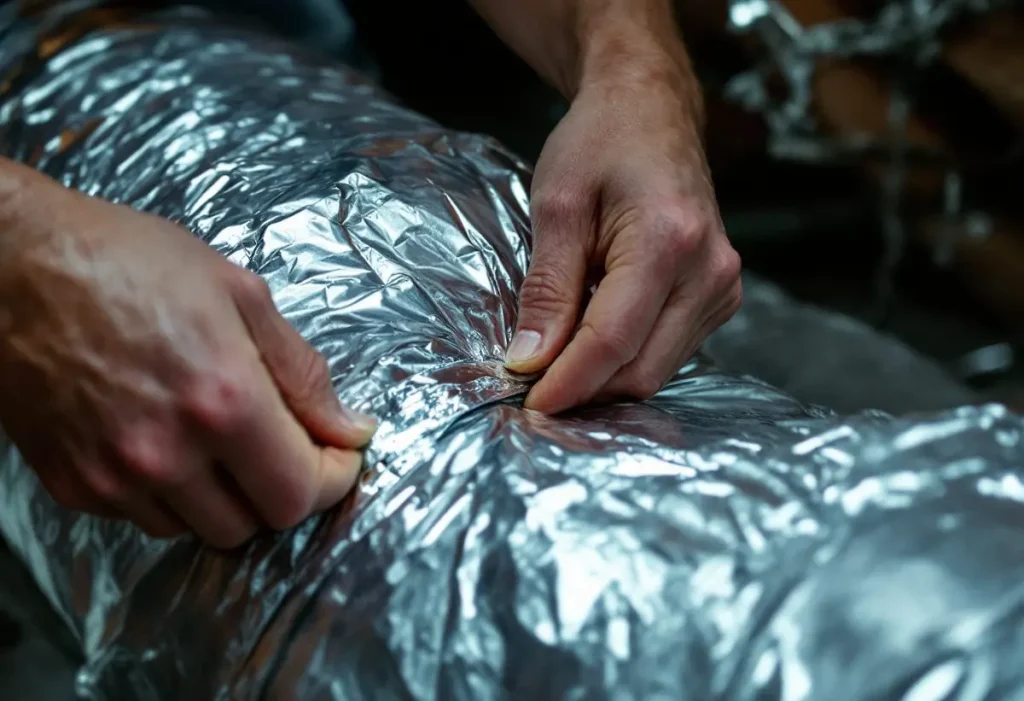
Which fix works: seal, insulate with a vapor retarder, or bring the ducts inside?
Seal first, then insulate, and move ducts indoors when the attic run keeps failing; only a duct inside conditioned space stays above a 44.6°F house dew point all winter.
Seal. IRC M1601.4.1 requires joints and seams to be sealed with mastics, gaskets or tapes, with tapes and mastics on metal and flex duct complying with UL 181B and marked “181 B-FX” or “181 BM.” PNNL notes the 2018 IECC/IRC require sealing both “supply and return” register boots.
Insulate with an intact jacket. IRC M1601.4.6 requires a vapor retarder of not more than 0.05 perm, or foil at least 2 mils thick, only on “cooling supply ducts that pass through unconditioned spaces conducive to condensation.” Code does not require it on a return or heat-only duct, but a torn jacket on any cold duct lets house air reach the metal, so tape every tear. PNNL quotes R-8 for attic ducts 3 inches and larger.
Bring the ducts inside. DOE says many efficient new homes “place the duct system within the conditioned space”; in an existing house that means a dropped soffit or encapsulated attic, a remodel more than a repair.
Where water sat, check for growth: NAIMA cites Duke University researchers who found fungal growth “can and does occur” on every duct surface once moisture is present, and our mold in air ducts page covers cleanup. Ask a technician for the wet-spot surface temperature, the indoor dew point and a duct leakage test result.
Frequently asked questions
Is condensation on ductwork normal in winter?
No. A duct carrying warm air stays above the house dew point, so winter water means a duct that is idle, leaking or carrying outdoor air. NAIMA’s AH107 fact sheet says unused ducts in unconditioned spaces can become saturated with water during the heating season.
Should I close the vents to attic AC ducts in winter?
Closing the louvers is not enough. NAIMA’s AH107 fact sheet says dampers are not airtight and let moist indoor air into the cold duct. It recommends removing the register or grille and taping the opening, or taping plastic over larger openings, on supplies and returns.
How do you stop condensation on ductwork permanently?
Keep house air off the cold surface or keep the surface warm. Seal joints and boots with UL 181 listed mastic or tape as IRC M1601.4.1 requires, tape the jacket at every tear, and move a failing attic run inside conditioned space, as DOE describes for efficient new homes.
Is condensation in ductwork bad for the HVAC system?
It harms the ducts and the building more than the furnace. EPA’s 2013 Moisture Control Guidance says warm indoor air condensing in cold cavities can support mold growth and corrode structural fasteners, and NAIMA cites research finding fungal growth on every duct surface type once moisture is present.
What causes condensation on ductwork in the garage in winter?
A duct in an unheated garage cools toward garage temperature between heating cycles, and house air inside it condenses once the metal drops below the indoor dew point, about 44.6°F for a 70°F house at 40% RH. NAIMA’s AH107 sheet notes insulation only slows that cooling, so seal joints first.
How we researched this
On November 21, 2026 we read NAIMA’s fact sheet AH107 (Insulation Facts #52, 1998), EPA’s Moisture Control Guidance for Building Design, Construction and Maintenance (EPA 402-F-13053, December 2013), the 2021 Seattle Residential Code Chapter 16 reprint of IRC M1601, the PNNL Building America code brief on register boots, DOE’s Energy Saver duct page (archived copy), the Bryant ERVBBSVA1100 manual, the Aprilaire 350 to 700M owner’s manual, and the NWS vapor pressure sheet. We ran the dew point arithmetic ourselves and show the formula. We excluded top-ranking contractor and maker blog posts because they cite nothing, and left summer sweating and R-values to our duct insulation page.
Sources
- North American Insulation Manufacturers Association (Insulation Institute). “Glass Fiber Air Transmission Systems: Preventing Moisture Accumulation in Ducts,” AH107. https://insulationinstitute.org/wp-content/uploads/2016/01/AH107.pdf. Accessed November 2026.
- U.S. Environmental Protection Agency. “Moisture Control Guidance for Building Design, Construction and Maintenance.” https://www.epa.gov/sites/default/files/2014-08/documents/moisture-control.pdf. Accessed November 2026.
- Seattle Department of Construction and Inspections. “2021 Seattle Residential Code, Chapter 16 Duct Systems.” https://www.seattle.gov/documents/Departments/SDCI/Codes/SeattleResidentialCode/2021SRCChapter16.pdf. Accessed November 2026.
- Pacific Northwest National Laboratory, Building America Solution Center. “Sealing Heating, Ventilating, and Air Conditioning Supply and Return Register Boots.” https://basc.pnnl.gov/code-compliance/sealing-heating-ventilating-and-air-conditioning-supply-and-return-register-boots. Accessed November 2026.
- U.S. Department of Energy. “Minimizing Energy Losses in Ducts” (archived copy). https://web.archive.org/web/2025id_/https://www.energy.gov/energysaver/minimizing-energy-losses-ducts. Accessed November 2026.
- Bryant. “ERVBBSVA1100 Energy/Heat Recovery Ventilator manual,” page 4 (ManualsOnline copy). https://audio.manualsonline.com/manuals/mfg/bryant/ervbbsva1100.html?p=4. Accessed November 2026.
- Aprilaire. “Humidifiers Owner’s Manual for Models 350, 360, 400, 400M, 500, 500M, 600, 600M, 700 and 700M” (retailer-hosted copy). https://cdn.shopify.com/s/files/1/0253/0852/8730/files/Owner_Guide_350-700M.pdf. Accessed November 2026.
- National Weather Service, El Paso. “Vapor Pressure.” https://www.weather.gov/media/epz/wxcalc/vaporPressure.pdf. Accessed November 2026.
Leave a Reply