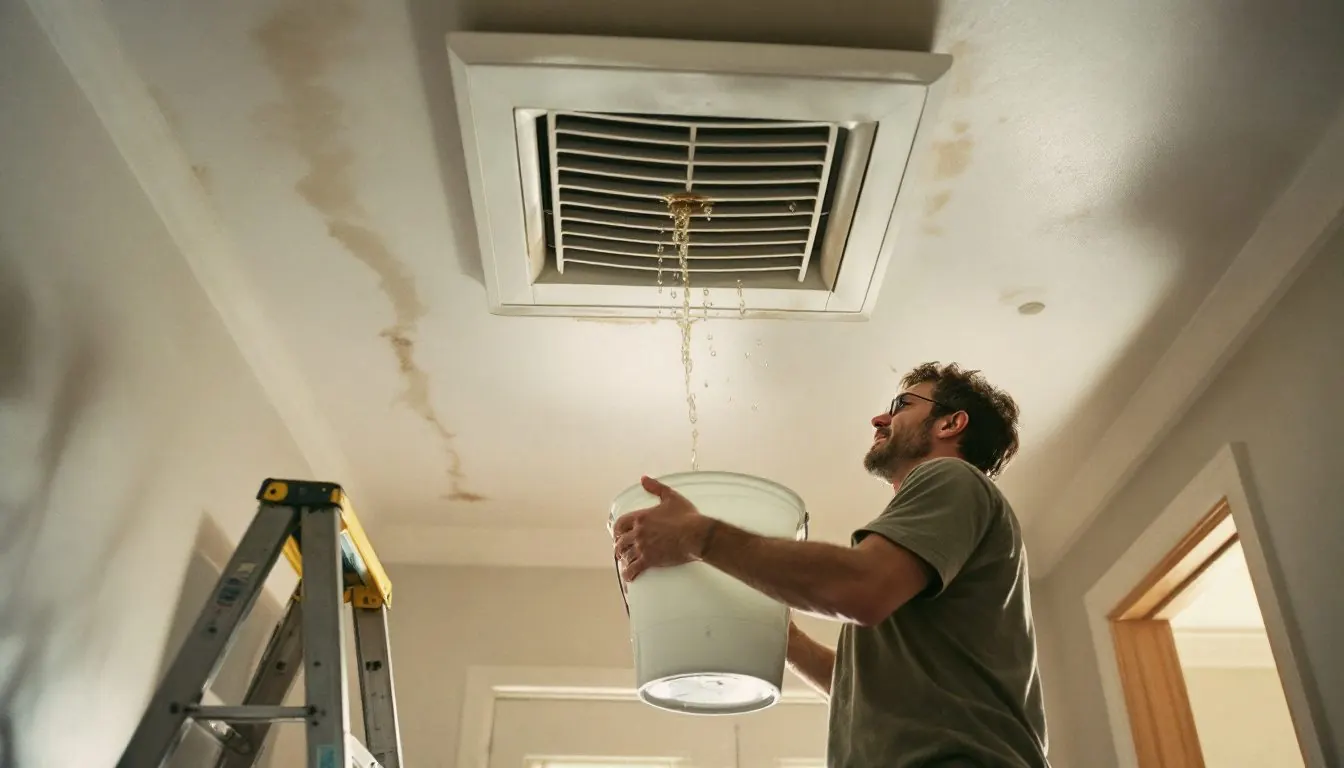
Water dripping from ceiling vent grilles in summer points to a 55°F surface sweating below the dew point or an attic drain pan overflowing. In winter it points to a condensing bath fan duct or melting attic frost. If it drips only in rain, suspect the roof. Turn the system off first.
Which row matches your dripping ceiling vent?
The EPA and DOE documents we read do not rank causes by frequency, so this table sorts by season and room instead.
| When and where | Likely source | Test | Next step |
|---|---|---|---|
| Summer, AC on, beads on the register blades | Blades colder than the room’s dew point | Read temperature and RH; do the math below | Lower indoor RH; check airflow |
| Summer, AC on, wet ring around the register | Attic air at a cold, unsealed boot | Pull the grille; look for a gap at the drywall | Seal and insulate the boot |
| Summer, steady drip, or AC shut itself off | Attic pan overflow, blocked drain | Check the pan and float switch | Clear the line; check the backup |
| Summer, starts after the AC quits cooling | Frozen coil thawing | Ice on the coil or large copper line | New filter; technician checks airflow and charge |
| Summer, bath supply register, after showers | Shower air on cold blades | Shower-free days stay dry | Run the exhaust fan; shut the door |
| Winter, bath fan grille | Exhaust condensing in a cold duct | Attic run bare, sagging or sloped to the fan | Insulate; slope away from fan; end outdoors |
| Winter, first thaw, several spots | Attic frost melting | Frost or wet patches under the roof deck | Air seal the ceiling; lower indoor RH |
| Winter, heat on, condensing furnace in the attic | Frozen trap or drain line | Ice or a split pipe at the trap | Technician adds freeze protection |
| During rain only | Roof opening or flashing | Dry days stay dry with the system on | Roofer |
| Any season, under a bath or laundry | Plumbing | Run each fixture above while watching | Plumber |
Compiled by The HVAC Brief from EPA, 2021 IRC, DOE, Carrier/Bryant, Lennox and NuTone documents.
What should you do in the first 10 minutes?
Stop the water and protect the ceiling first. EPA says to dry wet areas within 24-48 hours to prevent mold growth.
- Set the thermostat to Off and the fan to Auto.
- If water touches a light, fan or wiring, turn that circuit off at the breaker and stay off the wet floor.
- Catch the drip and stay out from under any sagging ceiling.
- Note which grille, the weather, any recent shower, and whether the AC was running.
Why is there water dripping from the ceiling vent in summer with the AC working?
A working AC makes surfaces near 55°F, and anything colder than the dew point of the air touching it collects water. EPA’s moisture guidance says a duct carrying 55°F air “will have a surface temperature near 55°F,” and humid air can condense on it “and possibly on the supply air diffuser.”
Worked example with the National Weather Service vapor pressure formula, at 75°F and 60% RH: 23.89°C gives saturation pressure of 6.11 × 10^(7.5 × 23.89 ÷ 261.19) = 29.6 hPa. Times 0.60 is 17.8 hPa. Inverted, the dew point is 60.2°F, which is 5.2°F above a 55°F blade.
Run it backward: at 75°F a 55°F blade reaches the dew point at 49.8% RH, the top of EPA’s ideal 30 to 50 percent band. At 72°F the line is 55.1% RH; at 78°F it is 45.1%. Grille frames run warmer than blades in the jet, so read these as worst cases. Our indoor humidity guide covers holding the number down.
Attic air can be wetter still. Rudd and Lstiburek (ASHRAE Transactions, 1998) call it “not uncommon” in much of Florida to find a 75°F outdoor dew point and an 85°F attic dew point, worst in the daytime when long run times keep ducts cold. DOE’s register boot brief lists condensation and water damage at poorly sealed boots, and says they “shall be sealed” to the ceiling.
Does an insulated attic duct really sweat, or is the jacket damaged?
By our arithmetic, an intact jacket in open attic air stays above the dew point until attic air falls close to it, while bare metal stays below a 75°F dew point in every case. So wet insulation over an R-8 duct means look for a tear, a crushed section or a bare collar before buying new insulation.
| Attic air | Bare metal | R-4.2 jacket | R-8 jacket |
|---|---|---|---|
| 120°F | 68.0°F | 111.2°F | 115.0°F |
| 85°F | 61.0°F | 81.0°F | 82.7°F |
| 78°F | 59.6°F | 74.9°F | 76.2°F |
HVAC Brief calculation: surface temperature with 55°F air inside, steady state. Ts = Ta minus (Ta minus 55) × 0.68 ÷ (0.85 + jacket R). Films from Seattle 2015 Energy Code A101.3; 55°F, 120°F and R-4.2 from NREL/SR-5500-55876; other attic temperatures illustrative. EPA rounds bare ducts to “near 55°F.”
Rudd and Lstiburek warn the jacket must be “properly installed to avoid insulation compression.” Burial also changes the result: NREL’s Building America report cites lab testing that ducts “cannot safely be fully buried in insulation when design dew point temperatures approach 80°F.” R-values by location are on our duct insulation page.
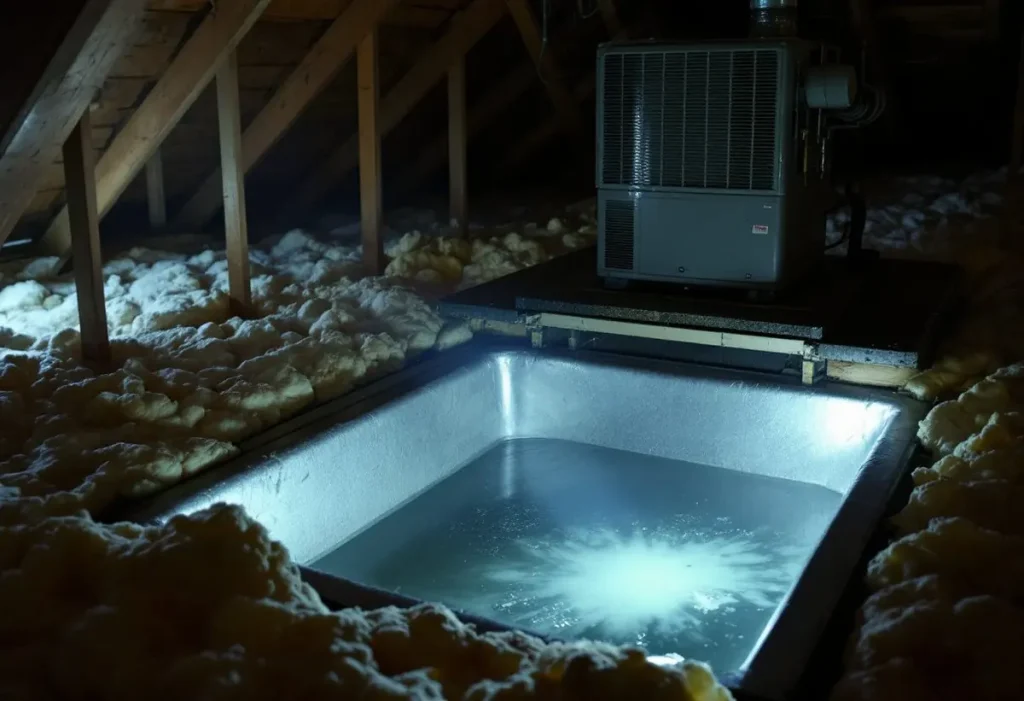
Is the attic drain pan overflowing, and what should the code backup have done?
If the AC shut itself off, or a pipe over a window is running, the pan is the likely source. IRC M1411.3.1, as printed in the 2021 Seattle code, requires a backup where overflow would cause damage and allows four: an auxiliary pan with its own drain, an overflow line, an auxiliary pan with a UL 508 shutoff, or a UL 508 shutoff alone. Your local inspector decides what applies.
Two of those discharge “to a conspicuous point of disposal” and two kill the system. So an AC that stopped with a full pan means a device worked, and the next job is clearing the clogged drain line. An AC still running with water at the ceiling means the backup is missing, failed or bypassed, or the pan (1.5 inches deep minimum) has rusted through.
A frozen coil can do the same: Lennox says a dirty filter can ice the coil and the melt “drips into areas it shouldn’t.” Our frozen AC guide separates the causes, and AC leaking water covers the indoor unit.
Why is water dripping from the ceiling vent in winter with the AC off?
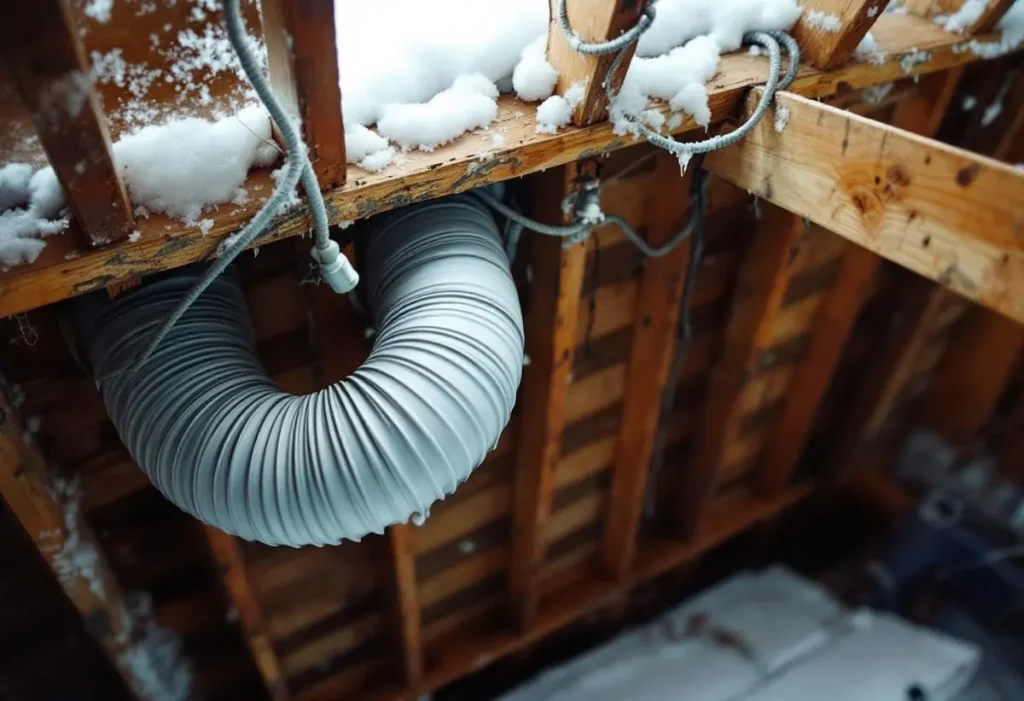
With no cold coil running, look at frost or a frozen drain. EPA describes humid air leaking into a freezing attic and forming frost on the roof deck “until a warm day when it melts and leaks back through the ceiling,” and warns it “may be mistaken for rainwater or plumbing leaks.”
A Carrier/Bryant kit manual warns that freezing in a condensing furnace trap and drain line “may cause cracks, and possible water damage,” and specifies 3 to 6 watt per ft. heat tape where protection is needed. It also warns that an unprimed trap can admit carbon monoxide, so trap repairs are a stop line for owners.
Why is the ceiling vent dripping in the bathroom?
A bath fan that drips in cold weather has condensation in its duct: EPA recommends insulating those ducts in cold climates because the exhaust dew point is “likely to be above” attic temperatures. DOE’s Building America guide says to let the duct “slope down and away from the housing,” and NuTone’s guide names duct wrap of R-5 or above. IRC M1501.1 bars exhausting “into an attic, soffit, ridge vent or crawl space”; Chapter 15 itself (Seattle printing) sets no slope or insulation rule, so a duct can satisfy it and still drip. Sizing is on our bathroom exhaust fan page.
A supply register that drips after summer showers has shower air on cold blades. At an assumed 78°F and 90% RH the dew point is 74.8°F, almost 20°F above a 55°F blade, so no AC setting fixes it. Run the exhaust fan and shut the door.
Does the ceiling vent only drip when it rains?
A drip that follows rain and ignores the thermostat is a roof problem, not HVAC. IRC R903.2.1 (Seattle printing) requires flashing “around roof openings,” and bath fan caps and plumbing vents are roof openings.
What should a technician measure before charging for a repair?
Ask for three readings, because “condensation” is a symptom and not a diagnosis. Refrigerant work, gas furnace traps and line voltage stay with the licensed technician.
- Dew point against surface temperature at the wet spot.
- Drain slope against M1411.3 (1/8 unit vertical in 12 horizontal, 3/4-inch pipe) and which backup exists.
- Supply temperature and airflow, read against our temperature split guide.
Frequently asked questions
Is water dripping from a ceiling vent an emergency?
Treat it as urgent if water reaches a light or wiring, the ceiling sags, or the drip is steady: shut off the system and that circuit. A slow bead is less urgent, but EPA still wants wet areas dried within 24-48 hours.
Will insulating the duct stop water dripping from the ceiling vent?
Only if a bare, torn or crushed section is the source. By our calculation an intact R-8 jacket reads 115.0°F in a 120°F attic, far above the 85°F attic dew point Rudd and Lstiburek report in Florida. Insulation also cannot help a clogged drain, attic frost or a roof leak.
Why does my ceiling vent drip only at night?
Attic air cools toward its dew point after dark: in a 78°F attic our math puts an R-4.2 jacket at 74.9°F, just under a 75°F dew point. Rudd and Lstiburek (1998) also describe night condensation on metal roofing and radiant barriers, which can wet ceiling materials below.
How we researched this
In November 2026 we read the documents below and six top search results. Contractor pages were excluded as sources because they publish unsourced numbers. Seattle’s code carries local amendments; your edition may differ.
Sources
- U.S. EPA. “Moisture Control Guidance.” https://www.epa.gov/sites/default/files/2014-08/documents/moisture-control.pdf. Accessed November 2026.
- U.S. EPA. “A Brief Guide to Mold, Moisture and Your Home.” https://www.epa.gov/mold/brief-guide-mold-moisture-and-your-home. Accessed November 2026.
- Rudd and Lstiburek. “Vented and Sealed Attics In Hot Climates,” ASHRAE Transactions 1998. https://www.aivc.org/sites/default/files/airbase_11885.pdf. Accessed November 2026.
- NREL. “Buried and Encapsulated Ducts in Hot-Humid Climates (SR-5500-55876).” https://www.osti.gov/servlets/purl/1067903. Accessed November 2026.
- DOE Building America. “Sealing Supply and Return Register Boots.” https://basc.pnnl.gov/code-compliance/sealing-heating-ventilating-and-air-conditioning-supply-and-return-register-boots. Accessed November 2026.
- DOE Building America. “Bathroom Exhaust Fans.” https://basc.pnnl.gov/resource-guides/bathroom-exhaust-fans. Accessed November 2026.
- City of Seattle. “2021 Residential Code, Chapter 14.” https://www.seattle.gov/documents/Departments/SDCI/Codes/SeattleResidentialCode/2021SRCChapter14.pdf. Accessed November 2026.
- City of Seattle. “2021 Residential Code, Chapter 15.” https://www.seattle.gov/documents/Departments/SDCI/Codes/SeattleResidentialCode/2021SRCChapter15.pdf. Accessed November 2026.
- City of Seattle. “2021 Residential Code, Chapter 9.” https://www.seattle.gov/documents/Departments/SDCI/Codes/SeattleResidentialCode/2021SRCChapter9.pdf. Accessed November 2026.
- City of Seattle. “2015 Energy Code, Appendix A.” https://seattle.gov/documents/departments/sdci/codes/seattleenergycode/2015secappendixa.pdf. Accessed November 2026.
- National Weather Service, El Paso. “Vapor Pressure.” https://www.weather.gov/media/epz/wxcalc/vaporPressure.pdf. Accessed November 2026.
- Carrier/Bryant. “External Trap Kit KGAET0101ETK Instructions.” https://www.shareddocs.com/hvac/docs/1009/Public/09/AG-GAET-02.pdf. Accessed November 2026.
- NuTone. “Ventilation Fans Installation Guide.” https://cellphone.manualsonline.com/manuals/mfg/nutone/qtxn.html?p=6. Accessed November 2026.
- Lennox. “Why Is Water Dripping from My AC Vent?” https://www.lennox.com/residential/lennox-life/consumer/water-dripping-from-ac-vent. Accessed November 2026.
Leave a Reply