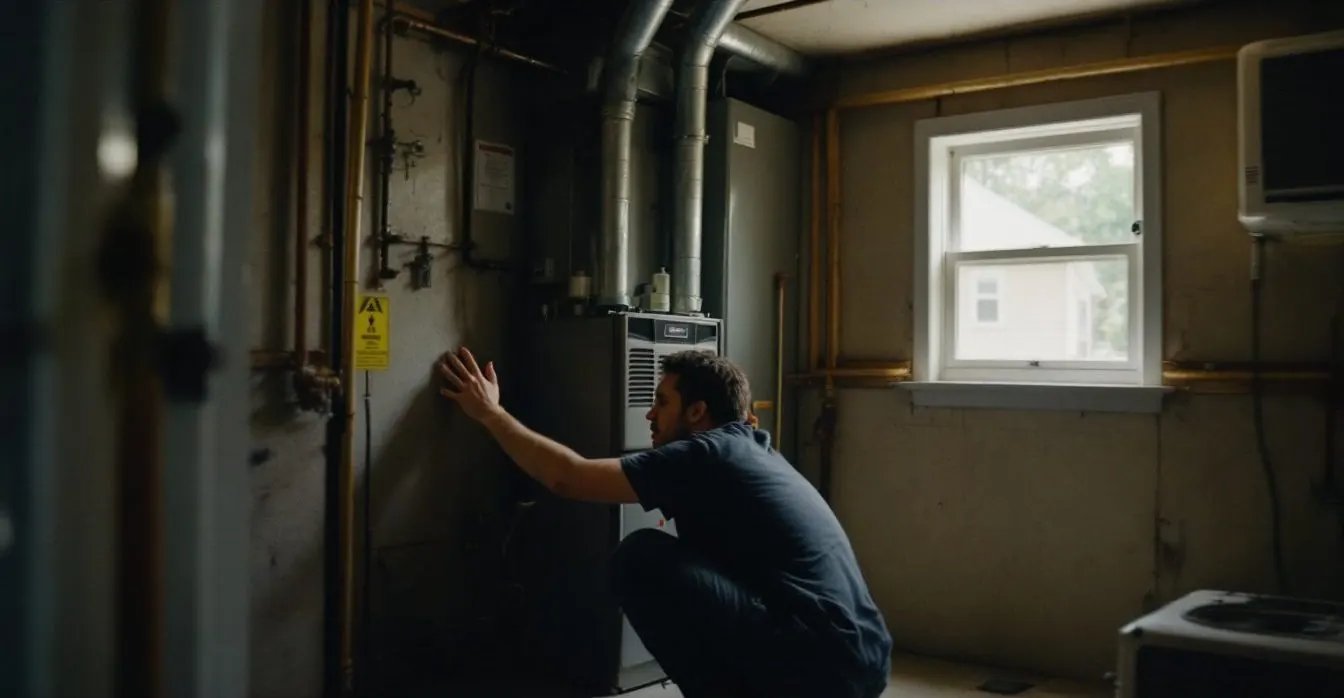
Outside AC unit running but inside fan not moving? Set the thermostat to OFF now, because a coil with no airflow ices over. Then switch the fan to ON. No blower means the motor, capacitor, relay or G wire. Outside still running with the thermostat off means a welded contactor: open the disconnect.
Should you turn the AC off before testing anything?
Yes. Set the thermostat mode to OFF first, because the outdoor unit is still chilling the indoor coil and nothing is carrying that cold away. Goodman’s GRVT96 and GDVT96 service manual says most cooling systems work with airflow between 350 and 450 CFM per ton. HVAC Brief calculation: a 3 ton system at 400 CFM per ton needs 1,200 CFM, and a stopped blower delivers almost none of it.
The result is ice, then compressor risk. Rheem’s RGEA troubleshooting chart pairs an iced evaporator coil and cool compressor with “Low evaporator airflow”. Copeland’s AE4-1395 bulletin for 3 to 15 ton digital scroll compressors says suction superheat “must remain positive”, and a coil with no air across it cannot finish boiling its liquid. The fan-on thaw in why an AC freezes up is not an option here, so leave mode and fan off.
If the outdoor unit keeps running at mode OFF, open the outdoor disconnect or the breaker. That is a stuck contactor, and our HVAC contactor guide explains why its terminals stay live.
What does the thermostat FAN ON test say about your blower?
It sorts the fault without opening a panel: mode OFF, fan ON, then listen at the furnace or air handler. One false alarm: Carrier’s FV4C fan coil offers a selectable “30 sec on delay with no airflow” in cooling, so a blower that starts half a minute after the outdoor unit may be working as set.
| What you see | Most likely fault | Reading that confirms it |
|---|---|---|
| FAN ON runs the blower, a cool call does not | Cooling speed relay, tap wire or winding | Line voltage at the cooling tap with Y and G energized |
| FAN ON: hum, no spin | Open run capacitor, seized motor or jammed wheel | Capacitor MFD against its label; shaft turns freely with power off |
| FAN ON silent, heat call starts the blower | G wire, thermostat fan output or fan relay | 24 VAC from G to C with fan on |
| Silent on FAN ON and on a heat call | Motor, ECM module or board output | Line voltage at the motor with G called; Goodman’s spec: 115 volts ± 10 percent |
| Blower runs, little air at the registers | Iced coil, loose wheel or disconnected duct | Coil inspection; wheel set screw at 165 in-lbs |
Compiled by The HVAC Brief from Goodman RS6612305, Rheem RGEA and Carrier 58DXT. Readings are technician work on live circuits.
The heat call works on a gas furnace because W is a separate input from G. In Goodman’s sequence, a 15-second prepurge runs, the burners light, and the blower follows after a fan-on delay that defaults to 30 seconds. If the blower has not started about a minute after the burners light (our margin on that default), end the call: the limit controls guard against overheating from “insufficient conditioned air”. Skip this step on a heat pump, because a heat call restarts the outdoor compressor.
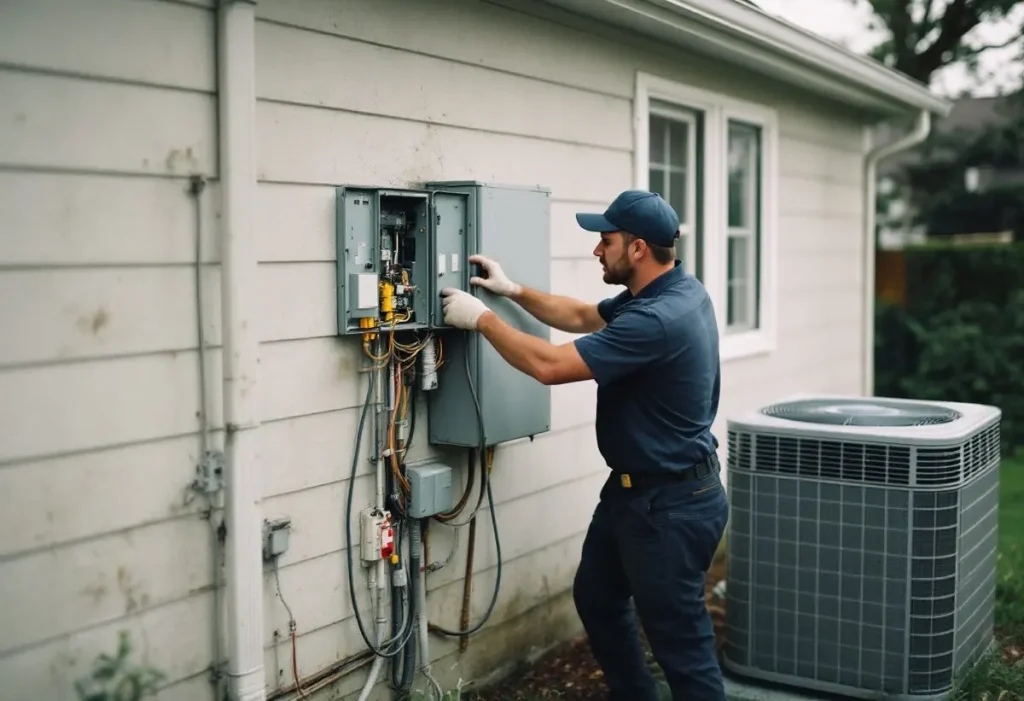
Why can the outside unit run while the inside fan is dead?
Because the two take separate orders on separate wires. Carrier’s 58DXT manual describes a cooling call as the thermostat closing “R to G-and-Y circuits.” Y pulls in the contactor feeding the outdoor unit from its own double pole 240 volt breaker, while G tells the indoor board to run the blower; Rheem’s legend labels G as FAN ONLY. Break anything on the G side alone and the outdoor unit carries on.
Both orders come from one indoor transformer: 120 volt primary to 24 volt secondary, 40 VA in Goodman’s furnace.
Can a tripped furnace breaker, door switch or float switch cause this?
Usually not, and several top-ranking guides get this wrong. Goodman says a missing 24 VAC at R and C indicates a faulty transformer, open fuse, bad wiring or “open door interlock switch.” On a furnace wired that way, those faults also drop the Y wire, the contactor opens and the outdoor unit stops. A running outdoor unit therefore suggests 24 V is alive indoors.
Look at the furnace breaker anyway. If it is off and the outdoor unit is still running, you have the one combination that fits: a welded contactor, so open the disconnect. One exception: Goodman describes an outdoor transformer “providing 24VAC to the outdoor control” on 2 stage equipment, so those systems need the diagram. A welded contactor is also one of the two usual reasons an AC will not turn off at the outside unit.
The float switch fails the same test. RectorSeal’s Safe-T-Switch data sheet says the red circuit position “shuts down entire unit” and in the yellow circuit the “fan continues to run”. Neither gives blower off with outdoor unit on, so a clogged drain line is not your suspect today.
| Fault | 24 V at thermostat? | Outside unit | Inside blower | Fits your symptom? |
|---|---|---|---|---|
| Furnace breaker off, door switch open, or control fuse open (3 amp on Rheem RGEA, 5-amp on Carrier FV4C) | No | Stops | Stops | No, unless the contactor is welded |
| Float switch wired in the red wire | No | Stops | Stops | No |
| Float switch wired in the yellow wire | Yes | Stops | Runs | No, the reverse symptom |
| G wire open or moved, or fan relay failed | Yes | Runs | Dead on fan and cool | Yes |
| PSC capacitor or motor, or ECM motor or module, failed | Yes | Runs | Hums or dead | Yes |
| Contactor welded closed | Either | Runs, even at mode OFF | Follows the indoor fault | Yes, and urgent |
Compiled by The HVAC Brief from Goodman RS6612305, RectorSeal R50109-0724, Rheem RGEA and Carrier FV4C. Outcomes are our reading for a split system with the transformer indoors; your unit’s diagram governs.
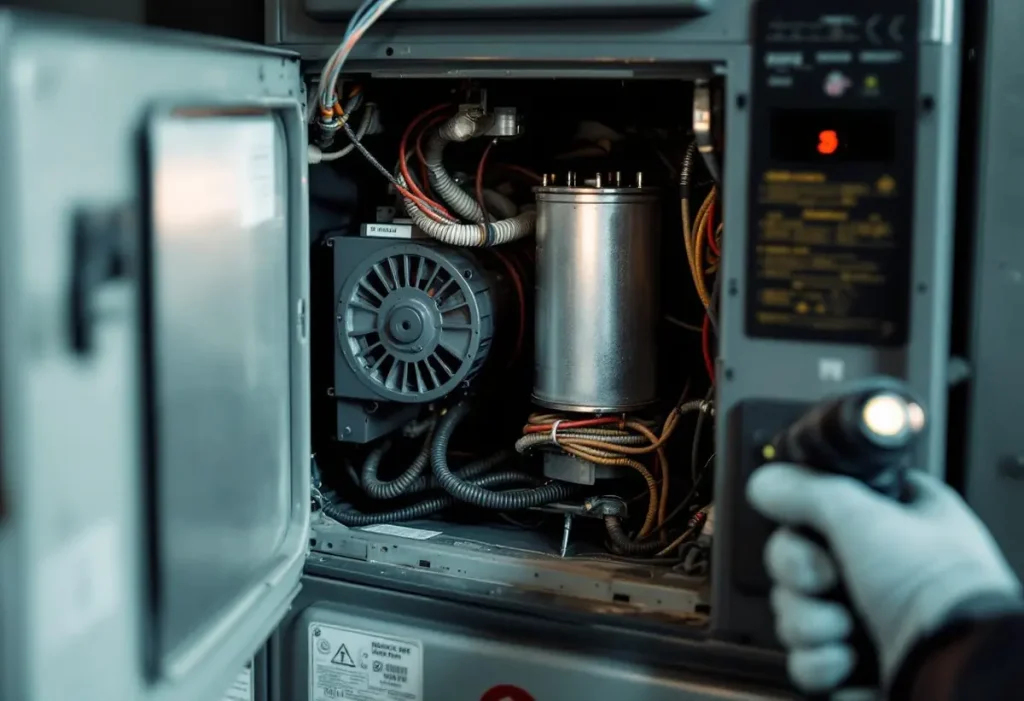
Does a PSC, X-13 or ECM blower change what fails?
Yes, because only the PSC depends on an external run capacitor. The TRADEPRO motor guide says “Capacitor value should match value on replacement motor label”, and the spread is wide: one PEMS listing shows 5 MFD, 370V at 1/4 HP and 1.9 / 1.1 / 0.9 Amps by speed at 208 to 230 V, another shows 15 MFD, 370V at 3/4 HP and 10.2 / 7.3 / 4.5 Amps at 115 V. Both pages also show conflicting amp figures, so use them for scale and trust the nameplate.
Reading a capacitor is the stop line for an owner, because it holds a charge; our HVAC capacitor explainer covers the label. On an X-13 motor, Rheem says “Numbered terminals are 24V blower taps”, so hunting for line voltage on a tap misleads.
On a variable speed ECM, Goodman says the control is “powered continuously”, so line voltage at a stopped motor proves little, and warns to “Wait 5 minutes” after power-off before opening it. Our blower motor guide covers telling the types apart.
Is it the control board or the blower motor: which reading decides?
The board is at fault only when it receives the 24 V command and fails to pass it on. These are live tests for a technician, adapted from the Goodman manual:
- R to C “Must read 24 VAC”. If not, go back to the transformer, fuse and door switch.
- G to C with the fan called should also read 24 VAC. If not, suspect the thermostat or wire.
- With the thermostat wires off, jumper R to G (Goodman’s cooling check adds Y). If the blower starts, the manual places the trouble “in the thermostat or wiring”.
- If G is present and nothing moves, no line voltage at a PSC tap points to the control board; line voltage with a stopped motor points to the capacitor or motor.
- On Goodman’s 4-wire ECM, control harness pins 1 and 4 should read between 3 and 15 VDC. If not, check the board.
Did the blower quit right after a smart thermostat install?
Then check the G wire first. Copeland’s Sensi support page says “In some cases, you can use a G wire or fan wire as your C wire.” Without another way to command the fan, that conversion removes the G signal, so FAN ON goes silent while Y still starts the outdoor unit. Compare your old wiring photo with our thermostat wiring color guide. If neither unit runs, see thermostat says cool on but AC not running.
What if it is reversed: inside fan running but outside unit not?
That is a different fault tree, and what most results for this query answer. A running blower proves G and 24 V are alive, so attention moves to the Y wire, a float switch in yellow, outdoor power and the contactor. Start with AC not turning on.
Frequently asked questions
Why is the outside AC unit running but no air coming out of the vents?
Listen at the furnace or air handler first. A silent cabinet means the blower stopped, so use the FAN ON test. A running motor with weak airflow points to an iced coil, a disconnected duct or a loose wheel: Goodman has the set screw on the shaft flat at 165 in-lbs minimum.
Why does the outside unit keep running with the thermostat off?
The contactor is stuck. The Comfort Alert chart in Rheem’s RGEA manual gives Flash Code 8 as Compressor always runs, with the compressor contactor failed closed as the first cause. Thermostat settings cannot stop it, so open the outdoor disconnect or breaker and book a technician.
How do I thaw the coil if the inside fan will not run?
Leave mode and fan OFF and let the coil melt on its own. The usual thaw needs the blower you lost, so it works only after the repair. Do not chip the ice. Before restarting, confirm roughly 400 CFM per ton of airflow.
How we researched this
On 5 November 2026 we read Goodman RS6612305, the Rheem RGEA instructions, Carrier FV4C and 58DXT (manualslib copy), RectorSeal R50109-0724, Copeland AE4-1395 (manualsonline copy), the Sensi support page, the TRADEPRO guide and two PEMS listings. We excluded figures from the contractor and content sites ranking for this query. We could not obtain a Goodman PSC furnace manual, so PSC numbers rest on retail listings. Tables and diagrams are our own reading of these documents; we did no hands-on testing.
Sources
- Goodman. “Service and Troubleshooting GRVT96/GDVT96, RS6612305.” https://hf-files-oregon.s3.amazonaws.com/hdpjswmi_kb_attachments/2026/02-03/49affee0-d6f9-48c3-bf5b-09ceb574fa72/Goodman_GRVT96_GDVT96_Troubleshooting_and_Service_Manual_RS6612305.pdf. Accessed November 2026.
- Rheem. “Installation Instructions RGEA13, RGEA14, RGEA15.” https://resource.gemaire.com/is/content/Watscocom/Gemaire/rheem_rgea13_ii.pdf?fmt=pdf. Accessed November 2026.
- Carrier. “58DXT Sequence of Operation (manualslib copy).” https://www.manualslib.com/manual/857468/Carrier-58dxt.html?page=14. Accessed November 2026.
- Carrier. “FV4C Installation Instructions.” https://refripartes.com/uploads/FV4C%20Installation%20Manual.pdf. Accessed November 2026.
- RectorSeal. “Safe-T-Switch SS1 Data Sheet, R50109-0724.” https://pdf.lowes.com/productdocuments/272cd199-7801-4897-950b-732afaecb5d4/70441877.pdf. Accessed November 2026.
- Emerson Copeland. “Bulletin AE4-1395 (manualsonline copy).” https://kitchen.manualsonline.com/manuals/mfg/emerson/ae41395_1.html?p=7. Accessed November 2026.
- Copeland Sensi. “What is a common wire?” https://sensi.copeland.com/en-us/support/what-is-a-common-wire. Accessed November 2026.
- TRADEPRO. “Fractional Horsepower Motors brochure.” https://resource.ecmdi.com/is/content/Watscocom/Gemaire/tradepro_tp-c16-1sp2_article_1418039134043_en_ss.pdf. Accessed November 2026.
- Electric Motor Warehouse. “PEMS 1/4 HP Blower Motor listing.” https://electricmotorwarehouse.com/hvac-furnace-blower-motor-replacement-1-4-hp-1075-rpm-3-speed/. Accessed November 2026.
- Electric Motor Warehouse. “PEMS 3/4 HP Blower Motor listing.” https://electricmotorwarehouse.com/furnace-blower-motor-3-4-hp-1075-rpm-115v-3-speed/. Accessed November 2026.
Leave a Reply