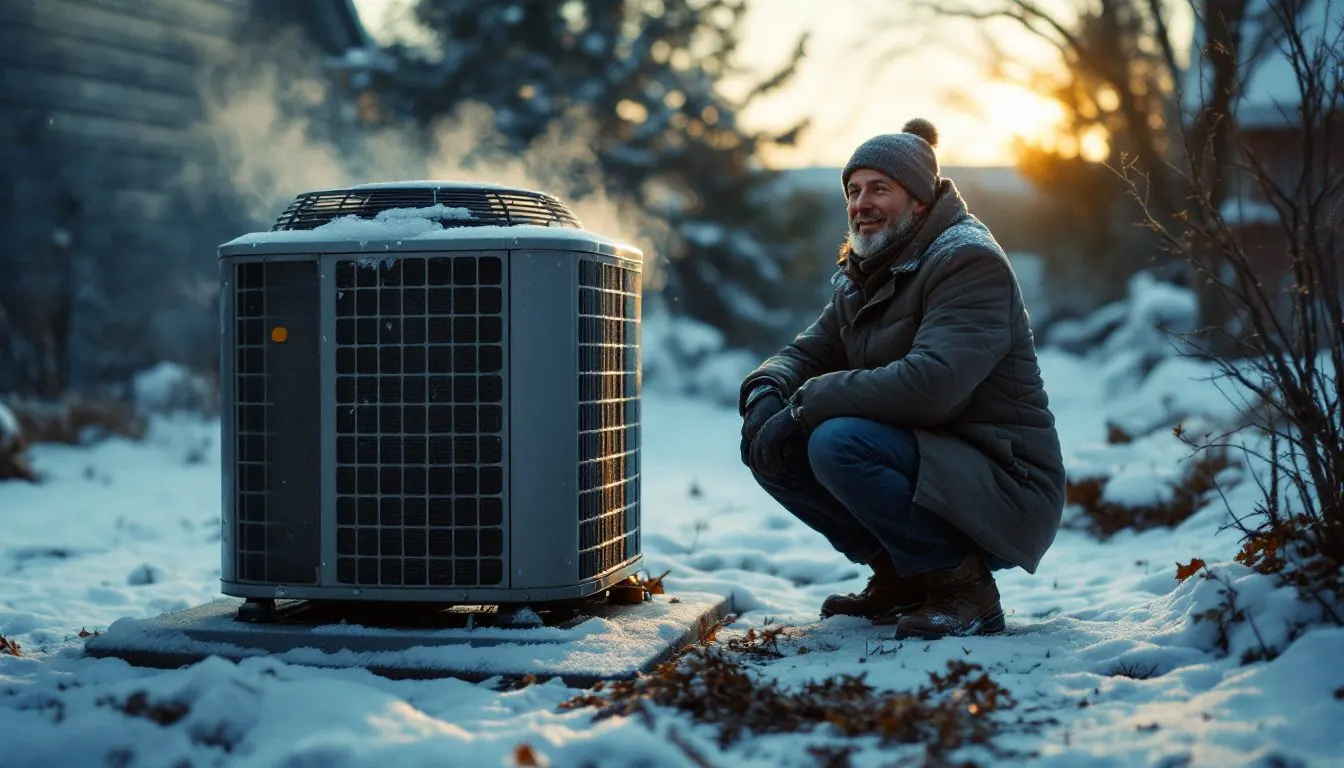
Ice on an outside AC unit is normal in one case: a heat pump heating in cold, damp weather, where thin frost melts in each defrost cycle, every 30 to 90 minutes per Lennox. Thick ice that survives defrost, or ice on a cooling-only AC’s lines in summer, is a fault: blocked airflow, low refrigerant or failed defrost.
Where is the ice on the outside unit, and what does each spot mean?
Read the location first, then the mode: the same crust means routine defrost on a heat pump in January and a frozen indoor coil on an AC in July.
| Where the ice is | System and season | What it usually means | What you can do | What the technician checks |
|---|---|---|---|---|
| Thin, even frost on the coil fins | Heat pump heating, cold damp weather | Normal; Rheem: “This is normal” | Nothing; steam in defrost is expected | Nothing, unless it stops clearing |
| Thick ice that survives several defrosts | Heat pump, winter | Defrost board or sensor fault, low charge, restricted airflow | Emergency heat or off; change a dirty filter | Forced defrost test; reversing valve shift; coil sensor |
| Ice band on the lower coil and base pan | Heat pump, winter | Defrost meltwater refreezing on the cold frame | Clear snow from the base; stop gutter drip | Unit height against the Goodman table; base cutouts open |
| Ice on the top grille or fan blades | Either system, winter | Roof drip or freezing rain | Divert the gutter; never chip it | Fan turns freely after the thaw |
| Frost on the larger insulated line and service valve | AC or heat pump cooling, summer | Frozen indoor coil: filter, stopped blower or low charge | Cooling off, fan on | Suction pressure (R-410A below about 101.6 psig is below freezing), superheat, leak search |
| Ice on the coil of a cooling-only AC | Cooling below 55°F | Outside its rated range (Carrier, Goodman) | Turn cooling off | Thermostat or stuck contactor; low ambient kit |
| Whole cabinet iced while running | Either system | No defrost or no airflow | Turn it off at the thermostat | Defrost control, fan motor, charge |
Is it a heat pump or a cooling-only AC, and why does that decide the answer?
Only a heat pump runs its outdoor coil below freezing on purpose. If the outdoor unit runs while the house is heating, it is a heat pump, and per the DOE Building America report its coil runs colder than the air, so condensate “turns to ice on the coil.” A cooling-only AC has no defrost control, so ice on it while it runs is a fault. The heat pump vs air conditioner difference is one reversing valve.
When does frost on a heat pump in winter turn into a defrost failure?
When ice survives cycle after cycle. Rheem’s 13 SEER heat pump instructions (708163b) call a coating of snow and ice on the coil normal; that board’s sensor closes at 32°F and opens at 68°F, and a defrost ends after 10 minutes at most. Carrier’s 25HNB6 board defrosts only below 50°F outdoors and stops at 65°F. The full sequence is in our heat pump defrost cycle explainer.
Lennox’s warning signs are thick ice on coil and cabinet, ice stopping the fan, ice on one side only, and a defrost that “never kicks in after running for several hours” (Lennox, 2026). In a 2013 DOE Building America test in Madison, Connecticut (Johnson, CARB), meltwater refroze on the cold steel frame until ice blocked much of the coil, and the report cites a Canadian install where ice “crushed and cracked a copper tube in the outdoor coil.”
The technician forces a defrost: a jumper across the Carrier 25HNB6 forced defrost pins for 5 seconds, or across T2 and DFT on the Rheem board. If the reversing valve shifts and the coil warms, the fault is drainage, charge or sensor contact. Ice can also lock the fan blade itself, a cause covered in heat pump outdoor fan not running along with the capacitor and the defrost board relay. If nothing starts, Rheem’s manual 7083670 says to “replace the defrost board.”
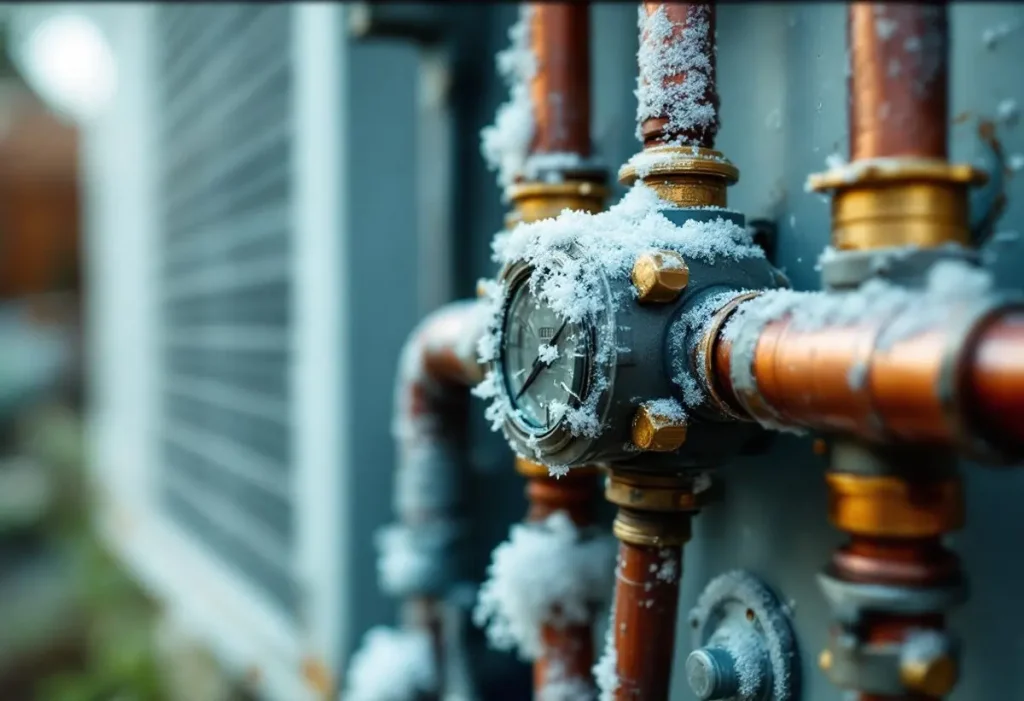
Why is there ice on the outside AC lines in July?
The indoor coil is freezing and the cold travels out the suction line; in cooling the outdoor coil is the hot side, so frost sits on the larger insulated line and its valve. The Bonneville Power Administration’s R-410A chart lists 100 psig at 31.2°F and 102 psig at 32.2°F; interpolating, we calculated that R-410A boils at 32°F at about 101.6 psig, so a steady suction reading below that means refrigerant evaporating below freezing.
Two faults push it there. Too little air: a clogged filter or an indoor blower that stopped while the compressor runs, the case in an outside unit running with the inside fan dead. Or too little refrigerant: Lennox’s leak guidance says condensation “can build up and freeze on the evaporator coils” when charge is short, and low charge means a leak to find through refrigerant leak detection.
On Rheem units with the Comfort Alert module, one yellow ALERT flash (long run time) lists low charge, a stopped evaporator blower and a frozen evaporator coil among its causes. After the thaw, superheat and subcooling readings separate an airflow fault from a charge fault; the fan-on thaw is in why an AC freezes up.
Why does a cooling-only AC ice up when it runs below 55°F?
It is outside its rated range. Carrier’s owner’s manual (OG-ACR410GEN-03) says the outdoor unit “is not designed to operate when outdoor temperatures are lower than 55°F/13°C without modification,” and Goodman’s IOG-4002A says it “requires the use of an approved low ambient kit.” Two top-ranking pages give 60°F with no source.
Night icing on a cooling-only AC usually means a thermostat left on Cool or a stuck contactor, both traced in an AC that won’t turn off. When the indoor coil is what ices on cool nights, an AC freezing up at night usually traces to how a fixed piston metering device handles low outdoor temperatures.
Can you pour hot water on a frozen outside unit or chip the ice off?
Never chip it, and use hot water only if your own manual allows it, because the maker documents disagree.
| Document | Hot water or hose | Chipping and tools | Thaw guidance |
|---|---|---|---|
| Lennox (2026) | “Never pour hot water on the unit” | Don’t “chip or break the ice” | 2 to 4 hours above freezing; call after 6 to 8 hours |
| Hallowell manual, per DOE (2013) | “pouring hot water over the coil” | Not stated | Repeated defrosts could not clear it |
| Rheem 708163b | Not addressed | “being careful not to damage the aluminum fins” | Normal frost clears in defrost |
| Carrier OG-ACR410GEN-03 | Not addressed | Warns of sharp edges inside | Ice under the unit “drained away from the unit” |
Lennox warns that “chipping ice, pouring hot water, or using high heat sources” may cause damage its warranty does not cover.
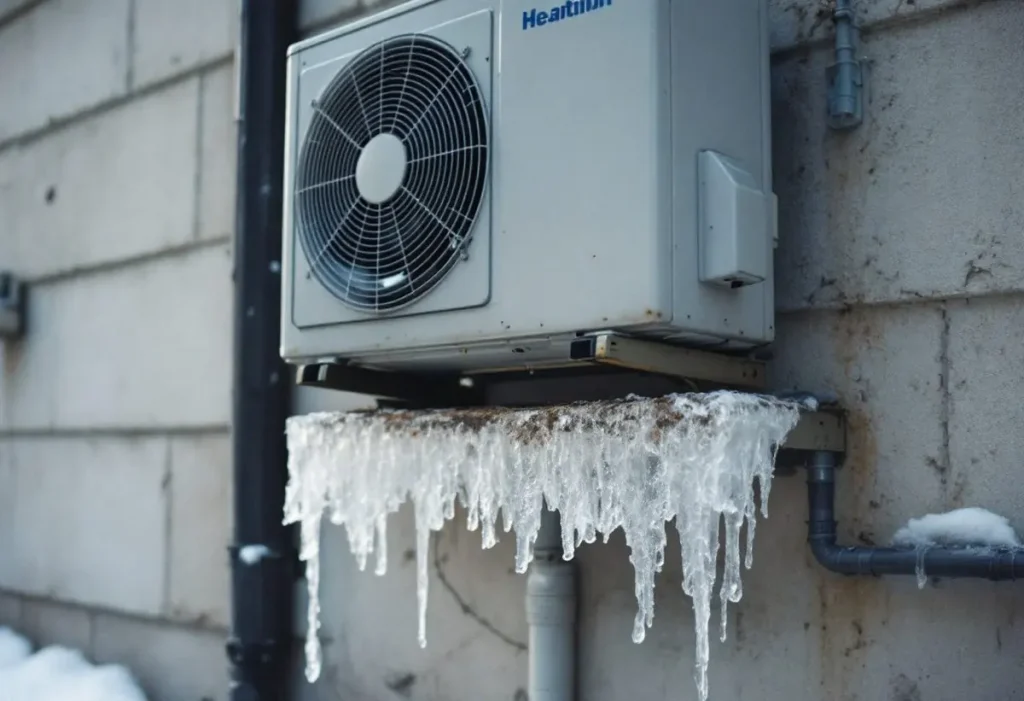
Why is water or ice collecting under the outside unit?
On a heat pump, every defrost makes water that has to leave. Goodman’s IOG-4002A says heat pump bases “have cutouts under the outdoor coil that permit drainage of frost accumulation” and suggests raising the unit where winters are colder:
| Winter design temperature | Minimum elevation |
|---|---|
| +15°F and above | 2 1/2 in. |
| -5°F to +14°F | 8 in. |
| Below -5°F | 12 in. |
The DOE unit’s legs, the report notes, “can be as much as 2 ft longer in snowier climates.” Lennox says gutters should not drain onto a heat pump and allows a top-only snow guard, never side covers, as our AC unit cover guide compares. Summer water by the unit is usually indoor coil condensate, which Carrier says “should trickle from the condensate drain of the indoor coil”; where that line may end is covered in whether HVAC condensate can drain outside.
What should you do in the next hour, and where does DIY stop?
For a heavily iced heat pump, Lennox says switch the thermostat off, clear at least two feet on all sides and replace a dirty filter; emergency heat keeps the house warm meanwhile. For an AC with frosted lines, set cooling off and the fan on until the indoor coil thaws.
Stop at the refrigerant circuit and line voltage. Under 40 CFR 82.154, refrigerant is sold only to certified technicians and no one servicing a system may knowingly vent it. If ice returns after a clean filter and a full thaw, ask the technician for the suction pressure, the superheat and the forced defrost result.
Frequently asked questions
Is it safe to run the AC with ice on the outside unit?
Not in cooling mode. Frost on the suction line means the indoor coil is frozen, and Lennox warns that ice on the coils “can lead to your system breaking down.” The exception is thin frost on a heat pump in heat mode, which Rheem’s 708163b manual calls normal.
How long does it take a frozen heat pump to thaw?
Lennox says natural thawing typically takes 2 to 4 hours above freezing, longer in colder weather, and emergency heat keeps the house warm meanwhile. If the ice has not melted within 6 to 8 hours, or it refreezes quickly, Lennox says to call a technician.
Can an AC unit that turns on outside but not inside freeze up?
Yes. With the indoor blower stopped, no warm air crosses the indoor coil, so it drops below freezing and frost spreads along the suction line. Rheem’s Comfort Alert table in manual 7083670 lists a stopped evaporator blower and a frozen evaporator coil under the same long run time code.
Why is my AC unit leaking water outside?
In summer it is usually indoor coil condensate from a drain line that ends outdoors. A heat pump in winter sheds defrost meltwater through cutouts in its base, per Goodman’s IOG-4002A. Water or ice pooling under the unit points to poor drainage, not a refrigerant leak.
How we researched this
On 6 November 2026 we read the ten documents listed below: five maker manuals, two Lennox homeowner pages, a DOE field report, the BPA chart and eCFR rule text. The 101.6 psig figure is our interpolation of two BPA rows. We excluded the four top-ranking articles and contractor blogs as sources because none cites a primary document.
Sources
- Rheem. “Outdoor Heat Pump User’s Information/Installation Instructions (708163b).” https://files.rheem.com/LiteratureArchive/708163b.pdf. Accessed November 2026.
- Rheem. “Outdoor Heat Pump User’s Information/Installation Instructions (7083670).” https://files.rheem.com/LiteratureArchive/7083670.pdf. Accessed November 2026.
- Carrier. “Owner’s Manual, Split-System Air Conditioner Using R-410A (OG-ACR410GEN-03).” https://res.cloudinary.com/ddi66icj4/image/upload/v1658097162/NH_Manual_Air_Conditioner_Carrier_R_Split_System_AC_410_A_Refrigerant_6ef95ef748.pdf. Accessed November 2026.
- Carrier. “25HNB6 Heat Pump Wiring Diagram (338054-101 Rev. B).” https://www.partstown.com/modelManual/CRR-25HNB6-English_wd.pdf. Accessed November 2026.
- Goodman Manufacturing. “Installation and Service Reference (IOG-4002A).” https://cdn.shopify.com/s/files/1/0253/0852/8730/files/Goodman_GSZ16_Installation_Manual__1.pdf. Accessed November 2026.
- Lennox. “What to Do If Your Heat Pump Is Frozen?” https://www.lennox.com/residential/lennox-life/consumer/heat-pump-frozen. Accessed November 2026.
- Lennox. “How to Identify an AC Refrigerant Leak.” https://www.lennox.com/residential/lennox-life/consumer/how-to-identify-an-ac-refrigerant-leak. Accessed November 2026.
- U.S. DOE Building America. “Measured Performance of a Low Temperature Air Source Heat Pump.” https://www1.eere.energy.gov/buildings/publications/pdfs/building_america/low_temp_air_source_heat_pump.pdf. Accessed November 2026.
- Bonneville Power Administration. “R-410A Pressure-Temperature Chart.” https://www.bpa.gov/-/media/Aep/energy-efficiency/residential/residential-ptcs-essentials/r-410a-pressure-temperature-chart.pdf. Accessed November 2026.
- eCFR. “40 CFR 82.154, Prohibitions.” https://www.ecfr.gov/current/title-40/chapter-I/subchapter-C/part-82/subpart-F/section-82.154. Accessed November 2026.
Leave a Reply