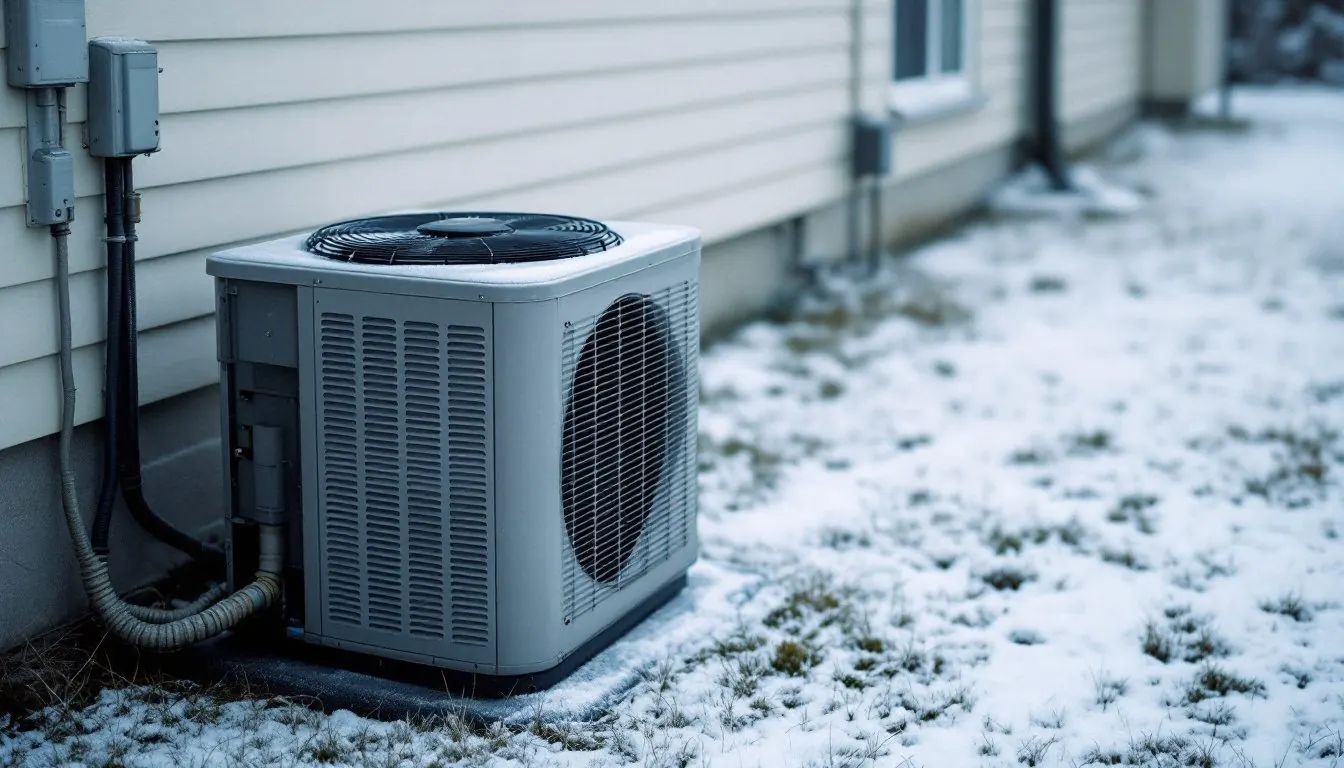
A heat pump outdoor fan not running in winter is usually a defrost cycle: the board stops the fan, steam rises, and the fan restarts within 15 minutes. If it stays stopped while the compressor hums, set the thermostat to EM HEAT; the usual causes are the fan capacitor, the motor, the board’s fan relay or ice.
Is the outdoor fan stopped for defrost, or stopped for good?
Time it. Maker boards stop the outdoor fan on purpose during defrost, and the documents below that state a time cap end the cycle within 10 to 14 minutes, so a fan that sits still for more than 15 minutes, with no steam, is a fault. Rheem’s owner manual (708163B) says that during defrost “the outdoor fan will stop” and “some steam may rise from the outdoor unit”. Goodman says the fan stops “to hasten the temperature rise of the outdoor coil”. How the cycle works is in our heat pump defrost cycle guide; this table only covers how long the fan may stay off.
| Maker and document | Fan during defrost | Longest defrost allowed | Fan after defrost |
|---|---|---|---|
| Rheem 13 SEER heat pump, 708163B | Stops; steam may rise | 10 minutes if the defrost thermostat does not open at 68°F | Restarts when defrost ends |
| Carrier Infinity 25HNB6, 338054-101 | Off (restart is delayed) | Ends at a 65°F coil; no time cap stated | Waits 20 seconds, then starts |
| Trane time and temperature controls, 34-4101-07 | Stopped by the board | 10 minute timed override | Turned back on by the board |
| Lennox XP17, 506586-01 | Fan not described; steam is “a normal occurrence” | 14 minutes, then the control terminates on time | Restarts when defrost ends |
| Goodman A/GPHH3 packaged, IOG-3038A | Stops | “Normally” 2 to 3 minutes; twelve minute override | Restarts when defrost ends |
Weather is the second clue. Carrier’s 25HNB6 board only defrosts below 50°F outdoors with the coil under 32°F, and Lennox tells XP17 owners frost forms below 45°F, so a fan stopped on a 60°F afternoon is not defrost.
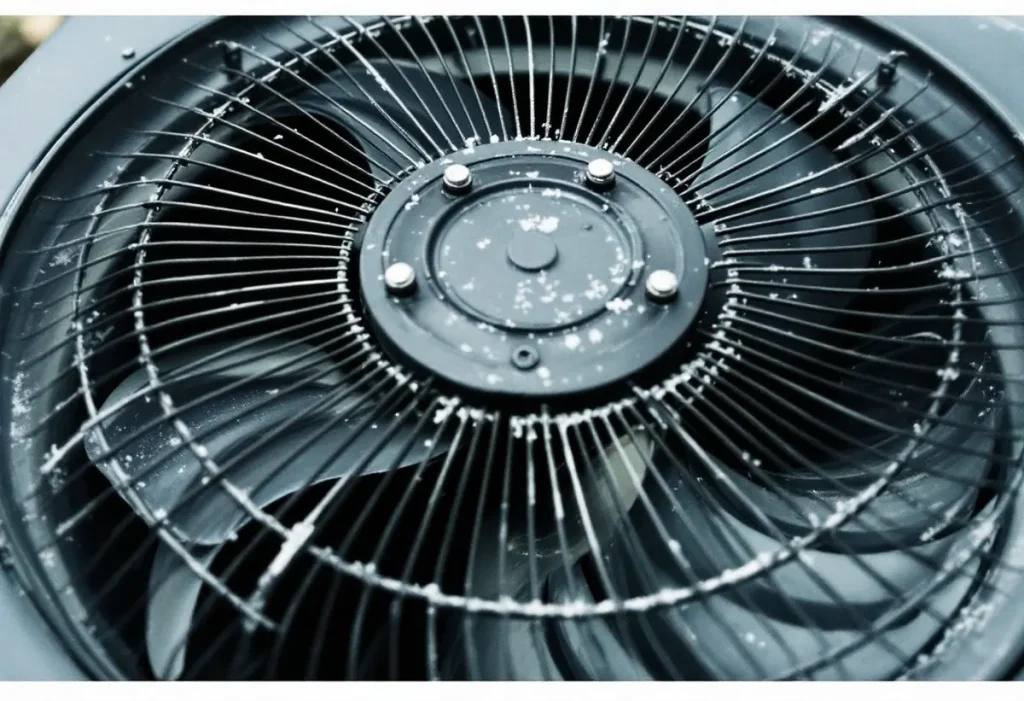
Why is my heat pump running but the outside fan is not spinning?
If the compressor hums and the fan stays still past the defrost window, the fan has lost its own circuit (capacitor, motor or board relay) or ice is locking the blade. Trane’s defrost control checkout chart names the same parts: “Check 240V AC field wiring, OD fan motor, fan capacitor.”
| What you see | Likely cause | What proves it |
|---|---|---|
| Fan stops, steam, restarts in minutes | Defrost | It ends inside the time cap in the first table |
| Whole unit silent after a power blip or thermostat change | Restart delay | Starts on its own within about 5 minutes |
| Whole unit silent, delay long past | Thermostat, breaker, disconnect fuses, 24 V, or the contactor | 24 V at the contactor coil but no 240 V through it |
| Compressor hums, fan blade turns freely with power off | Weak fan section of the dual run capacitor | Microfarad reading outside the tolerance printed on the can |
| Compressor hums, blade stiff or grinding with power off | Seized bearings or failed motor | Good capacitor, 240 V at the motor leads, no rotation |
| Capacitor and motor test good, no 240 V to the fan | Fan relay on the defrost board | No output at the board’s fan terminal (ODF on the Carrier 25HNB6 board) during a heat call |
| Blade or top grille encased in ice | Freezing rain, snow drift or blocked drainage | Ice visible from outside the guard |
The silent rows belong to the power supply and the HVAC contactor. A fan that runs while the compressor does not is the reverse fault, sorted in our condenser fan motor guide.
Can a heat pump run without the outside fan running in heat mode?
It can run, but it cannot heat properly. In heating the outdoor coil is the evaporator, and with no air moving across it the coil temperature falls far below the outdoor temperature. Trane’s demand defrost controls flag exactly that as Fault C, a “High ∆T” between coil and outdoor air shown as 3 flashes per second, and list “OD fan motor failure” among its causes.
Suction pressure falls with the coil temperature, and if it falls far enough the low pressure switch opens: on the Lennox XP17 it trips at 25 psig and resets at 40, and the control locks the compressor out after five pressure trips in one call. Meanwhile the strip heaters carry the house, at a cost the AUX versus EM heat comparison prices out.
The warning that the fan is there “to cool the compressor”, repeated on Trane’s consumer page, and the high head pressure story describe cooling season, when the outdoor coil is the condenser. In winter the risk is a starved, freezing outdoor coil and nonstop strip heat.
What should you do in the first ten minutes?
Set the thermostat to EM HEAT, then look without touching. Rheem’s owner manual says EM HT is “to be used only if there is a suspected problem with the outdoor unit” and that in that mode “the outdoor unit will be locked off”.
- Wait out one possible defrost: 15 minutes from when the fan stopped.
- Confirm HEAT mode with the setpoint above room temperature, Rheem’s first before-you-call check.
- Check the breaker and the outdoor disconnect; Rheem’s second check is that “the unit disconnect fuses are in good condition”. Lennox says to call a professional rather than reset a tripped breaker yourself.
- From outside the guard, look for ice, snow or sticks in the blade.
Stop there. The capacitor can hold a charge with the power off, and the motor, relay and contactor sit on 240 V. A blade pushed with a stick usually stalls again, because the capacitor or bearings that stopped it are still bad.
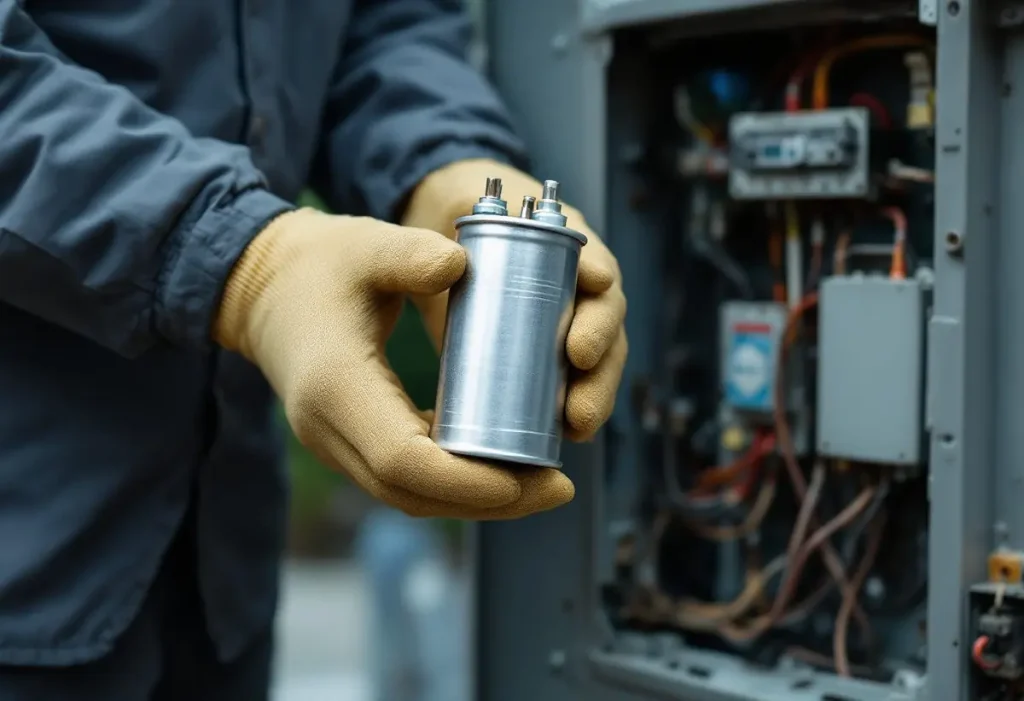
Is it the capacitor, the fan motor or the defrost board relay?
A technician tests them in that order, cheapest part first. Trane’s consumer page notes that the compressor and fan run capacitors “may be contained in one cylindrical unit”, so a weak fan section can stop the fan while the compressor keeps running.
The pass mark is the tolerance printed on that capacitor, not a universal figure. Cornell Dubilier’s SF motor run series is ±10% as standard, with ±6% and ±3% available. A 5 µF fan section that reads 4.6 µF is 8% low (0.4 ÷ 5): a pass on a ±10% can, a fail on a ±6% can. Label reading is in our HVAC capacitor explainer; repeat failures are covered in why capacitors keep going bad.
A PSC motor needs the capacitor; an ECM motor like the Lennox XP17’s does not. Lennox’s test unplugs the motor from its control (A177) and powers it from a 9 V battery: no rotation at reduced speed means a new motor assembly.
The board relay is last. Defrost boards switch the fan through their own relay so they can stop it for defrost: Trane describes “on-board relays for control of the outdoor fan”, the White-Rodgers 47D40-801 fan relay is rated 1/2 HP at 240 VAC, and Carrier’s 25HNB6 board has a terminal marked ODF. No voltage there during a heat call, with a good motor and capacitor, means a new board.
Why does the heat pump outdoor fan run continuously, even in defrost?
A fan that keeps spinning through defrost is usually a stuck board relay, and Trane’s instruction is blunt: “If outdoor fan will not turn off during a defrost cycle, replace DFC timer board.” Trane also lists “OD fan on during defrost” under the same Fault C as a dead fan motor.
There is one documented exception. Trane’s CNT03716 control watches the first defrost after power-up; after a high ∆T it runs the fan for six (6) minutes in the next defrost, which Trane warns “will seem to be a fault”. Speed changes are normal too: Trane’s two-speed controls in 34-4101-07 run the fan at high speed in heating and drop to low speed only in mild cooling weather. Defrost noises are decoded in our guide to a heat pump making loud noise in cold weather.
Is ice or snow holding the fan blade, and how high should the unit sit?
Ice that reaches the blade usually means the unit cannot shed its defrost water. Goodman’s A/GPHH3 manual requires “free unobstructed drainage of the defrost water and ice”, at least 2 inches under the coil in milder climates, and a taller base as the design temperature falls.
| Winter design temperature | Goodman suggested minimum elevation |
|---|---|
| +15°F and above | 2-1/2 inches |
| -5°F to +14°F | 8 inches |
| Below -5°F | 12 inches |
Lennox raises XP17 units on 2 inch Schedule 40 threaded adapters in the support feet. What not to do to a frozen coil is covered in ice on the outside unit; for the blade, EM HEAT and time beat any tool.
Frequently asked questions
Should the outside fan run when the heat pump is on?
Yes. In normal heating the outdoor fan runs whenever the compressor runs, pulling outdoor air across the coil the heat pump draws heat from. The planned exception is defrost, when Rheem, Carrier, Trane and Goodman boards stop the fan; Lennox puts a typical cycle at 5 to 15 minutes.
Why is the heat pump outdoor fan not turning on after the power came back?
Most boards hold the outdoor unit off after a power interruption. Rheem describes a protective timer that keeps the unit off for “approximately five minutes”, Carrier’s 25HNB6 board has a five minute short cycle protector, and Goodman’s A/GPHH3 defrost control provides a 3 minute off cycle compressor delay. If the fan and compressor are still silent after that, check the breaker and disconnect.
Does the heat pump outdoor temperature sensor control the fan?
On many boards it shapes when the fan stops or changes speed. Carrier’s 25HNB6 board only defrosts, and so only stops the fan for defrost, below 50°F outdoors. Trane’s 21C151619 controls use the outdoor ambient sensor to pick the fan speed for heating or cooling, and Carrier lists sensor faults as flash codes 53 and 55.
How we researched this
On November 17, 2026 we read the defrost and fan sections of six maker documents (Rheem, Carrier, Trane, Lennox, Goodman, White-Rodgers) and the Cornell Dubilier SF catalog, plus the Lennox and Trane consumer pages that rank for this query. Each setting applies only to the series named. Contractor blogs and forums were excluded as sources for figures, and repair prices were left out because no federal or national lab source lists them. The diy.stackexchange thread in the results would not load and has no archived copy.
Sources
- Rheem. “Outdoor Heat Pump User’s Information/Installation Instructions, 708163B.” https://files.rheem.com/LiteratureArchive/708163b.pdf. Accessed November 2026.
- Carrier. “25HNB6 Infinity 16 Heat Pump Wiring Diagram and Unit Operation, 338054-101 Rev. B.” https://www.partstown.com/modelManual/CRR-25HNB6-English_wd.pdf. Accessed November 2026.
- Trane. “Heat Pump Defrost Controls, Pub. No. 34-4101-07.” https://support.trane.com/hc/en-us/article_attachments/4423636411405. Accessed November 2026.
- Lennox Industries. “XP17 Heat Pumps Installation Instructions, 506586-01.” https://www.lennox.com/lib/legacy-res/pdfs/installation_maintenance/lennox_xp17_iom.pdf. Accessed November 2026.
- Goodman (Daikin Comfort Technologies). “A/GPHH3 Packaged Heat Pump Installation Instructions, IOG-3038A.” https://pdf.lowes.com/productdocuments/99a0b2f9-433d-48c4-8bfd-27d752e771e7/71067956.pdf. Accessed November 2026.
- Copeland (White-Rodgers). “47D40-801 Demand Defrost Control Instructions.” https://media.copeland.com/d9f5a9d4-30ab-4f1e-8bb7-b16b00f7d2d1/0037-7200-Instructions-47D40-801%20Demand%20Defrost%20Control.pdf. Accessed November 2026.
- Cornell Dubilier. “Type SF Motor-Run and Power Supply Capacitors.” https://www.cde.com/resources/catalogs/SF.pdf. Accessed November 2026.
- Trane. “Heat Pump Fan Not Spinning.” https://www.trane.com/residential/en/resources/troubleshooting/heat-pumps/heat-pump-fan-not-spinning/. Accessed November 2026.
- Lennox. “Heat Pump Fan Not Spinning: Troubleshooting and Solutions.” https://www.lennox.com/residential/lennox-life/consumer/heat-pump-fan-not-spinning. Accessed November 2026.
Leave a Reply