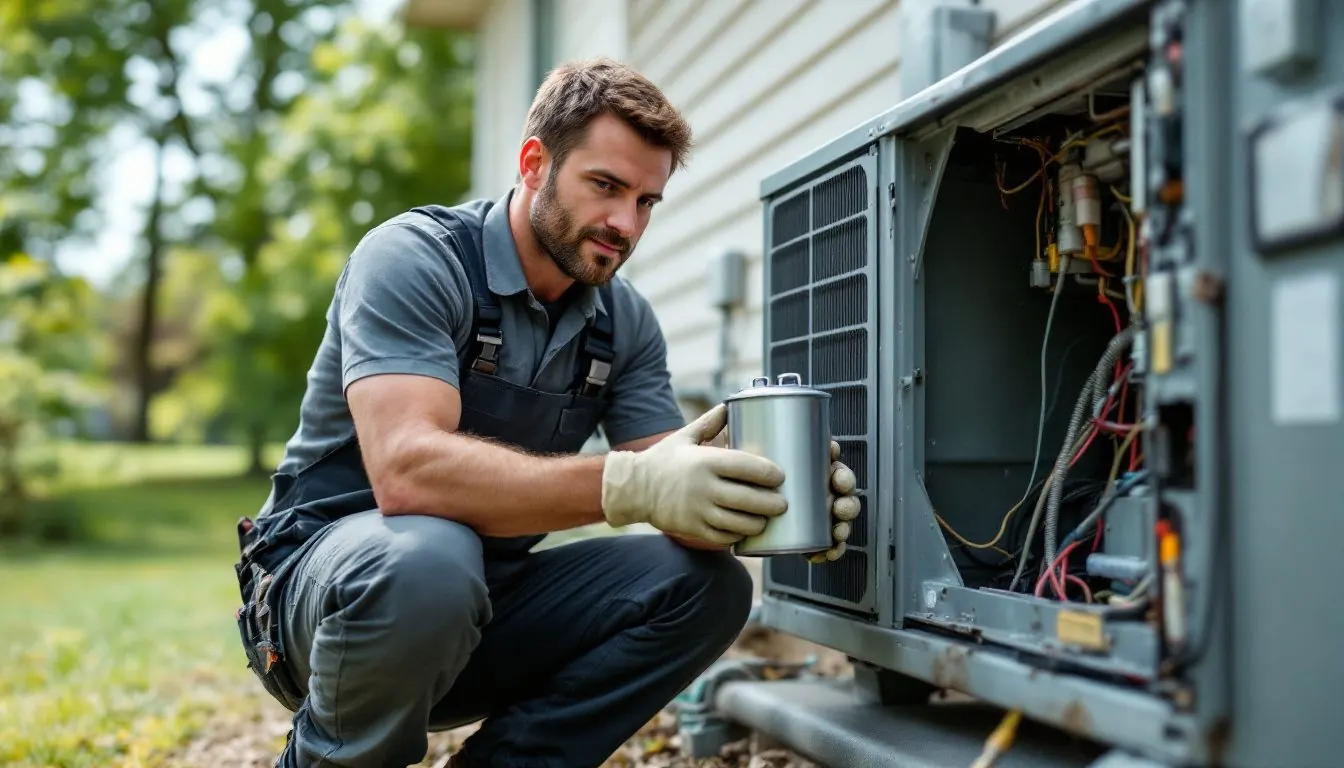
Why does my capacitor keep going bad? Usually because something outside the can is still wrong: voltage above its rating, a heat source, a replacement with the wrong µF or voltage, a start relay stuck closed, or a compressor or fan motor that is failing. Tecumseh’s service chart lists line voltage at “110% of rated-max” as a run capacitor killer.
A replacement that dies within a season or two is a measurement problem. Cornell Dubilier (CDE), a maker of oil filled motor run capacitors, publishes a service life objective of 60,000 hours with a 94% survival rate, but only “when operated at full voltage, 60 Hz, and rated ambient temperature” (CDE Type SF datasheet). That is 6.8 years of round the clock running; a can that fails fast is running outside those conditions. The basics of the part live in our HVAC capacitor explainer.
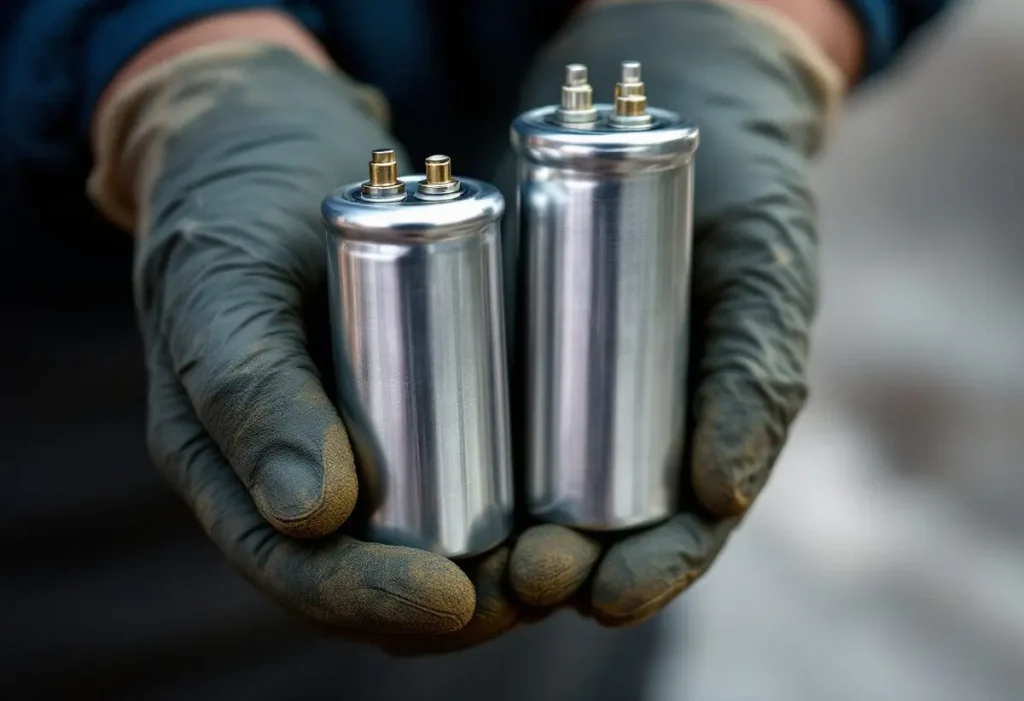
Why does a new capacitor fail in the same spot, and which reading proves the cause?
Each cause below is named in a Tecumseh, Rheem, Copeland or CDE service document, and each has a meter or data plate reading that proves it.
| Cause of repeat failure | Where the maker names it | Reading that proves it | What fixes it |
|---|---|---|---|
| Line voltage too high | Tecumseh row H: “Excessively high line voltage (110% of rated-max)” | Volts at the disconnect, unit running; Goodman GSXN4 plates allow 197 and 253 volts | Utility or wiring repair |
| Wrong capacitor fitted | Tecumseh row H: “Improper capacitor” | µF and volts on the can against the wiring diagram, not the old can | Fit the specified rating |
| Start capacitor left in circuit | Tecumseh row G: “Relay contacts not operating properly” | Relay opens once the compressor is up to speed | Replace relay and capacitor |
| Too many starts | Tecumseh row G: “Excessive short cycling” | Run times and starts per hour | Find the short cycling cause first |
| Compressor dragging | Rheem Flash Code 4 (locked rotor) | Running amps against RLA (16 A on a 3 ton Goodman GSXN403610) | Compressor diagnosis |
| Heat | CDE rates SF and MPF run capacitors to 70°C (158°F); SF also comes in a 90°C version | Can beside the compressor, in sun, or behind a dead condenser fan | Restore airflow; ask whether the maker allows a 90°C can |
Compiled by The HVAC Brief from the Tecumseh service chart, Rheem 7083500, Goodman SS-GSXN4 and CDE SF and MPF datasheets, November 2026.
Copeland’s bulletin AE4-1331 says it is “highly recommended that the run capacitor be replaced when a single phase compressor is replaced” (Copeland AE4-1331 R9). The reverse holds too: a new capacitor on a compressor pulling well over its RLA fixes nothing. Our guide to air conditioner amps and watts explains how RLA differs from the running draw.
Does voltage 10% over the rating really halve a capacitor’s life?
Close to it. CDE’s life versus voltage chart for its Type SF run capacitors puts life at about 45% of rated life at 110% of rated voltage, and about 25% at 120%. Running 5% under the rating stretches it to about 150%.
| Voltage across the can, % of its rating | % of rated life (CDE SF chart) | Hours, from the 60,000 hour objective |
|---|---|---|
| 95% | about 150% | about 90,000 |
| 100% | 100% | 60,000 |
| 105% | about 75% | about 45,000 |
| 110% | about 45% | about 27,000 |
| 120% | about 25% | about 15,000 |
HVAC Brief calculation: points read by eye from CDE’s Type SF “Life vs. Voltage” chart, times the 60,000 hour objective. Approximate; CDE publishes a curve, not a table.
Two things push the can over its rating. One is the supply: Copeland designs its ZP scroll motors for ±10% of nameplate, so a 200 to 230 volt compressor may start and run anywhere from 180 to 253 volts. The other is a downgrade at the last repair. ACHR News, in a 2003 technical article, put it flatly: a higher voltage rating “can safely be substituted,” but a lower one “can never be used” (ACHR News). A 370 V can where the diagram calls for 440 V is the textbook repeat failure. Surges are a third path; a surge protector on the AC stops some of them.
Heat works the same way: CDE plots a separate life versus temperature curve for the SF series on a logarithmic scale and rates standard parts for 70°C. A dual capacitor against a hot compressor shell, or in a cabinet whose condenser fan motor has stopped, runs outside the conditions behind the 60,000 hour number.
Start, HERM or FAN: which section failed, and what does it point to?
The section that died narrows the cause. A dead start capacitor points to the relay or the number of starts, a weak HERM section to the compressor or the supply, and a weak FAN section to the fan motor or the can’s location.
Start capacitors are a different part. CDE’s PSU motor start capacitors are aluminum electrolytic, rated to 65°C (149°F), with optional bleeder resistors “to extend the life of relay contact switches” (CDE Type PSU datasheet). A relay that sticks closed keeps one in the circuit until it vents. If your hard start kit capacitor keeps popping, check the relay and the start count; too many starts trace back to AC short cycling.
Can I replace a capacitor with a higher uF, a lower uF or a higher voltage?
Higher voltage, yes: a 440 V can of the correct µF can replace a 370 V one. Higher or lower µF, only inside the tolerance band of the value on the wiring diagram; outside it is Tecumseh’s “Improper capacitor.”
CDE sells its SF run capacitors at ±10% as standard, with ±6% and ±3% available, and says capacitance drifts by no more than ±3% across the operating temperature range. ACHR News allowed ±10% of the original value when an exact match is unavailable. Here is what those bands mean in microfarads for common HERM and FAN values:
| Rated value | ±6% window | ±10% window | Expected current at 240 V |
|---|---|---|---|
| 5 µF (fan) | 4.70 to 5.30 | 4.50 to 5.50 | 0.45 A |
| 7.5 µF (fan) | 7.05 to 7.95 | 6.75 to 8.25 | 0.68 A |
| 35 µF (HERM) | 32.90 to 37.10 | 31.50 to 38.50 | 3.17 A |
| 45 µF (HERM) | 42.3 to 47.7 | 40.50 to 49.50 | 4.07 A |
| 60 µF (HERM) | 56.40 to 63.60 | 54.00 to 66.00 | 5.43 A |
HVAC Brief calculation: window = rated µF × (1 ± tolerance); current = V × 2π × 60 Hz × C at 240 V.
Can capacitors be run in parallel or in series?
In parallel, yes: values add, and that is how universal replacement capacitors work. AmRad’s Turbo 200 instructions build a 30 µF HERM value by jumpering its 20 and 10 µF sections, written “20+10,” and rate the can at 370 VAC or 440 VAC (AmRad Turbo 200 instructions).
In series, the total drops: two 10 µF cans make 5 µF, from 1/C = 1/10 + 1/10. ACHR News says it is “not recommended to connect capacitors of unequal values in series.” Voltage splits in inverse proportion to capacitance, so a 45 µF and a 5 µF in series give 4.5 µF, with the 5 µF part carrying about 90% of the voltage.
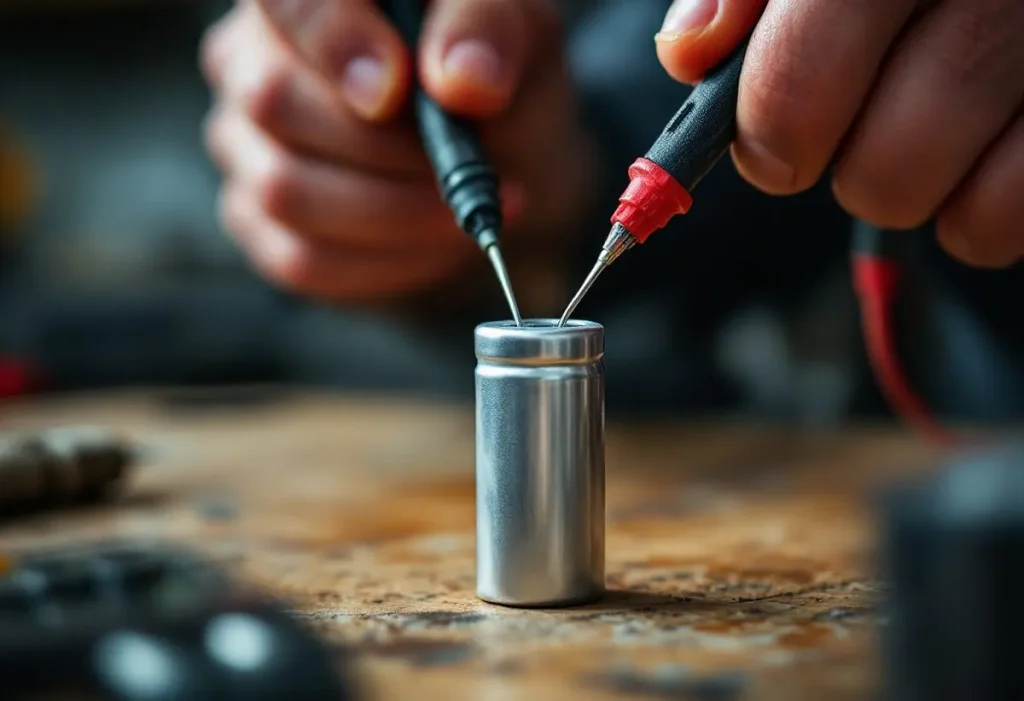
Can I test a capacitor with a multimeter, and what reading fails it?
Yes, with a meter that has a µF range, power off and the can discharged. A reading outside the tolerance window in the table above fails it; so does a bulged top or leaking oil.
Technicians also test it running. A capacitor at 60 Hz passes a current set by its µF and the voltage across it, so µF = 2,652 × amps ÷ volts. A healthy 45 µF can with 240 V across it passes 4.07 A; one that has drifted to 40.5 µF passes 3.66 A. The same test reads the voltage across the can, which is the root cause check: compare it with the label.
The stop line for a homeowner is opening the panel. A capacitor holds charge after the 240 V disconnect is pulled: OSHA says “Capacitors shall be discharged” before contact (29 CFR 1910.333), and Copeland says to discharge them “for a minimum of two minutes.” Ask the technician to write down line volts running, volts and µF of each section, and compressor and fan amps against their plates. On Rheem units with Comfort Alert, Flash Code 4 (locked rotor) and Flash Code 6 (open start circuit) both list “Run capacitor has failed” as cause 1 (Rheem 7083500). The contactor that switches the outdoor unit gets checked too; Copeland says to inspect it for “pitted/burnt contacts” when a compressor is replaced.
Frequently asked questions
Can I bypass the capacitor on an AC unit?
No. A single phase compressor or fan motor without its run capacitor cannot develop normal starting torque, so it hums, overheats and trips its protector. Rheem’s Comfort Alert lists a failed run capacitor as the first cause of Flash Code 4, locked rotor, and of Flash Code 6, current only in the run circuit. Running a motor that way risks the motor, which costs far more than the capacitor.
Can you use capacitors as batteries?
Not an AC run capacitor. Stored energy is ½CV², so a 45 µF can charged to the 339 V peak of a 240 V supply holds 2.59 J, enough to light a 60 W bulb for 43 milliseconds. That is far too little to power anything, yet enough to injure you, which is why Copeland says to discharge capacitors for at least two minutes before work.
How long should an AC capacitor last?
CDE gives its Type SF and MPF run capacitors a service life objective of 60,000 hours with a 94% survival rate at full rated voltage, 60 Hz and rated ambient temperature, which is 70°C for the standard parts. Even at those conditions about 6 in 100 are expected to fail before 60,000 hours, so one early failure is possible. Two in a row is a pattern.
How we researched this
Researched 9 November 2026 from the ten documents listed below, plus CDE’s Type PD datasheet; calculations are shown and scripted. We excluded the top results for this query (Smart AC Solutions, Gloomba, Weishi, WeeTech), which cite no maker document and mostly discuss circuit board electrolytics, and the “life halves every 10°C” rule, which we found in no run capacitor maker’s document. No repair prices: no federal series measures them.
Sources
- Cornell Dubilier. “Type SF Motor-Run and Power Supply Capacitors.” https://www.cde.com/resources/catalogs/SF.pdf. Accessed November 2026.
- Cornell Dubilier. “Type MPF, AC Motor Run Capacitors.” https://www.cde.com/resources/catalogs/MPF.pdf. Accessed November 2026.
- Cornell Dubilier. “Type PSU AC Motor Start Capacitors.” https://www.cde.com/resources/catalogs/PSU.pdf. Accessed November 2026.
- Tecumseh. “Trouble Shooting and Service Chart” (distributor hosted copy). https://www.industrialstores.com/media/industrialstores/product/attachments/Tecumseh-Electrical-Service-Parts-Troubleshooting-Guide.pdf. Accessed November 2026.
- Copeland. “Application Engineering Bulletin AE4-1331 R9.” https://apps.copeland.com/Publications/AEB/AE4_1331_R9.pdf. Accessed November 2026.
- Rheem. “Installation Instructions 7083500, Two-Stage R-410A Outdoor Air Conditioner.” https://files.rheem.com/LiteratureArchive/7083500.pdf. Accessed November 2026.
- Goodman. “SS-GSXN4 Specification Sheet” (distributor hosted copy). https://cdn.shopify.com/s/files/1/0766/1171/5363/files/GSXN402410.pdf. Accessed November 2026.
- AmRad. “Turbo 200 Universal Motor-Run Capacitor Installation.” https://sidharvey.com/documents/TURBO200_Install.pdf. Accessed November 2026.
- ACHR News. “Capacitors and Single-Phase Compressors” (2003). https://achrnews.com/articles/91641-capacitors-and-single-phase-compressors. Accessed November 2026.
- OSHA. “29 CFR 1910.333, Selection and use of work practices.” https://www.osha.gov/laws-regs/regulations/standardnumber/1910/1910.333. Accessed November 2026.
Leave a Reply