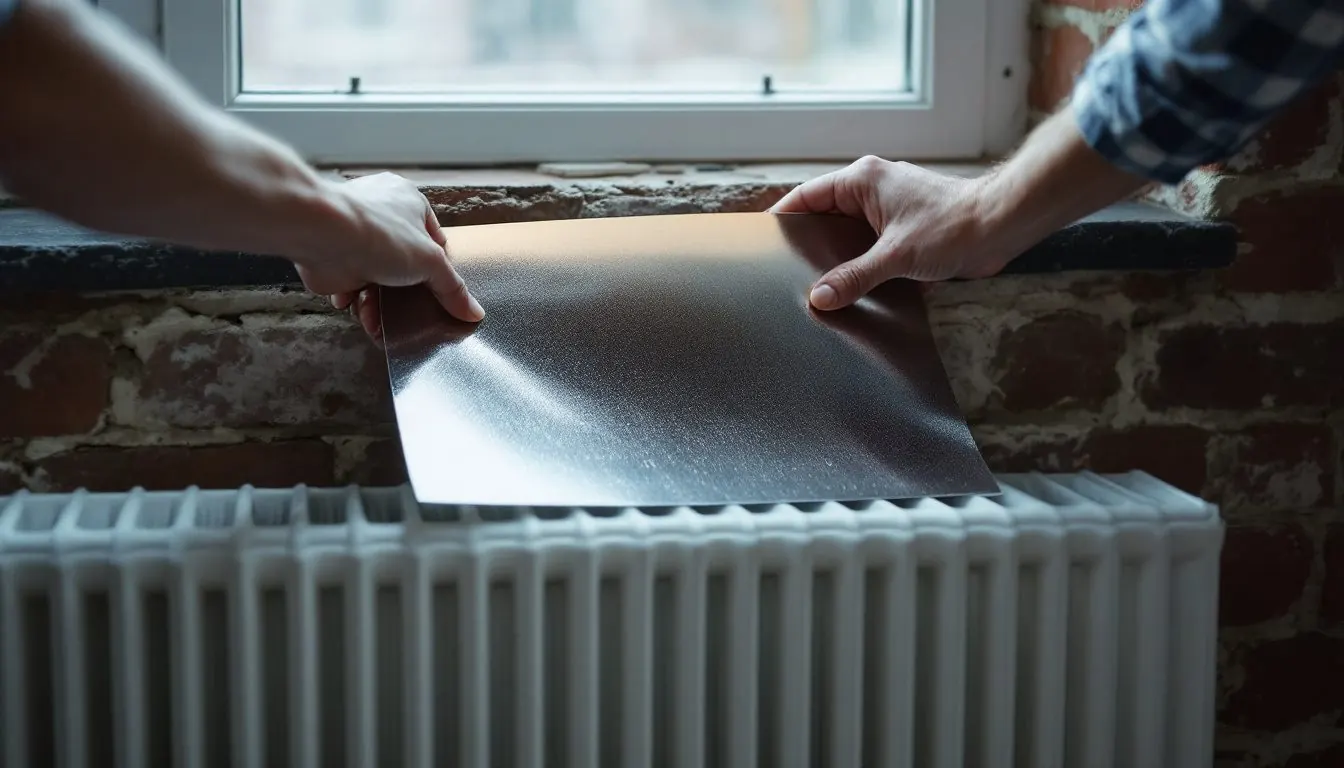
Yes, radiator reflectors work, but only a little, and only on an outside wall with poor insulation. In the best measured house test they cut heat loss through the wall behind the radiators by 54%, yet trimmed the whole home’s heating gas by just 2.9%. On an insulated or interior wall, expect close to nothing.
What did the radiator reflector tests actually measure?
All five sources we could open found a big cut in heat flowing into the wall and a cut of 9% or less in total heating energy. Two were commissioned by a foil maker, so the table shows who paid.
| Source and type | Set-up | Wall behind radiator | Whole room or house | Independence |
|---|---|---|---|---|
| Beck, Blakey and Chung, University of Sheffield (2001), peer-reviewed lab test | Two 600 x 600 mm single-panel radiators, 50 mm from a wall; one foiled, one plain | Wall face averaged 32 °C with foil vs 47 °C plain | Radiator back-face output fell from 198 W to 157 W (21%) | Academic |
| Salford Energy House 1 (test late 2024), full-size test house | Warmroom magnetic foil, simulated UK winter day | Heat loss through the wall cut 54%, peaks of 66% | Space heating gas cut 2.9%; no change in room temperature | Commissioned by Anchor Magnets; Innovate UK funded |
| University of Sheffield voucher study, reported on the UKGBC solutions listing | 0.5 mm shiny magnetic sheets behind radiators | Up to 60% less heat loss through the wall | Useful heat output up 3%; at least 30 W saved on a 600 x 600 mm radiator | Maker-supplied summary |
| Baldinelli and Asdrubali, University of Perugia (2008), heat-transfer model | Three wall types, three Italian climate zones | Not reported separately | Savings up to 8.8% on the worst-insulated wall | Academic |
| Energy Saving Trust (page updated 31 October 2025), consumer guidance | Purpose-made panels, uninsulated external walls | Not stated | £25 a year saved (£20 in Northern Ireland) for a £13 roll | UK government-funded adviser |
Compiled by The HVAC Brief from Beck et al. (2001), the Salford case study, the UKGBC listing, the Baldinelli and Asdrubali abstract and the Energy Saving Trust page. November 2026.
The gap between the wall column and the house column is geometry: radiators cover a small share of the outside walls, while windows, roof and air leaks keep losing heat. Plan with the Salford 2.9%, the only result measured on a whole test house.
Why does a shiny wall behind a radiator change anything?
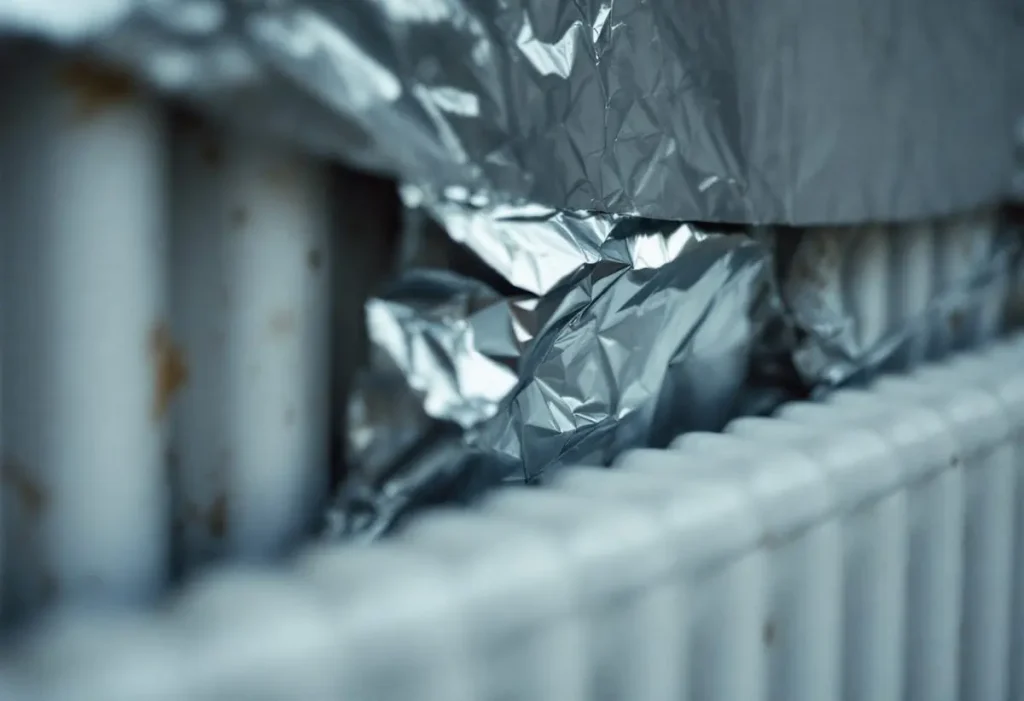
A radiator’s back face beams infrared heat at the wall; low-emissivity foil sends most of it back. In the Sheffield model the radiant output from the radiator’s back fell by three quarters, from 55 W to 13 W, while the convected heat did not change (Beck et al.).
That cooler wall is the saving: the 2001 authors conclude a reflective sheet “will certainly decrease the heat loss though the wall.” The same paper holds a twist foil sellers skip: a hot painted wall acts as a second heating surface that drives air up the gap, so a shiny wall also cuts the radiator’s own output. By the authors’ extrapolation, a dull wall gives a single-panel radiator about 10% more output than a shiny one, and a double 5% more. Their summary line: a reflector “will reduce the running costs, but it will also reduce the heat output!”
In practice the boiler or a thermostatic radiator valve makes up that 5% to 10% with a little more run time, which matches Salford’s finding of no change in room temperature. The Sheffield authors favoured a sheet reflective on the wall side and dark on the radiator side. Paint on the radiator itself is a separate question, covered in can you paint radiators.
Do radiator reflectors save money, and how fast do they pay back?
Yes, on the right wall, and payback is short because the product is cheap. The Energy Saving Trust puts the saving at £25 a year in Great Britain for a roll it prices at about £13 (Energy Saving Trust, archived copy), which pays back in about 6 months.
| Measured or modelled saving | What it means per $1,000 of yearly heating fuel | Applies to |
|---|---|---|
| 2.9% (Salford test house) | $29 | Solid-wall UK house, most radiators on outside walls |
| Up to 8.8% (Perugia model) | $88 | Worst-insulated wall in the model only |
| £25 a year for a £13 roll (Energy Saving Trust) | Payback about 6 months | Uninsulated external walls in Great Britain |
HVAC Brief calculation: saving percentage x $1,000; payback = £13 / £25 a year x 12 = 6.2 months. Script kept with this article’s research files.
Scale those to your own bill: 2.9% of $1,500 a year is about $44, and only if every radiator sits on an uninsulated outside wall. Insulated walls return far less.
Are radiator reflectors worth it on insulated or internal walls?
No for internal walls, and rarely for insulated ones. The Energy Saving Trust (EST) says it is “not really worth” adding panels on internal walls because that heat “will stay in your home” by warming the next room. On walls insulated to current standards, the Perugia model’s finding that savings shrink as wall resistance rises leaves little to recover.
The US picture follows from that. If your radiators sit on uninsulated masonry or empty frame walls, you match the walls where the measured savings came from; see the share of US homes rated poorly insulated for how common that is. The best-known American installation is the Empire State Building, where more than 6,000 insulated reflective barriers went behind perimeter radiators; RMI reports $491,191 in first-year savings for that measure bundled with steam trap work, so the reflector share is not published.
Fin-tube baseboard is a different animal: as our hot water baseboard guide explains, it works as a convector behind a metal cover, so a reflector behind it has very little radiant heat to turn around and no published test we found measured one.
Do radiator reflectors cause condensation or mould?
They can if fitted badly, and the risk sits behind the foil, not in front. The tesa instructions for its foam-backed reflector state that “to avoid mould, the reflector foil should not lie directly against the wall”, and the maker sells it without glue for that reason. The DOE, writing about the attic radiant barrier products that use the same physics, adds that “the reflective surface must face an air space” (DOE Energy Saver, archived copy).
A foam-backed panel stops the radiator warming that patch, so the plaster behind cools toward the temperature of the rest of the outside wall; if that wall stays dry, the patch normally will too. If black spots already show in corners or under windows, treat indoor humidity first; our window condensation guide gives the numbers.
Which reflector type works best: foil, panels, sheets or magnetic?
Purpose-made foam-backed panels and magnetic sheets both have test data behind them; plain kitchen foil is the weakest choice. The Energy Saving Trust says kitchen foil “won’t work” because it is hard to keep in place and lacks the insulation of a proper panel. Heating author Dan Holohan disagrees on HeatingHelp, recommending foil on cardboard, dusted twice a season.
Magnetic sheets such as Anchor Magnets Warmroom hold to a steel panel radiator, per the UKGBC listing; they will not grip aluminum. Whatever the pack says, check for a shiny face, a thin insulating backing and a size that fits the gap without touching the radiator.
How do you fit a radiator reflector so it works?
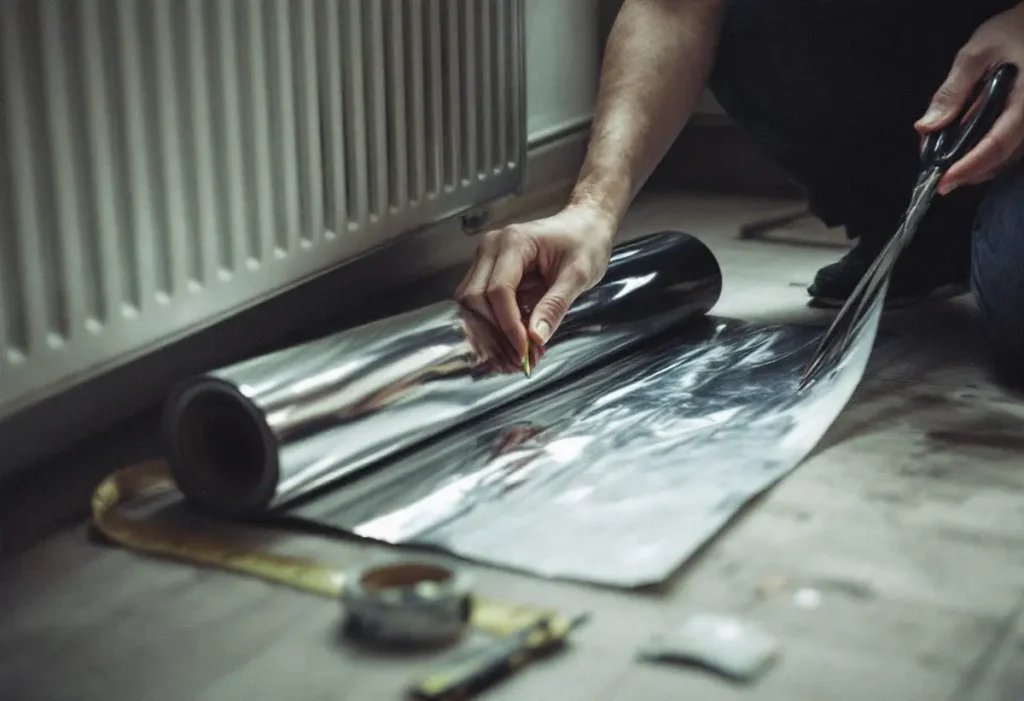
Cut the panel slightly smaller than the radiator and slide it down the back onto the wall, shiny side toward the radiator. The EST steps: heating off or valve closed, let the radiator cool, measure, cut so it does not show, slide it down and press it in place.
How small can you cut it? The Sheffield authors found that with a 50 mm (about 2 inch) gap a sheet can be trimmed 60 mm (about 2.4 inches) inside each side edge and still shield the hottest part of the wall. Keep the panel off the radiator, never block the air channel with thick insulation, and on a steam radiator leave the air vent and supply valve clear; our radiator repair guide covers a cold radiator that a reflector will not fix.
The DOE Energy Saver page lists reflectors behind radiators on exterior walls as one steam-system tip, next to insulating steam pipes and replacing failed steam traps (DOE, archived copy). Leaky sash windows usually deserve the effort first; our guide on stopping window drafts ranks those fixes.
Frequently asked questions
Does radiator reflector foil really work?
Yes, on outside walls with little insulation. In a late-2024 Salford Energy House test commissioned by Anchor Magnets, foil behind the radiators cut heat loss through those walls by 54% and the house’s heating gas by 2.9%. The Energy Saving Trust prices the saving at £25 a year in Great Britain. On an insulated or interior wall the benefit is close to zero.
Do magnetic radiator reflectors work?
They work like any reflector, with a magnetic backing for fixing. Anchor Magnets Warmroom is the magnetic product behind the Salford test (2.9% less heating gas) and a University of Sheffield study reported on the UKGBC listing (up to 60% less wall heat loss). The magnet needs a steel radiator; it will not hold on aluminum.
Do radiator reflectors work on internal walls?
Not in any way that saves money. The Energy Saving Trust (EST) says heat going into a wall between two rooms “will stay in your home” and calls internal-wall panels not really worth it. Every measured saving in the five studies we read came from radiators on external walls, where the heat would otherwise leave the building.
How we researched this
On 21 November 2026 we read the full text of Beck, Blakey and Chung (2001) from the University of Sheffield repository, the Salford Energy House Labs case study, the UKGBC solutions listing, the Baldinelli and Asdrubali abstract via OpenAlex, an archived copy of the Energy Saving Trust page, two archived DOE Energy Saver pages, the RMI write-up of the Empire State Building retrofit and the tesa product page. We excluded Harris (1995, Applied Energy) and a Fraunhofer IBP report, whose primary text we could not open, and retailer blog figures that cite no test. We ran no tests.
Sources
- Beck, S.B.M., Blakey, S.G. and Chung, M.C. “The effect of wall emissivity on radiator heat output.” Building Services Engineering Research and Technology 22(3), 2001. https://eprints.whiterose.ac.uk/id/eprint/121224/7/paper%2024.pdf. Accessed November 2026.
- University of Salford Energy House Labs. “Anchor Magnets warmroom Magnetic Radiator Foil.” https://energyhouselabs.salford.ac.uk/case-studies/anchor-magnets-warmroom-magnetic-radiator-foil/. Accessed November 2026.
- UK Green Building Council. “Magnetic Radiator Heat Savers.” https://ukgbc.org/resources/magnetic-radiator-heat-saver/. Accessed November 2026.
- Baldinelli, G. and Asdrubali, F. “Reflecting panels for radiators in residential buildings: Theoretical analysis of energy performance.” THETA 2008 (abstract via OpenAlex). https://doi.org/10.1109/THETA.2008.5167195. Accessed November 2026.
- Energy Saving Trust. “Radiator reflector panels explained” (archived copy). https://web.archive.org/web/2025id_/https://energysavingtrust.org.uk/advice/radiator-reflector-panels/. Accessed November 2026.
- U.S. Department of Energy, Energy Saver. “Heat Distribution Systems” (archived copy). https://web.archive.org/web/2025id_/https://www.energy.gov/energysaver/heat-distribution-systems. Accessed November 2026.
- U.S. Department of Energy, Energy Saver. “Radiant Barriers” (archived copy). https://web.archive.org/web/20260101015315id_/https://www.energy.gov/energysaver/radiant-barriers. Accessed November 2026.
- RMI. “Empire State Building Retrofit Surpasses Energy Savings Expectations.” https://rmi.org/blog_empire_state_retrofit_surpasses_energy_savings_expectations/. Accessed November 2026.
- tesa. “Radiator insulation with tesamoll.” https://www.tesa.com/en-gb/consumer/tesamoll/insulating_radiators. Accessed November 2026.
- Holohan, D. “Do Radiator Reflectors Work?” HeatingHelp. https://heatinghelp.com/systems-help-center/do-radiator-reflectors-work/. Accessed November 2026.
Leave a Reply