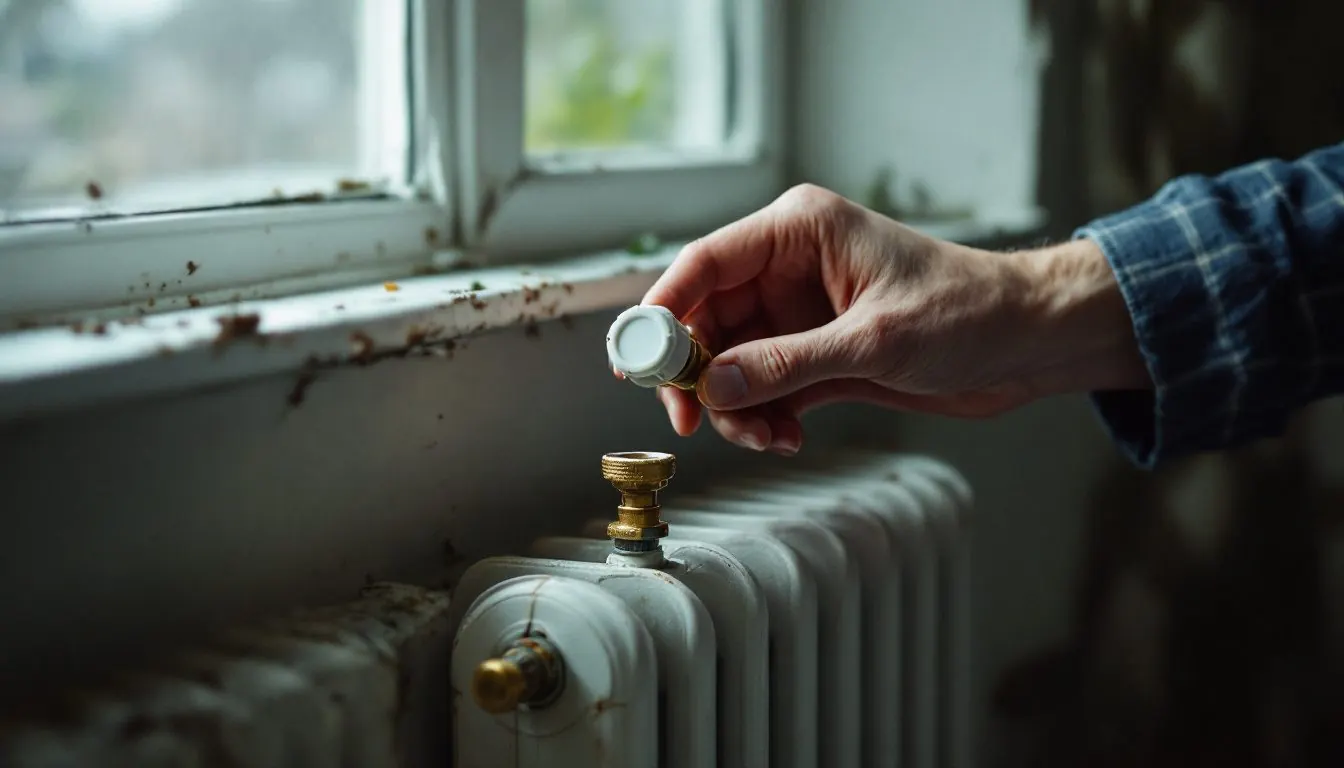
A thermostatic radiator valve not working shows one of three faults: the radiator stays cold because the head sits on * (frost) or the valve pin is stuck pressed in; it never shuts off because the sensor reads the wrong air or the pin is stuck out; or it whistles because flow runs backwards or pump pressure has no bypass.
Is your TRV radiator stone cold, always hot, or whistling?
Each symptom points at a different part. Danfoss describes a capsule in the head “operating a piston that acts on the valve pressure pin (spindle).” On one-pipe steam the head sits on the air vent instead; the PNNL Building America guide says it “blocks the release of air through the vent which prevents steam from entering the radiator.”
| Symptom | Likely cause | Test that decides it | Fix |
|---|---|---|---|
| Cold, hot water system | Head turned to * or 0 | Read the dial; Danfoss * holds about 45°F | Turn to 3 (about 68°F) |
| Cold, hot water system | Pin stuck pressed in (valve shut) | Head off, heat on: pin should spring out | Work the pin until it moves freely |
| Cold, warms with head off | Failed head | Swap heads with a working radiator | Replace the head only |
| Cold, one-pipe steam | Air vent stuck closed, radiator pitch, supply valve part open | Danfoss 1PS troubleshooting table | Clear or replace the vent, re-pitch, open supply valve fully |
| Never shuts off | Sensor behind curtain, in a cabinet or above the hot valve | Does the room overshoot only on that radiator? | Move the sensor or fit a remote sensor |
| Never shuts off | Pin stuck out (valve open) | Head off: press the pin; does it stay down or bind? | Free the pin; a leak means a new gland |
| Steam room still overheats | Boiler pressure above 2 psig | Read the boiler gauge on a long cycle | Lower the pressure control setting |
| Whistle or hum, hot water | Valve fitted against its flow arrow | Stamped arrow vs the pipe that heats first | Reverse the valve |
| Whistle when most rooms are warm | Fixed-speed pump, no differential bypass | Noise grows as more TRVs close | Differential pressure bypass or pressure-regulated pump |
Compiled by The HVAC Brief from Danfoss, Caleffi, Hive (archived copy) and PNNL documents listed under Sources.
Radiator stays cold: is the head on * or is the pin stuck pressed in?
Check the dial first. The * mark on Danfoss RA2000 and Caleffi 200 series heads is frost protection at about 45°F, so a head turned down for summer holds a cold radiator all winter. Turn it to 5 and wait one heat call.
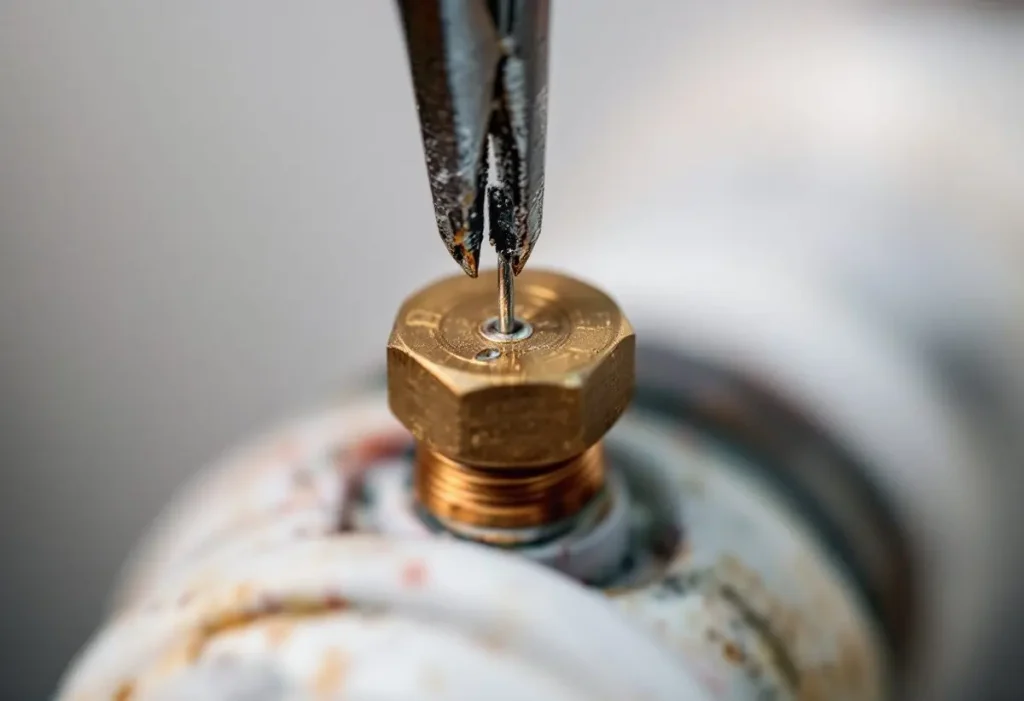
If it stays cold, separate the head from the valve. Pressing the pin in closes the valve: Caleffi’s 220 series sheet says the valve plug is in a “spring-to-open (normally open) position without the control head,” and that a warming room makes the bellows “expand, pushing the valve control stem down against the return spring.” With the head off and the boiler running, a healthy valve opens fully.
To free a stuck pin, Hive’s support page says to press it with a coin: it “should glide smoothly without resistance until it contacts the rubber diaphragm.” If it binds, Hive suggests wiping it, adding silicone lubricant and rotating it with the coin. Press gently; the pin passes through a seal holding system water. Danfoss sells an RA2000 packing gland, code 013G0290, for exactly this; wetness at the pin means the gland or valve needs replacing.
Heats with the head off, cold with it on: the head has failed. Refit any head set to 5, as Danfoss and Caleffi both instruct. Cold with the pin free: the TRV is not the problem. Air, a closed lockshield or a zone fault is, and the guide to one cold room on a hot water system and the steps to bleed air from the loop take over.
Why does the radiator still heat with the TRV turned down to 1?
Usually the sensor reads air cooler than the room. Danfoss UK says sensors “behind curtains or furnishings, or in tight corners alongside hot pipes, will not control satisfactorily,” and Caleffi warns against “niches, alcoves, behind curtains” and direct sun. The fix is a remote sensor; Danfoss RA2000 remote sensors run on a capillary of up to 6 ft.
Next, rule out a pin stuck out: with the head off, it will not travel down when pressed. If it moves freely, turn a Danfoss RAS-D2 head past * to 0, its “positive shut-off” position. Still heating there means a failed head.
Also check where the room thermostat is. Danfoss says the radiator in the room with the wall thermostat “should not normally have a TRV,” and its one-pipe steam sheet says not to install the 1PS “in the same room where the boiler is cycled by an existing space thermostat.” A TRV there can keep the thermostat calling while every other room overheats. Many TRVs closing at once can also drive the pattern traced in boiler short cycling.
One-pipe steam: why does a TRV on the air vent leave the room cold or overheated?
On one-pipe steam the TRV controls air, not steam. PNNL says these TRVs sit on the “vent side” because of clogging at the inlet. The Danfoss RA 2000 1PS is a valve body, a separate air vent (013L8011) and an operator, for “max. 15 psig” systems. For under heating, its troubleshooting table lists a vent “stuck closed,” the riser vent, radiator pitch and excess pressure; hand valves must be “FULLY open,” and the boiler “must not run at constant pressure,” or air cannot re-enter between cycles. Vent faults that hiss rather than block belong to steam radiator hissing.
Overheating with the TRV closed is usually boiler pressure. Danfoss recommends steam pressure “at or below 2 psig. Otherwise air will be compressed in the radiator, allowing steam to enter when not required.” PNNL puts numbers on it: 5 psi “would compress the trapped air volume by approximately 25%,” against 12% at 2 psi. We reproduced that with Boyle’s law.
| Boiler pressure at the radiator | Trapped air shrinks to | Share of the radiator steam can still fill with the TRV closed |
|---|---|---|
| 0.5 psig | 96.7% | 3.3% |
| 1 psig | 93.6% | 6.4% |
| 2 psig (Danfoss ceiling) | 88.0% | 12.0% |
| 3 psig | 83.1% | 16.9% |
| 5 psig | 74.6% | 25.4% |
HVAC Brief calculation: share filled = 1 minus 14.7 / (14.7 + gauge psi), isothermal, ignoring pressure drop in mains and risers. Matches PNNL’s 25% at 5 psi and 12% at 2 psi.
Timing matters too: PNNL says a cast iron radiator “can take eight to ten minutes” to fill, so a sensor in a dead corner may react too late. Pressure controls and mains are covered in the guide to one-pipe steam systems; the pressure control and low water cutoff stay with the boiler technician.
What makes a thermostatic radiator valve whistle or hum on hot water?
Reversed flow, or too much pump pressure across a nearly closed valve. Danfoss’s RA2000 hot water body carries a stamped flow arrow, and if flow is incorrect “the result will lead to noise.” Its RAS-D2 valve has a setting ring to reverse direction “to eliminate the risk of water hammer.”
Pressure noise grows as more TRVs close against a fixed-speed circulator. Caleffi limits its valves to 15 psi (1 bar) differential with the head fitted, and its 519 bypass, adjustable over 2 to 10 psi, relieves “the differential pressure created by the pump as the zone valves close, thus eliminating water hammer noise.” Danfoss UK says automatic bypasses cut “the risk of system noise.” Noises from pipes rather than the valve are sorted in hot water baseboard noise; how two-way valves load the pump is covered under zone valves.
What do the numbers 1 to 5 on a TRV head mean in °F?
Approximate room temperatures, which differ by maker; Danfoss calls them “guidelines only.”
| Dial mark | Danfoss RA2000 head | Caleffi 200/201 series head |
|---|---|---|
| * (frost) | 45°F | 45°F |
| 1 | 57°F | 54°F |
| 2 | 63°F | 61°F |
| 3 | 68°F | 68°F |
| 4 | 73°F | 75°F |
| 5 | 79°F | 82°F |
Compiled by The HVAC Brief from Danfoss RA 2000 universal instructions (marks read against the printed °C row) and Caleffi sheet 01034. The Danfoss 1PS steam head spans about 45°F to 85°F.
Set it and leave it: Danfoss says a higher setting “will not make the room heat up any faster.” Whether TRVs suit an underheated room at all is covered in radiator heating repair.
Frequently asked questions
How do you reset a thermostatic radiator valve?
There is no electronic reset on a non-powered TRV. Danfoss says that removing an RA2000 head by turning the base counter-clockwise also resets its snap-action mechanism, and that you check it is at the factory setting of 5 before pushing it back on until it clicks. Then set the dial to the room temperature you want, such as 3 for about 68°F.
Do thermostatic radiator valves wear out?
The head and the pin seal are the wear parts. Danfoss recommends replacing the RA2000 packing gland, code 013G0290, after several years, and the gland can be changed with a 10mm wrench. A sensing head that no longer closes the valve at 0 or * is replaced on its own; the valve body in the pipe usually stays.
Can you replace the thermostatic radiator valve head only?
Yes, if the new head fits the valve body’s connection, so match the head to the body’s brand and series. Danfoss sells RA2000 heads separately from the valve body, which stays in the pipe. If the radiator heats with the old head removed, a head swap is the fix; refit with the dial at 5, the factory setting Danfoss specifies.
Why is my Caleffi thermostatic radiator valve not working?
Caleffi’s 220 series valve is normally open without its head, so a radiator still cold with the head removed points to a stuck stem, air or a closed lockshield, not the head. Caleffi also requires heads mounted horizontally, away from niches, curtains and direct sun, where they misread the room.
Why is my Hive thermostatic radiator valve not working?
Hive’s smart TRV still pushes the same mechanical pin. Its support page says to remove the head, press the pin with a coin and check it glides to the rubber diaphragm, then clean a sticky pin with a dry cloth and silicone lubricant. It also says to confirm the valve orientation in the app’s Radiator Valve settings.
How we researched this
Research date: November 20, 2026. We read seven Danfoss instruction sheets and guides, two Caleffi sheets, Hive’s troubleshooting page (archived copy) and the PNNL Building America TRV guide. The pressure table is our calculation, checked against PNNL. We excluded forums, videos and blogs, including a top-ranking blog that reverses the pin direction. We found no Honeywell, Drayton or ecocal troubleshooting document, so those brands get no specific claims.
Sources
- Pacific Northwest National Laboratory, Building America Solution Center. “Thermostatic Radiator Valves for Steam Heating Systems.” https://basc.pnnl.gov/resource-guides/thermostatic-radiator-valves-steam-heating-systems. Accessed November 2026.
- Danfoss. “Installation Instructions: RA2000 One Pipe Steam (1PS) Thermostatic Radiator Valve” (VISXA322, via Kele). https://assets.kele.com/product-assets/danfoss/skus/013g8013/related/installsheet_1595_013g8013.pdf. Accessed November 2026.
- Danfoss. “Installation RA2000 Thermostatic Radiator Valve: Instructions for 2-Pipe Hot Water Applications.” https://assets.danfoss.com/documents/47250/AN000086406172en-010201.pdf. Accessed November 2026.
- Danfoss. “RA 2000 Valves Installation Guide” (013R9055). https://assets.danfoss.com/documents/47251/AN000086406182en-US0101.pdf. Accessed November 2026.
- Danfoss. “Radiator thermostat RA 2000, universal model: Installation Instructions.” https://assets.danfoss.com/documents/46833/AN000086404937en-010602.pdf. Accessed November 2026.
- Danfoss. “Radiator Thermostat RAS-D2 Instruction.” https://assets.danfoss.com/documents/latest/362042/AN000086405177en-010301.pdf. Accessed November 2026.
- Danfoss. “Domestic Heating Controls Are Easy, Part 5: Radiator Thermostats.” https://assets.danfoss.com/documents/latest/44965/AM000086447758en-010101.pdf. Accessed November 2026.
- Caleffi. “Thermostatic radiator valves for NPT threaded radiators, 220 series” (01034). https://www.caleffi.com/sites/default/files/media/external-file/01034_NA.pdf. Accessed November 2026.
- Caleffi. “519 Series Differential Pressure By-pass Valve Instructions” (via SupplyHouse). https://s3.amazonaws.com/s3.supplyhouse.com/product_files/Caleffi-519609A-Install-Instructions.pdf. Accessed November 2026.
- Hive. “Troubleshooting your Hive Thermostatic Radiator Valves (TRV)” (archived copy). https://web.archive.org/web/2025id_/https://www.hivehome.com/ie/support/Our_Hive_Products/OHP_Hive_Active_Heating/Troubleshooting-your-Hive-Thermostatic-Radiator-Valves-TRVs. Accessed November 2026.
Leave a Reply