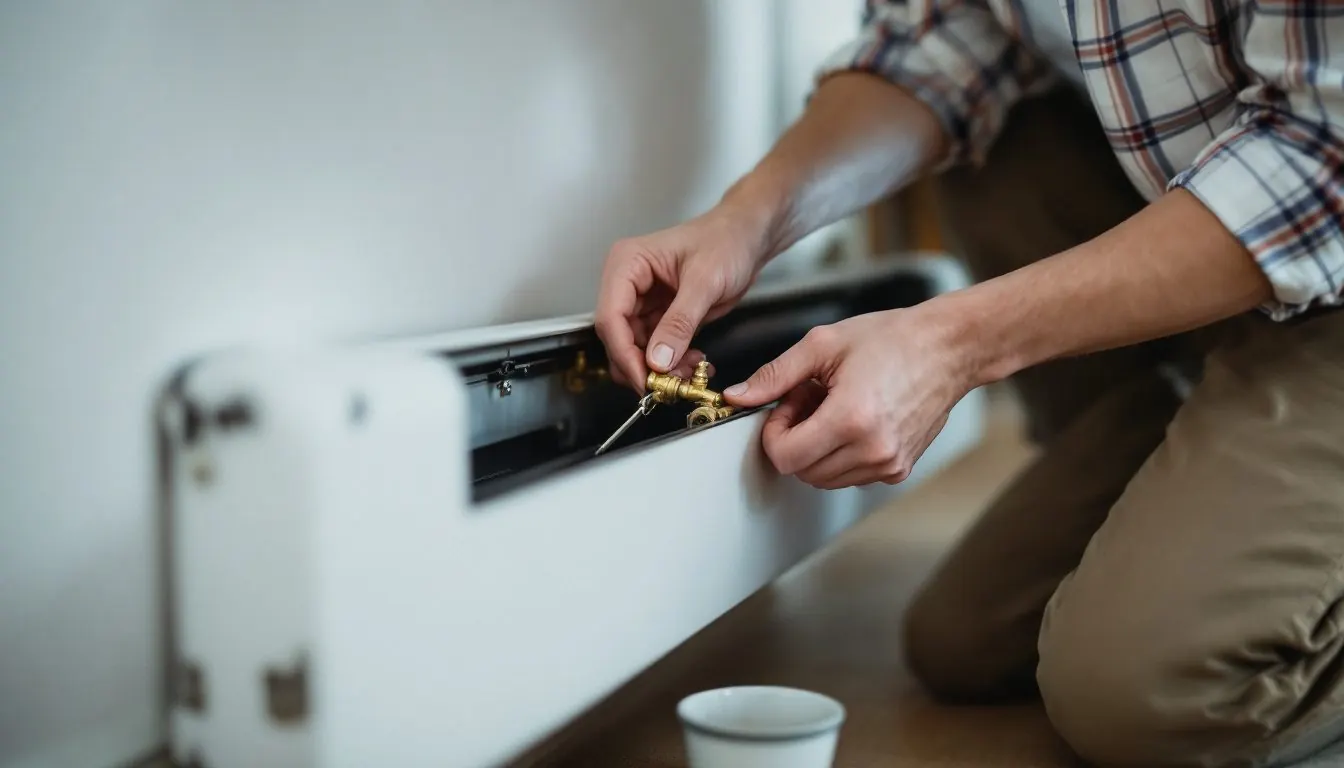
How to bleed baseboard heaters: with the boiler pressure near 12 psi, open the small vent at the end of each hot water baseboard until water, not air, flows steadily for about 5 seconds, working from the first unit in the loop. No vents? Purge each zone from the boiler with the fast fill lever open.
The 5 second test and the 12 psi fill come from Burnham’s ES2 boiler manual, Appendix E. The method depends on which of three setups you have. Electric baseboards hold no water and have nothing to bleed.
| What you find at the baseboard ends | How the air gets out | Tools | Done when |
|---|---|---|---|
| Small brass vent under a hinged end cap | Open each vent in loop order, pressure on | Vent key, cup | Steady water for about 5 seconds per vent (Burnham ES2) |
| One vent at the highest point, float vent at the boiler | Bleed the high vent; the separator catches the rest | Vent key, cup | Solid water; gauge at fill pressure |
| No vents on the loop | Purge from the boiler, zone by zone | Garden hose, 5 gallon bucket | Hose runs bubble free for 30 seconds (Burnham ES2, V8H) |
Compiled by The HVAC Brief from Slant/Fin publication BB-40, Burnham ES2 and V8H manuals, and Taco TD11.
Where is the bleed valve on a baseboard heater, and do all baseboards have one?
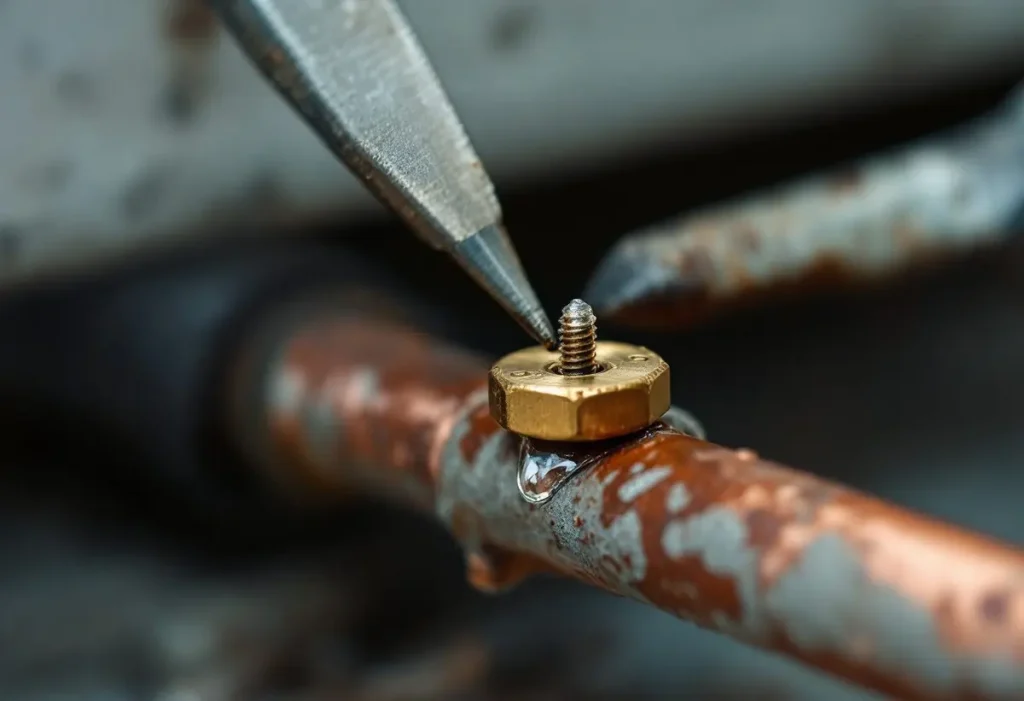
Not all of them do. Slant/Fin’s own installation guide (publication BB-40) gives installers a choice: “Either install a manual air vent at every drop, or install an automatic air eliminator device at the boiler and a vent at highest point of the system.” A house built the second way has no bleeder on most units, by design.
A vent sits where the pipe drops through the floor, in a 1/8″ IPS opening on Slant/Fin’s return bend; hinged end caps “provide easy access to vent.” The element itself is 3/4″ nominal copper on Sterling’s line (Sterling PB-11). Slant/Fin calls a vent at every drop “an advantage” when a system is refilled without purging.
How do you bleed baseboard heaters that have a bleeder at each end?
One at a time, in flow order, with the system under pressure. Burnham’s ES2 says to start “with the first convector in the loop” and open each vent “until a steady stream of water flows into container for approximately 5 seconds.”
- Turn the thermostat down and let the loop cool. CPSC publication 5098 says most adults suffer third degree burns from 150 degree water in two seconds.
- Read the boiler gauge: Burnham and Taco both fill to 12 psi cold. If it is far lower, fix that first (table below).
- Check that the shutoff ahead of the feed valve is open; Taco’s 329 sheet says it “must always be kept open when the system is in operation.”
- At the first baseboard, hold a cup under the vent and open it a fraction of a turn. Close it after about 5 seconds of steady water, then move downstream.
- Recheck the gauge and restore the thermostat.
The step most guides skip is pressure. Every bleeder sits above the gauge, and height costs pressure: Taco’s 329 sheet uses 0.43 psi per foot of lift. If the pressure at the vent falls to zero, nothing comes out, or air goes in.
| Height of the vent above the boiler gauge | Pressure at the vent, gauge reads 12 psi | Pressure at the vent, gauge reads 5 psi |
|---|---|---|
| 4 ft (first floor baseboard, basement boiler) | 10.3 psi | 3.3 psi |
| 8 ft | 8.6 psi | 1.6 psi |
| 12 ft | 6.8 psi | minus 0.2 psi: air is drawn in |
| 16 ft (second floor) | 5.1 psi | minus 1.9 psi: air is drawn in |
| 25 ft | 1.2 psi | minus 5.8 psi: air is drawn in |
HVAC Brief calculation: gauge pressure minus 0.43 psi per foot of height (Taco instruction sheet 102-006). Script and output kept with this article.
Bleed several units with the feed shut and upstairs vents pull air in. Taco’s TD11 guide wants every vent location “at least 3 psi above atmospheric pressure.” Normal readings are on our boiler pressure page.
How do you bleed baseboard heat without bleeders, from the boiler?
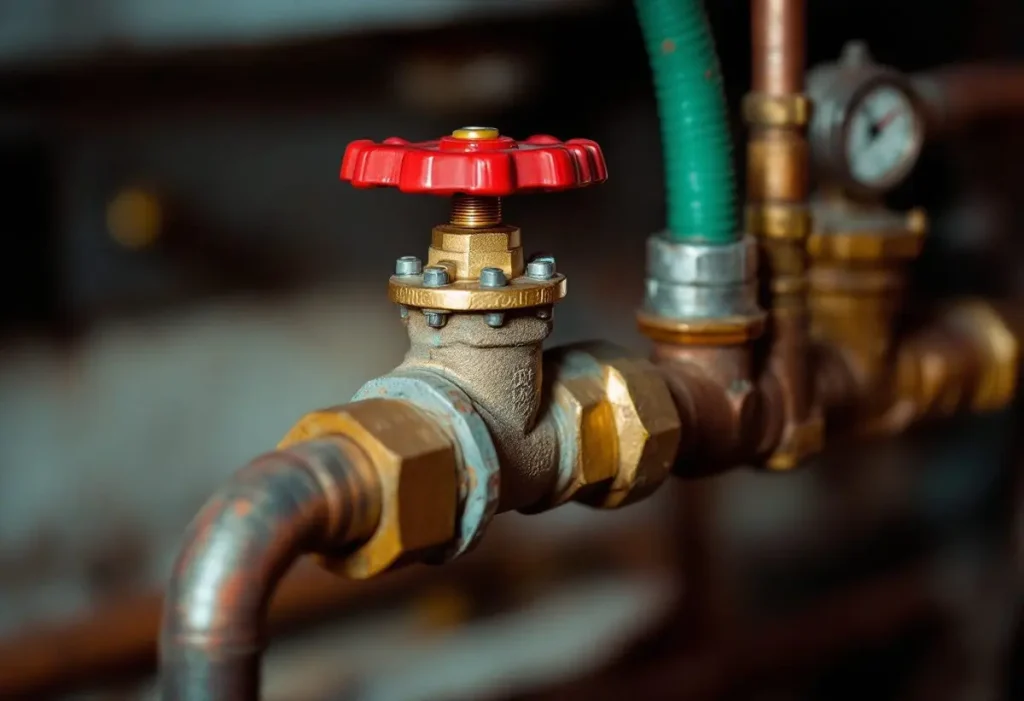
Push the air out with fresh water: close one valve so feed water must travel the whole zone, and let it exit through a hose at the boiler until it runs clear. Taco TD11 says the moving water “pushes most of the air in the piping ahead of it like a piston.” You need a purge valve (hose bib) beside a full port ball valve.
The steps follow Burnham ES2 Appendix E and its V8H manual, written for use “on a series loop or multi-zoned system.”
- Boiler off and cooled. Close the full port ball valve between the purge valve and the air scoop.
- Close every zone valve or zone shutoff on supply and return. On powered zone valves, use the manual open lever only on the zone you are purging.
- Run a hose from the purge valve into a 5 gallon bucket at a floor drain.
- Open one zone, open the purge valve, then open the feed. On a Taco 329, push the fast fill lever to the “O” (override) position; Taco says the lever “is supplied for use during purging of the system.”
- Let water run until the hose discharge is “bubble free for 30 seconds.” Close that zone, open the next, repeat.
- Close the purge valve, let the system fill to 12 psi, then return the fast fill lever to “A” (automatic). Open the ball valve and all zones, and remove the hose.
Where Angi’s version goes wrong. It never closes the ball valve in the boiler piping, so fill water takes the short path and the zone keeps its air. Taco TD11 marks that valve “shut during purging.”
How much water and time does purging one zone take?
A few gallons per zone. Taco TD11 Table 1 says 3/4″ type M copper needs 3.2 gpm to reach 2 feet per second, the speed that carries bubbles down drops, so each foot holds about 0.027 gallon.
| Zone loop length (3/4″ copper) | Water in the loop | Time for one loop volume at 3.2 gpm | Minimum through the hose, with 30 s bubble free |
|---|---|---|---|
| 50 ft | 1.33 gal | 25 s | 2.9 gal |
| 100 ft | 2.67 gal | 50 s | 4.3 gal |
| 150 ft | 4.00 gal | 75 s | 5.6 gal |
| 200 ft | 5.33 gal | 100 s | 6.9 gal |
HVAC Brief calculation: 3.2 gpm / 120 = 0.0267 gal per ft (Taco TD11 Table 1), plus 30 seconds at 3.2 gpm (Burnham ES2).
A 5 gallon bucket overflows past about 100 feet of loop. At a weak flow, Taco warns, larger bubbles “may be able to rise upward faster than the water is flowing downward,” so a trickle may never clear a second floor loop.
What should the boiler gauge read when you finish?
The cold fill pressure: 12 psi on the Burnham and Taco hardware above. Burnham says a pressure reducing valve “will automatically fill to 12 psi.” For taller systems Taco sets the 329 to height in feet times .43, plus 3 psi.
A gauge climbing toward the 30 psi relief setting when hot points at the boiler expansion tank, not air. Leave the fast fill lever in the “A” notch; Taco says it “should not be moved during system operation.”
Why does air keep coming back after bleeding baseboard heat?
Fresh water carries air you cannot see. Taco TD11 says cold water at 50°F and 50 psi “can be up to 10 percent dissolved gas molecules,” released as the boiler heats it, so some gurgling after the first hot cycles is normal. Weekly is not.
- No central separator. TD11 says every closed loop “should include a properly sized and properly located central air separator.” Taco’s 4900 series catches bubbles “as small as 8/10000 of an inch.”
- Constant make up water. Each refill brings new dissolved air. Burnham’s ES2 piping appendix says to “repair leaking pipes, fittings, and vents to minimize the need to add makeup water.”
Air noise versus expansion or circulator noise is sorted in our hot water baseboard noise decoder. If the boiler itself rumbles like a kettle, that is scale, covered on boiler kettling.
When should a technician do the purge, and what will they check?
When there is no purge valve, the feed valve passes no water, or pressure falls again within days. The technician checks the expansion tank charge against fill pressure, the feed valve setting (Taco’s 329 adjusts across 10 to 25 psi), and for a weeping relief valve or leak driving make up water.
Our guide to hot water baseboard heating covers output per foot, and radiator heating repair covers cast iron radiators and steam, which is never bled.
Frequently asked questions
Do baseboards need to be bled every year?
Hot water ones do. DOE Energy Saver says to “bleed radiators at the start of each heating season to remove unwanted air.” Systems with a central air separator release little, but checking each vent in November costs a cup of water.
Can you bleed baseboard heaters while the heat is on?
You can, but you should not. The water at the vent is boiler water, and CPSC publication 5098 reports third degree burns in adults after six seconds at 140 degrees and two seconds at 150 degrees. Turn the thermostat down, let the loop cool, and keep the gauge near its 12 psi fill.
How to bleed baseboard heating pipes with no baseboard vents?
Look for an automatic float vent at a high point or on the air scoop beside the boiler. Taco places its Hy-Vent float vents “at high points in system piping where large air bubbles might collect,” such as riser tops. If there is none, purge the zone from the boiler until the hose runs bubble free for 30 seconds.
How to bleed baseboard radiators with no bleeder valve on the end?
Use the zone by zone boiler purge: ball valve shut, one zone open, hose from the purge valve to a bucket, fast fill open, and run until the hose is bubble free for 30 seconds, as Burnham’s ES2 manual sets out. Then refill to 12 psi and set the Taco fast fill lever back to “A”.
How we researched this
On 17 November 2026 we read Burnham’s ES2 and V8H manuals, Taco sheet 102-006 and guide TD11, Slant/Fin BB-40, Sterling PB-11, the DOE heat distribution page (archived copy) and CPSC publication 5098. Top Google results (a cover retailer’s blog, Angi) were compared, not cited, and pressure ranges not printed by a maker were excluded. The tables are our arithmetic from Taco data.
Sources
- Burnham (U.S. Boiler Company). “ES2 Installation, Operating and Service Instructions, 103780-07.” https://res.cloudinary.com/dzhpkjoqj/US%20Boiler%20%2D%20Burnham/ES2_IO_Manual_ht4xvg.pdf. Accessed November 2026.
- Burnham (U.S. Boiler Company). “V8H Series Installation, Operating and Service Instructions.” https://s3.amazonaws.com/s3.supplyhouse.com/product_files/Burnham-V8HSeries-Installation.pdf. Accessed November 2026.
- Taco, Inc. “Instruction Sheet 102-006: Boiler Feed Valves 329 and 335, Dual Controls 334.” https://s3.amazonaws.com/s3.supplyhouse.com/manuals/1319637262560/67032_PROD_FILE.pdf. Accessed November 2026.
- Taco, Inc. “TD11: Air Elimination from Hydronic Heating Systems” (InspectAPedia copy). https://inspectapedia.com/heat/Air-Elimination-Guide-TACO.pdf. Accessed November 2026.
- Slant/Fin Corp. “Baseboard installation, Publication BB-40.” https://s3.amazonaws.com/s3.supplyhouse.com/product_files/Slantfin%20%2D%20104001050%20%2D%20Install%20Instructions.pdf. Accessed November 2026.
- Sterling (Mestek). “PB-11 Hydronic Baseboard.” https://www.sterlingbaseboard.com/documents/PB-11.pdf. Accessed November 2026.
- U.S. Department of Energy, Energy Saver. “Heat Distribution Systems” (archived copy). https://web.archive.org/web/2025id_/https://www.energy.gov/energysaver/heat-distribution-systems. Accessed November 2026.
- U.S. Consumer Product Safety Commission. “Avoiding Tap Water Scalds, Publication 5098.” https://www.cpsc.gov/s3fs-public/5098.pdf. Accessed November 2026.
Leave a Reply