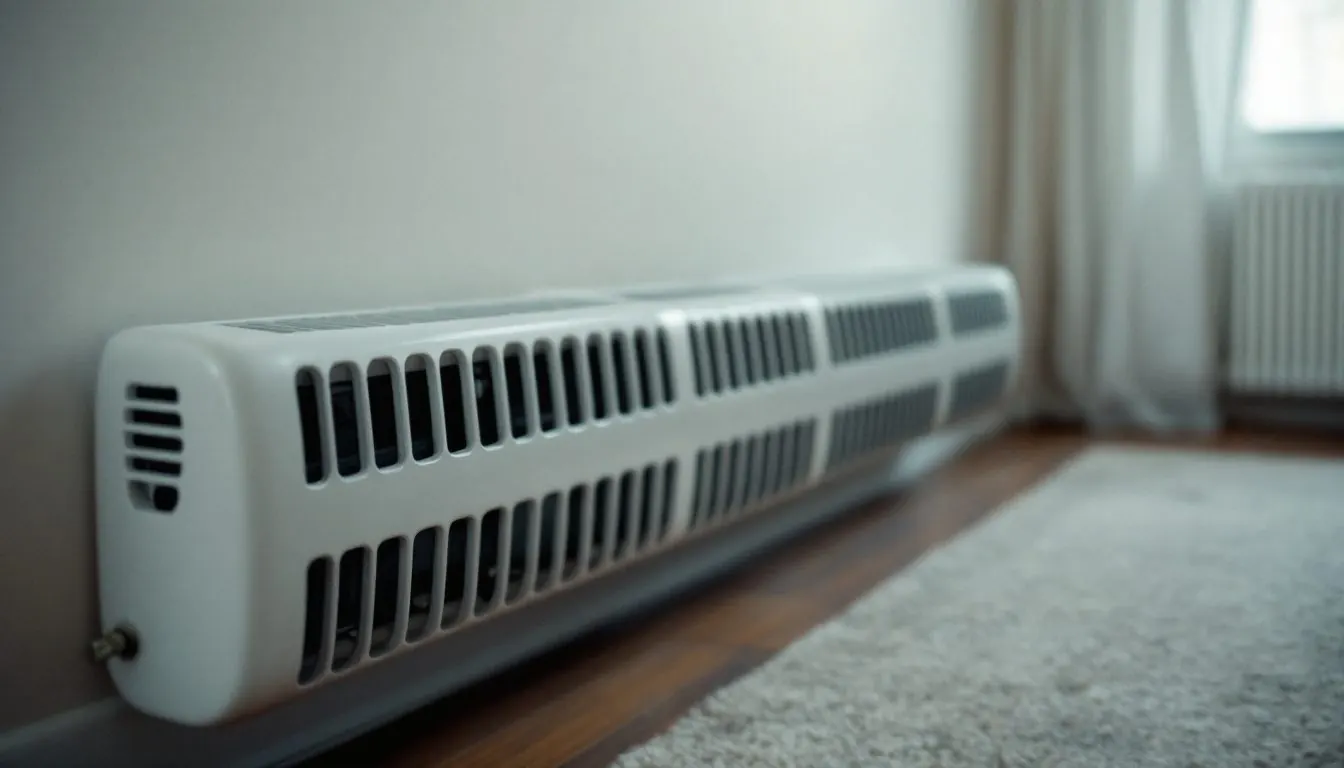
Hot water baseboard noise is usually one of four things: ticking or creaking from copper tube sliding on its cradles as it expands, gurgling or running water from trapped air, a bang from a zone valve closing, or a whoosh or hum from water moving too fast. When the sound happens tells you which.
Which hot water baseboard noise is it? Match the sound to the moment you hear it
Time the noise against the heat cycle: warm-up and cool-down sounds are expansion, sounds only while the circulator runs are air or water speed, and one bang as the room satisfies is usually the zone valve.
| Sound | When | Where it starts | What the maker documents say | First fix |
|---|---|---|---|---|
| Ticking, clicking, creaking | After the zone starts and after it stops | Cradles and brackets | Slant/Fin: center cradles over brackets to avoid “scraping noises” | Recenter or replace cradles |
| Creak or snap at the floor | Warm-up and cool-down | Riser holes in floor or wall | Slant/Fin sizes riser holes 1/2 in. over the pipe | Enlarge the hole |
| Running water, trickling, gurgling | While the pump runs | High points and vents | Weil-McLain: air in the system or low system pressure | Bleed, then check the gauge |
| Bang or thud as the heat shuts off | As the thermostat is satisfied | Zone valve | Resideo V8043 is built to close against the flow; arrow must match flow | Check the flow arrow |
| Steady whoosh or hiss | All the time the pump runs | Piping near the pump | Caleffi: keep under 4 ft/s; Weil-McLain: under 6 gpm in a 3/4 in. element | Lower the pump speed |
| Rumble, popping, percolating | While the burner fires | The boiler, not the baseboard | Weil-McLain: deposits, pH or low flow | Service call |
Compiled by The HVAC Brief from Slant/Fin, Weil-McLain, Resideo and Caleffi documents listed under Sources.
Electric units have no water in them; the electric baseboard heater guide covers those, and steam radiator hissing covers steam.
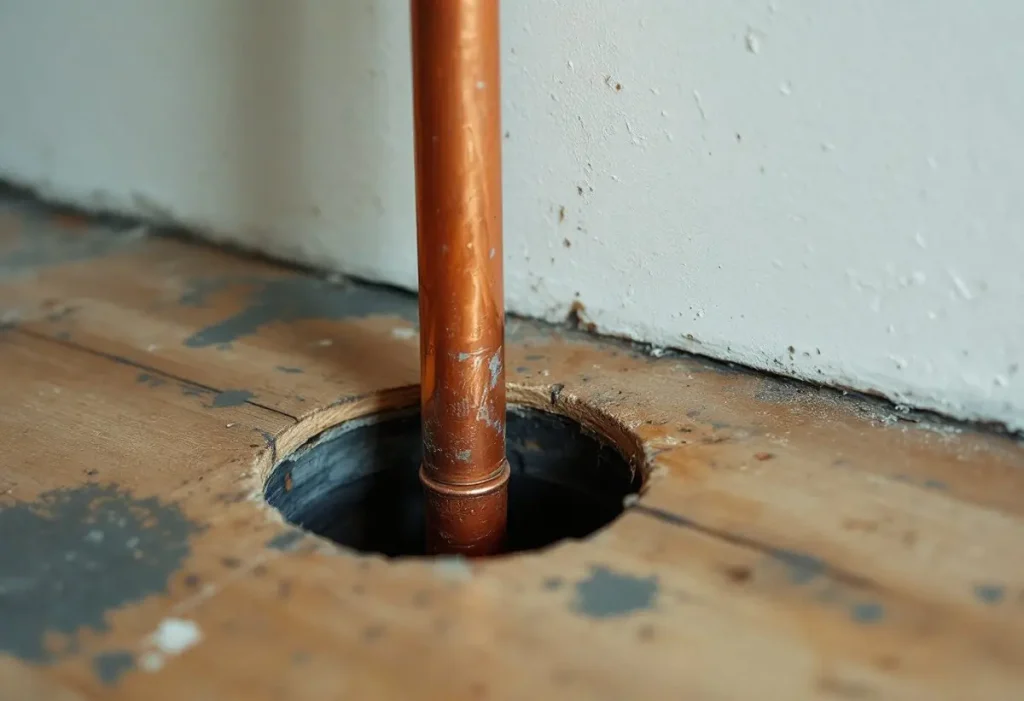
Why does hot water baseboard tick and creak as it heats up and cools down?
Because the copper tube inside the fins gets longer every time hot water reaches it, and drags across its supports as it moves. The Copper Development Association’s Copper Tube Handbook gives copper an average expansion coefficient of 0.0000094 inch per inch per °F between 70°F and 212°F,; its worked example has 100 feet of tube heated by 100°F growing 1.128 inches.
We calculated the growth for common runs from a 70°F room:
| Length of run | Water at 140°F | Water at 160°F | Water at 180°F |
|---|---|---|---|
| 8 ft | 0.063 in. | 0.081 in. | 0.099 in. |
| 14 ft | 0.111 in. | 0.142 in. | 0.174 in. |
| 20 ft | 0.158 in. | 0.203 in. | 0.248 in. |
| 40 ft | 0.316 in. | 0.406 in. | 0.496 in. |
HVAC Brief calculation: length (ft) × 12 × 0.0000094 × (water temperature minus 70°F), using the CDA coefficient. Script kept with our working files.
Slant/Fin’s installation instructions size each riser hole 1/2 in. larger than the pipe and tell installers to set the riser “snug to inside edge of hole” so it has room to move outward. A 40 ft run held at one end at 180°F uses almost all of that 1/2 in., which is why Slant/Fin calls for a Hydro/Tite compensator at the center of long runs. A riser set mid-hole or packed with foam binds sooner and creaks at the floor.
Ticks along the wall come from the element sliding on its hangers, and makers ship parts to quiet that slide: Sterling’s Petite 7 uses plastic glide rails that “promote quiet floating action during expansion and contraction,” Sterling’s Heatrim uses a nylon “silent slide shoe,” and Slant/Fin’s Fine/Line 30 literature describes expansion cradles that avoid “noisy metal-to-metal contact with bracket and enclosure.” A cradle that has shifted or worn through is the usual culprit when one spot ticks loudest. Lower water temperature shrinks the movement too: at 140°F a 20 ft run grows 0.158 in. instead of 0.248 in., one benefit of outdoor reset on the boiler aquastat buys. Weil-McLain lists “high limit set too low” as a cause of noisy or cold baseboard, so it is a trade.
Why does the baseboard sound like running water or gurgle?
A trickling or gurgling sound while the pump runs is air in the loop. Weil-McLain’s troubleshooting table for “some radiators or baseboard units do not heat or are noisy” lists air in the system first and tells owners to bleed it “through air vents in radiators or baseboard units,” then lists low system pressure and says to fill to correct pressure.
Slow flow is why the air stays. Caleffi’s idronics 16 says pipe velocity should be no lower than 2 feet per second to carry air bubbles back to a central separator, and gives 3/4 in. copper a velocity of 0.62 ft/s per gpm. At the 1 gpm flow that Slant/Fin and Weil-McLain base their standard baseboard ratings on, the water moves at 0.62 ft/s, under a third of that threshold, so bubbles at a drop stay put. Slant/Fin’s answer is a manual air vent “at every drop,” or an automatic eliminator at the boiler plus a vent at the highest point, to prevent “noise or blockage of circulation by air pockets.” Our guide to how to bleed baseboard heaters covers bleeders, coin vents and purging.
If the gurgle comes back after bleeding, look at the boiler gauge. The CDA handbook notes that a 2.3 ft column of water creates 1 psi, so for an upstairs element 20 ft above the gauge, 8.7 psi of the cold reading does nothing but hold the water up there. A reading near that leaves the top of the system near zero, where air collects. The boiler pressure guide lists maker fill settings and what a falling gauge or a failing expansion tank means.
What makes a hot water baseboard bang or knock?
A single bang when the room reaches temperature is almost always a zone valve stopping moving water too abruptly. Resideo designs its V8043 zone valve to close “against the flow of water to assure quiet operation” and requires that “the arrow stamped on the valve body’s side corresponds to the flow direction.” A valve installed backwards closes with the flow instead, so a technician checks that arrow first, then the ball plug’s seat. The zone valve explainer covers the powerhead.
Knocking in one spot through the whole warm-up is usually expansion at a pipe strap, joist notch or riser hole. Knocking or rumbling at the boiler itself is a different fault: Weil-McLain’s user manual pins a “popping or percolating noise heard in boiler” on mineral deposits, incorrect pH or insufficient water flow, which is boiler kettling and needs a service visit, not bleeding.
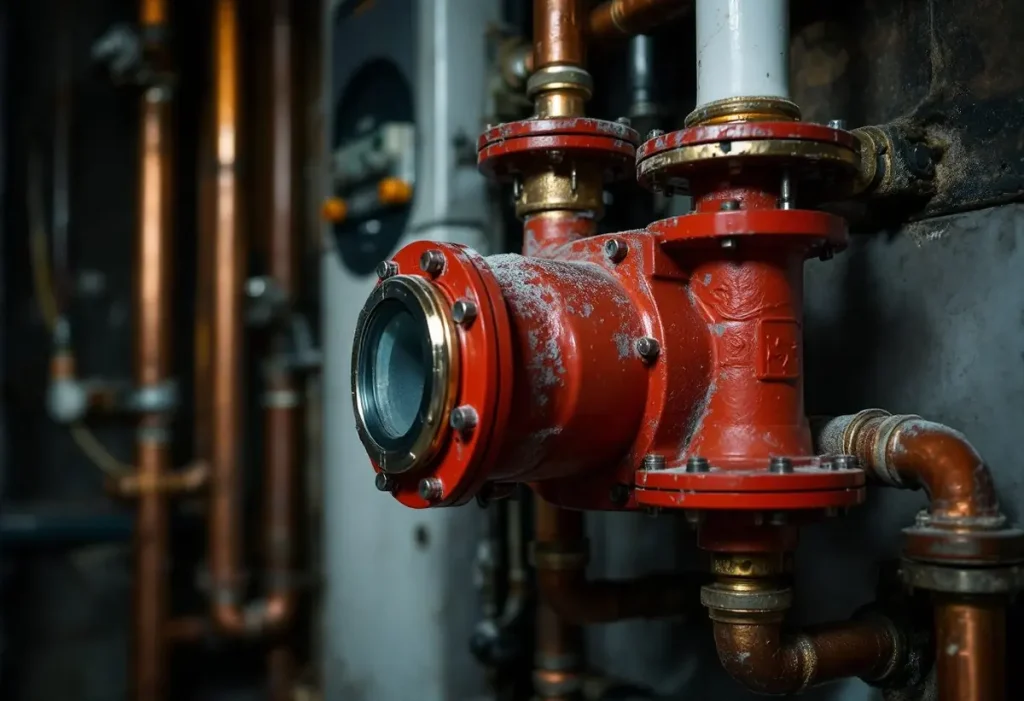
Is a whoosh or hum from forced hot water baseboard a flow problem?
Usually yes: a steady whoosh while the pump runs means water moving faster than the pipe carries quietly. Caleffi’s idronics 16 says the ASHRAE guideline of an average 4 feet per second in pipes 2 in. and smaller “is based on keeping any flow noise emitted from the piping at levels that are not objectionable in occupied space.” Weil-McLain’s High Trim baseboard instructions say flow above 6 gpm through the 3/4 in. element “should be avoided because of possible noise.”
| Flow through 3/4 in. copper | Average velocity | Caleffi guide |
|---|---|---|
| 1 gpm | 0.62 ft/s | Too slow to carry air |
| 4 gpm | 2.48 ft/s | Carries air, quiet |
| 6 gpm | 3.72 ft/s | Near the noise limit |
| 8 gpm | 4.96 ft/s | Over the noise limit |
HVAC Brief calculation: velocity = 0.62 × gpm, Caleffi idronics 16 formula for 3/4 in. copper. The 4 ft/s line falls at about 6.45 gpm, which matches Weil-McLain’s 6 gpm warning.
A technician will drop a three speed circulator one step and listen; the circulator pump guide shows how flow is sized from the heat load. A hum that stays at the pump is the circulator motor. Grundfos’s UP series instructions set a minimum inlet pressure of 4.0 psi at 190°F water and warn against running below it for prolonged periods, so a humming pump on a low-pressure system gets a gauge check before it gets replaced.
When should a noisy hot water baseboard system be shut off?
Ticks, gurgles and a soft whoosh can wait; three things cannot. Turn the boiler off at its service switch and call the same day if the relief valve on the boiler discharges water, if the gauge climbs toward the pressure stamped on that relief valve, or if the boiler itself rumbles or bangs while firing. Weil-McLain’s user manual tells owners to contact a qualified service technician if a relief valve keeps weeping, and to call one for de-liming when deposits cause popping. A wet baseboard joint, where expansion has worn the tube against a bracket, is a same-week call.
Frequently asked questions
Should I be able to hear the water in my baseboard heater?
Not as a steady trickle. A quiet loop moves water you cannot hear; a running-water sound that lasts the whole cycle is air. Weil-McLain’s user manual lists air in the system and low system pressure as the causes of noisy baseboard units, and says to bleed air through the vents in the baseboard units and fill to the correct pressure.
Why does my baseboard heater buzz?
A hot water element has no electrical parts, so a buzz comes from something wired: the circulator, or a zone valve motor. Resideo’s V8043 zone valve runs its powerhead on a 24 V circuit, and a buzzing powerhead or transformer is a technician check.
How to make baseboard heaters quiet?
Work through the causes in order: recenter or replace the plastic cradles under the element, open riser holes so the pipe can move (Slant/Fin sizes them 1/2 in. larger than the pipe), bleed every vent, confirm the boiler pressure, then lower the circulator speed so pipe velocity stays under the 4 feet per second Caleffi cites for quiet flow.
Can hot water baseboard heater covers cause noise?
Yes, when the element or riser touches the cover or back panel as it grows. Slant/Fin’s Fine/Line 30 literature says its expansion cradles avoid metal-to-metal contact with the bracket and enclosure, and that its riser rings use wax loaded neoprene to cushion expansion squeaks and vibration noises.
How we researched this
In November 2026 we read the ten maker and trade documents listed below: the CDA Copper Tube Handbook, Slant/Fin, Sterling and Weil-McLain baseboard literature, a Weil-McLain boiler user manual, Resideo zone valve, Caleffi idronics and Grundfos circulator instructions. The expansion and velocity tables are our calculations from their coefficients. We read the top search results for the questions they answer but took no figures from them. Electric and steam noises are excluded.
Sources
- Copper Development Association. “Copper Tube Handbook.” copper.org. Accessed November 2026.
- Slant/Fin. “Baseboard installation instructions, 104001050.” s3.amazonaws.com/s3.supplyhouse.com. Accessed November 2026.
- Slant/Fin. “Fine/Line 30 brochure, 30-10-2.” images.thdstatic.com. Accessed November 2026.
- Sterling (Mestek). “Petite 7 hot water baseboard, PB-11.” www.sterlingbaseboard.com. Accessed November 2026.
- Sterling (Mestek). “Heatrim, HAC-10.” www.literature.mestek.com. Accessed November 2026.
- Weil-McLain. “High Trim Hydronic Baseboard.” www.weil-mclain.com. Accessed November 2026.
- Weil-McLain. “User’s Manual, CGa, CGi, EG, PEG, LGB.” www.weil-mclain.com. Accessed November 2026.
- Resideo. “V8043 Motorized Zone Valves, Installation Instructions.” res.cloudinary.com. Accessed November 2026.
- Caleffi. “idronics 16 (January 2015), on circulation in hydronic systems.” www.caleffi.com. Accessed November 2026.
- Grundfos. “UP Series circulators, Installation and operating instructions.” res.cloudinary.com. Accessed November 2026.
Leave a Reply