An electric heater that smells like burning on its first run or first cold day is usually dust or factory coating burning off; 6 of 7 maker manuals we read say that fades within minutes to several hours. A hot plug, melting plastic or fishy smell, or steady smoke means unplug it now.
Which burning smell from an electric heater is normal, and which one means unplug it?
Burn-off is a dusty smell at the grille that fades within the maker’s window; a smell at the plug, or one that returns every cycle, is a fault. The table sorts each smell using 12 primary documents.
| What you smell | Likely source | Verdict | What to do |
|---|---|---|---|
| Dusty, toasty burning | Dust settled on the element since spring | Normal if it fades | Ventilate; if it lingers, unplug and vacuum the fins |
| Hot oil or “chemical” smell, light smoke | Factory oil or coating on the element | Normal on a new unit | Run on high, window open; keep birds out |
| Burning hair | Pet hair and lint on the element | Not a fault, but a fire load | Unplug, cool, vacuum the fins |
| Hot or melting plastic | Loose or worn outlet contacts; arcing | Stop now | Unplug; electrician checks the outlet |
| Fishy or plastic smell from the case | No maker document defines it; treat as overheating | Stop now | Unplug or breaker off; service it |
| Steady smoke, glowing red, sparks | Overheating element or control | Stop now | Breaker off; check for a recall |
| Rotten eggs or sulfur | Gas odorant, not the electric heater | Leave the house | Call the gas utility from outside |
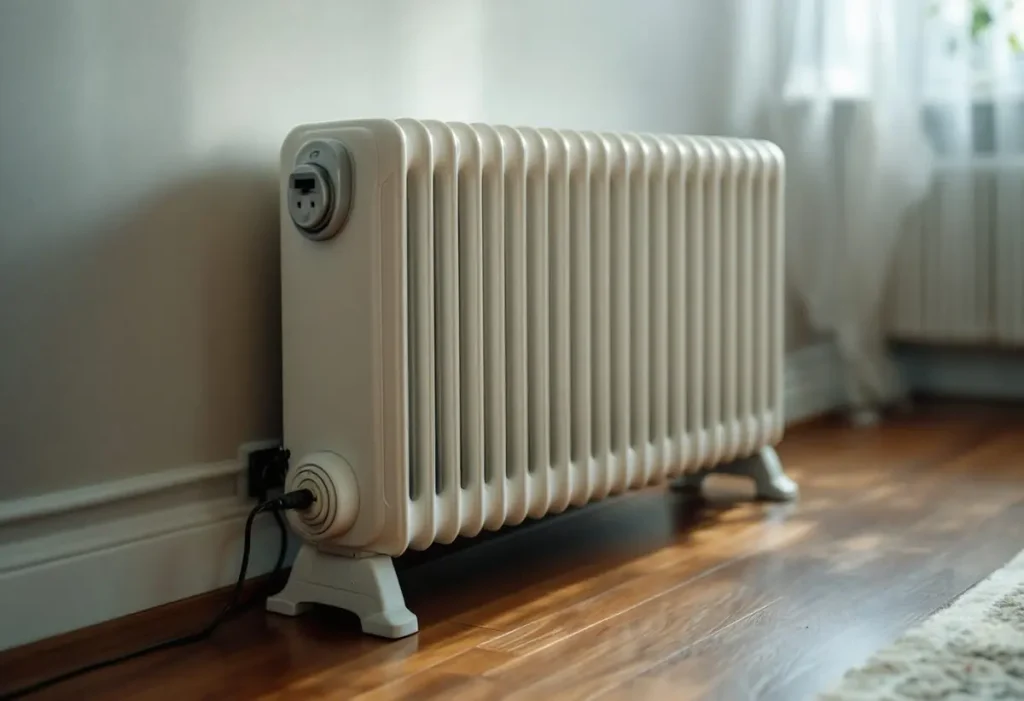
How long should a new electric heater smell when first turned on? From minutes to days, by maker
It depends on the heater type, and the useful test is your own maker’s window: Comfort Zone says “a few minutes,” Dimplex and Cadet say “within several hours,” and Fujitsu allows “a few days” for strip heat with construction dust.
| Maker and model | Heater type | Cause the maker gives | How long the maker says | What the maker says to do |
|---|---|---|---|---|
| Comfort Zone CZ40E | Fan-forced space heater | Element lubrication | “after a few minutes of use” | Keep birds and small pets away |
| Dr Infrared DR-910F | 240 V wall or ceiling garage heater | “a drop of oil fell on the heating coil” | “will quickly evaporate” | Ventilate; combustibles 3 feet away |
| Utilitech HTFN1003N | Compact heater and fan | Heat-resistant coating | “the first few hours of operation” | Pre-burn in an open garage |
| Marley Qmark FBE15002 | Portable baseboard, 1500 W | “a new smell” on initial use | “within the first few hours of operation” | Vacuum lint from the fins |
| Cadet portable baseboard | Portable baseboard | Residue from manufacturing | “within several hours” | If it persists, unplug; call Cadet |
| Dimplex T Series | Hardwired baseboard | “the manufacturing process” | “within several hours” | 30 minutes on high; glowing red means breaker off |
| Fujitsu F1T Series | Air handler with electric strip heat | Construction dust | “for a few days” | Clean elements with low-pressure air |
The spread runs from “a few minutes” (Comfort Zone) to “a few days” (Fujitsu). A start-of-season dust smell on an older heater should sit at the short end. The oil filled radiator page quotes De’Longhi’s 2 hour first run, and the smell after a new furnace is installed follows the same coating logic.
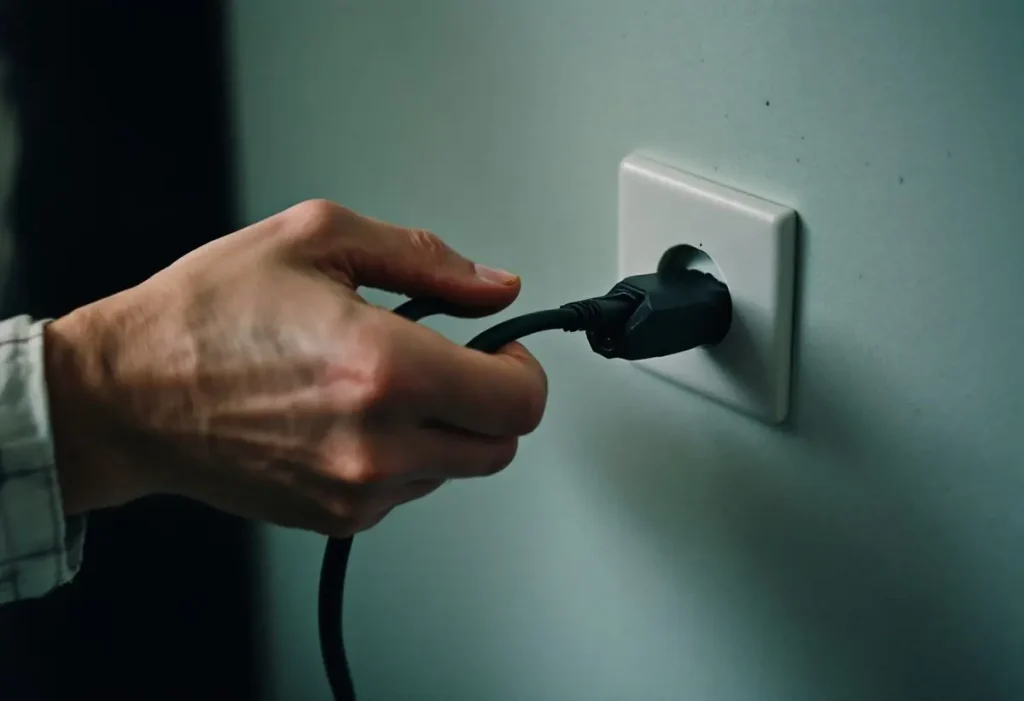
Why does the plug or wall outlet smell like burning plastic?
Because the connection, not the heater, is overheating: a 1500 W space heater draws 12.5 amps at 120 V, and a loose or worn receptacle turns that current into heat at the plug blades. The Marley FBE15002 nameplate lists exactly 12.5 amps on high, and its manual says to stop using the heater on a loose or worn outlet “until the outlet can be replaced.”
A warm cord alone is not the fault. Utilitech’s HTFN1003N manual rates its cord to 221°F, but says heat, smoke or melting at the outlet “may be due to loose or worn wall contacts (or arcing)” and to stop using the heater. CPSC agrees: a hot plug means repair, a hot outlet means an electrician.
CPSC’s January 2026 release says to plug space heaters “directly into a wall outlet,” never a power strip, and counts 1,600 fires a year from portable heaters, 2020 to 2022. If the circuit also trips, see the space heater tripping breaker worked example, and the fire record in our space heater cost and safety breakdown.
The electrician checks the receptacle’s grip on the blades, browning on the face plate, the terminal behind it and other loads on the 120 V circuit. A melted receptacle is replaced. Leave the cover plate on.
Why does a baseboard or wall heater smell like burning every fall?
Lint collects on idle fins all summer. Cadet’s portable baseboard troubleshooting table lists two causes for a heater that “smells when first plugged in or after not being used”: the factory odor, and “dust or lint inside the heater,” fixed by cleaning.
The smell that comes back on every cycle in January is the one to act on. Dimplex tells T Series owners that a heater “glowing red or repeatedly getting unusually hot and shutting off” needs the circuit breaker turned off. Fan-forced wall heaters add a motor: in September 2024 CPSC announced a recall of about 12,900 Cadet Apex72 units because “the fan can malfunction and fail to turn on causing the unit to overheat and ignite internally.” How each is built: electric baseboard heaters and the wall heater.
Check what touches the heater: curtains and furniture scorch. The US Fire Administration found that the leading factor in portable heater fires in residential buildings from 2017 to 2019 was a heat source too close to combustibles, at 48%.
Why does electric heat smell like burning from the vents?
In a heat pump or electric furnace, the burning smell comes from the strip heater elements in the air handler, and dust that reaches them gets charred and blown through the house. The Fujitsu F1T air handler manual says “electric strip heater elements tend to emit a burning odor for a few days if dust has accumulated during construction” and that circulated dust “could be heated and charred by contact with the air handler elements.”
A heat pump that only smells on the coldest mornings is likely bringing its strips on for the first time that season; the guide to whether you need heat strips explains when they run. A smell past a few days, or with a breaker trip, is a service call: the technician checks blower speed against minimum heating airflow, each element’s amp draw, the limit switches and melted insulation at the terminals. Those are 240 V circuits; your part is the filter. The HVAC smells guide covers musty and sour smells from the same ducts.
Can an electric heater smell like rotten eggs, gas or chemicals?
Not rotten eggs: an electric heater burns no fuel, so a sulfur smell is the odorant in natural gas, which 49 CFR 192.625 requires to be detectable at one-fifth of the lower explosive limit. Leave the house and call the gas utility from outside; our furnace smells like gas page has the full sequence.
A sharp “chemical” smell on a new heater is the factory coating. Comfort Zone’s CZ40E manual says the fumes from initial use “are not harmful to humans” but advises against running the heater near birds and small pets “until the manufacturing corrosion coatings burn off.”
What should you do, in order, when the burning smell will not fade?
Work from the outlet inward, where Utilitech, Marley and CPSC put the stop line.
- Switch off and unplug by the plug body; hardwired units, breaker off.
- Browning or melting on the plug or outlet: retire that outlet until an electrician checks it.
- Clear 3 feet around the heater, per CPSC.
- Once cool, vacuum the grille and fins.
- Run it once on high for 30 minutes, window open, as Dimplex instructs.
- Smell returns, or smoke or glowing: stop and check CPSC’s recall list.
Frequently asked questions
Is it okay if my heater smells like burning?
Yes, briefly, on a new heater or the first cold day. Cadet and Dimplex say first-start odor typically goes away within several hours, and Comfort Zone says a few minutes. A smell past that window, at the plug, or every cycle is not okay: unplug and check the outlet.
Why do I smell electrical burning but nothing is burning?
The heat is often at a connection you cannot see, such as plug blades in a loose receptacle. Utilitech’s manual names loose or worn wall contacts and arcing as the cause of heat or melting at the outlet. A hot outlet means a certified electrician, per CPSC.
Why does my electric heater smell like burning hair?
Hair and lint pulled onto the hot element char on contact. Cadet lists dust or lint inside the heater as a cause of a heater that smells after not being used, and the fix is cleaning. Unplug it, let it cool, and vacuum the fins as Marley’s FBE15002 instructions describe.
Is there a smell before an electrical fire?
Sometimes, but do not rely on it. Utilitech’s manual treats heat, smoke or melting at the outlet as a sign of arcing. Many heater fires involve no electrical fault: USFA found the leading factor, at 48%, was a heat source too close to combustibles. CPSC says to put smoke alarms on every level.
Why does my electric heater smell like burning when first turned on?
Dust that settled since the last run burns off first, which is normal if it fades quickly. A smell that builds points to packed lint or something touching the grille. The Fujitsu F1T manual says circulated dust can be charred by the elements, so clean the heater and change any duct filter.
How we researched this
On November 17, 2026 we read the 7 maker manuals in sources 1 to 7 (Fujitsu via a mirror copy), three CPSC documents, the USFA portable heater fire report and 49 CFR 192.625. Seven air handler and heat kit manuals (Lennox, Nortek H6HK, Bard, MRCOOL) describe no burning odor, so they are not quoted. Excluded: contractor blogs, Reddit, Quora, and claims that a fishy smell has a specific chemical cause, which no primary document supports. We tested no heaters.
Sources
- Comfort Zone. “CZ40E Series Heater Owner’s Manual.” https://pdf.lowes.com/productdocuments/23ae6135-9a69-4216-be56-13d7e18a6c9a/49803275.pdf. Accessed November 2026.
- Dr Infrared Heater. “DR-910F Owner’s Manual.” https://images.homedepot-static.com/catalog/pdfImages/3e/3e843eeb-d370-4241-91cb-0d76eabcc208.pdf. Accessed November 2026.
- Utilitech (LF, LLC). “HTFN1003N Manual.” https://pdf.lowes.com/productdocuments/7eb51837-1f14-4972-8f47-42a01f8da545/68421107.pdf. Accessed November 2026.
- Marley Engineered Products. “Qmark FBE15002 Instructions.” https://s3.amazonaws.com/s3.supplyhouse.com/product_files/Qmark%20%2D%20FBE15002%20%2D%20Install%20Instructions.pdf. Accessed November 2026.
- Cadet (Glen Dimplex Americas). “Owner’s Guide: Portable Baseboard.” https://images.thdstatic.com/catalog/pdfImages/e8/e8a32315-9680-4c62-8d31-ce40eaf694c4.pdf. Accessed November 2026.
- Dimplex. “Owner’s Guide: T Series Electric Baseboard.” https://www.dimplex.com/sites/g/files/emiian436/files/2021-12/uslvjmln52nriu3vwzaj.pdf. Accessed November 2026.
- Fujitsu. “F1T Series Air Handler User Manual” (third-party mirror copy). https://manualedistruzioni.it/fujitsu/air-handler/f1t-series/user-manual/1g7xm. Accessed November 2026.
- US Consumer Product Safety Commission. “7 Highly Effective Portable Heater Safety Habits.” https://www.cpsc.gov/s3fs-public/PortableElectricHeaterSafetyNSN.pdf. Accessed November 2026.
- US Consumer Product Safety Commission. “Keep Warm and Safe This Winter” (archived copy). https://web.archive.org/web/20261024092112/https://www.cpsc.gov/Newsroom/News-Releases/2026/Keep-Warm-and-Safe-This-Winter-Tips-for-Using-Generators-Furnaces-and-Space-Heaters. Accessed November 2026.
- US Consumer Product Safety Commission. “Cadet Apex72 Electric Heaters recall” (archived copy). https://web.archive.org/web/20260721160347/https://www.cpsc.gov/Recalls/2024/Glen-Dimplex-Americas-Recalls-Cadet-Apex72-Electric-Heaters-Due-to-Fire-Hazard. Accessed November 2026.
- US Fire Administration. “Portable Heater Fires in Residential Buildings (2017-2019).” https://www.usfa.fema.gov/statistics/reports/fire-causes/portable-heater-fires-residential-buildings-v21i11.html. Accessed November 2026.
- eCFR. “49 CFR 192.625: Odorization of gas.” https://www.ecfr.gov/current/title-49/section-192.625. Accessed November 2026.
Leave a Reply