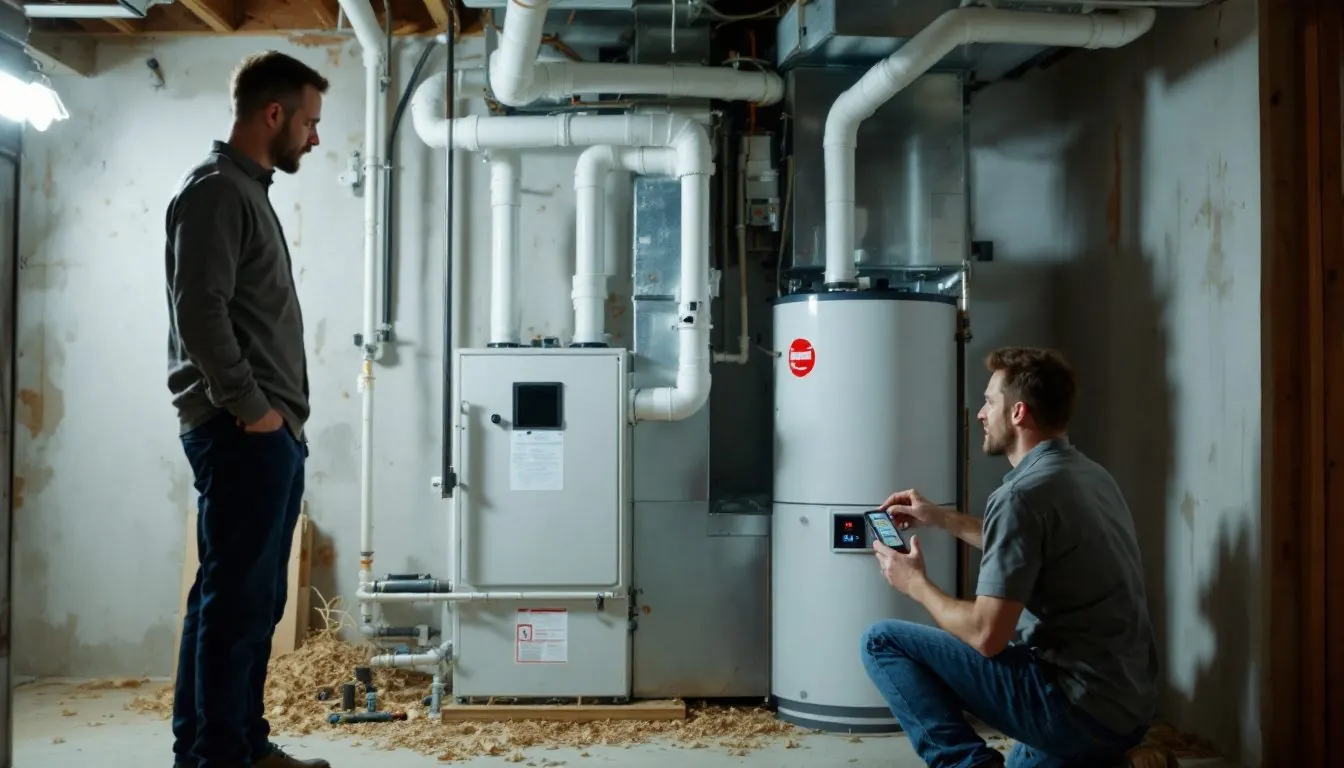
A smell after a new furnace is installed is usually the factory finish and installation dust burning off, and Lennox says the finish odor should clear after a few hours of running in a ventilated house. A rotten egg smell means leave and call the gas utility; burning plastic, hot wiring or exhaust means shut the furnace off.
What matters is which smell it is and how long it has lasted. For odors from a system that has run for years, our guide to what HVAC smells mean is the better starting point.
Which smell is the new furnace giving off, and what does each one mean?
Hot dust and a mild hot-paint smell in the first hours are expected; gas odorant, hot wiring and exhaust are never expected. If the odor is exhaust, furnace exhaust smell in the house starts with the CO alarm, shutting the burners off and airing the house. Each row names the Lennox, Carrier, federal or EPA document behind it.
| Smell | Likely source on a new install | What the maker or agency says | What to do now |
|---|---|---|---|
| Hot dust, from the registers | Dust on the heat exchanger and in new ducts | Carrier: about 30 minutes to a few hours; Lennox: run it an hour or two | Keep heating, ventilate, check the filter |
| Mild chemical, strongest at the cabinet | Protective finish heating for the first time | Lennox: should disappear after a few hours in a well-ventilated home | Open windows, run a long heat call |
| Solvent or glue | Primer and cement on new PVC vent and drain joints | Lennox EL196UHE: let glue fumes dissipate at least 5 minutes before startup | Ventilate; still strong days later, ask for a vent check |
| Rotten egg or sulfur | Gas odorant from a leaking new connection | 49 CFR 192.625: gas must be detectable at one-fifth of the lower explosive limit | Leave, call the gas supplier from outside |
| Burning plastic, hot wiring, metallic | Overheating motor or wiring, or debris left inside | Carrier: potentially serious; Lennox: metallic can mean a serious electrical problem | Turn the furnace off |
| Exhaust, stinging eyes | Flue gas from a vent connection | EPA: furnaces emit CO if the flue is improperly sized, blocked or disconnected | Shut off, ventilate, call the installer |
| Oily | Oil furnaces only | Carrier: oil leak, burner or heat exchanger problem on an oil furnace | Turn off if strong or persistent |
| Wet drain or sewer | Dry condensate trap, or the floor drain it empties into | Lennox: prime the trap with 10 fl. oz. (300 ml) before startup; no maker text we read ties a sewer smell to the furnace | Ask if the trap was primed; a floor drain smell is plumbing |
Compiled by The HVAC Brief from Lennox and Carrier odor pages, the Lennox EL196UHE manual, 49 CFR 192.625 and EPA, November 2026.
How long should a new furnace smell last: one hour, one day or one week?
The maker documents put the normal window at hours, not days: Carrier gives 30 minutes to a few hours for burning dust at a season’s first firing, and Lennox says a few hours for a new furnace’s finish. Carrier’s line for action is a smell that lasts longer than a few hours, becomes stronger or returns repeatedly.
A smell still there on day 2 is past both the Carrier and the Lennox windows. That does not prove a fault, but it turns “wait it out” into a call back to the installer, who holds the startup readings.
Is the burning smell from the new furnace’s finish or from construction dust?
If the smell is strongest at the cabinet, it is most likely the finish; if it is strongest at the registers, it is most likely dust in the ducts. Lennox describes the first case: “When a new furnace is initially heated, its protective finish starts to burn, which can cause a mild, chemical-like smell.”
Dust is the bigger factor when the furnace went in during a remodel. Goodman’s GM9S80 manual lets the furnace heat a construction site only if filters are “replaced daily during construction and upon completion of construction” and the heat exchanger, ducts and coil are “thoroughly cleaned following final construction clean up.” It adds that a new home “may require more frequent replacement until all construction dust and dirt is removed.” After drywall sanding, a fresh filter is the first fix; Carrier’s guidance is 30 to 90 days for basic 1-inch filters, and our HVAC filter guide covers sizes.
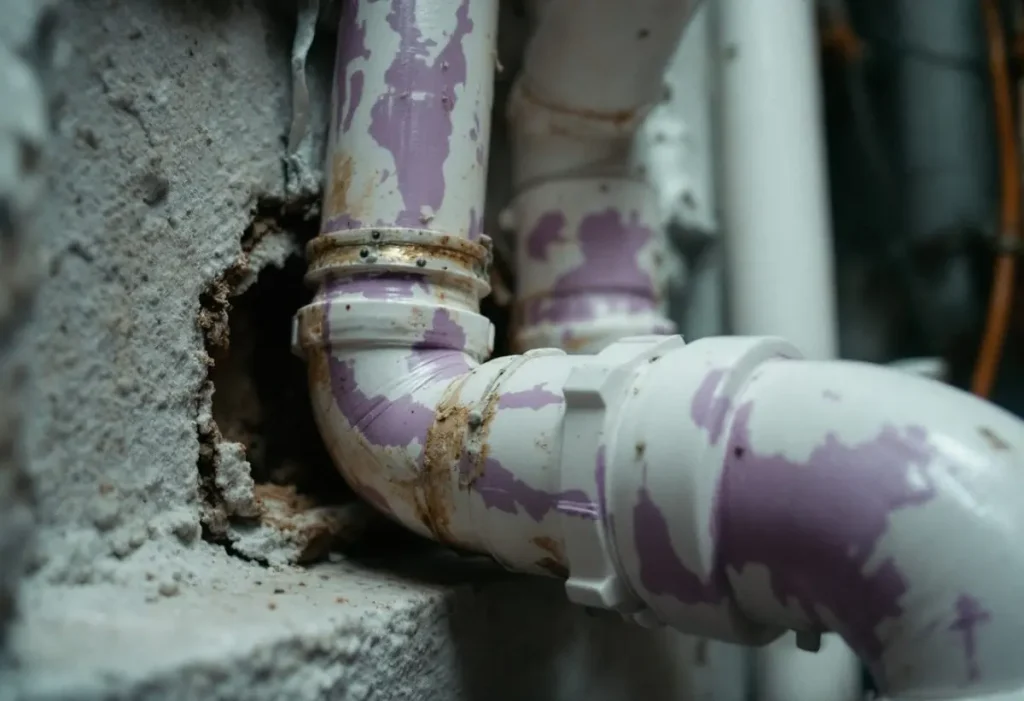
Why does a new high-efficiency furnace smell like PVC glue?
Condensing furnaces vent through plastic pipe glued on site, and the solvents smell strongly while they flash off. Lennox’s EL196UHE manual warns that “Fumes from PVC glue may ignite during system check” and requires at least 5 minutes for them to dissipate before startup.
Its vent tables list 1-1/2, 2, 2-1/2 and 3 inch pipe, all in the 1½ to 3 inch row of Oatey’s chart:
| Temperature while the joint sets | Oatey handling/set time, PVC | Oatey cure time, up to 180 psi |
|---|---|---|
| 60°F to 100°F | 5 minutes | 30 min |
| 40°F to 60°F | 10 minutes | 45 min |
| 20°F to 40°F | 12 minutes | 60 min |
| 0°F to 20°F | 15 minutes | Oatey says contact its technical services |
Compiled by The HVAC Brief from Oatey’s “Solvent Weld Cure Times” chart (LCS358G, 11/20), 1½ inch to 3 inch PVC and ABS row. Oatey adds 50% in damp or humid weather and defines cure as the time before pressure testing; it publishes no odor duration.
So a glue smell on the first afternoon is ordinary; one that grows each time the burners fire on day 3 is not. Joints in a 40°F to 60°F basement pass Oatey’s cure time within an hour, so a smell that tracks the heat cycle means the vent should be inspected. Lennox notes that a gap in the cement bead “may indicate an improper assembly,” and our page on furnace vent pipe termination clearances lists the distances from windows an inspector checks.
What should you do about a gas smell after a new furnace installation?
Leave the house and call the gas supplier from outside; do not try to find the leak. The rotten egg smell is added on purpose: 49 CFR 192.625 requires gas in a distribution line to be odorized so it is “readily detectable by a person with a normal sense of smell” at one-fifth of the lower explosive limit.
Goodman’s manual spells it out: do not light any appliance, touch any electrical switch or use any phone in the building; call the gas supplier from a neighbor’s phone, or the fire department if the supplier cannot be reached. Before the unit runs, Goodman requires the new connections to be leak tested with “an approved chloride-free soap and water solution, an electronic combustible gas detector, or other approved testing methods.”
Propane homes cannot rely on the nose. Goodman says “Rust can reduce the level of odorant in propane gas. Do not rely on your sense of smell,” and Lennox says LP settles near the floor and a leak detector belongs in all LP applications. Why propane changes the sniff test, and what the gas company checks when no leak is found, is covered in furnace smells like gas.
Can a new furnace make you sick, and can you smell carbon monoxide?
The burn-off odor can irritate, but the dangerous gas has no smell. EPA lists eye, nose and throat irritation, headaches and nausea among the effects of volatile organic compounds, the family that finish and solvent odors belong to.
Carbon monoxide is different. EPA calls it “an odorless, colorless and toxic gas” and names furnaces as a source “if the flue is improperly sized, blocked or disconnected” or leaking, faults a new vent connection can have. Its symptom list includes headaches, dizziness, nausea and “flu-like symptoms that clear up after leaving home.” Symptoms that fade when you leave point at CO, not burn-off.
Carrier’s OM58 owner’s manual recommends a CO alarm “in the living area of your home and away from gas appliances and doorways to attached garages.” Code rules are on our carbon monoxide detector placement page; whether a smell signals a split heat exchanger is covered in our cracked heat exchanger explainer.
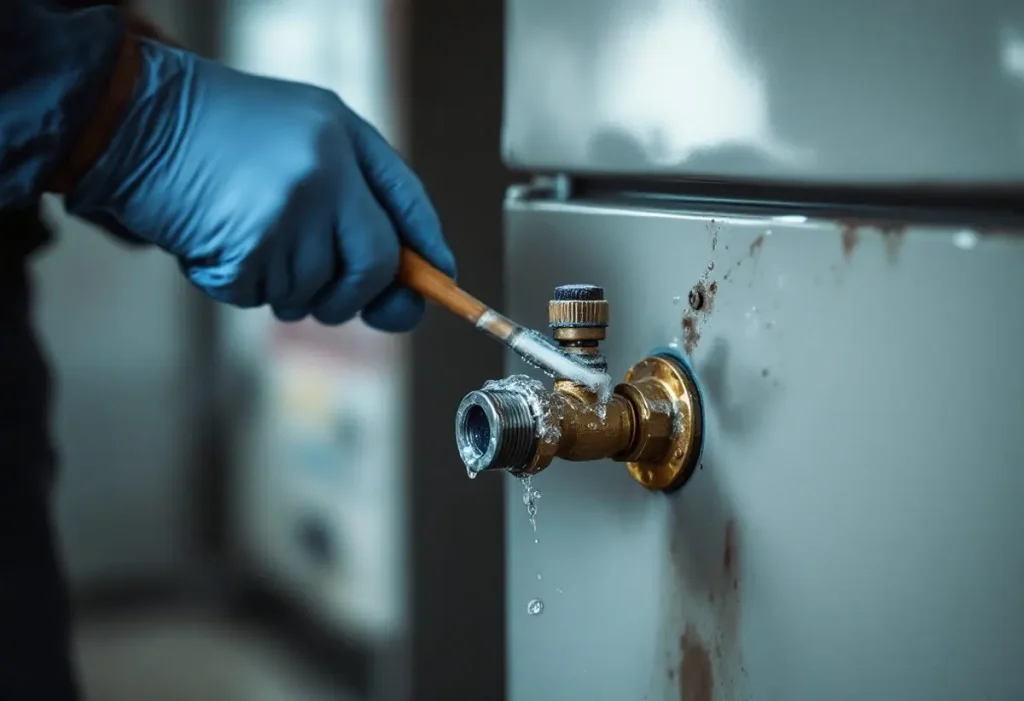
What should the installer check if a smell after a new furnace installed will not fade?
A callback should produce numbers: a gas leak test, the manifold pressure and the temperature rise. Goodman’s GM9S80 manual says manifold pressure “must be within 0.3 inches w.c.” of the specification sheet value and the air temperature rise “must be within the range listed on the furnace nameplate.”
On a condensing furnace, also ask whether the condensate trap was primed. Lennox has installers pour 10 fl. oz. (300 ml) of water into the EL196UHE trap, or fire the burners for about 3 minutes twice, and route the line to an open drain. Ask to see the vent joints at the furnace and at the wall or roof. Our HVAC installation day checklist lists startup items to get in writing, and the furnace replacement guide covers decisions made before the box arrives.
Frequently asked questions
Is a burning smell after a new furnace installed normal?
A light burning smell in the first hours is normal. Carrier says burning dust lasts about 30 minutes to a few hours, and Lennox says the new finish smell should disappear after a few hours in a well-ventilated home. Carrier’s trigger for an inspection is a smell that lasts longer, gets stronger or keeps returning.
Why does my whole house smell after a new furnace?
The blower carries whatever the heat exchanger and ducts give off to every room, so a whole-house smell on day 1 is usually dust and finish burn-off. After a remodel, Goodman’s manual calls for cleaning the ducts, filters and coil after final construction cleanup and more frequent filter changes in a new home.
Should I open windows after a new furnace is installed?
Yes, for the first heat calls. Lennox’s advice for the new-finish odor is a few hours of running in a well-ventilated home, and EPA’s first step to reduce exposure to volatile organic compounds is to increase ventilation. Open windows do not fix a gas, wiring or exhaust smell; those still mean shutting the furnace off.
Is it safe to sleep in the house with a new furnace smell?
A fading dust or finish smell is not carbon monoxide, which EPA describes as odorless and colorless. That is why a working CO alarm belongs in place before the first night, in the living area and away from gas appliances, as Carrier’s owner’s manual says. Any rotten egg smell means leaving the house.
How we researched this
On 6 November 2026 we read the Lennox EL196UHE installation instructions (507764-06), Goodman’s GM9S80 and GC9S80 installation instructions, Carrier’s OM58-131 owner’s manual, the Lennox and Carrier homeowner pages on furnace odors, Oatey’s solvent weld cure chart (LCS358G), the eCFR text of 49 CFR 192.625, and EPA’s indoor air pages on carbon monoxide and volatile organic compounds. The 4 top-ranking articles cited no source for their durations, so none were used; contractor blogs and forums were excluded, and no installed prices appear because no federal source measures them. Durations are the makers’ statements, not our measurements.
Sources
- Lennox. “Does Your Heater Smell Like It’s Burning?” https://www.lennox.com/residential/lennox-life/consumer/does-your-heater-smell-like-it%27s-burning. Accessed November 2026.
- Carrier. “Burning Smell in House? Causes and Solutions for Furnace Odors.” https://www.carrier.com/residential/en/us/products/furnaces/burning-smell-in-house/. Accessed November 2026.
- Lennox Industries. “Installation Instructions, EL196UHE Elite Series Gas Furnace, 507764-06.” https://www.lennox.com/dA/77ba4690a5/507764-06g.pdf. Accessed November 2026.
- Goodman Manufacturing. “Installation Instructions for *M9S80 and *C9S80 Gas Furnace.” https://documents.alpinehomeair.com/product/goodmangm9s8gc9s8installationmanual.pdf. Accessed November 2026.
- Carrier Corporation. “Induced Combustion Gas Furnace Owner’s Manual, OM58-131.” https://www.shareddocs.com/hvac/docs/1009/Public/01/OM58-131.pdf. Accessed November 2026.
- Oatey. “Solvent Weld Cure Times, LCS358G.” https://www.oatey.com/sites/default/files/2020-11/01_SolventWeldCureTimes_CureChart_LCS358G.pdf. Accessed November 2026.
- eCFR. “49 CFR 192.625 Odorization of gas.” https://www.ecfr.gov/current/title-49/section-192.625. Accessed November 2026.
- U.S. EPA. “Carbon Monoxide’s Impact on Indoor Air Quality.” https://www.epa.gov/indoor-air-quality-iaq/carbon-monoxides-impact-indoor-air-quality. Accessed November 2026.
- U.S. EPA. “Volatile Organic Compounds’ Impact on Indoor Air Quality.” https://www.epa.gov/indoor-air-quality-iaq/volatile-organic-compounds-impact-indoor-air-quality. Accessed November 2026.
Leave a Reply