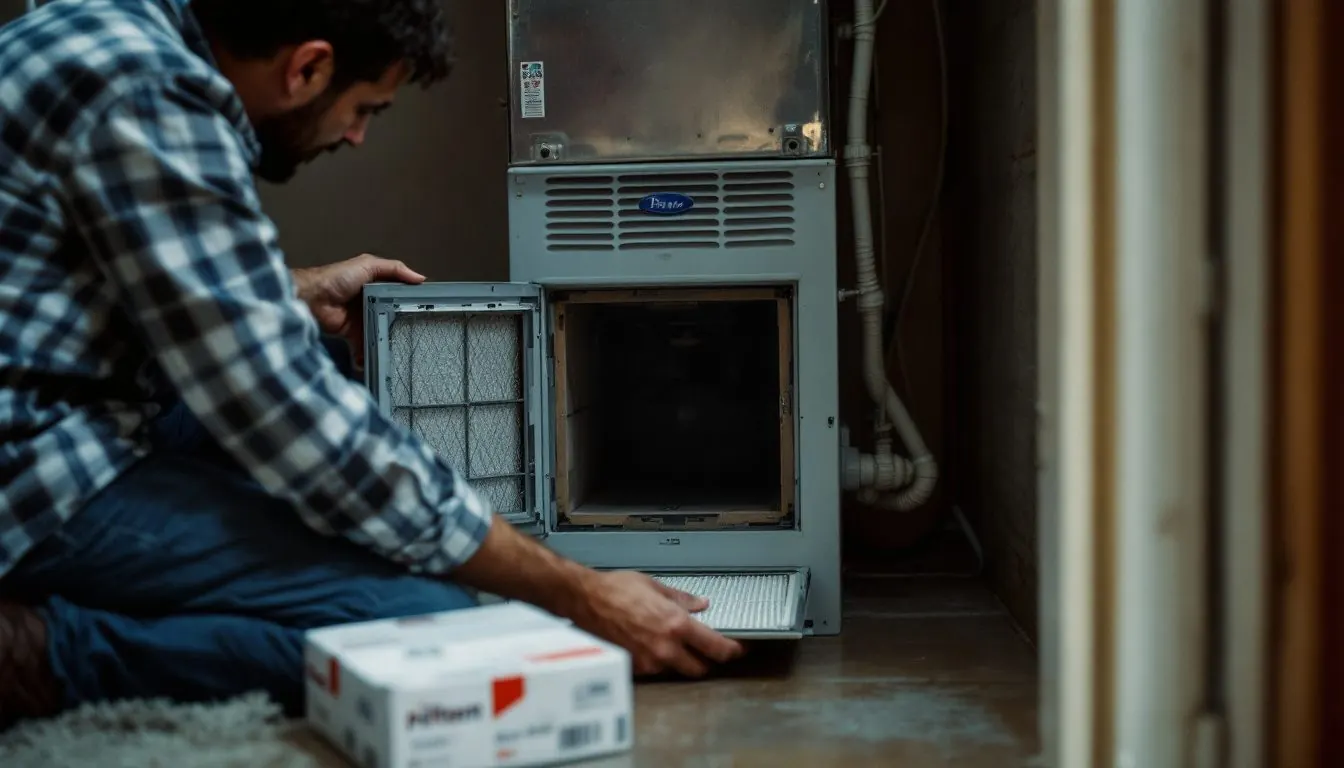
Can you run AC without a filter? For a night or a few days, yes: nothing breaks right away. But dust starts landing on the indoor coil at once. In Purdue lab tests, a year’s worth of dust with no filter left about 300 grams on the coil, against 4 to 50 grams with any filter in place.
How many hours or days can you run AC without a filter before it matters?
No manual or lab paper we read sets an hour limit, and the “6 to 8 hours” figures on today’s top results cite nothing. The research gives a loading rate instead, which scales to any gap.
At Purdue’s Ray W. Herrick Laboratories, Yang, Braun and Groll fed 600 grams of ASHRAE test dust, which they say “was meant to simulate a year of operation in the field,” through a 0.372 square meter coil with five filter grades and with none. We divided that year by days:
| Time without a filter | Share of one year’s dust | Dust on the coil, no filter | Dust on the coil, any filter (upper end) | Rise in coil pressure drop, 2-row coil (ceiling) |
|---|---|---|---|---|
| A few hours, or one night counted as a full day | 0.27% | 0.8 g | 0.14 g | 0.6% or less |
| 3 days | 0.82% | 2.5 g | 0.41 g | 1.7% or less |
| 1 week | 1.9% | 5.8 g | 0.96 g | 3.9% or less |
| 1 month | 8.2% | 25 g | 4.1 g | 16.5% or less |
| A 91 day cooling season | 25% | 75 g | 12.5 g | 50% or less |
| 1 year (measured) | 100% | about 300 g | 4 to 50 g | 201% (measured) |
HVAC Brief calculation: Purdue R113 one year values multiplied by days divided by 365. LBNL measured coil pressure drop rising geometrically with deposited mass, so the straight-line shares in the last column are ceilings for short gaps, not predictions.
One night adds under 1 gram. One month with an empty slot adds about 25 grams, inside the 4 to 50 gram range a coil collects in a full year behind a filter.
Real homes can load faster: the Purdue “year” is an assumption, and its ASHRAE dust (72% silica test dust, 7.7 micrometer mass mean diameter) has no pet hair. LBNL’s 2002 model found continuous fan operation cut coil fouling time to 30% of the cycling case, so the thermostat fan setting matters too.
What lands on the evaporator coil when the filter slot is empty?
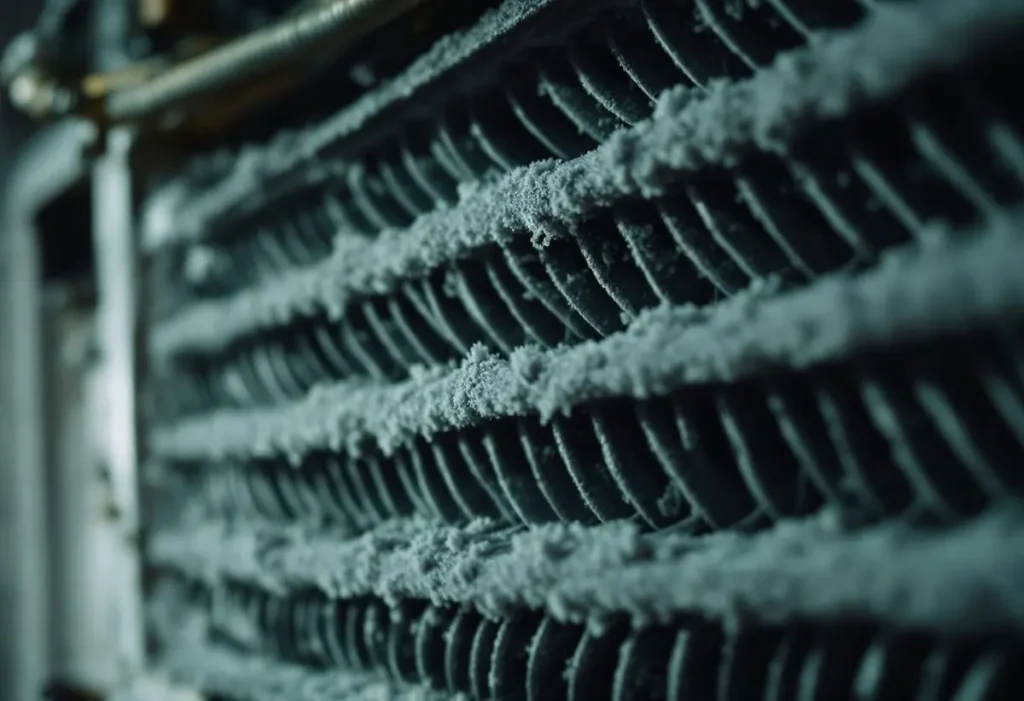
About half of the dust in the airstream. In Purdue’s no-filter runs roughly 300 of the 600 grams stuck to the coil and 30% passed through it; filtered runs left 4 to 50 grams. That is 6 to 75 times as much coil dust without a filter.
Even the cheapest filter does most of the work. The MERV 4 fiberglass pad Purdue tested is listed at 75% to 80% arrestance, and with it 15.5% to 18.8% of the dust passed the coil instead of 30%. The dust that did reach the coil piled on its entering face; the authors noted “the rear of the coil was very clean compared to the front,” which is the face indoor coil cleaning has to reach.
Shallow, tightly finned coils take the hardest hit, and those are the residential ones. With no filter, Purdue measured the coil pressure drop rising about 45% on an 8-row coil, 108% on a 4-row coil and 201% on a 2-row, 14 fin per inch coil, the geometry it modeled in a 3-ton unit.
Does a missing filter cut cooling or raise the power bill right away?
No. For the first hours it does the opposite, because a filter adds resistance. Purdue’s equipment model found “The clean equipment without an upstream filter worked at the highest EERs for all coil cases.” The airflow penalty belongs to a clogged filter; Trane’s TUH2 manual warns that “Excessive accumulation can block the airflow.” A missing filter is a dust problem that compounds.
The cost shows up as the coil loads. After the full year of dust with no filter, Purdue’s modeled 3-ton unit lost about 5% of its cooling capacity and 10% of its EER. LBNL’s 2002 ACEEE paper puts a coil whose pressure drop has doubled at 5% to 10% less airflow and 2% to 4% less efficiency and capacity, then 10% to 20% less airflow and 5% to 15% degradation after twice as long. Systems already short of air fare worse, which is the starting point of our guide to an AC coil freezing up.
Can you run a furnace or heat pump without a filter for a day?
For a day, the dust arithmetic is the same, because the blower and indoor coil sit in one airstream in both seasons. Trane’s TUH2 furnace manual says the furnace “should never be run without a filter” and “Never operate your unit for either heating or cooling with filters removed.”
Carrier and its Bryant brand name the parts at risk. Bryant’s 355CAV service manual says running without a filter “could cause damage to the furnace blower motor” and that “Dust and lint on internal parts of furnace can cause a loss of efficiency.” Carrier’s 58MCA instructions say ignoring the warning “could result in a fire or personal injury.” The blower motor and wheel are the first parts unfiltered air reaches in a furnace.
Stop line for gas furnaces
Bryant prints its no-filter warning under a CARBON MONOXIDE POISONING HAZARD heading that also covers running with the blower access panel removed. Never run a gas furnace with that door off. When a new filter goes back in, its arrow should point toward the blower, and a furnace filter put in backwards is worth replacing if it has run that way for weeks.
Does running without a filter void the furnace or AC warranty?
None of the warranty texts we read names a missing filter, but all of them leave room to deny a claim. Goodman’s warranty FAQ excludes “Damage or the need for repairs resulting from any improper use, maintenance, operation, or servicing” and lists “filter cleaning and/or replacement” as normal maintenance the owner pays for. The CAC/BDP (Carrier and Bryant) ductless warranty excludes failure due to “improper operation.”
Since the Carrier, Bryant and Trane manuals all define proper operation as running with a filter, a lint-matted coil gives the maker grounds; using them is its call, claim by claim.
What should you do tonight if there is no spare filter?
Move as little air as possible across the bare coil and fit any filter within 1 or 2 days. In order:
- Set the thermostat fan to AUTO, not ON.
- If the weather allows, switch the system off until a filter arrives.
- Fit any filter that matches the slot size, even a cheap fiberglass pad: every filter Purdue tested, MERV 4 up, held coil dust to 50 grams or less a year.
- For a washable filter, Bryant says to spray cold tap water through it against the airflow, then “Rinse filter and let dry.”
- Keep the filter door and blower door closed, per Carrier 58MCA and Bryant 355CAV.
We found no lab data on improvised media such as cloth. Our filter sizing guide covers nominal versus actual dimensions, and MERV and airflow explains why the top rating is not automatically right for a 1 inch slot.
After weeks without a filter, how does a technician tell if the coil is fouled?
By measuring. LBNL’s authors call for “measurement of air flow, coil inspection for low flow situations, and verified cleaning,” and say cleaning should bring the pressure drop back “to the manufacturers specified value.” Ask for three readings: coil pressure drop against the maker’s figure at measured airflow, total external static pressure, and the temperature split across the coil.
By the table, a month bare is roughly a filtered year of coil loading: a cleaning question, not a reason to buy a coil. Evaporator coil replacement is for leaks and corrosion. LBNL also cautions that cleaning may push dirt “deeper into the coil,” so a before and after pressure reading matters more than a shiny face.
Frequently asked questions
Can you run AC without filter for a few hours?
Yes. A few hours is a fraction of the one day row in our table: under 0.8 grams of coil dust in Purdue’s terms, against about 300 grams for a full year with no filter. The Carrier, Bryant and Trane manuals set no hour limit; they say not to run without one, so treat it as a stopgap.
Can you run AC without filter for one night?
Yes, with little measurable effect. One night, counted as a full day, is about 0.27% of the year of dust Purdue used, or roughly 0.8 grams on the coil, and the straight-line ceiling on added coil pressure drop is about 0.6%. Keep the fan on AUTO.
Can you run heat pump without filter?
Only as a stopgap, in either season. Trane’s TUH2 manual says never to operate “for either heating or cooling with filters removed.” In Purdue’s limited tests on an 8-row coil behind a MERV 11 filter, fouling raised pressure drop 17% to 25% on a dry coil against 2% to 8% on a wet one, so a winter gap may load the indoor coil faster than a summer one.
Can HVAC run without a filter?
Mechanically, yes: Purdue’s model found clean equipment without a filter ran at its highest EER. The cost is dust. With no filter, 30% of the test dust passed the coil toward the rooms, nearly 60 times the MERV 14 figure. A filter that stays oddly clean is a separate problem: why a furnace filter never gets dirty.
How we researched this
We read in full the two 2004 Purdue IRACC papers by Yang, Braun and Groll (R113 and R114, archived copies; the Purdue PDFs returned a bot check), the abstract of the 2007 journal version, the 2002 LBNL ACEEE paper, the Carrier 58MCA, Bryant 355CAV and Trane TUH2 manuals (Trane via a ManualsLib mirror) and the Goodman and CAC/BDP warranty texts. We did no home testing, and excluded the unsourced hour limits on top search results and all installed prices. Research date: November 2026.
Sources
- Yang, L., Braun, J. E. and Groll, E. A. “The Impact of Fouling on the Performance of Filter-Evaporator Combinations.” International Refrigeration and Air Conditioning Conference at Purdue, 2004, paper R113 (archived copy). https://web.archive.org/web/2024id_/https://docs.lib.purdue.edu/cgi/viewcontent.cgi?article=1629&context=iracc. Accessed November 2026.
- Yang, L., Braun, J. E. and Groll, E. A. “The Impact of Evaporator Fouling on the Performance of Packaged Air Conditioners.” International Refrigeration and Air Conditioning Conference at Purdue, 2004, paper R114 (archived copy). https://web.archive.org/web/2024id_/https://docs.lib.purdue.edu/cgi/viewcontent.cgi?article=1686&context=iracc. Accessed November 2026.
- International Institute of Refrigeration. “The impact of fouling on the performance of filter: evaporator combinations” (International Journal of Refrigeration, 2007, abstract). https://iifiir.org/en/fridoc/the-impact-of-fouling-on-the-performance-of-filter-evaporator-127701. Accessed November 2026.
- Siegel, J., Walker, I. and Sherman, M. “Dirty Air Conditioners: Energy Implications of Coil Fouling.” Lawrence Berkeley National Laboratory, ACEEE Summer Study, 2002. https://www.aceee.org/files/proceedings/2002/data/papers/SS02_Panel1_Paper23.pdf. Accessed November 2026.
- Carrier. “58MCA 4-Way Multipoise Fixed-Capacity Direct-Vent Condensing Gas Furnace: Service and Maintenance Instructions.” https://www.shareddocs.com/hvac/docs/1009/Public/0C/58MCA-7SM.pdf. Accessed November 2026.
- Bryant Heating and Cooling Systems. “Plus 95s Model 355CAV Condensing Gas Furnace: Service and Maintenance Procedures” (SM05-06, 2007). https://www.shareddocs.com/hvac/docs/1009/Public/08/SM05-06.pdf. Accessed November 2026.
- Trane. “TUH2 User’s Information Manual,” page 6, ManualsLib mirror. https://www.manualslib.com/manual/511033/Trane-Tuh2.html?page=6. Accessed November 2026.
- Goodman. “What problems does the limited warranty not cover?” https://www.goodmanmfg.com/resources/faq/what-problems-does-the-limited-warranty-not-cover. Accessed November 2026.
- CAC/BDP (Carrier and Bryant). “Limited Warranty for Ductless Split Units.” https://www.shareddocs.com/hvac/docs/1009/Public/07/DLS-G454-02WAR.pdf. Accessed November 2026.
Leave a Reply