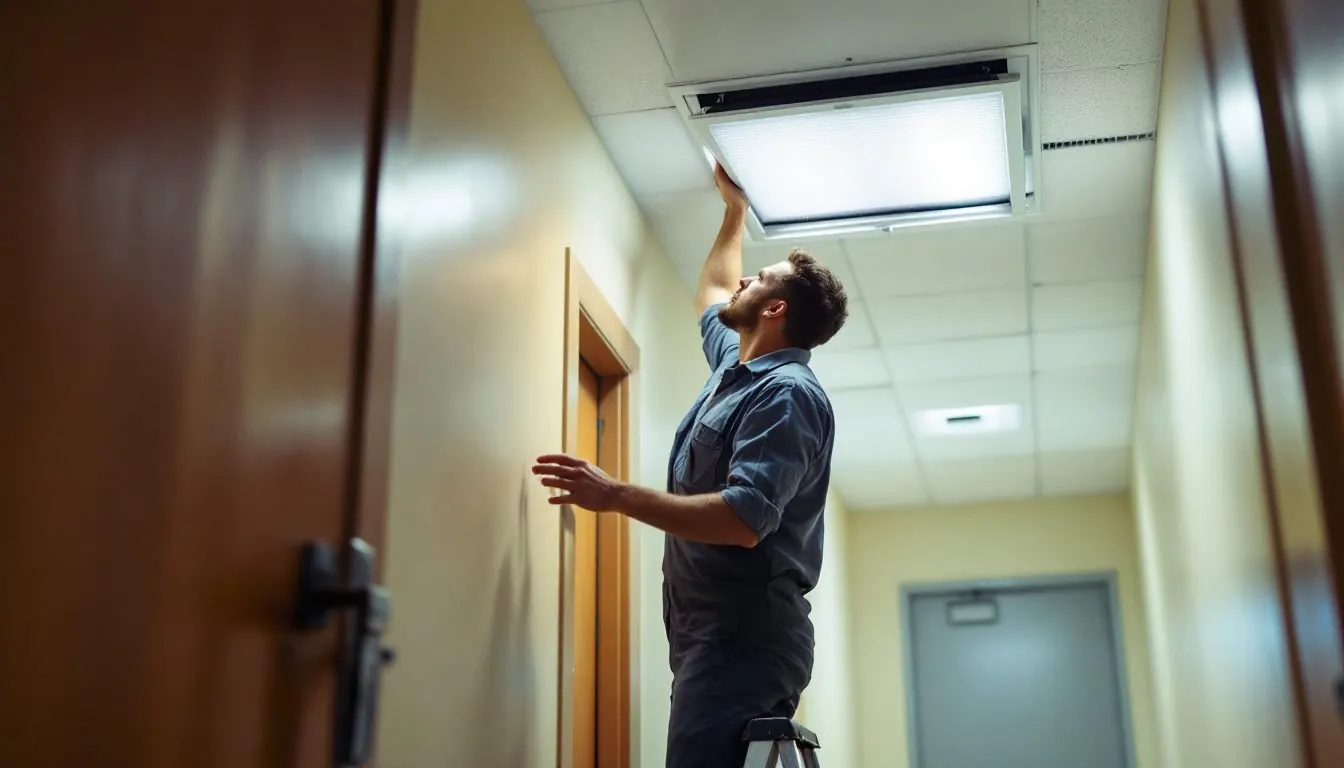
Why does my furnace filter never get dirty? Most often because little air crosses it or because the dust is too light to see: a modeled 16×25 filter gains about 2.3 grams in 90 days, under a penny’s weight. Heavy dust on the blower or coil points to air going around it.
Is a furnace filter that never gets dirty a bad sign, and which cause fits yours?
Not by itself. A clean filter is a fault only when air is missing it, and the first two checks settle that in about a minute.
| What you find | Likely cause | Reading that confirms it |
|---|---|---|
| Tissue falls off every return grille | Blower not moving air | No pull anywhere; technician checks motor and capacitor |
| Filter slides loose or light shows at its edges | Bypass gap at the slot | Visible gap plus heavy dust behind the filter |
| Grille filter, attic ducts, dust past the filter | Return duct leak after the filter | Duct test reports leakage in CFM25 |
| Filters at both a grille and the furnace | Second filter sees air already cleaned | Grille filter is gray, cabinet filter is white |
| Several filtered return grilles, one stays white | That grille moves little air | Tissue pull is weak there, strong elsewhere |
| Mild weather, or window units do the cooling | Low runtime | Under 389 hours in 90 days on the thermostat log |
| Pleated media 4 inches or thicker | Same dust spread over more media | Pressure drop rises while the face looks clean |
| Empty or lightly occupied house | Little dust to catch | Pressure drop flat within 0.02 in. w.c. |
Compiled by The HVAC Brief from EPA, DOE and the Stephens, Novoselac and Siegel Austin studies.
If the tissue test fails, our page on the furnace blower motor covers what the technician measures next. The opposite symptom has its own page: a furnace filter that turned black.
How much dust should a working filter catch in 90 days?
About 2 grams on a 16×25 filter, if the best available model holds, which is easy to miss by eye. Waring and Siegel predicted a median residential filter loading of 2.97 g per square meter per month. We multiplied that by filter face area.
| Nominal size | Face area | 3 months | 12 months |
|---|---|---|---|
| 16×20 | 0.206 m² | 1.8 g | 7.4 g |
| 16×25 | 0.258 m² | 2.3 g | 9.2 g |
| 20×25 | 0.323 m² | 2.9 g | 11.5 g |
HVAC Brief calculation: 2.97 g per m² per month, times nominal face area, times months. For scale, the US Mint lists a penny at 2.50 g (archived copy).
The figure is modeled, usable “once validated” in the authors’ words, and the abstract does not say whether area means filter face or pleated media; grams would run higher on media area. In the field, Mahdavi and Siegel vacuumed 0.02 to 11.4 grams from 41 filters loaded in homes, recovering only 1.8 to 72.9 percent of what those filters held.
So weigh it. Put a new filter on a scale that reads to 0.1 gram, write the weight on the frame, and reweigh at 90 days. A gain of a few grams on a white filter means it works. A gain near zero after 389 or more hours of runtime points at bypass.
Has enough air crossed the filter to dirty it?
Often not: the filter only sees air while the fan runs. EPA says HVAC systems usually run “less than 25%” of the time during heating and cooling seasons, and smart thermostat data from over 7,000 homes put the median at 18%.
| Runtime | Basis | Hours of air in 90 days | Air across the filter |
|---|---|---|---|
| 18% | Touchie and Siegel median | 389 | 21.9 million cu ft |
| 25% | EPA’s usual upper bound | 540 | 30.4 million cu ft |
| 100% | Thermostat fan set to ON | 2,160 | 121.7 million cu ft |
HVAC Brief calculation: 90 days times 24 hours times runtime; volume at 939 CFM, the Austin field study median fan-only airflow with low-MERV filters.
Running the fan ON gives 5.6 times the air hours of an 18% system; the page on fan ON versus AUTO prices that choice. EPA’s technical summary notes that where window units provide the cooling, a central system “may not operate at all for many months of the year,” so a filter installed there in April can come out spotless in September.
Why is my furniture dusty when the filter stays clean?
Because much coarse dust settles before it reaches a return grille. EPA’s technical summary says larger particles “settle out of the air and onto surfaces rather rapidly,” so filters are unlikely to remove them effectively. A dusty shelf over a clean filter is not, on its own, evidence of bypass, whatever several top results imply.
How do you tell if air is going around the furnace filter?
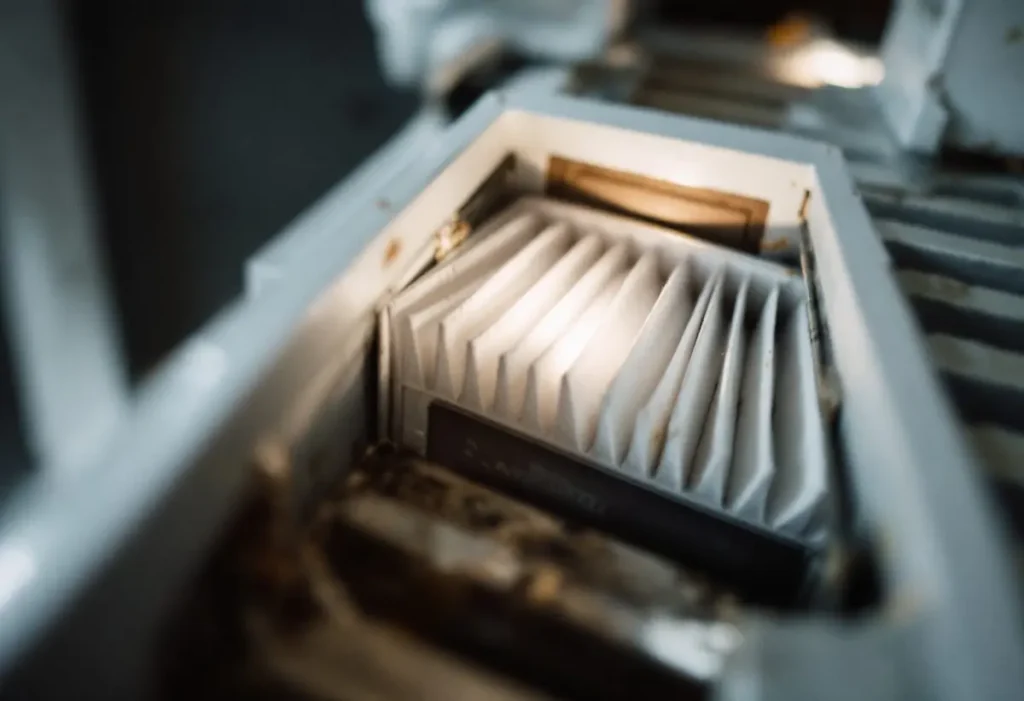
Look downstream of it, with the furnace switch off. DOE, writing about clogged filters, says where the escaped dirt goes: it “can bypass the filter and accumulate on the evaporator coil” (archived copy). A heavy mat behind the filter or on the blower wheel means it is not seeing all the air. A light film proves little: Waring and Siegel predict a median 0.756 g per square meter per month on residential coils. Stop if reaching the coil means removing sealed panels or touching wiring; coil inspection is a technician’s job, as is anything near the gas burners.
Then measure the gap. North Carolina’s state filter specification lets the actual face run five-eighths of an inch under nominal. In a slot of exactly 16×25 with no lip over the edges, that filter leaves 25.2 square inches open, 6.3 percent of the opening, or roughly 8 mm per side. The Ward and Siegel bypass model found gaps “on the order of 1 mm” around well-seated filters have little effect on most filters, and large gaps substantially cut high pressure drop filters. So a high MERV filter in a loose slot loses the most.
EPA asks for a snug fit with no bending or crushing. At a 2022 National Academies workshop, the proceedings record researcher Jeffrey Siegel saying he would rather see people invest in a sealed filter rack that eliminates bypass than replace filters twice as often. A filter that is missing altogether is the extreme case, and while you can run AC without a filter for a few days, dust starts reaching the coil at once.
Can a leaky return duct keep a furnace filter clean?
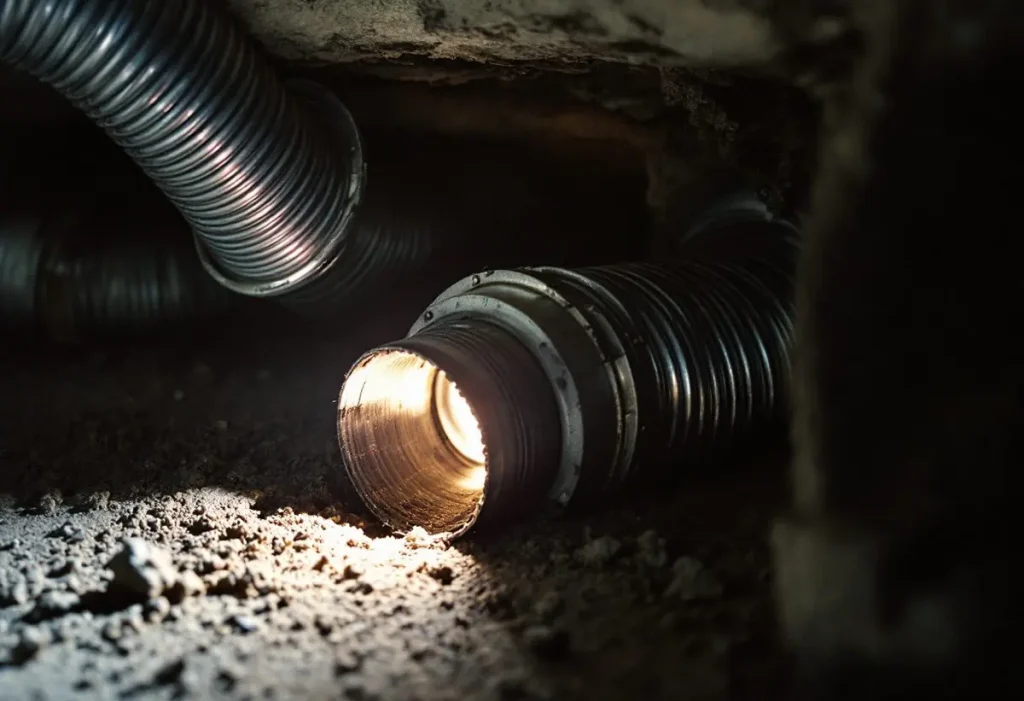
Only when the filter sits at a return grille. EPA’s wording is exact: air from unconditioned spaces “can circumvent the filter, if the filter is installed at a return grille, rather than at the base of an air-handling unit.” With the filter at the furnace (diagram A), leaked attic air still crosses the media and adds load, so a return leak cannot explain a clean filter there.
In the Austin field study, 4 of the 8 homes had filters at grilles and 6 of the 8 had attic ducts. You cannot see this leak, so ask for a duct test that separates supply from return; our page on duct repair explains the CFM25 result.
What should a manometer show on a filter that is really loading?
A number that climbs from its reading when new. In the Austin field study, drop across the filter “generally increased with each month of filter life,” with medians of 0.137, 0.213 and 0.221 in. w.c. for low, mid and high MERV filters in fan-only mode across 15 systems. Those included light-commercial offices, so they are a range, not a pass mark.
In the unoccupied test house, a low MERV panel read 0.104 in. w.c. on one system and 0.064 on the other, and no filter moved more than 0.02 in. w.c. during its life. The authors read that as minimal dust loading. Ask a technician to record the drop across a new filter during a static pressure test, then again at 90 days at the same fan speed. A flat reading with real runtime on the log sends the search back to the gap and the ducts.
Should you change a furnace filter that still looks clean?
Yes, on the maker’s calendar, because looks do not measure filtration. EPA says charged electret filters sometimes lose fine particle efficiency as the charge fades, while mechanical filters typically gain coarse particle efficiency as they load. The workshop proceedings record Siegel saying electret degradation “can happen within a few hours depending on the loading.”
| Who says it | Interval | Applies to |
|---|---|---|
| DOE Energy Saver | Every month or two in cooling season, if unsure | Central and room air conditioner filters |
| EPA | Every 60 to 90 days, as makers typically recommend | Furnace and HVAC filters generally |
| Aprilaire (maker claim) | Each year; up to two years if the blower does not run continuously | Models 3210, 3310 and 3410 media air cleaners |
Compiled by The HVAC Brief from each publisher’s own guidance.
Our rule: a clean face can justify running to the end of the maker’s interval, never past it. Sizing and buying sit on our HVAC filters page.
Frequently asked questions
Why is my furnace filter never dirty?
Usually low runtime or light dust. Smart thermostat data from over 7,000 homes put median runtime at 18%, about 389 hours in 90 days, and the Waring and Siegel model predicts about 2.3 grams on a 16×25 filter over 3 months. If dust shows up past the filter, suspect bypass instead.
Can a furnace filter stay clean because it is in backwards?
None of the documents we read tested that. EPA says only that the printed arrow should point in the direction of airflow. Air still crosses the media either way, so check first for a gap at the slot, which EPA and the Ward and Siegel model both identify as a cause of air missing the filter.
How long can a furnace filter last if it looks clean?
Until the end of its maker’s interval, not longer. EPA says manufacturers typically recommend replacement every 60 to 90 days. Aprilaire recommends yearly media replacement on its models 3210, 3310 and 3410, or up to two years if the blower does not run continuously. A clean look alone does not extend those limits.
How we researched this
We read EPA’s air cleaner guide and 2018 technical summary, the DOE maintenance page (archived copy), both 2010 Stephens, Novoselac and Siegel papers, the National Academies chapter, North Carolina specification 4130-1Y and the Aprilaire manual. Waring and Siegel, Ward and Siegel, Touchie and Siegel, and Mahdavi and Siegel were read as abstracts only. We did no home testing, took no numbers from contractor or lead-generation sites, and omitted Honeywell and Filtrete intervals because we could not open those documents. Research date: November 2026.
Sources
- U.S. Environmental Protection Agency. “Guide to Air Cleaners in the Home.” https://www.epa.gov/indoor-air-quality-iaq/guide-air-cleaners-home. Accessed November 2026.
- U.S. Environmental Protection Agency. “Residential Air Cleaners: A Technical Summary, 3rd Edition.” https://www.epa.gov/sites/default/files/2018-07/documents/residential_air_cleaners_-_a_technical_summary_3rd_edition.pdf. Accessed November 2026.
- U.S. Department of Energy, Energy Saver. “Maintaining Your Air Conditioner” (archived copy). https://web.archive.org/web/2025/https://www.energy.gov/energysaver/maintaining-your-air-conditioner. Accessed November 2026.
- Touchie, M. and Siegel, J. “Residential HVAC runtime from smart thermostats: characterization, comparison, and impacts.” Indoor Air, 2018. https://doi.org/10.1111/ina.12496. Accessed November 2026.
- Waring, M. and Siegel, J. “Particle loading rates for HVAC filters, heat exchangers, and ducts.” Indoor Air, 2008. https://doi.org/10.1111/j.1600-0668.2008.00518.x. Accessed November 2026.
- Ward, M. and Siegel, J. “Modeling filter bypass: impact on filter efficiency.” ASHRAE 2005 Winter Meeting, abstract via AIVC. https://www.aivc.org/resource/modeling-filter-bypass-impact-filter-efficiency. Accessed November 2026.
- Mahdavi, A. and Siegel, J. “Extraction of dust collected in HVAC filters for quantitative filter forensics.” Aerosol Science and Technology, 2020. https://doi.org/10.1080/02786826.2020.1774492. Accessed November 2026.
- Stephens, B., Novoselac, A. and Siegel, J. “The effects of filtration on pressure drop and energy consumption in residential HVAC systems (RP-1299).” HVAC&R Research, 2010. https://www.caee.utexas.edu/prof/novoselac/Publications/Novoselac_HVAC&R_2010.pdf. Accessed November 2026.
- Stephens, B., Siegel, J. and Novoselac, A. “Energy Implications of Filtration in Residential and Light-Commercial Buildings” (OR-10-038, RP-1299). ASHRAE Transactions, 2010. https://www.caee.utexas.edu/prof/Novoselac/Publications/Novoselac_ASHRAE_Transactions_2010.pdf. Accessed November 2026.
- National Academies of Sciences, Engineering, and Medicine. “Indoor Exposure to Fine Particulate Matter and Practical Mitigation Approaches: Proceedings of a Workshop,” chapter 8. 2022. https://www.nationalacademies.org/read/26331/chapter/9. Accessed November 2026.
- North Carolina Department of Administration, Purchase and Contract. “Specification for Filters, Air (HVAC), 4130-1Y.” https://www.doa.nc.gov/pc-stc-031a-s4130-1pdf-standard-specification-air-filters/open. Accessed November 2026.
- Aprilaire. “Model 3410, 3310, 3210 owner’s manual, Maintenance” (manual text hosted by ManualsDir). https://www.manualsdir.com/manuals/35948/aprilaire-3410-3210-3310.html?page=3. Accessed November 2026.
- United States Mint. “Penny” specifications (archived copy). https://web.archive.org/web/2025/https://www.usmint.gov/learn/coins-and-medals/circulating-coins/penny. Accessed November 2026.
Leave a Reply